
Longitudinal Aberration: Understanding Optical System Imperfections | Althox
Longitudinal aberration is a fundamental optical phenomenon that significantly impacts the quality and clarity of images produced by lenses and reflective surfaces. It refers to the failure of an optical system to focus all incident light rays at a single, precise point along the optical axis. This imperfection leads to blurred or distorted images, a critical consideration in the design and application of various optical instruments, from simple magnifying glasses to complex telescopes and microscopes.
Understanding longitudinal aberration is paramount for optical engineers and physicists, as its mitigation is central to achieving high-fidelity imaging. The term encompasses two primary types: chromatic longitudinal aberration and spherical longitudinal aberration, each arising from distinct physical principles and requiring different corrective strategies. This comprehensive guide will delve into these types, their underlying causes, methods of measurement, and the advanced techniques employed to minimize their detrimental effects on optical performance.
Definition of Longitudinal Aberration
Longitudinal aberration, often referred to as axial aberration, describes the phenomenon where light rays originating from a single point on the optical axis do not converge to a single, sharp focal point after passing through an optical system. Instead, these rays intersect the optical axis at different distances, leading to a spread of focal points. This spread results in a blurred image, as the light from a single object point is distributed over an area rather than concentrated at a single image point.
The concept is crucial in understanding the limitations of simple lenses and mirrors. In an ideal optical system, all rays from an object point would converge perfectly to an image point. However, due to the physical properties of light and the geometry of optical components, such perfection is rarely achieved without specific design considerations. Longitudinal aberration is a measure of this deviation from ideal focusing along the optical axis.
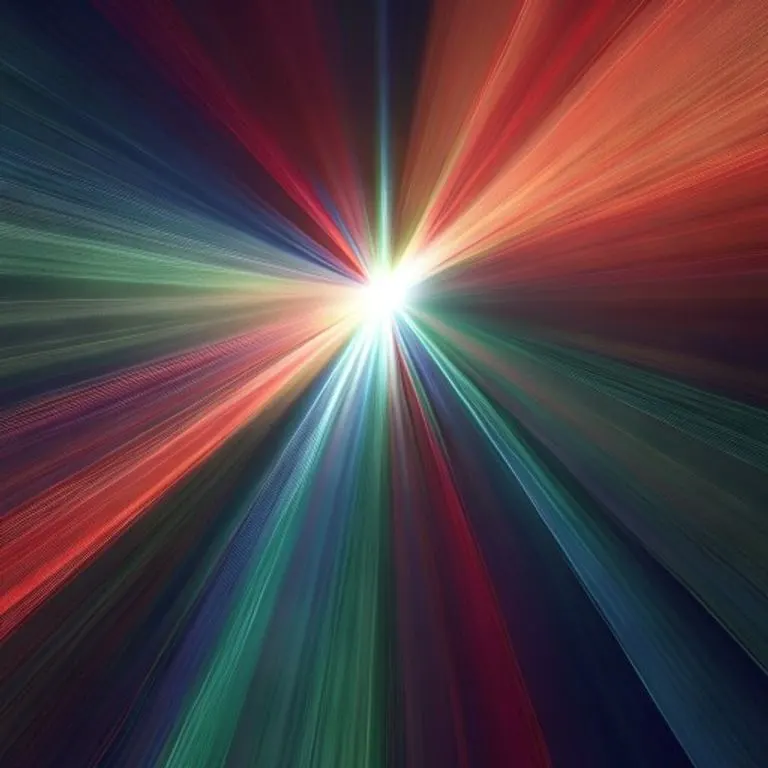
Visualizing Neuroarchitecture Longevity: Designing Brain Health Spaces: A digital illustration of chromatic longitudinal aberration, where different wavelengths of light focus at varying points along the optical axis, leading to color fringing and reduced image clarity.
The magnitude of longitudinal aberration is typically measured as the distance along the optical axis between the focal points of specific rays or wavelengths. For instance, in chromatic aberration, it's the distance between the focal points of red and blue light. In spherical aberration, it's the distance between the paraxial focus (rays close to the axis) and the marginal focus (rays from the outer edges of the lens).
This optical defect is inherent in many lens designs and is not caused by manufacturing errors, though manufacturing tolerances can exacerbate it. Its presence dictates the maximum achievable resolution and contrast of an optical system, making its understanding and correction a cornerstone of advanced optical engineering.
Chromatic Longitudinal Aberration
Chromatic longitudinal aberration, also known as axial chromatic aberration, arises from the dispersion of light as it passes through a lens. The refractive index of a material varies with the wavelength of light; this phenomenon is called dispersion. Consequently, different colors (wavelengths) of light are refracted at slightly different angles by the same lens.
As a result, blue light, which has a shorter wavelength, is refracted more strongly and comes to a focus closer to the lens than red light, which has a longer wavelength and is refracted less strongly. This separation of focal points along the optical axis for different colors is the essence of chromatic longitudinal aberration. The effect is particularly noticeable with white light sources, which contain a spectrum of wavelengths.
- Causes: The primary cause is the wavelength-dependent refractive index (dispersion) of the lens material. All transparent optical materials exhibit some degree of dispersion.
- Effects: Images exhibit color fringing or halos around objects, especially at high contrast edges. This reduces image sharpness, contrast, and overall fidelity, making colors appear impure.
- Manifestation: In photographs, this often appears as purple or green fringes around bright objects. In telescopes, stars may appear as tiny colored disks rather than sharp points.
The magnitude of chromatic longitudinal aberration is quantified by the distance between the focal points of two specific wavelengths, typically red (C-line, 656.3 nm) and blue (F-line, 486.1 nm) light. The Abbe number of a material is a key parameter used to characterize its dispersion properties, with higher Abbe numbers indicating lower dispersion and thus less chromatic aberration.
Spherical Longitudinal Aberration
Spherical longitudinal aberration occurs when light rays passing through different zones of a spherical lens or mirror do not converge to a single focal point. Specifically, rays passing through the outer regions (marginal rays) of a spherical lens are refracted more strongly than rays passing closer to the optical axis (paraxial rays).
This differential refraction causes marginal rays to focus at a point closer to the lens than paraxial rays. The spread of these focal points along the optical axis is known as spherical longitudinal aberration. Unlike chromatic aberration, spherical aberration is independent of the wavelength of light and can occur even with monochromatic light.

An antique optical bench setup, featuring a lens and detailed ray tracing diagrams, illustrates the foundational principles of Michael Jackson Fanatismo: Neurociencia Adoración Legado Inigualable and the study of aberrations.
The fundamental cause of spherical aberration is the spherical shape of the lens or mirror surfaces. While spheres are easy to manufacture, they are not the ideal shape for perfect focusing. The effect is more pronounced in lenses with larger apertures and shorter focal lengths, where the curvature of the spherical surface deviates significantly from the ideal parabolic or hyperbolic shape required for perfect focusing.
The presence of spherical longitudinal aberration leads to a general blurring of the image. Instead of a sharp point, an object point is imaged as a blur circle. This reduces the overall sharpness and contrast of the image, making fine details difficult to resolve. The extent of blurring depends on the aperture size and the specific design of the optical element.
- Causes: Inherent to spherical lens/mirror surfaces; rays passing through different radial zones have different focal lengths.
- Effects: Leads to a general blur, reducing image sharpness and contrast. The image appears "soft" or "hazy."
- Dependence: Increases with larger apertures and stronger lens curvatures.
Measurement and Quantification
Accurate measurement and quantification of longitudinal aberrations are essential for evaluating optical system performance and guiding corrective designs. Various methods are employed to characterize these defects, ranging from theoretical calculations to practical experimental techniques.
For chromatic longitudinal aberration, the measurement typically involves determining the focal length for specific wavelengths. This can be done using monochromatic light sources (e.g., lasers or filtered lamps) and precisely locating the focal point for each color. The difference in focal positions for two distinct wavelengths (e.g., C and F lines) provides a direct measure of the aberration.
Spherical longitudinal aberration is often measured by tracing rays at different radial distances from the optical axis. The distance between the paraxial focal point (for rays near the axis) and the marginal focal point (for rays at the edge of the aperture) quantifies the aberration. Modern optical design software utilizes ray tracing algorithms to simulate and predict these values with high precision.
| Aberration Type | Primary Cause | Key Effect on Image | Measurement Metric |
|---|---|---|---|
| Chromatic Longitudinal | Dispersion (wavelength-dependent refractive index) | Color fringing, reduced color purity | Difference in focal length for two wavelengths |
| Spherical Longitudinal | Spherical surface geometry | General blur, reduced sharpness and contrast | Distance between paraxial and marginal focal points |
Experimental methods often involve setting up an optical system and using a pinhole or slit to isolate specific rays or a spectrometer to analyze the focal points of different wavelengths. Wavefront sensing techniques, such as Shack-Hartmann sensors, can also be used to characterize the overall wavefront distortion caused by aberrations, providing a comprehensive picture of optical performance.
Correction Techniques and Solutions
Mitigating longitudinal aberrations is a primary goal in optical engineering to ensure high-quality imaging. Various sophisticated techniques have been developed to correct or significantly reduce these defects.
A conceptual art painting depicting a distorted light cone illustrates the subtle yet significant impact of spherical aberration on AI Preventive Medicine: Diagnosis, Longevity, Personalized Treatments within an optical system.
For chromatic longitudinal aberration, the most common solution involves using achromatic or apochromatic lens designs. An achromatic doublet, for instance, combines two lenses made of different types of glass (e.g., crown glass and flint glass) with different dispersion properties. One lens is typically positive and the other negative, and their powers and materials are chosen such that the chromatic aberration introduced by one lens is largely canceled out by the other, at least for two specific wavelengths.
- Achromatic Lenses: Correct for two wavelengths (e.g., red and blue), bringing them to a common focus.
- Apochromatic Lenses: Achieve even better correction, bringing three wavelengths to a common focus and significantly reducing secondary spectrum (residual chromatic aberration). These often use special low-dispersion (ED) glass.
- Superachromats: Correct for four or more wavelengths, offering the highest level of chromatic correction, often used in high-precision scientific instruments.
To correct spherical longitudinal aberration, aspheric lenses are frequently employed. An aspheric lens has a surface profile that is not spherical but rather a more complex curve, often parabolic or hyperbolic. This non-spherical shape allows for precise control over the refraction of light rays at different distances from the optical axis, enabling all rays to converge to a single focal point.
Other techniques include using multiple spherical lenses in combination to distribute the aberration among several elements, or "stopping down" the aperture (reducing its size) to block marginal rays, though this reduces light gathering capability and can introduce diffraction effects. Gradient-index (GRIN) lenses, which have a refractive index that varies radially, also offer a way to correct spherical aberration without complex surface shapes.
Adaptive optics systems, particularly in astronomy, use deformable mirrors to dynamically correct wavefront distortions, including spherical aberration, in real-time. This allows for unprecedented image clarity, overcoming atmospheric turbulence and inherent system aberrations.
Impact on Optical Systems
The presence of longitudinal aberrations has profound implications for the performance and utility of almost all optical systems. From consumer cameras to advanced scientific instruments, managing these aberrations is critical for achieving desired image quality and functional specifications.
In photography and cinematography, chromatic aberration can lead to noticeable color fringing, especially in telephoto lenses or wide-aperture lenses. This degrades the aesthetic quality of images and can be challenging to correct fully in post-processing. Spherical aberration contributes to a general softness or lack of critical sharpness, particularly at wider apertures, where more marginal rays are utilized.
- Telescopes: Astronomical telescopes, especially refractors, are highly susceptible to chromatic aberration, which can blur planetary details and star images. Reflecting telescopes inherently avoid chromatic aberration but can suffer from spherical aberration if their mirrors are not parabolic.
- Microscopes: High-magnification microscopy demands extremely well-corrected objectives to resolve fine biological structures. Both chromatic and spherical aberrations must be meticulously minimized to achieve the necessary resolution and contrast.
- Ophthalmology: In corrective lenses for human vision, aberrations can affect visual acuity and comfort. While the human eye has its own aberrations, designing lenses that minimize additional defects is crucial.
- Optical Communication: In fiber optics, chromatic dispersion (a form of chromatic aberration) can limit the bandwidth and transmission distance of optical signals, requiring specialized fibers or compensation techniques.
The impact of longitudinal aberrations extends beyond mere visual quality, affecting quantitative measurements in scientific applications. For instance, in spectroscopy or interferometry, precise focusing of different wavelengths is paramount. Uncorrected aberrations can introduce errors in data acquisition and analysis, compromising experimental results.
Advanced Considerations and Future Trends
As optical technology continues to advance, so too does the understanding and mitigation of longitudinal aberrations. Modern optical design relies heavily on computational tools and advanced manufacturing processes to push the boundaries of performance.
Computational optics, including advanced ray tracing software and optimization algorithms, allows designers to simulate and predict aberration performance with unprecedented accuracy. This enables the creation of complex multi-element lens systems that can correct for multiple aberrations simultaneously, often leading to designs that would be impossible to conceive manually.
New materials with tailored optical properties are also emerging. For example, meta-materials and diffractive optical elements (DOEs) offer novel ways to manipulate light, potentially enabling aberration correction in thinner, lighter, and more compact optical systems. These materials can exhibit properties not found in natural substances, opening new avenues for aberration control.
- Freeform Optics: Moving beyond traditional spherical and aspheric surfaces, freeform optics allows for highly complex, non-rotationally symmetric surfaces. These can correct for a wider range of aberrations across a larger field of view, leading to more compact and powerful optical instruments.
- Computational Imaging: Instead of solely relying on perfect optical hardware, computational imaging techniques use algorithms to correct aberrations in digitally captured images. This includes deconvolution and wavefront retrieval methods that can enhance image quality post-capture, complementing hardware solutions.
- Adaptive Optics Miniaturization: While traditionally large and expensive, research is ongoing to miniaturize adaptive optics systems for integration into consumer devices like smartphones and compact cameras, offering dynamic aberration correction on a smaller scale.
The ongoing pursuit of perfect imaging drives innovation in aberration correction. As demands for higher resolution, wider fields of view, and more compact optical systems grow, the sophisticated management of longitudinal aberrations will remain a cornerstone of optical science and engineering.
Fuente: Contenido híbrido asistido por IAs y supervisión editorial humana.


Comentarios