
Abbevillian Culture: Lower Paleolithic Tool Technology | Althox
The Abbevillian culture, a term deeply rooted in the annals of prehistoric archaeology, refers to an early phase of the Lower Paleolithic period, primarily characterized by the manufacture of rudimentary bifacial tools. Discovered and defined by French archaeologist Jacques Boucher de Perthes in the mid-19th century in the Somme Valley, France, this cultural designation marks a significant chapter in the technological evolution of early hominins.
It represents an era where early humans began to intentionally shape stone on both sides, creating what are known as handaxes or bifaces, a crucial step beyond the simpler choppers and flakes of the preceding Oldowan industry. Understanding the Abbevillian provides vital insights into the cognitive capabilities, subsistence strategies, and geographical spread of our ancient ancestors during a formative period of human history.

The ancient landscapes of the Somme Valley, France, where the earliest traces of the Abbevillian culture were unearthed, revealing a pivotal era in human prehistory.
Table of Contents
- Historical Context and Discovery
- Characteristics of Abbevillian Tools
- Associated Hominins and Geographical Distribution
- Chronology and Periodization
- Daily Life and Subsistence Strategies
- Significance in Human Evolution
- Debates and Modern Interpretations
Historical Context and Discovery
The recognition of the Abbevillian culture dates back to the pioneering work of Jacques Boucher de Perthes in the mid-19th century. Working in the gravel pits of the Somme Valley near Abbeville, France, he unearthed flint tools alongside the bones of extinct megafauna, challenging the prevailing belief that humanity was relatively young and had not coexisted with such ancient animals.
His meticulous observations and publications, particularly "Antiquités celtiques et antédiluviennes" (1847-1864), laid the foundation for modern prehistoric archaeology. Initially, the term "Chellian" was used, referencing tools found at Chelles, but later, "Abbevillian" became the preferred designation to describe the earliest bifacial industries due to the extensive and well-documented finds at Abbeville.
The significance of these discoveries was not immediately accepted, facing considerable skepticism from the scientific establishment. However, subsequent confirmations by prominent geologists and archaeologists, such as Hugh Falconer and John Evans, eventually validated Boucher de Perthes' claims, revolutionizing the understanding of human antiquity.
Characteristics of Abbevillian Tools
The defining characteristic of the Abbevillian culture is its distinctive lithic technology, primarily consisting of crude, heavy bifacial handaxes. These tools represent a significant leap in complexity compared to the earlier Oldowan choppers, as they involved shaping a core stone on both sides to create a working edge.
Abbevillian handaxes are typically massive, thick, and asymmetrical, often retaining a substantial amount of the original cortex. The manufacturing technique employed was predominantly hard hammer percussion, where a heavy hammerstone was used to strike flakes off the core. This method resulted in large, deep flake scars and a relatively sinuous, irregular cutting edge.
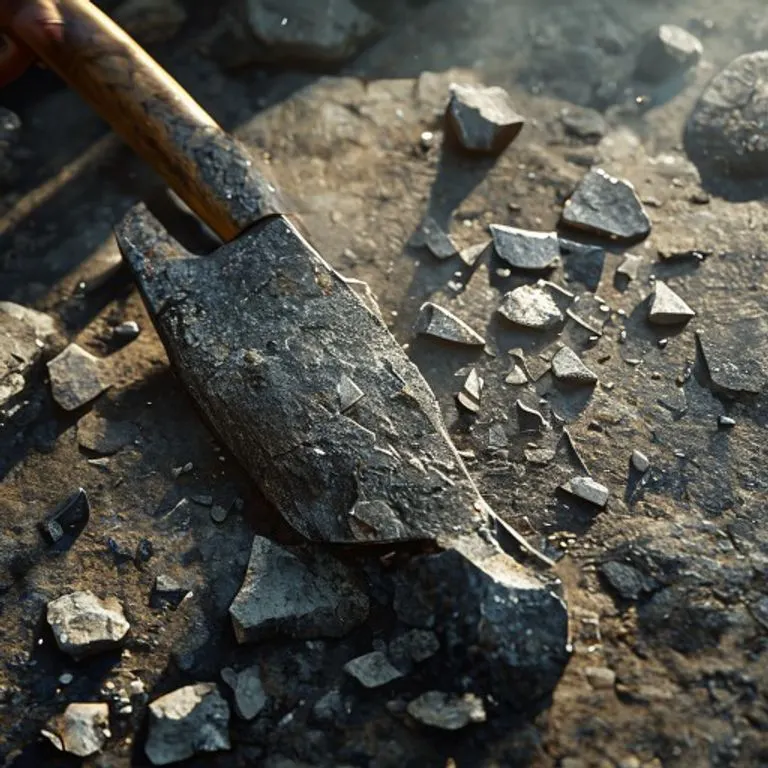
A close-up view of Abbevillian bifacial handaxes, illustrating the rough craftsmanship and the use of hard hammer percussion.
Unlike the later Acheulean handaxes, which exhibit greater refinement, symmetry, and often the use of soft hammer percussion (bone, antler, or wood), Abbevillian tools are characterized by their robust and less sophisticated form. They served multiple purposes, including butchering large animals, digging for roots, and processing wood.
Key features of Abbevillian tools include:
- Bifacial Flaking: Shaped on both faces, indicating a more complex understanding of stone knapping.
- Crude Workmanship: Less refined edges and overall shape compared to later Paleolithic tools.
- Hard Hammer Percussion: Dominant technique, leaving deep, wide flake scars.
- Thick Cross-Section: Often bulky and less flattened than Acheulean counterparts.
- Retained Cortex: A significant portion of the original stone's outer surface is frequently visible.
Associated Hominins and Geographical Distribution
The Abbevillian tool industry is primarily associated with early hominin species of the Lower Paleolithic. While direct fossil evidence is often scarce at Abbevillian sites, the tools are generally attributed to Homo erectus and possibly early forms of Homo heidelbergensis. These hominins were characterized by larger brains than their australopithecine predecessors, upright posture, and a greater capacity for complex tool-making and adaptation to diverse environments.
The geographical distribution of Abbevillian-like industries is extensive, reflecting the widespread migration of these early human populations out of Africa. While initially identified in Western Europe (France, Spain, Britain), similar crude bifacial technologies have been found across Africa, parts of the Middle East, and even into Asia.
This broad distribution underscores the adaptability and technological prowess of these early hominins, who were able to exploit various raw materials and survive in different ecological zones. The presence of these tools across continents provides crucial evidence for the "Out of Africa" migration theories, suggesting that early hominins carried their basic tool-making knowledge with them as they expanded their territories.
Chronology and Periodization
The Abbevillian culture falls within the Lower Paleolithic period, a vast span of time ranging from approximately 3.3 million years ago (with the earliest stone tools) to about 300,000 years ago. Specifically, the Abbevillian is often placed in the earlier part of the Lower Paleolithic, succeeding the Oldowan industry and preceding the more refined Acheulean culture.

A conceptual illustration depicting the gradual refinement of stone tool technology from the rudimentary Abbevillian to the more sophisticated Acheulean period.
While there is some overlap and regional variation, the general chronological sequence is as follows:
| Period | Approximate Dates (Years Ago) | Key Characteristics | Associated Hominins |
|---|---|---|---|
| Oldowan | 3.3 million - 1.7 million | Simple choppers and flakes, unifacial tools. | Homo habilis, Australopithecus garhi |
| Abbevillian | 1.7 million - 700,000 | Crude, thick, bifacial handaxes (hard hammer percussion). | Homo erectus, early Homo heidelbergensis |
| Acheulean | 1.7 million - 300,000 | More refined, symmetrical bifaces (soft hammer percussion), cleavers. | Homo erectus, Homo heidelbergensis |
It's important to note that the boundaries between these industries are not always clear-cut, and there can be regional variations and transitional phases. The Abbevillian is often seen as the initial stage of biface production, gradually evolving into the more sophisticated Acheulean tradition. This chronological framework helps archaeologists trace the progression of human technological capabilities over vast periods.
Daily Life and Subsistence Strategies
Reconstructing the daily life of Abbevillian hominins relies heavily on archaeological evidence from their toolkits and associated faunal remains. The presence of robust bifacial handaxes suggests a focus on processing large animal carcasses, indicating that hunting or scavenging played a significant role in their diet.
These tools would have been effective for dismembering animals, breaking bones to extract marrow, and possibly preparing hides. While direct evidence of hunting is difficult to ascertain with certainty for such an early period, the ability to create and utilize such tools points to a more organized approach to resource acquisition than previously thought.
In addition to meat, Abbevillian hominins would have relied on a diverse diet of plant foods, including roots, tubers, fruits, and nuts, gathered from their environment. The handaxes might also have been used for digging up these underground resources or for processing plant materials. Control of fire, though not definitively linked to the earliest Abbevillian sites, became increasingly common during the Lower Paleolithic, offering warmth, protection, and new cooking possibilities that would have further diversified their diet and social structures.
Their living arrangements likely involved temporary camps near water sources or in sheltered areas, moving with the availability of resources. The rudimentary nature of their tools implies a relatively mobile lifestyle, without permanent settlements. Social structures would have been essential for cooperation in hunting, gathering, and the transmission of tool-making knowledge across generations.
Significance in Human Evolution
The Abbevillian culture holds immense significance in the grand narrative of human evolution. It represents a critical juncture where hominins demonstrated a clear advancement in cognitive abilities and technological sophistication. The deliberate, bifacial shaping of stone is not merely a physical act but a testament to abstract thought, planning, and a mental template for tool design.
This ability to conceive of a tool's final form and execute the steps to achieve it marks a significant cognitive leap from the opportunistic flaking of the Oldowan. It suggests improved hand-eye coordination, spatial reasoning, and perhaps even rudimentary teaching and learning within early human groups.
Furthermore, the widespread distribution of Abbevillian-like tools across continents indicates successful adaptation and expansion. The technologies developed during this period allowed early hominins to exploit new ecological niches, access a wider range of food resources, and ultimately survive and thrive in diverse environments, laying the groundwork for subsequent human migrations and innovations.
Debates and Modern Interpretations
Despite its historical importance, the term "Abbevillian" has been subject to considerable debate and re-evaluation within the archaeological community. Some scholars argue that the distinction between Abbevillian and early Acheulean is often arbitrary or represents a continuous technological spectrum rather than two distinct cultures.
The main point of contention lies in the definition of "crudeness." What one archaeologist might classify as a crude Abbevillian biface, another might see as an early, less refined Acheulean tool. This has led to a trend among some researchers to subsume the Abbevillian within a broader "Early Acheulean" category, particularly in regions outside of Western Europe where the initial distinctions were made.
Nevertheless, the concept of the Abbevillian remains valuable for highlighting the initial stages of biface production and the technological transition from simpler Oldowan tools. It serves as a reminder of the gradual, incremental nature of human technological progress and the challenges of classifying prehistoric cultures based solely on lithic assemblages.
Modern archaeological research continues to refine our understanding of this period, utilizing advanced dating techniques, microwear analysis of tools, and comparative studies across different geographical regions. These efforts aim to provide a clearer picture of the specific behaviors, environments, and evolutionary trajectories of the hominins who crafted these foundational tools.
Fuente: Contenido híbrido asistido por IAs y supervisión editorial humana.


Comentarios