
Bumblebee Flight Aerodynamics: Paradox Unraveled | Althox
The flight of the bumblebee has long been a captivating enigma, challenging conventional understanding of aerodynamics and inspiring a blend of scientific inquiry and popular fascination. For decades, a persistent myth circulated that, according to the laws of aerodynamics, a bumblebee should not be able to fly. This assertion, often attributed to early 20th-century scientific calculations, highlighted a perceived paradox between the insect's stout body, small wings, and its remarkable aerial agility.
However, modern scientific advancements, particularly in the fields of fluid dynamics and biomechanics, have definitively debunked this misconception. The bumblebee's flight does not violate the laws of aerodynamics; rather, it operates under a sophisticated set of principles that were not fully understood by earlier, more simplified models. This article delves into the historical origins of the myth, the scientific breakthroughs that resolved the paradox, and the intricate mechanisms that allow these crucial pollinators to soar with such apparent defiance of gravity.
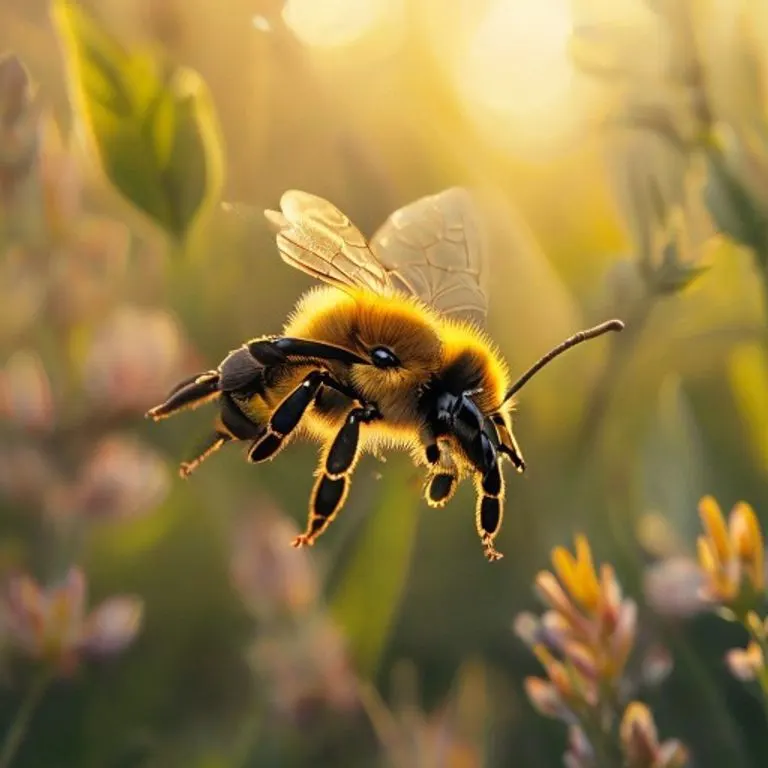
A bumblebee in mid-flight, showcasing its dynamic aerial capabilities, a testament to complex aerodynamic principles.
The journey to understanding bumblebee flight is a fascinating case study in the evolution of scientific thought, demonstrating how initial assumptions can be overturned by rigorous observation and advanced analytical techniques. What once seemed impossible has been revealed as a marvel of natural engineering, offering valuable insights for bio-inspired design and robotics. We will explore the specific aerodynamic phenomena, such as unsteady aerodynamics and vortex generation, that are fundamental to the bumblebee's flight, as well as the unique anatomical and physiological adaptations that make it possible.
Table of Contents
This dynamic index provides a clear roadmap through the intricate world of bumblebee flight, from historical misconceptions to cutting-edge research:
- Historical Misconceptions: The 1934 "Le Vol Des Insectes" Study
- The Flawed Premise: Why Early Aerodynamics Failed the Bumblebee
- Unveiling the Truth: How Bumblebees Defy Conventional Wisdom
- Unsteady Aerodynamics: The Secret Behind Insect Flight
- Vortex Generation: Creating Lift from Complex Airflows
- The Clap-and-Fling Mechanism: A High-Efficiency Wing Stroke
- Wing Kinematics and Flexibility: Adaptations for Power and Maneuverability
- Energetic Demands and Metabolic Efficiency of Bumblebee Flight
- Comparative Biomechanics: Bumblebees vs. Fixed-Wing Aircraft
- Bio-Inspired Engineering: Lessons from the Bumblebee
- Ecological Significance: The Role of Bumblebee Flight in Ecosystems
- Ongoing Research and Future Directions in Insect Aerodynamics
Historical Misconceptions: The 1934 "Le Vol Des Insectes" Study
The widely popularized notion that bumblebees defy aerodynamic laws can be traced back to a specific period in scientific history, primarily the 1930s. While often cited as a definitive pronouncement, the exact origin of the "bumblebee cannot fly" myth is somewhat nebulous, but it gained significant traction following discussions and calculations by prominent aerodynamicists of the time.
One frequently referenced source, though often misquoted or generalized, is the 1934 French book titled "Le Vol Des Insectes" (The Flight of Insects). This work, along with contemporary analyses, applied the then-prevailing theories of steady-state aerodynamics to insect flight. These theories were largely developed for fixed-wing aircraft, which operate at much higher Reynolds numbers and rely on different principles for lift generation.
When these linear equations were applied to the bumblebee's physical characteristics—its relatively large, heavy body and small, rapidly flapping wings—the calculations suggested insufficient lift could be generated to sustain flight. The core of the problem lay in the limitations of the models. Early aerodynamicists primarily focused on the lift generated by fixed wings moving through air at a constant angle of attack.
They assumed that the lift generated by an insect's wings would be proportional to its wing area and forward speed, similar to an airplane. For a bumblebee, with its short wings and seemingly slow forward speed relative to its body mass, these models simply did not compute enough lift. This led to the conclusion, based on the incomplete understanding of the time, that the bumblebee's flight was an aerodynamic impossibility.
It's crucial to understand that these scientists were working with the best available tools and knowledge of their era. Their calculations were not inherently "wrong" within the framework of the models they used; rather, the models themselves were insufficient to describe the complex, dynamic nature of insect flight. The perceived paradox served as a powerful motivator for future research, pushing scientists to develop more sophisticated experimental techniques and theoretical frameworks.
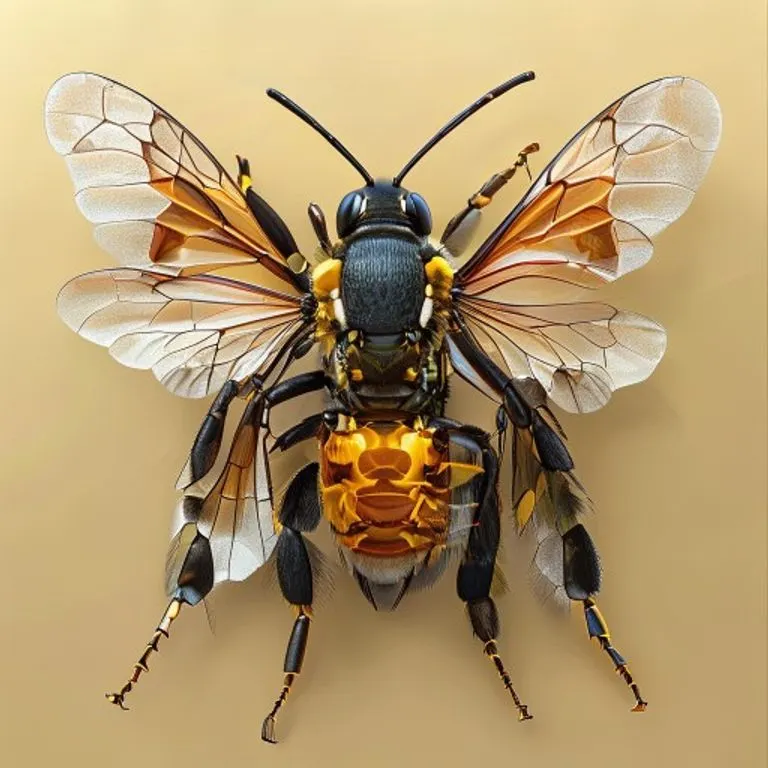
A detailed view of the intricate biomechanics within a bumblebee's wing and thorax, crucial for understanding its flight.
The Flawed Premise: Why Early Aerodynamics Failed the Bumblebee
The fundamental flaw in early aerodynamic analyses of insect flight stemmed from applying principles designed for large-scale, steady-state flight to a phenomenon that is inherently small-scale and unsteady. Fixed-wing aircraft, for example, operate at high Reynolds numbers, where inertial forces dominate viscous forces, and lift is primarily generated by the differential pressure created by airflow over an airfoil.
Their wings move relatively slowly compared to the air flowing over them, and their angle of attack is largely constant. In contrast, insects like the bumblebee operate at very low Reynolds numbers, where viscous forces become much more significant. More importantly, their wings do not move in a steady, fixed manner. Instead, they flap rapidly, twist, and rotate through complex trajectories.
These dynamic movements create transient aerodynamic effects that are crucial for lift generation but were entirely overlooked by the simplified, linear equations of early aerodynamics. The early models failed to account for several critical factors:
- Unsteady Aerodynamics: The rapid flapping motion of insect wings creates dynamic lift mechanisms that are not present in steady-state flight. These include leading-edge vortices, wake capture, and the clap-and-fling mechanism.
- Wing Kinematics: Insect wings do not just flap up and down; they rotate, pronate, and supinate, changing their angle of attack dynamically throughout each stroke. This complex motion generates lift during both the downstroke and the upstroke.
- Flexibility of Wings: Unlike rigid aircraft wings, insect wings are often flexible and deform during flight, which can enhance aerodynamic performance and efficiency, a factor not considered in rigid-body models.
- Scale Effects: The physics of fluid flow changes significantly at different scales. What works for an airplane in terms of lift generation is not directly transferable to an insect.
These oversights led to the erroneous conclusion. It was not a failure of the bumblebee, but a limitation of the scientific models available at the time. The perceived paradox served as a powerful motivator for future research, pushing scientists to develop more sophisticated experimental techniques and theoretical frameworks to truly understand the mechanics of insect flight.
Unveiling the Truth: How Bumblebees Defy Conventional Wisdom
The resolution of the bumblebee flight paradox began in earnest with the advent of high-speed photography, computational fluid dynamics (CFD), and robotic models in the latter half of the 20th century. These advanced tools allowed researchers to observe and analyze the intricate wing movements and the resulting airflow patterns around insects with unprecedented detail.
What they discovered was a highly complex and efficient system of lift generation that operates quite differently from conventional aircraft. Instead of relying solely on steady-state lift, bumblebees and other insects utilize a suite of unsteady aerodynamic mechanisms. These mechanisms are transient, meaning they are created and dissipate rapidly with each wing stroke, but they collectively generate substantial lift.
The key insight was recognizing that the rapid, oscillating motion of insect wings creates dynamic airflows that are far more effective at generating lift at low Reynolds numbers than previously thought. One of the most significant discoveries was the role of the leading-edge vortex (LEV). As an insect wing flaps forward, it creates a stable vortex along its leading edge.
This vortex generates a region of low pressure above the wing, effectively "sucking" the wing upwards and creating a significant portion of the total lift. This mechanism is highly robust and can generate lift at angles of attack that would cause a fixed wing to stall. Furthermore, insects employ precise wing kinematics, including rotation and pronation/supination, which optimize lift production throughout the entire wingbeat cycle.
They also exploit wake capture, where the wing re-encounters and interacts with the wake of the previous stroke, gaining additional lift. These sophisticated strategies, combined with the inherent flexibility of their wings, allow bumblebees to generate sufficient lift to overcome their body weight and achieve remarkable maneuverability. This understanding has paved the way for new designs in micro aerial vehicles (MAVs).
Unsteady Aerodynamics: The Secret Behind Insect Flight
Unsteady aerodynamics is the cornerstone of insect flight, a field of study that revolutionized our understanding of how small flying creatures generate lift and thrust. Unlike the steady airflow over an airplane wing, the air around a rapidly flapping insect wing is constantly changing direction and velocity. This dynamic environment allows insects to tap into lift-generating mechanisms that are unavailable to fixed-wing aircraft.
The primary mechanisms of unsteady aerodynamics in insect flight include:
- Leading-Edge Vortex (LEV): This is arguably the most critical unsteady mechanism. As the wing moves through the air, a stable vortex forms along its leading edge. This vortex creates a low-pressure region above the wing, significantly enhancing lift. The LEV remains attached to the wing throughout much of the stroke, preventing stall even at high angles of attack.
- Wake Capture: During the transition between the downstroke and upstroke (and vice versa), the wing can interact with the wake generated by its previous stroke. By "capturing" this wake, the wing can extract additional momentum and generate an extra burst of lift, effectively recycling energy from the disturbed air.
- Rotational Lift: As the wing changes direction at the end of each stroke (pronation and supination), its rapid rotation can generate a transient burst of lift. This effect is particularly pronounced in insects with high wingbeat frequencies.
- Added Mass Effect: The rapid acceleration and deceleration of the wing during flapping require moving a certain volume of air. This "added mass" of air contributes to the forces experienced by the wing, especially during rapid changes in direction and velocity.
These mechanisms work in concert, allowing the bumblebee to generate sufficient lift despite its seemingly unfavorable morphology. The efficiency and robustness of unsteady aerodynamics are particularly well-suited for flight at low Reynolds numbers, where conventional lift generation would be highly inefficient due to the dominance of viscous forces. Understanding these principles is vital for advancing biomimetic technologies.
Vortex Generation: Creating Lift from Complex Airflows
The generation and manipulation of vortices are central to the bumblebee's ability to fly. A vortex is a region in a fluid where the flow revolves around an axis line, which may be straight or curved. In the context of insect flight, these swirling air masses are intentionally created and managed by the wings to produce aerodynamic forces. The leading-edge vortex (LEV) is the most prominent example, but other vortices also play a role.
When a bumblebee's wing sweeps through the air, especially at a high angle of attack, the air separates from the leading edge, rolling up into a coherent, stable vortex. This LEV remains attached to the upper surface of the wing for a significant portion of the stroke. The rapid rotation of air within the LEV creates a region of significantly reduced pressure directly above the wing. This pressure differential is what generates a substantial amount of the lift force.
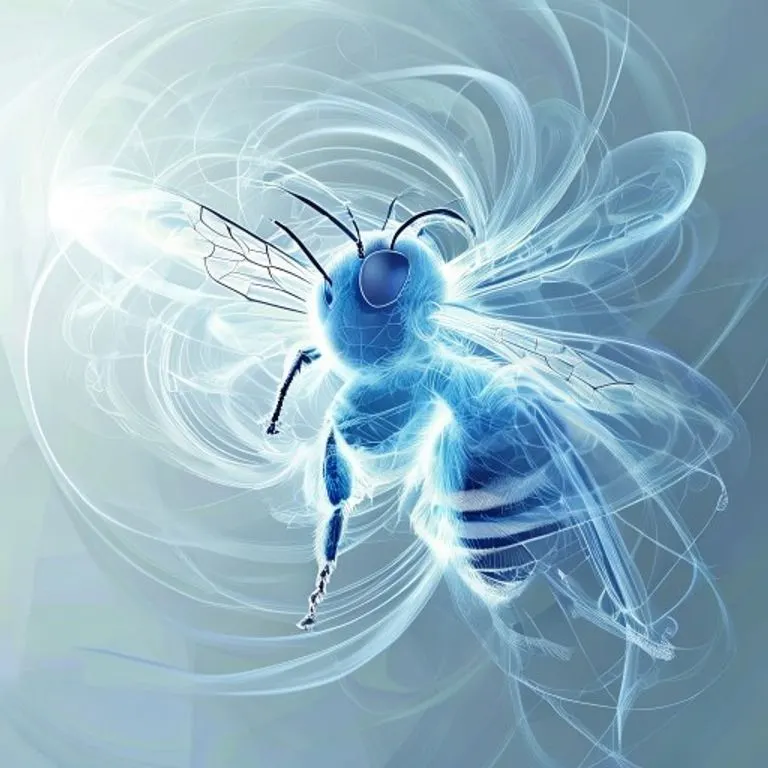
Conceptual representation of the complex air vortices generated by a bumblebee's wings, crucial for lift.
Beyond the LEV, the wingtips also shed vortices, known as tip vortices, similar to those seen at the wingtips of airplanes, though their dynamics are more complex in flapping flight. These vortices, along with the wake vortices shed behind the wing, contribute to the overall airflow pattern and can be exploited through wake capture mechanisms. The ability to create and maintain these stable, high-lift vortices is a key adaptation for insect flight.
Researchers have used particle image velocimetry (PIV) and computational fluid dynamics (CFD) to visualize and quantify these vortex structures. These studies have confirmed that the LEV is not just a theoretical construct but a measurable phenomenon that accounts for a large percentage of the lift generated by insect wings. The stability of the LEV, even at high angles of attack, is a critical factor distinguishing insect flight from conventional aerodynamics.
The Clap-and-Fling Mechanism: A High-Efficiency Wing Stroke
While the leading-edge vortex is a primary lift generator, many insects, particularly smaller ones and those with broad wings, employ an additional mechanism known as the "clap-and-fling." This technique significantly enhances lift generation, especially during the transition between the upstroke and downstroke.
The clap-and-fling mechanism involves the wings coming together at the top of the upstroke (the "clap") and then rapidly separating or "flinging" apart at the beginning of the downstroke. Here's a breakdown of the process:
- The Clap: As the wings move upwards, they meet and "clap" together, expelling air from between them. This creates a high-pressure region between the wings and a low-pressure region on their outer surfaces.
- The Fling: Immediately after the clap, the wings rapidly "fling" apart. As they separate, air rushes into the gap, creating a powerful circulatory flow around each wing. This rapid generation of circulation results in a strong burst of lift, particularly at the leading edges of the wings.
The clap-and-fling mechanism is particularly effective because it primes the airflow around the wings, essentially setting up the conditions for strong lift generation even before the main downstroke begins. It helps to establish the leading-edge vortex quickly and efficiently, contributing to the overall high lift coefficients observed in insect flight. While not all insects utilize the clap-and-fling to the same extent, it is a well-documented and crucial part of the aerodynamic repertoire for many species, including some bumblebees.
Wing Kinematics and Flexibility: Adaptations for Power and Maneuverability
Beyond the specific aerodynamic mechanisms, the precise movements (kinematics) and inherent flexibility of bumblebee wings are critical for their flight performance. Unlike rigid airplane wings, insect wings are complex structures that undergo significant deformation during each wingbeat cycle. This flexibility is not merely a passive consequence of their material properties but an active component of their aerodynamic strategy.
Wing kinematics refers to the intricate patterns of motion, including flapping amplitude, frequency, angle of attack, and pronation/supination (rotation around their long axis). Bumblebees exhibit highly controlled and dynamic wing movements, allowing them to adjust lift and thrust almost instantaneously. High-speed cameras reveal that the wings twist and bend, especially during stroke reversals, which helps to maintain favorable angles of attack and optimize vortex generation.
The flexibility of the wing membrane and veins allows for passive deformation in response to aerodynamic forces. This passive deformation can smooth out airflow, reduce drag, and even enhance lift by creating camber (curvature) that changes dynamically. Some studies suggest that wing flexibility plays a crucial role in the stability of the leading-edge vortex, preventing its premature detachment.
Furthermore, this adaptability in wing shape and motion contributes significantly to the bumblebee's extraordinary maneuverability. They can hover, fly backward, make sharp turns, and rapidly accelerate or decelerate, capabilities that fixed-wing aircraft cannot match. These adaptations are finely tuned products of natural selection, optimizing flight for foraging, escaping predators, and navigating complex environments.
Energetic Demands and Metabolic Efficiency of Bumblebee Flight
Flight is one of the most energetically demanding activities for any animal, and bumblebees are no exception. Their high wingbeat frequency (up to 200 beats per second) and the need to generate substantial lift to support their relatively heavy bodies require an immense metabolic rate. Bumblebees power their flight muscles through highly efficient oxidative metabolism, primarily fueled by nectar, which is rich in sugars.
To sustain this energetic output, bumblebees have several physiological adaptations. They can "shiver" their flight muscles to warm up their bodies before flight, maintaining a thoracic temperature significantly higher than the ambient air, even in cool conditions. This thermoregulation is crucial for enzyme activity and muscle performance. Their large flight muscles occupy a significant portion of their thorax and are among the most powerful per unit mass in the animal kingdom.
The efficiency of their flight is also linked to the aerodynamic mechanisms discussed. Unsteady aerodynamics, while complex, allows for effective lift generation at low Reynolds numbers, where viscous drag would otherwise be prohibitive. The ability to generate lift during both the downstroke and upstroke, and to recycle energy through wake capture, contributes to a more metabolically efficient flight than might be intuitively expected for such a heavy-bodied insect.
Understanding the energetic trade-offs and metabolic strategies of bumblebee flight provides insights into how organisms optimize performance under physiological constraints. This research is not only fundamental to biology but also informs the design of energy-efficient micro-robotics, where power-to-weight ratios and endurance are critical challenges.
Comparative Biomechanics: Bumblebees vs. Fixed-Wing Aircraft
A direct comparison between bumblebee flight and fixed-wing aircraft highlights the distinct aerodynamic regimes in which they operate. The fundamental difference lies in the Reynolds number (Re), a dimensionless quantity that characterizes the flow of fluid around an object. For large aircraft, Re is very high (millions), meaning inertial forces dominate, and lift is generated by pressure differences over airfoils.
For bumblebees, Re is very low (typically in the range of 100 to 10,000), where viscous forces become significant. This means that the air behaves more like a thick syrup to a bumblebee than it does to an airplane. The classic aerodynamic theories, which work perfectly for airplanes, simply do not apply efficiently at these low Reynolds numbers. The table below illustrates some key differences:
| Feature | Bumblebee Flight | Fixed-Wing Aircraft |
|---|---|---|
| Reynolds Number (Re) | Low (100 - 10,000) | High (Millions) |
| Primary Lift Mechanism | Unsteady aerodynamics (LEV, wake capture, rotational lift) | Steady-state lift (Bernoulli's principle over airfoil) |
| Wing Movement | Rapid flapping, twisting, rotation (complex kinematics) | Fixed, minimal movement relative to airflow |
| Wing Structure | Flexible, deformable membrane and veins | Rigid, fixed airfoil shape |
| Maneuverability | Exceptional (hovering, backward flight, sharp turns) | Limited (requires forward speed, larger turning radius) |
| Energy Source | Metabolic (nectar, high oxidative metabolism) | Combustion (jet fuel, aviation gasoline) |
This comparative analysis underscores that nature has evolved highly specialized solutions for flight across different scales. The bumblebee's "impossibility" was merely a reflection of human scientific models being too narrow to encompass the full spectrum of aerodynamic possibilities. The elegance of insect flight lies in its adaptation to a viscous, low Reynolds number environment.
Bio-Inspired Engineering: Lessons from the Bumblebee
The profound understanding gained from studying bumblebee flight has significant implications for bio-inspired engineering and robotics. Engineers are increasingly looking to nature's designs to overcome challenges in micro aerial vehicle (MAV) development, particularly in areas like efficiency, maneuverability, and payload capacity at small scales.
Mimicking the unsteady aerodynamic principles, such as the leading-edge vortex and clap-and-fling mechanism, is central to designing flapping-wing micro-robots. These robots could be used for a variety of applications, including environmental monitoring, search and rescue operations in confined spaces, surveillance, and even artificial pollination.
Key areas of inspiration include:
- Flapping Wing Design: Developing wings that can replicate the complex kinematics and flexibility of insect wings, often using smart materials that can deform actively or passively.
- Control Systems: Designing sophisticated control algorithms that can manage the rapid and precise wing movements required for agile flight, mimicking the insect's neuromuscular control.
- Energy Efficiency: Exploring ways to power these small robots efficiently, drawing lessons from the bumblebee's high metabolic rates and efficient energy conversion.
- Maneuverability: Integrating the ability to hover, perform rapid turns, and navigate obstacles, which are hallmarks of insect flight.
While replicating the full complexity of a bumblebee's flight system remains a significant challenge, ongoing research continues to bridge the gap between biological inspiration and engineering reality. The lessons learned from unraveling the bumblebee flight paradox are driving innovation in robotics and aerospace, promising a future of highly agile and efficient micro-flying machines.
Ecological Significance: The Role of Bumblebee Flight in Ecosystems
Beyond its scientific marvel, bumblebee flight plays a critical role in the functioning of natural ecosystems and agriculture. Bumblebees are vital pollinators for a wide array of plants, including many crops essential for human food security. Their unique flight capabilities enable them to access flowers that other pollinators might miss and to operate in colder climates where other insects are less active.
The ability of bumblebees to fly efficiently, even with heavy pollen loads, allows them to forage over significant distances, contributing to genetic diversity in plant populations. Their robust flight, powered by their high metabolic rate, also allows for "buzz pollination" (sonication), where they vibrate flowers at a specific frequency to release pollen that would otherwise remain trapped. This is crucial for crops like tomatoes, blueberries, and cranberries.
The decline in bumblebee populations worldwide due to habitat loss, pesticide use, and climate change poses a serious threat to both natural biodiversity and agricultural productivity. Understanding the intricacies of their flight mechanics is not just an academic exercise; it underpins conservation efforts and the development of strategies to protect these indispensable insects. Preserving their ability to fly and forage effectively is paramount for ecological balance.
Ongoing Research and Future Directions in Insect Aerodynamics
Despite the significant progress in unraveling the bumblebee flight paradox, research in insect aerodynamics remains a vibrant and active field. Scientists continue to push the boundaries of experimental techniques and computational modeling to gain an even deeper understanding of these complex biological systems. Future directions include:
- Neuromuscular Control: Investigating how the insect brain and nervous system precisely coordinate the rapid and dynamic wing movements. This involves studying the feedback loops from sensory organs that allow for real-time adjustments during flight.
- Wing-Wing and Wing-Body Interactions: Exploring the subtle aerodynamic interactions between the two wings, and between the wings and the body, which can influence overall flight performance and stability.
- Flight in Complex Environments: Studying how bumblebees navigate and maintain stable flight in turbulent air, through dense vegetation, or in adverse weather conditions. This research has direct relevance for robust MAV design.
- Evolutionary Aerodynamics: Tracing the evolutionary pathways that led to the development of such sophisticated flight mechanisms in insects, and comparing flight strategies across different insect species.
- Advanced Bio-inspired Materials: Developing new materials that can mimic the strength, flexibility, and self-repair capabilities of natural insect wings, leading to more durable and efficient robotic designs.
The bumblebee, once a symbol of aerodynamic impossibility, now stands as a testament to the intricate and elegant solutions found in nature. Continued research promises not only to deepen our appreciation for the natural world but also to inspire technological advancements that could revolutionize fields from robotics to aerospace. The paradox has been unraveled, but the journey of discovery continues, revealing ever more layers of complexity and ingenuity in the flight of these remarkable insects.
Fuente: Contenido híbrido asistido por IAs y supervisión editorial humana.


