
Humanoid Robots: Evolution, Applications, Future | Althox
Humanoid robots, once confined to the realm of science fiction, are rapidly transitioning into tangible realities, poised to revolutionize various sectors of human society. These sophisticated machines, designed to mimic human form and often human behavior, are no longer mere prototypes but active participants in our evolving technological landscape.
From assisting in complex industrial tasks to providing personalized customer service, their presence is expanding, driven by advancements in artificial intelligence, sensor technology, and mechanical engineering. This article delves into the current state of humanoid robotics, exploring their capabilities, diverse applications, and the profound implications for our future.
- Introduction to Humanoid Robots
- The Evolution of Humanoid Robotics
- Key Technologies Powering Humanoids
- Current Applications and Impact
- Case Study: Reem by Pal Robotics
- Challenges and Ethical Considerations
- The Future of Humanoid Robots
Introduction to Humanoid Robots
Humanoid robots are advanced robotic systems engineered to resemble the human body, typically featuring a torso, head, two arms, and two legs, although some variants may utilize wheeled platforms for mobility. Their design is not merely aesthetic; it is fundamentally driven by the desire to interact with human-centric environments and tools, which are inherently designed for our bipedal and dexterous form.
The primary goal behind their development is to create machines capable of performing tasks in spaces originally built for humans, thereby extending automation beyond specialized industrial settings. This includes navigating complex terrains, manipulating objects with human-like dexterity, and engaging in natural social interactions.
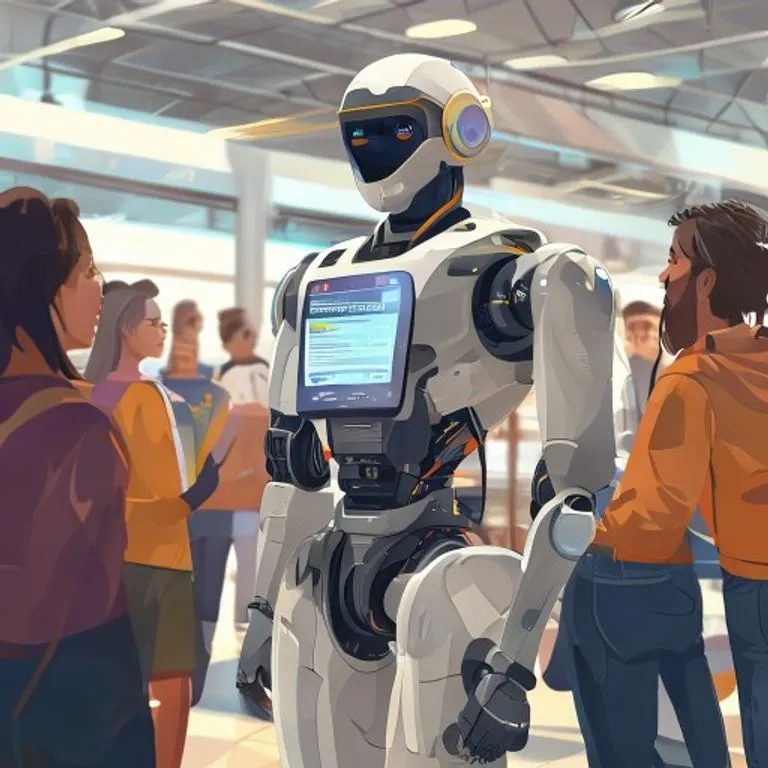
Humanoid robots are becoming increasingly common in public spaces, offering assistance and information with advanced AI capabilities.
The Evolution of Humanoid Robotics
The concept of automatons mimicking human form dates back centuries, with early mechanical figures designed for entertainment or philosophical inquiry. However, modern humanoid robotics truly began to take shape in the mid-20th century with the advent of computers and advanced control systems.
Pioneering efforts in the 1970s and 80s focused on basic bipedal locomotion, leading to significant breakthroughs in dynamic balancing and gait generation. The late 20th and early 21st centuries saw a surge in research, driven by projects like Honda's ASIMO, which demonstrated impressive mobility and interaction capabilities.
Today, humanoid robots are far more sophisticated, integrating complex AI for perception, decision-making, and natural language processing. This rapid evolution has transformed them from laboratory curiosities into potential everyday companions and workers.
Key Technologies Powering Humanoids
The development of modern humanoid robots relies on a convergence of cutting-edge technologies. Artificial Intelligence (AI) serves as the brain, enabling robots to learn, adapt, and make decisions. Machine learning algorithms, particularly deep learning, are crucial for tasks like facial recognition, object detection, and natural language understanding.
Sophisticated sensor arrays provide the robot with perception, including cameras for stereo vision, microphones for audio processing, and various tactile and proximity sensors for navigation and interaction. These sensors allow humanoids to map their environment, detect obstacles, and understand human cues.

The intricate control systems and AI algorithms are the backbone of modern humanoid capabilities.
Locomotion systems, including advanced actuators and sophisticated balance algorithms, enable bipedal movement, allowing robots to walk, run, and climb stairs. Dexterous manipulators, or robotic arms and hands, are equipped with multiple degrees of freedom and fine motor control, enabling them to grasp and manipulate a wide range of objects with precision.
Human-Robot Interaction (HRI) technologies are also paramount, focusing on creating intuitive and safe communication channels. This includes natural language processing for speech recognition and generation, as well as expressive facial features and body language to convey intent and emotion, making interactions more comfortable and efficient for humans.
Current Applications and Impact
Humanoid robots are finding their niche in an increasing number of sectors, demonstrating their versatility and potential to augment human capabilities. One prominent area is customer service and information dissemination. Robots are deployed in airports, shopping malls, and large exhibition centers to greet visitors, provide directions, and answer frequently asked questions in multiple languages.
In healthcare, humanoids are emerging as valuable assistants, particularly in non-clinical roles. They can help with patient transport, deliver supplies, or provide companionship and entertainment in long-term care facilities, freeing up human staff for more critical medical tasks. Their ability to navigate complex hospital environments and interact gently with patients makes them ideal for these supportive roles.
Furthermore, humanoid robots are being utilized in research and development, serving as platforms for studying bipedal locomotion, human-robot interaction, and advanced AI. They are also being explored for hazardous environments, such as disaster relief operations or space exploration, where their human-like form allows them to operate tools and equipment designed for humans without putting human lives at risk.
Case Study: Reem by Pal Robotics
A prime example of a commercially viable humanoid robot is Reem, developed by the Catalan company Pal Robotics. Reem is designed as a versatile service robot, standing at 1.66 meters tall and weighing 90 kilograms. Unlike purely bipedal robots, Reem H moves on a stable wheeled platform, allowing it to navigate at speeds up to 5 km/h, making it highly efficient for indoor environments.
Reem's capabilities are impressive, featuring two articulated and motorized arms for basic manipulation tasks. A touch screen on its torso allows users to select from over 30 languages for interaction. Its advanced facial detection and recognition system enables personalized greetings and responses, enhancing the user experience.
The integration of mechanical engineering and artificial intelligence defines the cutting edge of humanoid development.
Equipped with stereo vision, microphones, and various sensors, Reem can move autonomously, mapping its environment and navigating without human intervention or external wires. This makes it an effective dynamic information point, capable of guiding customers in large venues or even carrying small luggage (up to 30 kg) on a rear platform.
Pal Robotics aims to industrialize Reem for commercial sale, with initial orders already secured for fairs and congresses in the UAE. The company continues to refine Reem's voice recognition capabilities and its ability to handle complex social situations, such as interacting with multiple people simultaneously in crowded environments, building on the success of its earlier prototypes, Reem A and Reem B, which explored bipedal locomotion.
Challenges and Ethical Considerations
Despite rapid advancements, humanoid robotics faces significant challenges. The cost of manufacturing and maintaining these sophisticated machines remains high, limiting their widespread adoption. Achieving true autonomy in complex, unstructured environments, especially those with dynamic human interaction, is another hurdle. While robots like Reem excel in controlled settings, unpredictable real-world scenarios pose greater difficulties.
Ethical considerations are also paramount. Concerns about job displacement, privacy (especially with advanced facial recognition and data collection), and the potential for misuse of autonomous systems require careful deliberation. Ensuring the safety of human-robot interactions, particularly in sensitive environments like hospitals, demands robust regulatory frameworks and rigorous testing.
The psychological impact of humanoids on society is also being studied. How will humans adapt to interacting with machines that look and behave increasingly like them? Addressing these challenges requires a multidisciplinary approach, involving engineers, ethicists, policymakers, and the public to ensure that humanoid robotics develops responsibly and benefits humanity as a whole.
The Future of Humanoid Robots
The trajectory of humanoid robotics points towards an increasingly integrated future. We can expect to see more dexterous and agile robots capable of performing a wider array of physical tasks, from complex assembly in factories to delicate surgical assistance. Advancements in battery technology will extend their operational times, while improved AI will enhance their decision-making and social intelligence.
Future applications may include widespread home assistance, particularly for the elderly or individuals with disabilities, offering support with daily chores, medication reminders, and companionship. In education, humanoids could serve as interactive tutors, adapting to individual learning styles and providing engaging educational experiences.
The development of more robust voice recognition and natural language processing will enable seamless communication, making interactions with robots as intuitive as speaking to another human. As costs decrease and capabilities increase, humanoid robots are set to become an integral part of our daily lives, transforming how we work, live, and interact with technology.
Fuente: Contenido híbrido asistido por IAs y supervisión editorial humana.


