
Russian Abacus: History, Mechanics, Cultural Legacy | Althox
The Russian abacus, known as Schoty (счёты), stands as a testament to the enduring power of simple, yet effective, calculating tools. Far from being a mere historical artifact, this device played a pivotal role in the daily lives of millions across the former Soviet Union, influencing commerce, education, and even the very fabric of its society. Its unique design and operational methodology set it apart from other abacus variants, offering a fascinating glimpse into a distinct approach to arithmetic.
Despite the advent of more sophisticated mechanical and electronic calculators, the Schoty maintained its relevance for centuries, embodying principles of practicality and accessibility. This article delves into the intricate details of the Russian abacus, exploring its distinctive features, historical journey, cultural significance, and eventual decline in the face of modern technology, while acknowledging its undeniable mathematical value.
Table of Contents
- Distinctive Characteristics of the Russian Abacus (Schoty)
- Mechanics and Operation: Mastering the Schoty
- Historical Significance and Widespread Use
- Cultural Impact and Educational Role
- The Decline of the Schoty in the Digital Age
- Modern Relevance and Enduring Legacy
- Schoty in Context: A Brief Comparison
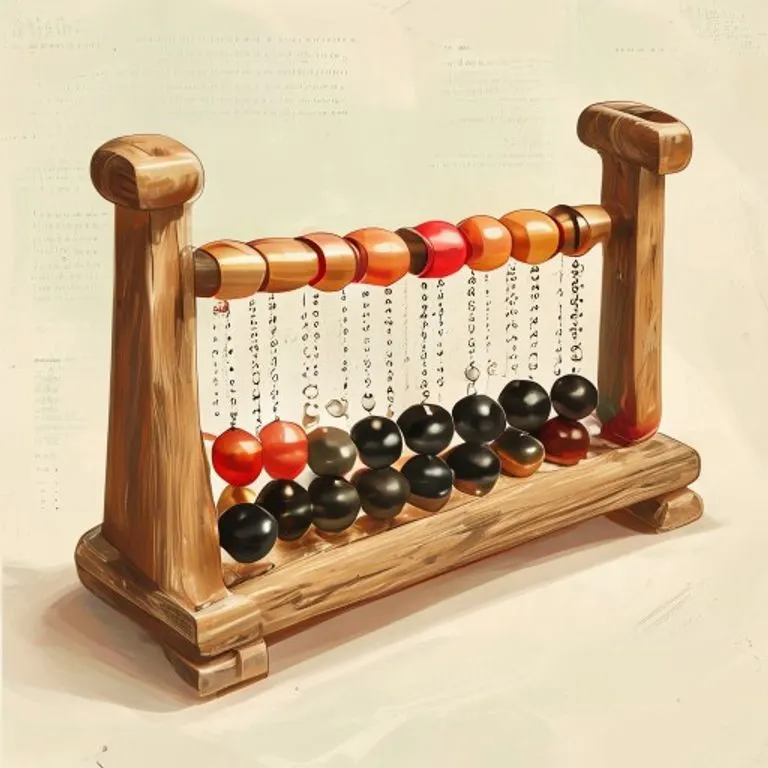 The Schoty, a traditional Russian abacus, is known for its distinctive sloping design and fractional bead system.
Distinctive Characteristics of the Russian Abacus (Schoty)
The Russian abacus, or Schoty, possesses several unique design elements that differentiate it from other abacus types found across Asia and the Middle East. Its most recognizable feature is the often-present sloping roof, though this is primarily an aesthetic and ergonomic detail rather than a functional one. The core functionality lies in its bead arrangement and specific wire configurations.
Typically, a Schoty consists of multiple wires, each strung with a specific number of beads. The standard configuration includes 10 oval or spherical beads on most wires. This decimal arrangement facilitates direct calculation in base-10, making it intuitive for users accustomed to the decimal number system.
- The Fractional Wire: A crucial distinguishing feature is the presence of a unique wire, typically the fourth from the bottom, which traditionally holds not 10, but four beads. These four beads were historically used for calculating fractional quarter-rubles, reflecting the monetary system of the time. Older models might even feature an additional wire for quarter-kopeks, which were in circulation until 1916.
- Vertical Orientation: Unlike many horizontal abacus designs, the Russian abacus is often used vertically. The wires run from left to right, similar to lines in a book, allowing for a natural flow of calculation and visual organization.
- Bead Placement and Clearing: To maintain the beads in their respective positions and prevent them from sliding freely, the wires usually tend to lean or accumulate slightly towards the top center of the abacus. A count is "cleared" on a Russian abacus when all beads are slid to the right side of their respective wires. During calculation, beads are moved to the left.
- Color Coding: For enhanced readability and ease of use, the 5th and 6th beads on each wire are often colored differently from the other eight. This visual cue helps users quickly identify groups of five, simplifying counting and calculations. Similarly, the wire representing thousands (and sometimes millions) might also feature a distinct color to aid in place value recognition.
Mechanics and Operation: Mastering the Schoty
Operating the Schoty is a skill that combines tactile manipulation with mental arithmetic, allowing for rapid and accurate calculations once mastered. The principle is straightforward: beads represent units, and their movement across the wire signifies addition or subtraction.
To begin a calculation, all beads are typically positioned on the right side of the abacus, representing a zero state. As numbers are added, beads are moved from right to left. Each wire corresponds to a specific decimal place, with the bottom-most wire usually representing units, the next one tens, then hundreds, and so forth.
- Addition: To add a number, the corresponding number of beads are moved from the right to the left on the appropriate wire. If a wire reaches ten beads on the left, it is "cleared" (all ten beads moved back to the right), and one bead is moved to the left on the next higher-value wire (carrying over).
- Subtraction: Subtraction involves moving beads from left to right. If there aren't enough beads on a wire to subtract, one bead is "borrowed" from the next higher-value wire (moving it from left to right), and ten beads are then moved from right to left on the current wire before subtracting the required amount.
- Fractional Calculations: The unique four-bead wire for quarter-rubles allowed for precise financial calculations. Each bead on this wire represented 25 kopeks (a quarter of a ruble), enabling quick handling of common monetary divisions without complex decimal conversions.
- Speed and Efficiency: With practice, skilled users of the Schoty could perform calculations with remarkable speed, often rivaling early mechanical calculators. The tactile feedback and visual representation of numbers aided in both accuracy and the development of strong mental arithmetic skills.
 Historical photographs often depict the Schoty as a fundamental tool in Soviet education and commerce.
Historical Significance and Widespread Use
The Russian abacus holds a significant place in the history of calculation, particularly within the vast expanse of the Russian Empire and later the Soviet Union. Its origins are somewhat debated, but its widespread adoption is undeniable. For centuries, it served as the primary calculating device for merchants, accountants, and even ordinary citizens.
Its simplicity, affordability, and reliability made it an indispensable tool. Unlike complex mechanical calculators that required delicate mechanisms and regular maintenance, the Schoty was robust and could withstand the rigors of daily use in diverse environments, from bustling market stalls to remote village shops. This resilience contributed significantly to its pervasive presence.
- Ubiquitous Presence: The Schoty was a common sight in nearly every shop, market, and administrative office across the former Soviet Union. Its presence was so ingrained that it became a cultural icon, instantly recognizable as a symbol of commerce and basic arithmetic.
- Educational Staple: Beyond its commercial applications, the Russian abacus was a fundamental teaching aid in schools throughout the Soviet era, often until the 1990s. It provided a concrete, tangible way for students to grasp numerical concepts, place value, and the mechanics of addition, subtraction, multiplication, and division.
- Enduring Despite Innovation: The longevity of the Schoty is particularly remarkable given the parallel development of more advanced calculating machines. The first mechanical calculator was invented in 1874, and the mass production of the Felix arithmometer began in 1924. Despite these innovations, which significantly reduced the use of abaci in Western Europe, the Russian abacus continued to thrive. This can be attributed to its cost-effectiveness, ease of use, and the established infrastructure for its production and teaching.
Cultural Impact and Educational Role
The cultural impact of the Russian abacus extends beyond its utilitarian function. It became a symbol of Russian ingenuity and practicality, deeply embedded in the collective memory of generations. Its role in education was particularly profound, shaping the mathematical understanding of countless students.
The tactile nature of the Schoty provided a concrete representation of abstract mathematical principles. Moving physical beads to perform calculations helped students develop a strong sense of number and quantity, fostering a deeper understanding than rote memorization alone. This pedagogical approach is still valued today in certain educational philosophies.
 The principles of the abacus continue to inspire abstract representations of numerical processing and data flow.
Jean Victor Poncelet, a French mathematician, encountered the Russian abacus during the Napoleonic Wars and later introduced it to France in 1820. While abaci had largely fallen out of favor in Western Europe by the 16th century due to the rise of decimal notation and algorithmic methods performed on paper, Poncelet recognized the Schoty's educational potential. He used it as a demonstration tool to help his contemporaries grasp mathematical concepts, illustrating how physical manipulation could bridge the gap between abstract numbers and tangible reality. These teaching methods continue to influence modern pedagogical approaches, particularly in early mathematics education.
The Decline of the Schoty in the Digital Age
Despite its long and illustrious history, the reign of the Russian abacus eventually came to an end with the relentless march of technological progress. The turning point arrived in the mid-1970s, marking a significant shift in calculating practices across the Soviet Union.
The widespread availability of microcalculators, or handheld electronic calculators, beginning around 1974, proved to be the ultimate challenge to the Schoty's dominance. These new devices offered unprecedented speed, accuracy, and portability, making them far more efficient for complex calculations and large volumes of data. The convenience of electronic calculators quickly overshadowed the manual dexterity required for the abacus.
The transition was swift and comprehensive. As electronic calculators became cheaper and more accessible, they rapidly replaced abaci in shops, offices, and schools. What was once an indispensable tool quickly became obsolete for practical, everyday use. By the 1990s, the Schoty had largely faded from active use, relegated to museums, antique shops, and the occasional nostalgic display.
Modern Relevance and Enduring Legacy
While the Russian abacus may no longer be a primary calculating device, its legacy endures, and it continues to hold relevance in several contexts. Far from being merely a primitive mathematical tool, its historical significance and pedagogical value are increasingly recognized.
In educational settings, particularly for young children, the Schoty (or similar bead-based counting frames) can still be a valuable aid for teaching fundamental arithmetic. Its tangible nature helps children visualize numbers and operations, building a strong conceptual foundation before transitioning to abstract symbols and digital interfaces. This hands-on approach can be particularly beneficial for developing number sense and problem-solving skills.
Moreover, the Schoty serves as a powerful cultural artifact, representing a bygone era of commerce and daily life in Russia and the Soviet Union. It offers a tangible link to the past, reminding us of the ingenuity required to perform complex tasks before the digital revolution. Collectors and historians value it for its historical context and unique design.
The principles of the abacus, including place value and carrying/borrowing, are foundational to modern arithmetic and computer science. Understanding how an abacus works can provide insights into the basic logic underpinning digital calculations, making it a useful tool for illustrating computational concepts in a simplified, accessible manner. Its story is a reminder of human adaptability and the continuous evolution of tools that augment our intellectual capabilities.
Schoty in Context: A Brief Comparison
To fully appreciate the Russian abacus, it's helpful to briefly compare it with other prominent abacus types. While all abaci serve the same fundamental purpose of aiding calculation, their designs reflect different cultural contexts, mathematical systems, and ergonomic considerations.
| Feature | Russian Abacus (Schoty) | Chinese Abacus (Suanpan) | Japanese Abacus (Soroban) |
|---|---|---|---|
| Bead Configuration | 10 beads per wire (except for fractional wire with 4 beads). No central bar. | 2 beads above a central bar, 5 beads below (2/5 configuration). | 1 bead above a central bar, 4 beads below (1/4 configuration). |
| Orientation | Often used vertically, wires run left-to-right. | Used horizontally, wires run vertically. | Used horizontally, wires run vertically. |
| Decimal System | Directly represents decimal values. | Uses a bi-quinary system (base 10 with sub-base 5). | Uses a bi-quinary system, simplified from Suanpan. |
| Fractional Values | Dedicated wire for quarter-units (e.g., quarter-rubles). | Can represent fractions but without a dedicated wire. | Can represent fractions but without a dedicated wire. |
| Clearing Mechanism | All beads slid to the right. | Beads moved away from the central bar. | Beads moved away from the central bar. |
This comparison highlights the Schoty's straightforward decimal representation and its unique adaptation for fractional currency, reflecting the practical needs of its users. While the Suanpan and Soroban are more complex in their internal representation (bi-quinary), they offer immense speed for skilled operators. The Russian abacus, with its direct decimal system, remained highly accessible and effective for a broad population, underscoring its enduring appeal for centuries.
Fuente: Contenido híbrido asistido por IAs y supervisión editorial humana.


