
Mesopotamian Abacus: Ancient Origins, Function, and Legacy | Althox
The Mesopotamian abacus represents a pivotal, albeit often debated, chapter in the history of human computation. Long before the advent of electronic calculators or even mechanical devices, ancient civilizations developed ingenious methods to manage complex numerical tasks.
Among these, the abacus stands out as one of the earliest and most enduring tools, with its origins tracing back to the cradle of civilization: Mesopotamia. This region, nestled between the Tigris and Euphrates rivers, was home to the Sumerians, Akkadians, Babylonians, and Assyrians, who laid the groundwork for many aspects of modern society, including writing, law, and, critically, mathematics.
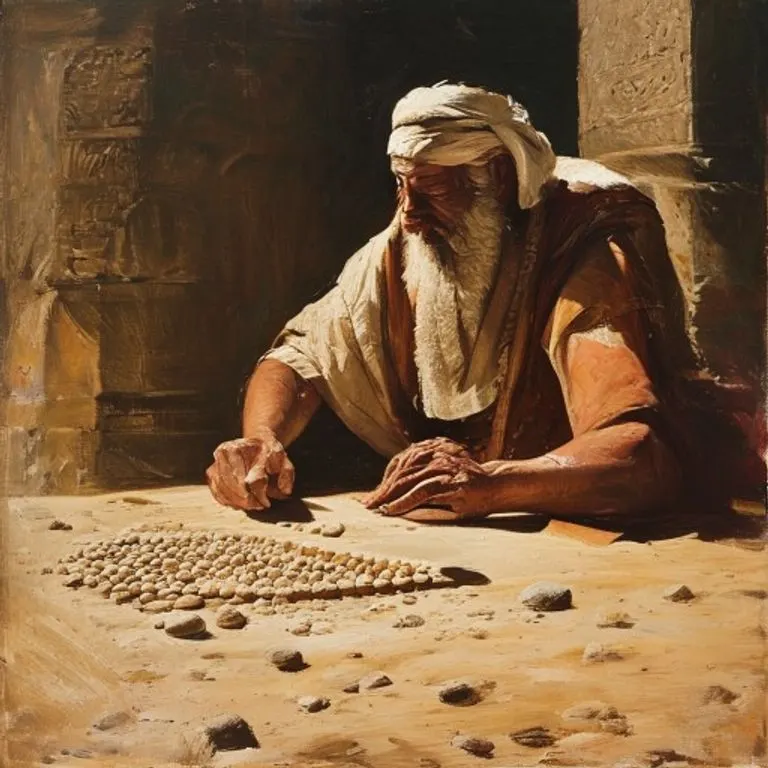
An artistic representation of an ancient Mesopotamian scholar utilizing a primitive abacus for numerical calculations, highlighting early computational practices.
Understanding the Mesopotamian abacus requires delving into the unique mathematical systems developed by these cultures, particularly the sexagesimal (base-60) system of the Babylonians. This system, which still influences our measurement of time and angles today, necessitated specialized tools for efficient calculation.
While direct archaeological evidence of a physical abacus is scarce, historical texts and scholarly interpretations provide compelling insights into its probable form and function. This article will explore the presumed design, materials, historical context, and the profound, albeit often understated, legacy of the Mesopotamian abacus.
The concept of an abacus, broadly defined as a counting frame or device, has appeared independently in various cultures across the globe. However, the Mesopotamian version is particularly significant due to its association with some of the earliest sophisticated mathematical and astronomical records.
Its existence underscores the universal human need for tools to aid in enumeration, trade, and the management of resources in increasingly complex societies. By examining the available evidence and scholarly theories, we can reconstruct a plausible picture of this ancient computational marvel and appreciate its contribution to the evolution of numerical thought.
This exploration will navigate through the historical backdrop of Mesopotamia, detailing the Sumerian and Babylonian contributions to mathematics. We will then focus on the specifics of the Mesopotamian abacus itself, including its construction, the materials used, and the methods by which it facilitated calculations within a base-60 system.
Furthermore, we will consider the scholarly debates surrounding its precise form and the extent of its usage, ultimately aiming to paint a comprehensive picture of this foundational instrument in the history of computing.
Table of Contents
- Historical Context of Mesopotamian Mathematics
- The Sumerian Abacus and the Sexagesimal System
- The Babylonian Sexagesimal System: A Deeper Dive
- Construction and Materials of the Mesopotamian Abacus
- Functionality and Usage in Ancient Mesopotamia
- Archaeological Evidence and Scholarly Debates
- The Abacus in Daily Life: Trade, Astronomy, and Administration
- Evolution of Counting Devices: From Mesopotamia to Modernity
- Comparing the Mesopotamian Abacus with Other Ancient Abaci
- The Enduring Legacy of Mesopotamian Computational Methods
- Conclusion: The Enduring Mystery of the First Calculator
Historical Context of Mesopotamian Mathematics
Mesopotamia, often referred to as the "Fertile Crescent," was a region of immense cultural and intellectual innovation from approximately 3500 BCE to 539 BCE. Its inhabitants, particularly the Sumerians and later the Babylonians, developed sophisticated systems for writing, astronomy, and mathematics, driven by the practical needs of a complex agrarian society.
The invention of cuneiform writing around 3200 BCE allowed for the recording of numerical data, administrative records, and eventually, abstract mathematical concepts. Early Sumerian mathematics, dating back to the late 4th millennium BCE, was primarily concerned with accounting and metrology.
They developed systems for measuring land, grain, and other commodities, which required basic arithmetic operations. The need to manage large-scale irrigation projects, collect taxes, and administer vast temple economies fostered a robust environment for numerical development.
This foundational period saw the emergence of a rudimentary sexagesimal (base-60) system, which was then fully developed by the Babylonians. The Old Babylonian period (c. 1894–1595 BCE) is widely considered the golden age of Mesopotamian mathematics.
During this era, Babylonian scribes and mathematicians produced an extensive corpus of clay tablets detailing advanced mathematical concepts. These tablets reveal a sophisticated understanding of algebra, geometry, and number theory, far beyond simple counting.
They used a positional numeral system with a base of 60, which allowed for the representation of very large numbers and fractions, making calculations incredibly efficient for their time. The sexagesimal system had several advantages.
The number 60 is highly composite, meaning it has many divisors (1, 2, 3, 4, 5, 6, 10, 12, 15, 20, 30, 60), which simplified calculations involving fractions and divisions. This system was particularly well-suited for astronomical observations, which required precise measurements of angles and time.
The division of a circle into 360 degrees and an hour into 60 minutes and 60 seconds are direct legacies of Babylonian mathematics. However, the Babylonian sexagesimal system lacked a true zero placeholder for many centuries, which could lead to ambiguities in number representation.
Context often determined the magnitude of a number. Despite this, their mathematical achievements were remarkable, including the development of multiplication tables, reciprocal tables, tables of squares and square roots, and even methods for solving quadratic equations.
It is within this rich mathematical landscape that the need for a physical calculation aid like the abacus becomes evident. The sheer volume and complexity of the calculations required for astronomical predictions, architectural planning, and economic administration would have been daunting without some form of mechanical or semi-mechanical assistance.
While clay tablets served as permanent records, a more dynamic tool was necessary for the iterative process of calculation itself. This is where the concept of the Mesopotamian abacus, as a practical and accessible instrument, fits into the historical narrative.
The Sumerian Abacus and the Sexagesimal System
The earliest references to a counting device in Mesopotamia are often associated with the Sumerians, the pioneers of urban civilization in the region. The period between 2700 and 2300 BCE saw the emergence of what scholars refer to as the "Sumerian Abacus."
This was not necessarily a device with beads on rods, as we commonly imagine a modern abacus, but rather a conceptual or physical table of successive columns. These columns were designed to delineate the successive orders of magnitude within their sexagesimal number system.
A detailed portrait of a Sumerian scribe, symbolizing the intellectual rigor and administrative precision required in ancient Mesopotamian societies.
In a sexagesimal system, each position represents a power of 60. For example, a number might be represented as A * 60^2 + B * 60^1 + C * 60^0. A physical abacus would need a way to represent these different powers.
The Sumerian abacus, as theorized, likely consisted of a flat surface divided into columns or sections, with each section corresponding to a specific power of 60. Counters, such as pebbles or small tokens, would be placed within these columns to represent the numerical value for that power.
The sexagesimal system itself was a groundbreaking innovation. Unlike the decimal system (base-10) that dominates modern arithmetic, the base-60 system offered unique advantages for calculations involving division and fractions, as 60 is divisible by 2, 3, 4, 5, 6, 10, 12, 15, 20, and 30.
This property made it particularly useful for trade, astronomy, and timekeeping, where quantities often needed to be divided into various parts. For instance, if a merchant needed to divide a quantity of goods among 12 people, using a base-60 system made the calculation straightforward, as 60 is perfectly divisible by 12.
In contrast, a base-10 system would often result in recurring decimals, which are more cumbersome to manage without advanced fractional notation. The Sumerian abacus, by providing a physical representation of this system, would have greatly facilitated such practical computations.
The concept of positional notation, where the value of a digit depends on its position, was central to the sexagesimal system and, by extension, to the Sumerian abacus. While the Sumerians didn't have a zero placeholder in the same way modern mathematics does, the empty column on their abacus would have implicitly indicated a lack of value for that specific power of 60.
This early understanding of positional value was a crucial step towards more abstract mathematical systems. The exact appearance of the Sumerian abacus remains a subject of academic discussion, as no physical artifacts have been definitively identified as such.
However, the logical necessity for such a tool, coupled with textual evidence describing counting methods, strongly supports its existence. It served as a bridge between abstract numerical concepts and tangible manipulation, making complex calculations accessible to a wider range of scribes and administrators.
The transition from simple tally marks to a positional system with a physical aid like the Sumerian abacus marked a significant cognitive leap. It allowed for the systematic representation and manipulation of numbers, which was indispensable for the burgeoning economies and sophisticated administrative structures of Sumerian city-states.
This early form of computational device laid the groundwork for the more refined mathematical practices of subsequent Mesopotamian civilizations.
The Babylonian Sexagesimal System: A Deeper Dive
The Babylonian sexagesimal system, inherited and refined from the Sumerians, stands as one of the most sophisticated numerical systems of the ancient world. Its base-60 structure offered unparalleled advantages for arithmetic, particularly in areas requiring precise divisions and fractional representations.
The number 60 is a highly composite number, meaning it has a large number of divisors (1, 2, 3, 4, 5, 6, 10, 12, 15, 20, 30, 60). This property made calculations involving fractions much simpler than in a base-10 system, where many common fractions result in repeating decimals.
For instance, 1/3 in base-10 is 0.333..., but in base-60, it is a clean 0;20 (meaning 20/60). This efficiency was crucial for practical applications like trade, land division, and astronomical observations, where exact measurements were paramount.
Babylonian mathematicians developed extensive tables to aid in calculations, including multiplication tables, reciprocal tables, and tables for squares and square roots. These tables, inscribed on clay tablets, demonstrate a profound understanding of numerical relationships and computational aids.
A notable feature of their system was its positional notation, where the value of a digit depended on its position within a number. This was revolutionary for its time, allowing for the representation of arbitrarily large or small numbers using a limited set of symbols.
However, the absence of a dedicated zero placeholder for many centuries presented challenges. The meaning of a number like "1 1" could be interpreted as 61, 3601, or even 1 + 1/60, depending on the context.
Scribes often relied on spacing or contextual clues to disambiguate numbers, and a true zero symbol eventually emerged, though its usage was not always consistent. This system's influence is still deeply embedded in modern society.
Our division of time (60 seconds in a minute, 60 minutes in an hour) and angles (360 degrees in a circle, 60 minutes in a degree, 60 seconds in a minute of arc) are direct descendants of Babylonian sexagesimal mathematics. This enduring legacy highlights the system's practical utility and intellectual power.
Construction and Materials of the Mesopotamian Abacus
Based on various historical interpretations and the nature of available materials in ancient Mesopotamia, the Mesopotamian abacus is believed to have been constructed from simple, readily available resources. The most widely accepted theory suggests a design involving a flat stone surface combined with a sand mixture.
This description aligns with the practical ingenuity of the era, where tools were often crafted from natural elements. The primary component, a "flat stone," would have provided a stable and durable base for calculations.
Mesopotamia was rich in various types of stone, and a smooth, flat slab would have been ideal. The size of such a stone could vary, from small, portable versions used by individual merchants to larger, more permanent installations in administrative centers or temples.
The flatness was crucial to ensure that the counters remained in their designated positions during calculations. Upon this stone, a "sand mixture" would have been spread.
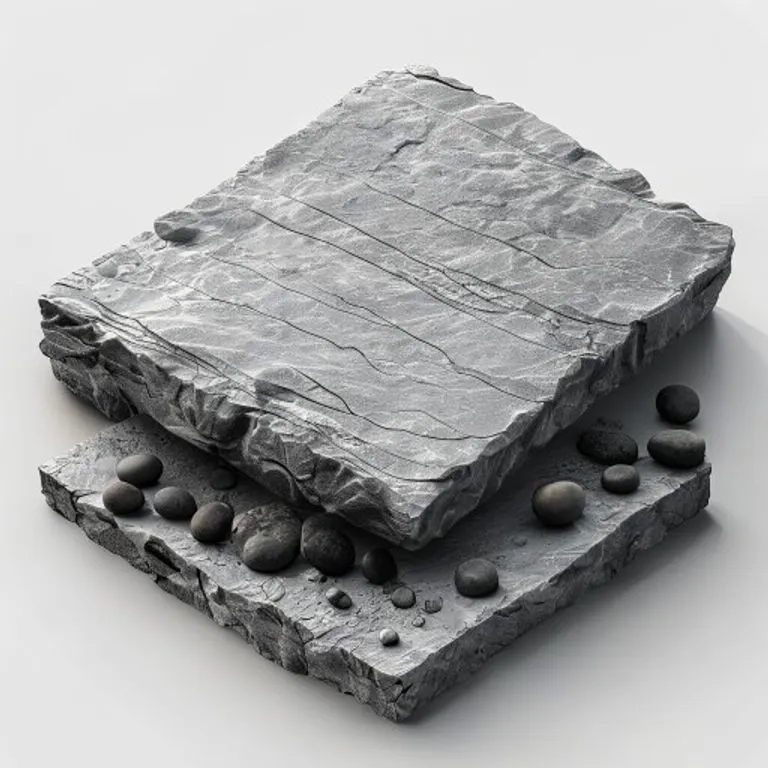
A close-up of an ancient stone abacus with pebbles, illustrating a primitive counting device used in Mesopotamia.
This layer of sand served a dual purpose. Firstly, it provided a soft, easily modifiable surface on which lines or columns could be drawn. Scribes or calculators could use a stylus or even their finger to delineate the different orders of magnitude for their sexagesimal system.
These lines would create the distinct columns necessary for positional notation, allowing counters to be placed in specific zones representing units, 60s, 3600s (60^2), and so on. Secondly, the sand mixture would have provided a slight friction, preventing the counters from sliding unintentionally.
This is a critical feature for any abacus, as accidental movement of counters would lead to errors in calculation. The specific composition of the "sand mixture" is not precisely known, but it likely involved fine sand, possibly mixed with a small amount of clay or water to give it some cohesion, allowing for temporary markings and easy erasure.
The "letters" mentioned in the original context, which were "drawn in the sand," likely refer to the numerical symbols or markers for the values being calculated, or perhaps the column dividers themselves. The counters, described as "stones on sand," would have been small pebbles, clay tokens, or even seeds.
These counters represented the value, quantity, or numbers within each column. The act of moving these counters between columns or within a column would constitute the arithmetic operation. The simplicity of these materials belies the sophistication of the system they supported.
The ability to create a temporary, reusable calculation surface was highly efficient. Unlike carving numbers into clay tablets, which created a permanent record but was time-consuming for iterative calculations, the sand abacus allowed for quick adjustments and recalculations.
Once a final result was obtained, it could then be transcribed onto a more permanent medium like a clay tablet. This method of construction also suggests a high degree of portability for smaller versions.
A flat stone and a pouch of sand and pebbles could be easily carried by a merchant or administrator. Larger versions might have been semi-permanent fixtures in public spaces or schools for scribes, where mathematical training was a crucial part of education.
The use of such basic materials highlights the practical and accessible nature of this early computational tool, making it widely available to those who needed to perform calculations.
Functionality and Usage in Ancient Mesopotamia
The primary function of the Mesopotamian abacus was to facilitate arithmetic operations, particularly addition and subtraction, within the complex sexagesimal system. While the exact algorithms used are not fully documented for this specific device, we can infer its operation based on the principles of positional notation and the known mathematical practices of the time.
The abacus would have provided a tangible, visual aid for manipulating numbers, reducing the cognitive load of mental calculation. For addition, counters representing the numbers to be added would be placed in their respective columns.
For example, if adding two numbers, the counters for the first number would be arranged, then the counters for the second number would be added to the same columns. When a column accumulated 60 or more counters, a "carry-over" operation would occur: 60 counters would be removed from that column, and one counter would be added to the next higher-order column (representing the next power of 60).
This process is analogous to carrying over tens in a decimal system. Subtraction would involve the reverse process. Counters would be removed from the appropriate columns.
If a column did not have enough counters for a subtraction, a "borrow" operation would be performed: one counter would be removed from the next higher-order column, and 60 counters would be added to the current column, allowing the subtraction to proceed.
This method, while simple in concept, requires careful manipulation and a clear understanding of the sexagesimal system's positional values. Beyond basic arithmetic, the abacus would have been invaluable for more complex tasks.
These tasks included managing inventories, calculating taxes, determining land areas for irrigation, and even assisting in astronomical predictions. The iterative nature of abacus calculations allowed scribes to perform multiple steps without needing to constantly erase and rewrite on clay tablets.
The abacus thus served as a dynamic workspace, complementing the permanent record-keeping on clay. Its widespread use, though largely inferred, points to its indispensable role in the administrative and scientific endeavors of ancient Mesopotamian societies.
Archaeological Evidence and Scholarly Debates
The precise physical form of the Mesopotamian abacus remains a subject of considerable scholarly debate, primarily due to the scarcity of direct archaeological evidence. Unlike the more robust abaci of later civilizations, such as the Roman abacus with its bronze or marble construction, the Mesopotamian version was likely made from perishable materials.
The theory of a sand-covered stone tablet with pebbles as counters is largely based on textual interpretations and the logical deduction of what materials would have been available and practical. Clay tablets, while abundant, served as permanent records rather than dynamic calculation tools.
However, some indirect evidence supports the existence of such a device. For instance, certain cuneiform tablets contain instructions or examples of calculations that strongly imply the use of a physical aid for manipulating numbers in columns.
These tablets often show intermediate steps of calculations, suggesting a method that allowed for easy adjustment and rearrangement of values, consistent with an abacus. Scholars like Otto Neugebauer and Marvin Minsky have contributed significantly to our understanding of ancient computational methods, often inferring the use of such tools from mathematical texts.
The debate also extends to the exact period of its invention and widespread adoption. While Sumerian texts hint at early counting boards, the more complex sexagesimal system of the Babylonians would have made an abacus even more essential for efficient calculations.
Some researchers argue that the "abacus" might have been more of a conceptual framework, a mental construct for organizing numbers, rather than a strictly physical device. However, the practical demands of a complex economy and administration almost certainly necessitated a tangible tool.
The lack of physical artifacts does not necessarily negate its existence, given the nature of the materials used. Wood, sand, and pebbles would decompose or scatter over millennia, leaving little trace for archaeologists.
Despite the ongoing debates, the scholarly consensus leans towards the existence of some form of abacus in Mesopotamia, crucial for the advanced mathematical achievements of the civilization. This ongoing discussion highlights the challenges of reconstructing ancient technologies based on limited evidence.
The Abacus in Daily Life: Trade, Astronomy, and Administration
The Mesopotamian abacus, in its various forms, played an indispensable role in the daily functioning of one of the world's earliest complex societies. Its utility extended across multiple domains, from the bustling markets of Sumerian cities to the meticulous observations of Babylonian astronomers and the intricate bureaucracy of empires.
In trade and commerce, the abacus would have been a merchant's best friend. Calculating prices, managing inventories, converting currencies (though often commodity-based), and tallying transactions in a sexagesimal system would have been cumbersome without a physical aid.
The ability to quickly add and subtract large quantities of goods, grains, or metals ensured fair exchanges and accurate record-keeping. This efficiency directly contributed to the economic stability and growth of Mesopotamian city-states.
For astronomers, the abacus was a critical tool for their groundbreaking work. Babylonian astronomy was remarkably advanced, involving precise calculations of planetary movements, lunar cycles, and eclipses. These computations often involved large numbers and complex fractional parts, perfectly suited for the sexagesimal system and its abacus.
The abacus allowed them to perform the iterative calculations needed for predicting celestial events, developing calendars, and creating sophisticated ephemerides. Its role in astronomical calculations underscores its importance in the development of scientific thought.
In administration, the abacus was vital for the vast bureaucracies that governed Mesopotamian empires. Tax collection, land surveys, resource allocation, and the management of large labor forces all required extensive numerical processing.
Scribes, who were the intellectual backbone of these societies, would have used the abacus to manage vast amounts of data, ensuring the smooth operation of government and temple economies. The abacus facilitated the efficient processing of information, a precursor to modern data management.
Even in education, the abacus likely played a role in teaching young scribes the intricacies of the sexagesimal system and basic arithmetic. Its tactile nature would have made abstract mathematical concepts more accessible and understandable.
The Mesopotamian abacus, therefore, was not merely a computational device; it was an integral part of the economic, scientific, and administrative fabric of ancient Mesopotamia, enabling the complex operations that defined this foundational civilization.
Evolution of Counting Devices: From Mesopotamia to Modernity
The Mesopotamian abacus stands at the beginning of a long and fascinating lineage of counting devices that spans millennia, ultimately leading to modern digital computers. Its conceptual foundation – using physical tokens or positions to represent numerical values – is a principle that has been reinvented and refined across cultures and eras.
From the simple sand abacus, the evolution progressed to more structured forms. The Roman abacus, for instance, featured grooves or rods with beads that could be moved, making it more durable and portable than its Mesopotamian predecessor.
In China, the suanpan, and in Japan, the soroban, developed into highly efficient bead-based abaci, still used in some contexts today. These devices allowed for rapid and complex calculations, often outperforming early mechanical calculators in speed and ease of use.
The invention of logarithms in the 17th century led to the development of the slide rule, a mechanical analog computer that significantly simplified multiplication and division. Blaise Pascal's Pascaline and Gottfried Leibniz's stepped reckoner were among the first true mechanical calculators, capable of performing all four basic arithmetic operations.
Charles Babbage's Difference Engine and Analytical Engine in the 19th century laid the theoretical groundwork for modern computers, introducing concepts like programmability and memory. While never fully realized in his lifetime, Babbage's designs were visionary.
The 20th century saw the rapid development of electromechanical and then electronic computers, starting with machines like ENIAC and Colossus. These behemoths gradually shrank in size and increased in power, leading to the personal computers and smartphones we use today.
Despite this incredible technological leap, the fundamental idea of representing and manipulating numbers through discrete units, first seen in the Mesopotamian abacus, persists. Every digital bit in a modern computer can be seen as a descendant of those ancient pebbles on sand, representing a foundational step in humanity's quest for computational mastery.
Comparing the Mesopotamian Abacus with Other Ancient Abaci
While the Mesopotamian abacus represents an early form of computational aid, it's insightful to compare it with other ancient abaci that emerged independently across different civilizations. These comparisons highlight both universal principles of counting and unique cultural adaptations.
| Feature | Mesopotamian Abacus | Roman Abacus | Chinese Suanpan |
|---|---|---|---|
| Primary Materials | Flat stone, sand mixture, pebbles/tokens | Bronze, marble, bone, glass beads | Wood frame, wooden/bamboo beads, metal rods |
| Numerical System | Sexagesimal (base-60) | Decimal (base-10), often with binary sub-base (5 beads per column) | Decimal (base-10), with two beads above and five below the beam (representing 5 and 1 units respectively) |
| Form Factor | Likely a flat board with drawn columns; temporary | Small, portable metal or stone plate with grooves/slots | Rectangular frame with rods and beads; highly structured |
| Zero Placeholder | Implicit (empty column), later a symbol | Not explicitly needed for its operation, positional system implies it | Implicitly represented by beads not touching the beam |
| Complexity of Operations | Basic arithmetic (addition, subtraction); inferred use for multiplication/division with tables | Basic arithmetic, fractions, currency conversions | All four basic operations, square roots, cube roots; highly versatile |
| Archaeological Evidence | Scarce direct evidence; inferred from texts | Numerous physical artifacts found | Many surviving examples, still in use |
The Mesopotamian abacus, with its ephemeral nature, stands in contrast to the more robust and enduring designs of the Roman and East Asian abaci. However, its significance lies in its pioneering role, demonstrating humanity's early recognition of the need for external computational aids.
While the Roman abacus offered greater portability and durability, and the suanpan/soroban achieved remarkable efficiency and versatility, the Mesopotamian version laid the conceptual groundwork. It proved that a positional number system, combined with a physical manipulation tool, could handle complex calculations far beyond mental arithmetic.
Each of these abaci, in its own cultural context, addressed specific computational needs and reflected the mathematical systems prevalent in their respective societies. Their evolution showcases a continuous human endeavor to simplify and accelerate numerical processing.
The Enduring Legacy of Mesopotamian Computational Methods
The legacy of Mesopotamian computational methods, including the principles embodied by their abacus, extends far beyond the ancient world. While the physical device itself may have faded, the intellectual innovations it supported continue to influence modern science, technology, and daily life.
The most direct and widely recognized legacy is the sexagesimal system. Our measurement of time into 60 seconds and 60 minutes, and the division of a circle into 360 degrees, are direct inheritances from Babylonian mathematics. This system proved so effective for astronomical and geometric calculations that it persisted for millennia.
The concept of positional notation, central to the Mesopotamian abacus, was a revolutionary idea. It allowed for the representation of any number, regardless of its magnitude, using a finite set of symbols and their positions. This fundamental principle is the bedrock of all modern numeral systems, including our decimal system and the binary system used in computers.
Furthermore, the Mesopotamians' systematic approach to mathematics, evident in their extensive tables for multiplication, reciprocals, and squares, foreshadowed modern computational algorithms. These tables were essentially pre-computed solutions that streamlined complex calculations, a concept analogous to lookup tables or libraries in programming.
The very act of using a physical tool to aid in calculation, as the abacus did, represents an early form of externalizing cognitive load. This idea is fundamental to all computing devices, from the simplest calculator to the most powerful supercomputer.
The Mesopotamian abacus, therefore, is not just a historical curiosity; it is a testament to the ingenuity of ancient cultures in solving practical problems through mathematical innovation. Its principles laid crucial groundwork for the development of mathematics and computing, shaping how we understand and manipulate numbers today.
Understanding this ancient tool provides valuable insight into the long human journey of developing computational power, a journey that continues to accelerate in the digital age.
Conclusion: The Enduring Mystery of the First Calculator
The Mesopotamian abacus, though shrouded in the mists of antiquity and lacking definitive archaeological proof, stands as a powerful symbol of human ingenuity. Its existence, inferred from the sophisticated mathematical practices of Sumerians and Babylonians, underscores the critical role of computational aids in the development of early complex societies.
From its presumed construction of a sand-covered stone board and pebbles to its crucial role in managing the sexagesimal system, the Mesopotamian abacus was an indispensable tool for trade, astronomy, and administration. It facilitated complex arithmetic, enabling advancements that would have been impossible through mental calculation alone.
Its legacy is not merely historical; it is embedded in the very fabric of our modern numerical systems and timekeeping. The principles of positional notation and externalizing computation, first explored with this ancient device, continue to resonate in the digital age.
While the exact form of the Mesopotamian abacus may remain an enduring mystery, its conceptual contribution to the history of computing is undeniable. It reminds us that the quest for efficient calculation is as old as civilization itself, a testament to humanity's continuous drive to understand and master the world through numbers.
Fuente: Contenido híbrido asistido por IAs y supervisión editorial humana.


