
Quantum Cybersecurity and Critical Infrastructure Protection
The advent of quantum computing heralds a new era of technological advancement, promising unprecedented computational power that could revolutionize various industries. However, this same power poses a significant threat to current cybersecurity paradigms, particularly for critical infrastructures that underpin modern society. Protecting these vital systems from emerging quantum threats is not merely a technical challenge but a strategic imperative for national security and economic stability.
This article delves into the complexities of quantum cybersecurity, exploring the vulnerabilities introduced by quantum computers and the sophisticated measures being developed to counteract them. We will examine the specific risks to critical infrastructures, the principles of post-quantum cryptography, and the roadmap for transitioning to quantum-resistant security protocols.
Table of Contents
- Quantum Threats to Current Cryptography
- Critical Infrastructure Vulnerabilities
- Post-Quantum Cryptography (PQC) Solutions
- Implementation Challenges and Strategies
- Regulatory Landscape and International Cooperation
- Future Outlook and Continuous Adaptation
Quantum Threats to Current Cryptography
The foundation of modern digital security relies heavily on cryptographic algorithms that are computationally infeasible for classical computers to break. Public-key cryptography, in particular, underpins secure communication, digital signatures, and data encryption across the internet and private networks. Algorithms like RSA and Elliptic Curve Cryptography (ECC) derive their security from the difficulty of factoring large numbers or solving discrete logarithm problems.
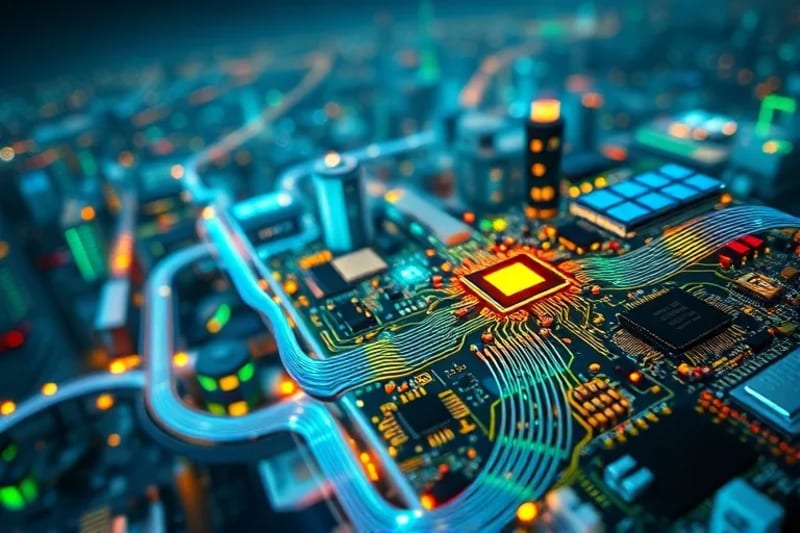
Conceptual representation of quantum computing's role in securing critical infrastructure, blending advanced circuitry with urban resilience.
This image is an AI-generated conceptual render, illustrating the complex interplay between quantum technology and the protection of vital systems.However, quantum computers, with their ability to perform calculations based on quantum-mechanical phenomena such as superposition and entanglement, can efficiently solve these problems. Shor's algorithm, for instance, can factor large numbers exponentially faster than any known classical algorithm, rendering RSA and ECC vulnerable. This capability threatens to compromise virtually all current public-key cryptography.
Another significant quantum algorithm is Grover's algorithm, which can speed up searches through unsorted databases. While it doesn't break symmetric-key cryptography (like AES) in the same way Shor's algorithm breaks public-key schemes, it reduces the effective key length. This means that a 128-bit AES key would effectively become a 64-bit key against a quantum attacker, necessitating a doubling of key lengths to maintain equivalent security levels. For a deeper dive into these specific threats, explore our article on Quantum Computing Threats and Post-Quantum Cryptography Solutions.
Critical Infrastructure Vulnerabilities
Critical infrastructures encompass a broad range of systems and assets vital to a nation's functioning, including energy grids, water treatment facilities, transportation networks, communication systems, and financial services. These systems are increasingly interconnected and reliant on digital technologies, making them prime targets for sophisticated cyberattacks.
The potential impact of quantum attacks on critical infrastructure is catastrophic. Compromised communication systems could disrupt emergency services and military operations. A breach in energy grid controls could lead to widespread power outages. Financial systems could face widespread fraud and collapse if their cryptographic protections are broken.

Abstract digital art illustrating advanced quantum encryption and protective shields safeguarding data.
This visual interpretation, crafted by an AI, serves as a metaphorical representation of the robust defense strategies required in the quantum era.Furthermore, the "harvest now, decrypt later" threat is particularly insidious. Adversaries can collect encrypted data today, store it, and decrypt it once powerful quantum computers become available. This poses a long-term risk to sensitive information, intellectual property, and national secrets that might be considered secure with current cryptographic standards.
Beyond direct quantum attacks, critical infrastructures also face persistent threats from social engineering and other conventional cyber tactics. Understanding and mitigating these broader risks is crucial for a holistic security posture. Our article on Social Engineering in Digital Finance: Cybersecurity Prevention highlights some of these enduring challenges.
Post-Quantum Cryptography (PQC) Solutions
To counter the quantum threat, the cybersecurity community is actively developing and standardizing Post-Quantum Cryptography (PQC) algorithms. These are cryptographic schemes designed to be secure against both classical and quantum computers. The National Institute of Standards and Technology (NIST) has been leading a multi-year process to evaluate and standardize PQC algorithms, with several candidates now moving towards final selection.
PQC algorithms are typically categorized into several families, each based on different mathematical problems believed to be hard even for quantum computers. These include lattice-based cryptography, code-based cryptography, multivariate polynomial cryptography, and hash-based cryptography. Each family offers unique security properties and performance characteristics, making the selection process complex.
The goal is to replace vulnerable public-key algorithms with PQC alternatives without compromising the efficiency or usability of cryptographic systems. This transition requires careful planning and extensive testing to ensure interoperability and robust security. Organizations must begin assessing their cryptographic inventory and developing migration strategies.
The National Institute of Standards and Technology (NIST) is currently working to standardize quantum-resistant public-key cryptographic algorithms. In July 2022, NIST announced the first four quantum-resistant algorithms to be standardized, with additional algorithms expected to follow.
These algorithms are designed to protect sensitive information from future quantum computer attacks, ensuring the long-term security of digital communications and data.
Implementation Challenges and Strategies
Migrating critical infrastructure to PQC presents significant challenges. The sheer scale and complexity of these systems mean that a "rip and replace" approach is often impractical. Many components have long lifecycles, and updating embedded systems or legacy hardware can be costly and disruptive. Moreover, the lack of standardized PQC solutions until recently has delayed proactive implementation.

A futuristic server room featuring holographic displays of quantum algorithms, symbolizing advanced security management.
This 3D render, generated by AI, envisions the human role in overseeing complex quantum cybersecurity systems.A phased approach is typically recommended, starting with a comprehensive inventory of all cryptographic assets and dependencies. This "crypto-agility" strategy involves designing systems to be easily updated with new cryptographic algorithms as they become standardized. Hybrid modes, where both classical and PQC algorithms are used concurrently, can provide an interim layer of security during the transition.
Key strategies for implementation include:
- Cryptographic Inventory: Identify all cryptographic instances, their locations, and their dependencies within critical infrastructure systems.
- Risk Assessment: Prioritize systems based on the sensitivity of data and the potential impact of a quantum attack.
- Pilot Programs: Implement PQC in non-critical systems first to gain experience and identify potential issues.
- Vendor Collaboration: Work with hardware and software vendors to ensure their products support PQC standards.
- Employee Training: Educate cybersecurity personnel on the principles and practices of PQC.
The legal framework surrounding digital assets and their protection is also evolving rapidly to keep pace with technological advancements. Understanding the challenges in this domain is essential for comprehensive security planning. For more information, see Digital Intellectual Property: Legal Challenges and Adaptations.
Regulatory Landscape and International Cooperation
Governments and international bodies are increasingly recognizing the urgency of quantum cybersecurity. Regulations and directives are being developed to mandate the transition to quantum-resistant cryptography for critical infrastructure. These efforts aim to provide a clear framework for organizations and ensure a coordinated global response to the quantum threat.
International cooperation is paramount, as cyber threats transcend national borders. Collaborative research, information sharing, and joint standardization efforts are crucial for developing robust and interoperable PQC solutions. Organizations like NIST, the European Telecommunications Standards Institute (ETSI), and the International Organization for Standardization (ISO) are playing key roles in this global endeavor.
The development of new legal frameworks for emerging technologies, such as those related to artificial intelligence, also provides a precedent for how governments might approach quantum cybersecurity. Understanding these parallels can inform policy development. Explore the Legal Challenges of AI: Discrimination, Employment, and Ethics for relevant insights.
Future Outlook and Continuous Adaptation
The landscape of quantum cybersecurity is dynamic and constantly evolving. As quantum computing technology advances, so too will the understanding of its cryptographic implications. Continuous research and development in PQC are essential to stay ahead of potential breakthroughs in quantum attack capabilities.
Organizations responsible for critical infrastructure must adopt a proactive and adaptive security posture. This includes not only implementing PQC but also investing in quantum-safe technologies like Quantum Key Distribution (QKD) where appropriate, and fostering a culture of cryptographic agility. Regular audits, threat intelligence sharing, and ongoing training will be vital for maintaining resilience.
The transition to a quantum-safe world is a marathon, not a sprint. It requires sustained effort, significant investment, and close collaboration between governments, industry, and academia. By embracing these challenges, we can ensure that critical infrastructures remain secure in the face of future quantum threats.
Explore More Cybersecurity Insights
- Blockchain Decentralized Governance: Transformative Social Impact
Source: Hybrid content assisted by AI and human editorial supervision.


Comentarios