
Space Mining: Geopolitical Impact - Sovereignty, Resources, and Law
The prospect of space mining, once confined to the realm of science fiction, is rapidly transitioning into a tangible reality. As humanity pushes the boundaries of exploration and resource acquisition, the potential for extracting valuable materials from asteroids, the Moon, and other celestial bodies presents unprecedented opportunities and complex challenges. This nascent industry promises to unlock vast reserves of precious metals, rare earth elements, and water ice, critical for sustaining future space missions and potentially impacting Earth's economy. However, this cosmic endeavor is not merely a technological or economic pursuit; it is intrinsically tied to profound geopolitical implications, raising fundamental questions about sovereignty, international law, and the distribution of power in an increasingly multi-planetary future.
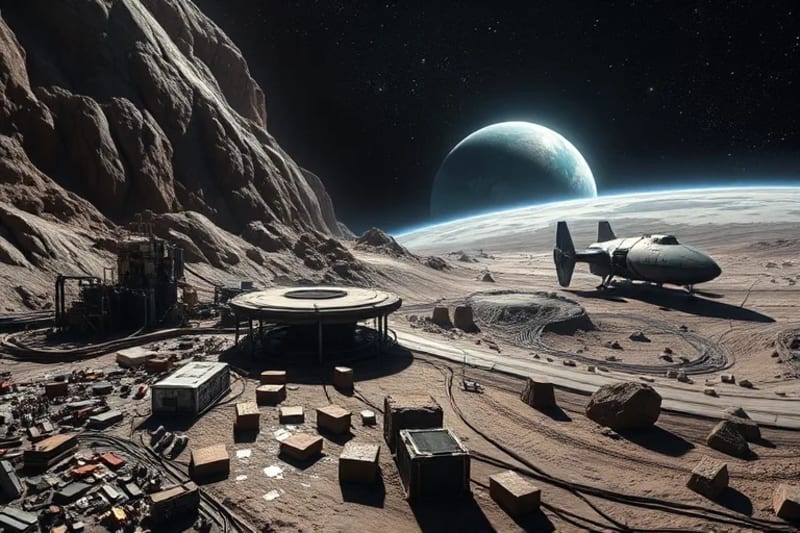
Conceptualizing the vast technological and geopolitical ambitions behind humanity's quest for extraterrestrial resources, from the pioneering extraction methods to the distant Earthly implications.
Image rendered by AI, exploring the intricate balance between technological advancement and the evolving legal and ethical frameworks in the cosmic domain.
The geopolitical landscape of Earth has long been shaped by the control and distribution of natural resources. From oil fields to mineral deposits, access to essential materials has fueled conflicts, fostered alliances, and dictated economic dominance. As the scope of resource acquisition extends beyond our planet, these terrestrial dynamics are poised to project onto the cosmic stage. The race to harness extraterrestrial resources introduces new dimensions to international relations, potentially leading to novel forms of competition, cooperation, and even conflict among nations and private entities. Understanding these emerging geopolitical currents is crucial for establishing a stable and equitable framework for humanity's expansion into space.
Table of Contents
- Extraterrestrial Riches: What's Out There?
- Beyond Earthly Borders: The Question of Sovereignty
- Crafting the Cosmos: International Space Law
- The New Space Race: Geopolitical Implications
- From Vision to Venture: The Role of Private Companies
- Ethical and Environmental Challenges
- Towards a Sustainable Future: Space Governance
Extraterrestrial Riches: What's Out There?
The primary targets for space mining are asteroids, the Moon, and potentially Mars' moons, Phobos and Deimos. These celestial bodies are believed to contain a wealth of resources far exceeding those found on Earth. Asteroids, particularly near-Earth asteroids (NEAs), are thought to be rich in platinum group metals (PGMs) like platinum, palladium, and rhodium, which are crucial for electronics, catalytic converters, and renewable energy technologies. They also contain nickel, iron, and cobalt, essential for construction and manufacturing.
The Moon is another prime candidate, especially for its reserves of water ice located in permanently shadowed craters at its poles. This water ice is invaluable not just as a life-support resource for future lunar bases but also as a source of hydrogen and oxygen, which can be used as rocket fuel. This capability, known as In-Situ Resource Utilization (ISRU), could drastically reduce the cost and complexity of deep-space missions, transforming the Moon into a cosmic gas station and manufacturing hub. Furthermore, the Moon is rich in helium-3, a rare isotope with potential as a clean energy source for future fusion reactors, though its extraction and utilization remain a distant prospect.
The economic implications of accessing these resources are staggering. A single asteroid could contain more platinum than has ever been mined on Earth, potentially disrupting global commodity markets and shifting economic power. The ability to produce rocket fuel in space would also democratize access to space, allowing more nations and private entities to participate in exploration and exploitation. This abundance, however, also brings forth the risk of resource monopolies and exacerbating existing inequalities if not managed through equitable international frameworks.
Beyond Earthly Borders: The Question of Sovereignty
One of the most contentious issues surrounding space mining is the concept of sovereignty. On Earth, nations claim territory and the resources within their borders. However, space is widely considered the "province of all mankind," a principle enshrined in international law. This raises a critical question: Can a nation or a private company claim ownership of an asteroid, a lunar region, or the resources extracted from them?
The Outer Space Treaty of 1967, the foundational document of international space law, explicitly prohibits national appropriation of outer space, including the Moon and other celestial bodies, by claim of sovereignty, by means of use or occupation, or by any other means. This means no country can plant a flag on the Moon and declare it theirs. However, the treaty is ambiguous about the ownership of resources once they are extracted. This legal grey area has become a focal point for debate and potential conflict.
Some nations, like the United States and Luxembourg, have enacted domestic laws that grant their citizens and companies the right to extract and own space resources. These laws argue that while celestial bodies cannot be owned, the resources extracted from them can be, similar to fishing in international waters. Other nations and legal scholars argue that such unilateral claims violate the spirit, if not the letter, of the Outer Space Treaty, particularly its principle that space activities should be carried out for the benefit and in the interests of all countries.

Interpreting the intricate legal frameworks and treaties that aim to govern humanity's expansion into space, particularly concerning the rights and responsibilities of resource extraction.
This conceptual artwork is an AI-generated representation, reflecting on the complex legal challenges posed by space mining and the need for robust international agreements.
Crafting the Cosmos: International Space Law
The existing international legal framework for space is primarily based on five United Nations treaties, with the Outer Space Treaty (OST) being the cornerstone. While the OST provides broad principles, it lacks specific provisions for resource extraction. The Moon Agreement of 1979 attempted to address this by declaring celestial bodies and their resources as the "common heritage of mankind" and proposing an international regime to govern their exploitation. However, this agreement has been ratified by very few spacefaring nations, rendering it largely ineffective.
The lack of a universally accepted legal framework creates significant uncertainty and potential for disputes. A clear, multilateral agreement is essential to prevent a "wild west" scenario in space, where powerful actors could monopolize resources or engage in aggressive competition. Discussions are ongoing within the United Nations Committee on the Peaceful Uses of Outer Space (COPUOS) and other international forums to develop norms and principles for space resource utilization. Initiatives like the Artemis Accords, led by the United States, aim to establish a set of principles for cooperation in lunar exploration and resource extraction, though these are bilateral agreements rather than multilateral treaties.
The development of international space law is a slow and complex process, often lagging behind technological advancements. As space mining capabilities mature, the urgency for a comprehensive legal regime will only increase. This regime would need to address issues such as property rights, environmental protection, liability for damages, and equitable sharing of benefits, ensuring that space resources are utilized responsibly and for the benefit of all humanity. For further insight into the evolving legal landscape, consider exploring the foundational principles of Ada Lovelace's legacy in programming, which, while distinct, highlights the importance of well-defined frameworks in emerging fields.
The New Space Race: Geopolitical Implications
The pursuit of space resources is igniting a new form of geopolitical competition, often dubbed the "new space race." Unlike the Cold War space race focused on prestige and scientific firsts, this new competition is driven by economic interests, strategic advantages, and long-term sustainability in space. Major spacefaring nations like the United States, China, Russia, and emerging powers such as India and the United Arab Emirates are all investing heavily in lunar and asteroid exploration, with an eye on resource potential.
Control over key orbital locations, access to prime mining sites, and the development of advanced extraction technologies will become critical determinants of power. Nations that can establish a foothold in space mining will gain significant economic leverage, potentially reducing their reliance on terrestrial resource markets and securing a strategic advantage in future space endeavors. This could lead to new alliances and rivalries, mirroring historical patterns of colonial expansion and resource competition on Earth.
The geopolitical implications extend to military strategy as well. The ability to refuel satellites in orbit, repair spacecraft, or even construct large orbital structures from space-mined materials could revolutionize space-based defense capabilities. While the Outer Space Treaty prohibits the stationing of weapons of mass destruction in space, the dual-use nature of many space technologies means that resource infrastructure could have strategic military applications, further complicating international relations and arms control efforts in space. The concept of post-truth and its impact on public opinion also plays a role, as narratives around space resource claims can be shaped to garner national support or international condemnation.

Visualizing the complex web of national interests and potential claims over extraterrestrial resources, illustrating how Earthly geopolitical dynamics extend into the solar system.
This AI-generated conceptual art explores the future of space resource allocation and the intricate geopolitical landscape that may emerge from it.
From Vision to Venture: The Role of Private Companies
A defining characteristic of the new space age is the significant role played by private companies. Startups and established aerospace firms are at the forefront of developing technologies for space mining, asteroid prospecting, and lunar resource utilization. Companies like Planetary Resources (though now acquired), Deep Space Industries (also acquired), and numerous others are pushing the boundaries of what's possible, driven by the promise of immense profits and the vision of a space-faring civilization.
The privatization of space activities adds another layer of complexity to the geopolitical landscape. While national space agencies operate under government mandates, private companies are driven by commercial interests. This raises questions about accountability, regulatory oversight, and the potential for private entities to exert significant influence over space policy. If a private company from one nation establishes a lucrative mining operation on an asteroid, what are the rights and responsibilities of that company, and what role does its home government play?
The rise of space startups also highlights the need for clear legal and regulatory frameworks that can foster innovation while ensuring responsible conduct. Governments are grappling with how to regulate private space activities, balance national interests with international obligations, and create an environment conducive to investment without creating monopolies. The success of these ventures will depend not only on technological prowess but also on the stability and predictability of the legal and political environment in which they operate. This entrepreneurial spirit in space mirrors the drive seen in fields like synthetic biology for sustainable businesses, where innovation meets complex ethical and regulatory challenges.
Ethical and Environmental Challenges
Beyond the geopolitical and legal complexities, space mining presents significant ethical and environmental considerations. The "common heritage of mankind" principle suggests that the benefits of space resource utilization should be shared equitably among all nations, particularly developing countries. How this benefit-sharing would be implemented in practice remains a major ethical dilemma, especially if resource extraction becomes highly profitable for a select few.
Environmental concerns, while different from terrestrial mining, are also pertinent. The creation of space debris from mining operations, the potential for contaminating pristine celestial environments with terrestrial microbes, or the alteration of celestial bodies themselves are serious issues. While space is vast, uncontrolled mining could lead to orbital debris fields that endanger future missions or irreversible changes to scientifically valuable sites. The long-term environmental impact of large-scale space industrialization needs careful consideration and robust international regulations to prevent irreparable harm.
Moreover, the introduction of vast quantities of extraterrestrial materials into Earth's economy could have unforeseen consequences. While some argue it could alleviate resource scarcity and reduce the environmental impact of terrestrial mining, others warn of market disruptions, job displacement, and the potential for new forms of economic inequality. A holistic approach that considers the full spectrum of impacts—economic, social, and environmental—is essential for responsible space resource development.
Towards a Sustainable Future: Space Governance
The future of space mining and its geopolitical impact hinges on the establishment of effective and equitable space governance. This requires a multi-stakeholder approach involving governments, international organizations, private industry, and academia. Key elements of a robust governance framework would include:
- Clear Legal Frameworks: Developing universally accepted international laws and norms that clarify property rights, responsibilities, and dispute resolution mechanisms for space resource utilization.
- Transparency and Data Sharing: Encouraging open communication and sharing of data regarding prospecting, extraction, and utilization activities to foster trust and prevent unilateral actions.
- Environmental Protection: Establishing regulations to minimize space debris, prevent contamination, and preserve scientifically significant celestial sites.
- Benefit Sharing: Creating mechanisms to ensure that the benefits derived from space resources are shared equitably, potentially through international funds or technology transfer programs for developing nations.
- Dispute Resolution: Implementing robust international mechanisms for resolving conflicts that may arise over resource claims, operational interference, or environmental damage.
The challenges are immense, but the potential rewards—a sustainable space economy, enhanced scientific understanding, and new opportunities for humanity—are equally significant. As we stand at the cusp of this new era, proactive diplomacy, collaborative policymaking, and a commitment to shared values will be essential to navigate the complex geopolitical landscape of space mining and ensure that humanity's expansion into the cosmos is peaceful, prosperous, and equitable for all.
Explore More About Space and Geopolitics
Delve deeper into related topics that shape our understanding of advanced technology, international relations, and the future of humanity's endeavors:
- Forgotten Tech Innovators: Shaping Our Digital Present: Discover the unsung heroes whose contributions laid the groundwork for modern technological advancements, including those relevant to space exploration.
- Neuroscience Leadership: Cognitive Optimization Strategic Decisions: Understand how cognitive processes influence high-stakes decision-making in complex fields like space policy and international negotiations.
- Decentralized Cryptocurrencies and Global Inequality: Impact Analysis: Explore how new financial paradigms intersect with global resource distribution and economic power, offering parallels to the potential impacts of space resources.
- Cosmo-Sociology Digital Age: Neural Networks Ethics: Examine the societal implications of technological advancement in a broader cosmic context, considering ethical frameworks for an interconnected future.
- Invisible Geopolitics: Archangels and Celestial Strategies in World Conflicts: For a more esoteric perspective, explore how unseen forces might influence geopolitical dynamics, offering a unique contrast to the material focus of space mining.
Source: Hybrid content assisted by AI and human editorial supervision.


Comentarios