
Greek Abacus Legacy: From Ancient Computing to AI
The Greek abacus, an ancient calculating device, represents a pivotal moment in the history of computation. Far from being a mere historical curiosity, its principles laid foundational groundwork that resonates even in the advanced fields of artificial intelligence and quantum computing. This journey from simple beads on rods to complex algorithms and qubits highlights humanity's continuous quest to master calculation and information processing.
Understanding the abacus's legacy offers crucial insights into how early civilizations approached mathematical challenges and how these initial steps paved the way for the digital age. This article explores the evolution of the Greek abacus, its operational principles, and its surprising connections to the cutting-edge technologies defining our present and future.
Table of Contents
- Origins and Evolution of the Greek Abacus
- Operational Principles and Mathematical Significance
- The Bridge to Modern Computing
- From Abacus to AI: Algorithmic Thinking
- Quantum Computing: Unexpected Parallels
- The Enduring Legacy in Education and Innovation

Conceptual representation of the Greek abacus, illustrating its foundational role in the journey from mechanical calculation to the digital era.
This image, a conceptual AI render, visualizes the abstract connection between ancient tools and modern computational concepts, drawing inspiration from historical artifacts and the evolution of technology.Origins and Evolution of the Greek Abacus
The concept of the abacus dates back millennia, with various forms appearing across different ancient civilizations. The Greek abacus, specifically, often refers to devices like the Salamis Tablet, discovered in 1846, which is believed to be the oldest surviving counting board. This marble tablet, dating back to 300 BCE, features carved lines and symbols used for calculations involving pebbles or counters.
Unlike the more commonly known Chinese or Japanese bead abaci, the Greek version typically involved a board with grooves or lines, on which small stones or metal discs (calculi) were moved. These devices were essential for managing trade, taxes, and complex astronomical calculations in a society that relied heavily on numerical precision but lacked the convenience of modern Arabic numerals and positional notation with zero.
The development of such tools underscores the universal human need for efficient computation, a need that has driven technological innovation from antiquity to the present day. The intellectual leap required to conceptualize and utilize these boards was significant, setting a precedent for future innovations in information processing.
Operational Principles and Mathematical Significance
The operational principles of the Greek abacus were rooted in a decimal system, though often adapted for specific monetary or measurement units. Each column or line on the abacus represented a different power of ten, allowing users to perform addition, subtraction, multiplication, and division by manipulating the counters. This system, while seemingly simple, required a sophisticated understanding of place value and arithmetic operations.
For instance, moving a counter from one column to the next could represent carrying over or borrowing a value, a fundamental concept in all arithmetic. The physical manipulation of these counters provided a tangible, visual representation of abstract mathematical processes, making complex calculations accessible to a wider range of individuals. This hands-on approach to problem-solving is a pedagogical strength still recognized today.
The abacus fostered a form of algorithmic thinking, where a sequence of defined steps led to a desired outcome. This systematic approach to problem-solving is a direct precursor to the logic embedded in modern computer programming and digital innovations. The ability to break down a complex problem into smaller, manageable steps is a cornerstone of computational theory.
The Bridge to Modern Computing
While the Greek abacus is a mechanical device, its conceptual framework shares surprising commonalities with modern digital computers. The discrete nature of its counters, representing specific numerical values, mirrors the binary digits (bits) that form the basis of all digital information. Each bead's position or presence can be seen as a state, much like a bit being 0 or 1.
Furthermore, the abacus operates through a series of defined rules and procedures, which can be likened to the algorithms executed by a computer processor. The act of performing a calculation on an abacus is, in essence, running a program. This abstract connection underscores how early tools laid the intellectual groundwork for later, more complex immersive technologies and computational systems.
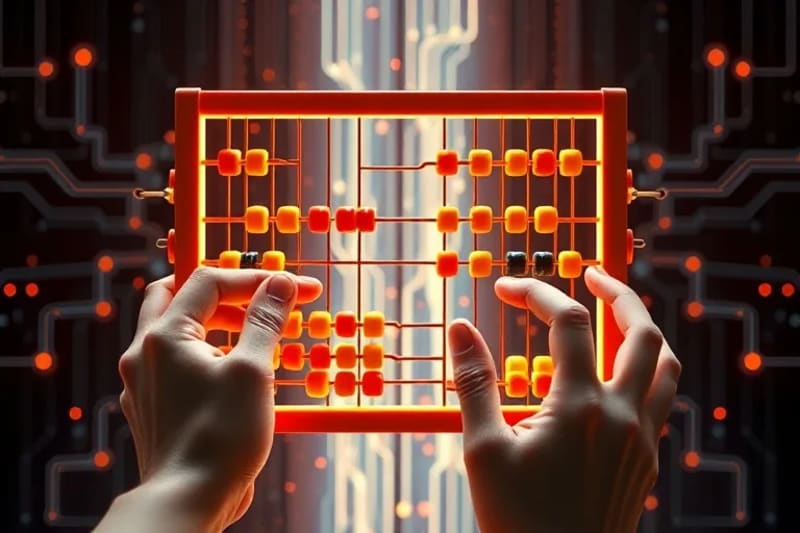
A visual metaphor illustrating the conceptual evolution from the discrete mechanics of the abacus to the interconnected nodes of a neural network, symbolizing the journey of computational thought.
The transition from manual calculation to automated computation was gradual, involving centuries of innovation, from mechanical calculators to analytical engines. Yet, the core idea of representing numbers and performing operations systematically remained constant. The abacus, therefore, serves as a tangible link between ancient mathematical practice and the abstract logic of modern computing.
From Abacus to AI: Algorithmic Thinking
Artificial intelligence, at its core, relies on sophisticated algorithms and data processing. The abacus, in its rudimentary way, introduced the concept of an algorithm: a finite sequence of well-defined, computer-implementable instructions, typically to solve a class of problems or to perform a computation. Every calculation on an abacus follows a set of rules, much like an AI program follows its code.
The ability of AI to recognize patterns, make decisions, and learn from data stems from these underlying algorithmic structures. While the complexity differs vastly, the fundamental principle of breaking down a task into discrete, logical steps can be traced back to early computational devices. This historical continuity highlights that AI is not a sudden invention but the culmination of centuries of intellectual development in computation.
Even in modern discussions about technological singularity and AI predictions, the emphasis remains on the logical and mathematical frameworks that underpin these advanced systems. The Greek abacus, by providing a tangible model for such frameworks, contributed to the cognitive evolution necessary for conceiving AI.
Quantum Computing: Unexpected Parallels
The connection between the ancient abacus and quantum computing might seem tenuous at first glance, given the vast technological chasm. However, a deeper look reveals intriguing conceptual parallels. Quantum computing harnesses phenomena like superposition and entanglement, allowing quantum bits (qubits) to exist in multiple states simultaneously, enabling parallel processing far beyond classical computers.
While the abacus operates with discrete, classical states (a bead is either here or there), the very act of manipulating physical objects to represent abstract numerical states is a form of physical computation. Quantum computing takes this idea to an extreme, using the quantum states of particles to perform calculations. Both systems, in their own ways, use physical properties to encode and process information.
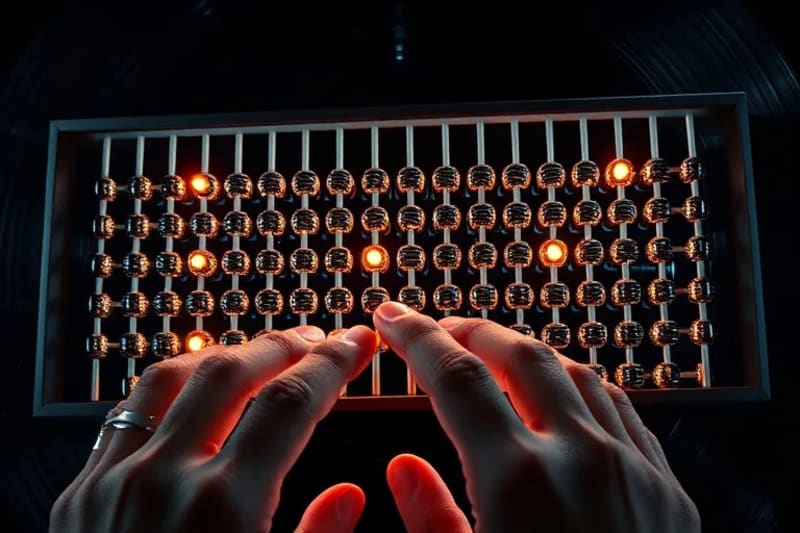
A conceptual depiction of a quantum abacus, where glowing qubits replace traditional beads, symbolizing the advanced principles of quantum computation and its departure from classical mechanical systems.
The abacus taught humanity to think about computation as a process of state changes and transformations. Quantum computing extends this by exploring the vast possibilities of quantum states. It's a testament to the enduring nature of computational thought that even the most advanced concepts can find distant echoes in the simplest of tools. The evolution of complex systems for global challenges often builds on these historical foundations.
The Enduring Legacy in Education and Innovation
The Greek abacus, along with its counterparts from other cultures, continues to hold relevance, particularly in educational contexts. It provides a tangible way for students to grasp fundamental mathematical concepts, such as place value, carrying, and borrowing, before delving into abstract numerical representations. This hands-on learning can significantly enhance understanding and retention.
Beyond education, the abacus serves as a powerful reminder of the iterative nature of innovation. Each technological advancement, no matter how revolutionary, often builds upon the conceptual frameworks established by earlier tools. The journey from the simple manipulation of beads to the complex orchestration of qubits in a quantum computer is a continuous narrative of human ingenuity and problem-solving.
In an era dominated by rapid technological change, reflecting on the origins of computation provides valuable perspective. It teaches us that the core principles of logic, algorithms, and data representation are timeless, evolving in complexity but remaining fundamentally connected to their ancient roots. The Greek abacus, therefore, is not just a relic but a living symbol of humanity's computational journey.
Explore More on Technology and Innovation
Nostradamus Technological Singularity: Prophetic AI Predictions
Colombian Commercial Code: Digital Legal Adaptations Challenges
Source: Hybrid content assisted by AI and human editorial supervision.


Comentarios