
Regenerative Economy Models: Beyond Sustainability
Table of Contents
Introduction to Regenerative Economy Business Models
The concept of a regenerative economy is rapidly gaining traction as a paradigm shift beyond traditional corporate sustainability. While sustainability often focuses on minimizing negative impacts, regeneration aims to actively restore, renew, and revitalize natural and social systems. This approach seeks to create net positive outcomes, leaving the world better than we found it, rather than merely doing "less bad."
For businesses, adopting regenerative models means embedding ecological and social well-being into their core operations, design, and value chains. It represents a fundamental rethinking of how products are made, services are delivered, and value is created. This shift is not just an ethical imperative but also a strategic necessity in a world facing increasing environmental degradation and social inequality.

A conceptual representation of a thriving, interconnected ecosystem where human enterprise harmoniously integrates with natural processes, embodying the principles of a regenerative economy.
This visual interpretation, generated by advanced AI, illustrates the symbiotic relationship between economic activity and ecological restoration, moving beyond mere sustainability to active regeneration.
This article explores the foundational principles and emerging business models that characterize the regenerative economy. We will delve into how companies can transition from a linear, extractive approach to one that fosters long-term systemic health. Understanding these models is crucial for businesses aiming for true resilience and positive societal contribution in the 21st century.
Core Principles of Regenerative Business
Regenerative business models are built upon a set of interconnected principles that guide their operations and strategic decisions. These principles move beyond simple compliance or risk mitigation, aiming instead for systemic transformation and value creation across multiple dimensions.
- Systems Thinking: Businesses operate within complex social and ecological systems, not in isolation. Regenerative models recognize these interdependencies, designing solutions that benefit the entire system, not just individual components. This holistic perspective considers upstream and downstream impacts, fostering symbiotic relationships.
- Circular Design: Moving away from the linear "take-make-dispose" model, regenerative businesses embrace circularity. This involves designing products for durability, reuse, repair, and recycling, ensuring materials flow in closed loops. The goal is to eliminate waste and pollution by keeping products and materials in use.
- Stakeholder Value Creation: Beyond shareholder primacy, regenerative models prioritize creating value for all stakeholders. This includes employees, customers, suppliers, communities, and the environment. Fair wages, ethical sourcing, community engagement, and ecological restoration are integral to this principle.
- Net Positive Impact: The objective is to go beyond neutrality or minimizing harm. Regenerative businesses actively contribute to the restoration and enhancement of natural capital and social well-being. This might involve regenerating soil health, improving biodiversity, or fostering equitable economic opportunities.
- Local Resilience and Self-Organization: Fostering local economies and empowering communities to self-organize are key. This reduces reliance on distant supply chains, strengthens local economies, and builds adaptive capacity to external shocks. Decentralized decision-making and local resource management are often emphasized.
These principles are not merely aspirational; they are actionable frameworks that guide the development of innovative business strategies. They challenge conventional thinking and encourage a deeper connection to the living systems that support all economic activity.
Sustainability vs. Regeneration: A Key Distinction
While often used interchangeably, "sustainability" and "regeneration" represent distinct levels of ambition and impact. Understanding this difference is fundamental to appreciating the transformative potential of regenerative business models. Sustainability, as it has largely been practiced, aims to maintain the status quo or slow down degradation.
The Brundtland Commission's definition of sustainable development, "development that meets the needs of the present without compromising the ability of future generations to meet their own needs," emphasizes preservation and minimization of harm. This often translates into reducing carbon footprints, minimizing waste, and adhering to environmental regulations.
In contrast, regenerative approaches seek to actively restore and enhance. They aim for a net positive impact, where business activities contribute to healthier ecosystems and stronger communities. This involves going beyond merely reducing negative externalities to creating positive ones.
Consider the analogy of human health: sustainability is like trying to stay "not sick," while regeneration is actively pursuing optimal health and vitality. A sustainable farm might minimize pesticide use, but a regenerative farm actively builds soil health, increases biodiversity, and sequesters carbon. This distinction highlights the proactive and restorative nature of regenerative practices.
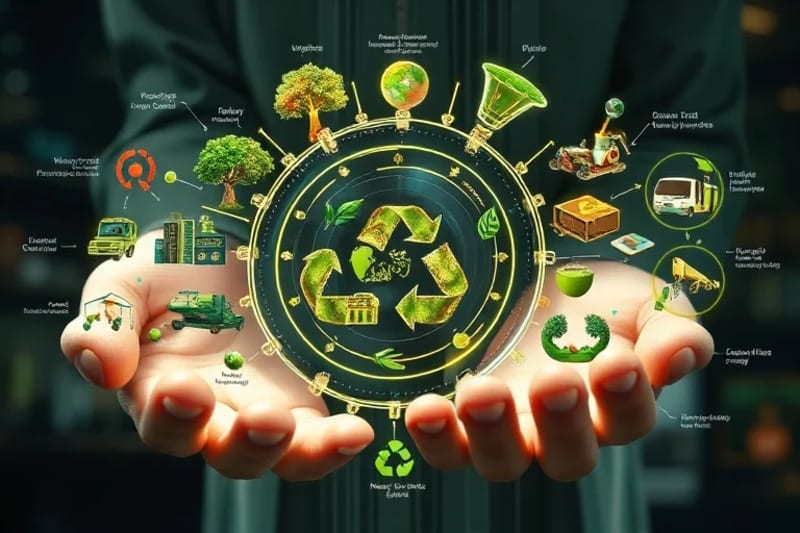
A dynamic visual depicting the closed-loop systems of a circular economy, emphasizing resource recovery, reuse, and the continuous flow of materials within an industrial ecosystem.
This AI-generated artwork conceptualizes how businesses can design out waste and pollution, keeping products and materials in use, a cornerstone of regenerative models.
The shift from sustainability to regeneration requires a fundamental change in mindset and operational strategy. It moves from a compliance-driven approach to one driven by innovation and a deep understanding of ecological and social systems. Businesses embracing regeneration are not just mitigating risks; they are actively building resilience and creating new forms of value.
This distinction is particularly important as global challenges intensify. Merely sustaining current levels of environmental impact may no longer be sufficient to address climate change, biodiversity loss, and social inequities. Regenerative models offer a pathway to not just survive, but to thrive and contribute positively to the future.
Emerging Regenerative Business Models
A variety of innovative business models are emerging that embody regenerative principles. These models often overlap and integrate, reflecting the holistic nature of the regenerative approach. They offer diverse pathways for businesses to create positive impact while generating economic value.
- Circular Economy Models: These are foundational to regeneration.
- Product-as-a-Service (PaaS): Instead of selling products, companies lease them, retaining ownership and responsibility for maintenance, repair, and end-of-life management. This incentivizes durability and efficient resource use.
- Resource Recovery and Upcycling: Businesses focus on collecting waste streams from other industries or consumers and transforming them into new, higher-value products. This minimizes landfill waste and creates new material inputs.
- Ecosystem-Based Models: These models actively contribute to ecological restoration.
- Agroecology and Regenerative Agriculture: Food and fiber producers adopt practices that build soil health, enhance biodiversity, and improve water cycles. Businesses in the food supply chain can support and invest in these practices.
- Biodiversity Credits and Nature-Based Solutions: Companies invest in projects that restore degraded ecosystems, such as reforestation or wetland restoration, often generating measurable biodiversity outcomes or carbon sequestration benefits.
- Community-Led and Social Equity Models: These prioritize local empowerment and fair distribution of value.
- Local and Distributed Production: Decentralizing manufacturing and supply chains reduces transportation impacts and strengthens local economies, creating jobs and fostering community resilience.
- Fair and Equitable Value Chains: Ensuring fair wages, safe working conditions, and equitable profit sharing throughout the supply chain, often involving direct relationships with producers.
- Bio-Inspired Models (Biomimicry): Learning from nature's designs and processes to create sustainable solutions.
- Material Innovation: Developing new materials that are biodegradable, non-toxic, and mimic natural processes, such as self-healing materials or compostable packaging.
- Process Optimization: Designing industrial processes that are as efficient and waste-free as natural systems, often using closed-loop water systems or natural ventilation.
These models represent a dynamic and evolving landscape of innovation. They demonstrate that economic prosperity can be achieved in harmony with ecological and social well-being. The integration of technology, such as blockchain for transparent supply chains or advanced material science, further enhances the potential of these models. For instance, new forms of digital copyright and NFTs can create new value streams and ownership models within these regenerative frameworks, supporting creators and transparent value distribution.
Strategic Benefits for Enterprises
Adopting regenerative business models offers a multitude of strategic advantages for enterprises, extending far beyond mere ethical considerations. These benefits contribute to long-term resilience, competitive differentiation, and enhanced financial performance in an increasingly complex global environment.
- Enhanced Innovation and Competitive Edge: The regenerative framework encourages radical innovation in product design, process optimization, and service delivery. This leads to unique offerings that differentiate businesses in the marketplace and attract conscious consumers.
- Increased Resource Efficiency and Cost Savings: By embracing circularity and waste reduction, companies can significantly lower material and energy costs. Optimizing resource flows and extending product lifecycles directly impacts the bottom line.
- Stronger Brand Reputation and Customer Loyalty: Consumers are increasingly seeking brands that align with their values. Regenerative practices build trust, enhance brand image, and foster deep loyalty among a growing segment of environmentally and socially aware customers.
- Attraction and Retention of Top Talent: Employees, especially younger generations, are motivated by purpose-driven work. Companies with strong regenerative commitments are better positioned to attract, engage, and retain skilled talent, reducing recruitment costs and improving productivity.
- Improved Risk Management and Resilience: Diversifying supply chains, fostering local resilience, and reducing reliance on finite resources mitigate risks associated with resource scarcity, price volatility, and regulatory changes. This builds a more robust and adaptive business model. Furthermore, securing critical infrastructure against advanced threats, as discussed in quantum cybersecurity defenses, is another aspect of building long-term business resilience.
- Access to New Markets and Investment: The growing demand for sustainable and regenerative products and services opens new market opportunities. Additionally, impact investors and green finance initiatives are increasingly channeling capital towards businesses demonstrating strong regenerative credentials.
These benefits underscore that regenerative business is not just about "doing good," but about "doing good business." It aligns economic success with ecological health and social equity, creating a virtuous cycle of positive impact and sustained growth. The long-term viability of any enterprise will increasingly depend on its ability to integrate these forward-thinking approaches.
Challenges and Transformative Opportunities
While the transition to regenerative business models offers immense potential, it also presents significant challenges. Overcoming these obstacles requires strategic foresight, collaborative effort, and a willingness to rethink established practices. However, each challenge also represents a profound opportunity for innovation and market leadership.
One primary challenge is the necessary mindset shift from linear, extractive thinking to systemic, regenerative thinking. This requires educating stakeholders across the organization, from leadership to frontline employees, about the interconnectedness of economic, social, and ecological systems. It demands a long-term vision that prioritizes systemic health over short-term profits.

An artistic rendering of a thriving community space, featuring bio-inspired architectural elements and lush gardens, symbolizing local resilience, community-led initiatives, and ecological harmony.
This AI-generated image highlights the importance of localized solutions and the integration of natural design principles in fostering regenerative social and economic systems.
Another significant hurdle is initial investment. Transitioning to new production processes, sourcing regenerative materials, or redesigning supply chains often requires upfront capital. However, these investments typically yield long-term returns through increased efficiency, reduced waste, and enhanced brand value. Governments and financial institutions play a crucial role in providing incentives and funding for these transitions. The integrity of financial markets, including discussions around topics like quantum forex and market integrity, also underpins the stability needed for such long-term investments.
Policy and regulatory support are also critical. Clear frameworks, incentives for regenerative practices, and disincentives for extractive ones can accelerate adoption. Collaboration between businesses, governments, and civil society is essential to create an enabling environment for regenerative economies to flourish. This includes developing new metrics and reporting standards that capture holistic value creation beyond traditional financial indicators.
Despite these challenges, the opportunities are vast. Businesses that proactively embrace regenerative models can become leaders in their industries, shaping new markets and setting new standards. They can attract a new generation of talent, build stronger relationships with communities, and create truly resilient and future-proof operations. The regenerative economy is not just an alternative; it is becoming the imperative for sustainable prosperity.
Embracing a Regenerative Future
The journey towards a regenerative economy is a transformative one, demanding courage, innovation, and collaboration. It calls for businesses to move beyond the conventional boundaries of sustainability and actively participate in restoring and enhancing the health of our planet and its communities. This is not a niche movement but a fundamental shift that will define the next era of commerce and societal well-being.
By adopting principles of systems thinking, circular design, and stakeholder value creation, enterprises can unlock new forms of innovation, build unparalleled resilience, and cultivate deep loyalty among customers and employees. The strategic benefits are clear: from cost savings and risk mitigation to enhanced brand reputation and access to new markets.
While challenges such as mindset shifts and initial investments exist, they are outweighed by the long-term opportunities for sustainable growth and positive impact. The regenerative economy offers a compelling vision for a future where business success is inextricably linked to the flourishing of all life. It is an invitation for every organization to become a force for good, actively contributing to a more vibrant, equitable, and resilient world.
Explore More Insights
- Quantum Encryption: Implications and Challenges
- Poppy Bioactive Compounds: Pharmacology, Therapeutic Potential
- Major Astrological Cycles: Uranus, Neptune, Pluto and Global Consciousness
- Karmic Nodes Fixed Stars Galactic Blueprint Soul Growth
Source: Hybrid content assisted by AI and human editorial supervision.


Comentarios