
Hedy Lamarr: Hollywood Icon, Wi-Fi Pioneer, Disruptive Visionary
Hedy Lamarr, often celebrated as "the most beautiful woman in the world," captivated audiences during Hollywood's Golden Age with her striking looks and undeniable screen presence. Yet, beneath the veneer of glamour and stardom lay a brilliant mind, driven by an insatiable curiosity and a passion for invention. Her contributions extended far beyond the silver screen, fundamentally shaping the landscape of modern wireless communication. This article delves into the dual life of a true visionary: a film star who secretly co-invented a technology that would become the bedrock of Wi-Fi, Bluetooth, and GPS.
Her story is a compelling narrative of overlooked genius, demonstrating how innovation can emerge from unexpected places and how societal roles can often obscure profound intellectual capabilities. Lamarr's journey from a controversial European film to a Hollywood sensation, and then to a pioneering inventor, challenges conventional perceptions of beauty, intelligence, and the capacity for technological advancement.
Table of Contents
- Early Life and European Cinema: The Genesis of a Star
- Hollywood Stardom and the Golden Age
- The Secret Inventor: A Wartime Innovation
- Frequency Hopping Spread Spectrum: The Breakthrough
- From Torpedoes to Wi-Fi: A Lasting Legacy
- Challenges, Recognition, and Later Years
- Hedy Lamarr's Enduring Impact on Technology and Society
Early Life and European Cinema: The Genesis of a Star
Born Hedwig Eva Maria Kiesler in Vienna, Austria-Hungary, in 1914, the future star displayed an early aptitude for both the arts and sciences. Her father, a bank director, encouraged her to think critically and observe the world around her, often taking her on walks and explaining the inner workings of various machines. Her mother, a concert pianist, fostered her artistic sensibilities. This upbringing provided a unique blend of analytical thinking and creative expression that would define her life.
Lamarr's acting career began in German cinema, but it was her role in the 1933 Czech film Ecstasy that brought her international notoriety. The film, controversial for its nudity and frank depiction of female desire, propelled her into the spotlight and simultaneously marked her as a figure of scandalous allure. This early experience with public scrutiny and the objectification of her image would later fuel her desire to be recognized for her intellect rather than just her beauty.
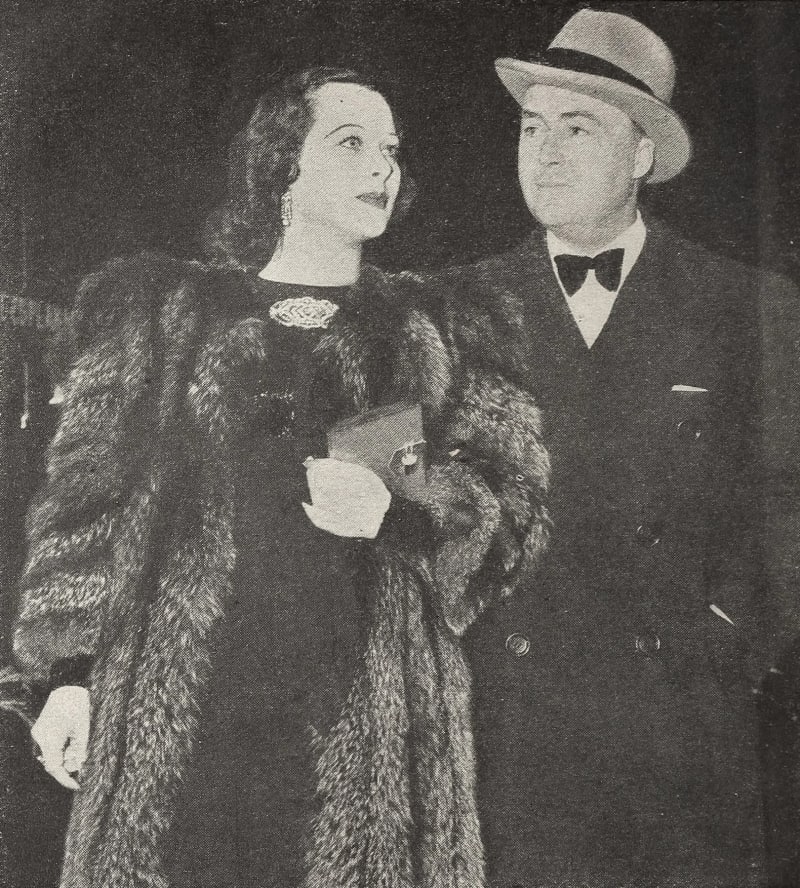 The enduring legacy of a pioneering figure, whose public image as a glamorous star often overshadowed her profound intellectual contributions to technology and innovation.
Image derived from Wikimedia Commons, available under Public Domain, representing a pivotal moment in the career of a celebrated actress.
Hollywood Stardom and the Golden Age
After escaping an unhappy marriage to Austrian arms manufacturer Fritz Mandl, Lamarr moved to Hollywood in the late 1930s. She was quickly signed by MGM studio head Louis B. Mayer, who rebranded her as Hedy Lamarr. Her exotic beauty and mysterious allure made her an instant sensation. She starred in numerous successful films, including Algiers (1938), Boom Town (1940), Comrade X (1940), and Ziegfeld Girl (1941).
Despite her cinematic success, Lamarr often felt unfulfilled by the roles she was offered, which frequently emphasized her looks over her acting abilities. She once famously said, "Any girl can be glamorous. All you have to do is stand still and look stupid." This sentiment highlighted her internal struggle between her public persona and her private intellectual pursuits. While her peers socialized, she often retreated to her trailer or home to tinker with inventions, a hobby she pursued with quiet determination.
The Secret Inventor: A Wartime Innovation
The outbreak of World War II deeply affected Lamarr. Having overheard conversations about military technology during her marriage to Mandl, she understood the critical need for secure communication systems. She was particularly concerned about the vulnerability of Allied torpedoes, which could be easily jammed or detected by enemy forces. This concern sparked an idea: a way to make radio-guided torpedoes undetectable.
Lamarr began collaborating with George Antheil, an avant-garde composer and inventor. Antheil had experimented with synchronized player pianos for his musical compositions, which involved coordinating multiple instruments to play simultaneously. This concept of synchronization, applied to radio frequencies, became the cornerstone of their groundbreaking invention. Their shared passion for innovation and their unique skill sets created a powerful synergy.
 A conceptual still life depicting the convergence of classic cinematic elements with early electronic components and engineering plans, representing the hidden intellectual life of a famous personality.
Conceptual AI render, illustrating the blend of entertainment and scientific pursuit in the mid-20th century.
Frequency Hopping Spread Spectrum: The Breakthrough
In 1942, Lamarr and Antheil patented their "Secret Communication System," which utilized a technique called frequency hopping spread spectrum. The core idea was to rapidly change the radio frequencies used to transmit a signal between a sending and receiving device. This made it incredibly difficult for enemies to jam the signal or eavesdrop on communications, as they wouldn't know which frequency to target at any given moment.
Their patent described a system where a synchronized roll of paper, similar to a player piano roll, would dictate the sequence of frequency changes. This mechanical solution was ingenious for its time, providing a robust method for secure communication. While initially conceived for torpedo guidance, the potential applications of such a system were vast, extending to all forms of wireless communication.
The concept was revolutionary, offering a solution to a critical wartime problem. However, the U.S. Navy, despite recognizing its potential, did not fully implement the technology during World War II. The complexity of building such a system with the technology available at the time, combined with the prevailing skepticism towards an invention from a Hollywood actress, meant it remained largely on the shelf.
From Torpedoes to Wi-Fi: A Lasting Legacy
Decades later, as electronics advanced, the principles of frequency hopping spread spectrum found new life. In the 1950s and 1960s, the technology was revisited and developed further, particularly for military communications during the Cuban Missile Crisis. Its true civilian impact, however, would come much later.
The fundamental concepts patented by Lamarr and Antheil became foundational to modern wireless technologies. Without their pioneering work, technologies like Wi-Fi, Bluetooth, and even GPS would not exist as we know them today. These systems rely on spread spectrum techniques to ensure robust, secure, and efficient data transmission. For instance, Bluetooth devices constantly hop between frequencies to maintain a stable connection and avoid interference, directly applying the principles of Lamarr's invention.
Her invention underscores the often-unseen connections between seemingly disparate fields, such as classical music composition and secure military communications. The ingenuity lay not just in the technical solution but in the cross-disciplinary thinking that brought it to life. This kind of disruptive vision is crucial for the evolution of technology, as seen in the ongoing development of the Metaverse, which demands innovative approaches to connectivity and data management.
 A visual representation of abstract concepts like frequency modulation and secure data transmission, emanating from an antique technological artifact, symbolizing the timeless nature of foundational inventions.
AI-generated conceptual art, exploring the visual metaphor of invisible waves shaping modern communication.
Challenges, Recognition, and Later Years
Despite the monumental impact of her invention, Lamarr received little public recognition for her technological contributions during her lifetime. Her patent expired in 1959, long before the widespread adoption of Wi-Fi and Bluetooth, meaning she never profited from her groundbreaking work. This lack of recognition for female innovators was, unfortunately, common for the era, highlighting systemic barriers that often prevented women from being credited for their intellectual achievements.
It wasn't until the 1990s, when the principles of her patent were widely applied in new wireless technologies, that her role as an inventor began to gain traction. In 1997, Lamarr and Antheil were posthumously honored with the Electronic Frontier Foundation (EFF) Pioneer Award. She was also inducted into the National Inventors Hall of Fame in 2014. These belated accolades finally brought her the recognition she deserved, solidifying her place not just as a Hollywood legend, but as a technological pioneer.
Her later years were marked by increased reclusiveness and legal troubles. However, her legacy as an inventor grew steadily. The story of her dual life serves as a powerful reminder that genius can be found in unexpected places, and that societal expectations should never limit one's potential. Her journey also provides valuable context for understanding the ongoing legal and ethical challenges surrounding data sovereignty and AI, where foundational innovations often precede complex regulatory frameworks.
Hedy Lamarr's Enduring Impact on Technology and Society
Hedy Lamarr's story is more than just a footnote in the history of technology; it is a testament to the power of human intellect and perseverance. Her invention not only laid the groundwork for ubiquitous wireless communication but also serves as an inspiring example for women in STEM fields. She defied the stereotype that beauty and brains are mutually exclusive, proving that a person can excel in vastly different domains.
Her life encourages us to look beyond superficial appearances and recognize the depth of talent and intelligence that often lies beneath. In an era where female leadership in business and innovation is increasingly vital, Lamarr's legacy resonates as a powerful symbol of breaking barriers and creating opportunities. She remains a compelling figure whose contributions continue to shape our connected world, proving that true innovation transcends fame and fortune, leaving an indelible mark on humanity's progress.
Explore More Content
- Female Leadership in Business: Breaking Barriers, Creating Opportunities
- eSports Business: Investment, Sponsorships, Global Audiences
- Urban Geomancy: City Dwellings Cosmic Well-being Alignment
- Spiritual Guides Digital Addiction: Protection from Disinformation 21st Century
Source: Hybrid content assisted by AI and human editorial supervision.


Comentarios