
Augmented Reality: Submerged Cultural Heritage Conservation
Submerged Cultural Heritage (SCH) represents a unique and invaluable part of humanity's past, encompassing shipwrecks, sunken cities, and ancient landscapes now resting beneath the waves. These sites offer profound insights into historical trade routes, technological advancements, and past civilizations. However, their underwater location presents significant challenges for discovery, documentation, preservation, and public access.
Augmented Reality (AR) is emerging as a transformative technology, offering innovative solutions to these long-standing issues. By overlaying digital information onto the real world, AR can enhance the way we interact with, understand, and protect these fragile underwater treasures. This article explores the profound impact of AR on the conservation of submerged cultural heritage, from enhancing archaeological fieldwork to revolutionizing public engagement.
Table of Contents
- Challenges in Submerged Cultural Heritage Conservation
- What is Augmented Reality?
- AR Applications in SCH Conservation
- Benefits of AR for SCH
- Challenges and Future Directions
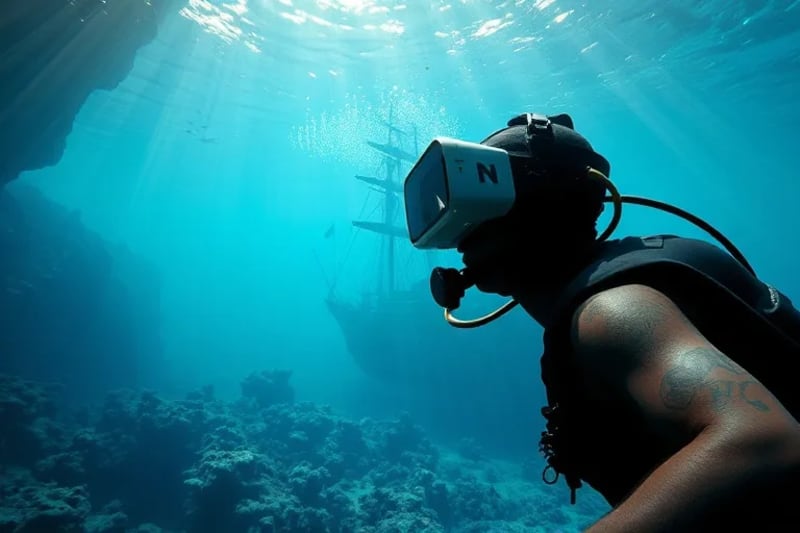 Conceptual rendering of advanced technological interfaces and historical reconstructions that shape our understanding of submerged cultural heritage.
This conceptual image, generated by AI, illustrates the fusion of digital information with real-world underwater exploration, offering a glimpse into future archaeological practices.
Challenges in Submerged Cultural Heritage Conservation
The unique environment of underwater sites poses formidable obstacles to their study and preservation. Unlike terrestrial archaeology, the marine realm is dynamic and often hostile, making direct human interaction both difficult and dangerous. These challenges necessitate innovative approaches to ensure that these irreplaceable historical records are not lost forever.
- Accessibility and Visibility: Deep waters, poor visibility, strong currents, and limited dive times severely restrict access for archaeologists. This makes comprehensive site surveys and detailed examinations incredibly difficult.
- Fragility and Degradation: Submerged artifacts are often in a delicate state, subject to erosion, biological degradation, and damage from human activities like trawling or looting. The act of recovery itself can accelerate decay if not handled with extreme care.
- Documentation Difficulties: Traditional methods of underwater documentation, such as manual sketching and photography, are time-consuming and often lack the precision required for detailed archaeological analysis. Creating accurate 3D models from fragmented data is a complex task.
- Public Engagement Limitations: The inaccessibility of SCH means that the general public rarely gets to experience these sites firsthand. This lack of direct engagement can hinder public awareness, educational efforts, and ultimately, support for conservation initiatives.
Addressing these issues requires technologies that can bridge the gap between the underwater environment and human understanding, a role perfectly suited for Augmented Reality. The integration of advanced digital tools is crucial for safeguarding these invaluable historical assets.
What is Augmented Reality?
Augmented Reality (AR) is a technology that superimposes computer-generated images on a user's view of the real world, thus providing a composite view. Unlike Virtual Reality (VR), which creates an entirely artificial environment, AR enhances the real world with digital information, making it an ideal tool for contexts where interaction with physical surroundings is paramount, such as underwater archaeology.
Key components of AR systems typically include:
- Tracking and Positioning: Sensors (GPS, accelerometers, gyroscopes, depth sensors) track the user's position and orientation in real-time, crucial for accurate overlay in dynamic environments.
- Rendering Engine: Software that generates and displays digital content (3D models, text, videos) in sync with the real-world view.
- Display Devices: These can range from smartphones and tablets to specialized AR glasses or underwater headsets, providing the visual interface for the augmented experience.
- Interaction Capabilities: Users can often interact with the digital overlays through gestures, voice commands, or physical controllers, allowing for dynamic data exploration.
The ability of AR to provide contextual information directly within the field of view makes it incredibly powerful for tasks requiring real-time data access and visualization. This is particularly beneficial for complex environments like underwater archaeological sites, where every second counts and information recall can be challenging.
AR Applications in SCH Conservation
The potential applications of Augmented Reality in the realm of submerged cultural heritage are vast and revolutionary, touching every aspect of conservation from initial discovery to public outreach. These technologies enable archaeologists to overcome many traditional barriers, making fieldwork more efficient, safer, and more informative.
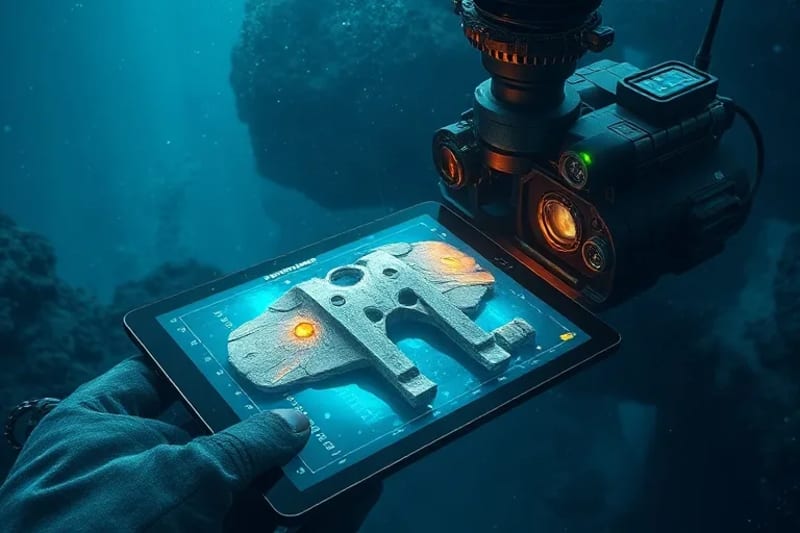 Illustration of advanced tools and digital overlays used in underwater archaeological research and documentation.
This digital artwork, created by AI, visualizes the integration of AR technology with traditional archaeological equipment for enhanced data collection.
One of the most immediate impacts is in on-site documentation and mapping. Divers equipped with AR headsets can see real-time overlays of site plans, previous survey data, or 3D models of artifacts directly in their field of vision. This allows for precise measurement, annotation, and comparison of objects without needing to surface repeatedly. For instance, a diver could identify a fragmented amphora and immediately see a digital reconstruction of its complete form, along with its historical context. This capability significantly streamlines the documentation process and improves data accuracy.
Furthermore, AR facilitates virtual reconstruction and visualization of entire submerged sites. By combining photogrammetry, sonar data, and historical records, archaeologists can create highly accurate 3D models of shipwrecks or ancient structures. AR then allows these digital models to be viewed in their original context, either by overlaying them onto the actual site for divers or by presenting them in a museum setting where visitors can "walk through" a virtual rendition of a sunken city. This brings lost history to life in an unprecedented way.
Public engagement and education stand to benefit immensely. AR applications can transform museum exhibits from static displays into interactive, immersive experiences. Visitors might use a tablet to scan an artifact and see its original appearance, its journey, or even watch a short animated sequence depicting its use. Mobile AR apps can allow users to explore virtual shipwrecks from their homes, fostering a deeper connection to these distant historical sites. Such tools are vital for raising awareness and garnering support for conservation efforts.
Finally, AR can play a crucial role in training and simulation for underwater archaeologists. Before diving into a complex site, trainees can use AR simulations to familiarize themselves with the layout, potential hazards, and specific tasks. This reduces risks, improves efficiency, and ensures that fieldwork is conducted with the highest level of preparation. The ability to practice complex maneuvers or documentation procedures in a simulated environment is invaluable for developing expertise.
Benefits of AR for SCH
The integration of Augmented Reality into submerged cultural heritage conservation brings a multitude of advantages, fundamentally changing how these sites are studied, protected, and shared with the world. These benefits extend beyond mere technological novelty, offering tangible improvements in efficiency, understanding, and outreach.
| Benefit Category | Description |
|---|---|
| Enhanced Understanding & Interpretation | AR provides real-time contextual data, allowing archaeologists to better interpret fragmented evidence and visualize sites in their original state. This leads to more accurate historical narratives. |
| Improved Accessibility | Non-divers, including researchers, students, and the general public, can experience underwater sites virtually, overcoming physical barriers and making heritage accessible to a global audience. |
| Better Preservation Strategies | Precise documentation and monitoring enabled by AR aid in developing targeted preservation plans, identifying areas of degradation, and mitigating risks more effectively. |
| Increased Public Awareness & Funding | Engaging AR experiences can captivate public interest, leading to greater awareness of SCH importance and potentially unlocking new sources of funding for conservation projects. |
| Efficiency in Fieldwork | AR tools reduce the time and effort required for documentation, mapping, and data collection underwater, allowing archaeologists to maximize their limited dive time. |
The ability to visualize and interact with digital reconstructions of submerged sites, whether in situ or in a museum, transforms the narrative of these hidden worlds. This not only aids scientific research but also fosters a deeper appreciation for the complex history they represent. For further insights into how technology can enhance cognitive functions, consider exploring Biohacking Mental: Strategies for Well-being and Productivity, which touches upon human-technology interaction for improvement.
Challenges and Future Directions
While the promise of AR for submerged cultural heritage is immense, its widespread adoption faces several challenges that need to be addressed. Overcoming these hurdles will be crucial for realizing the full potential of this technology in conservation efforts.
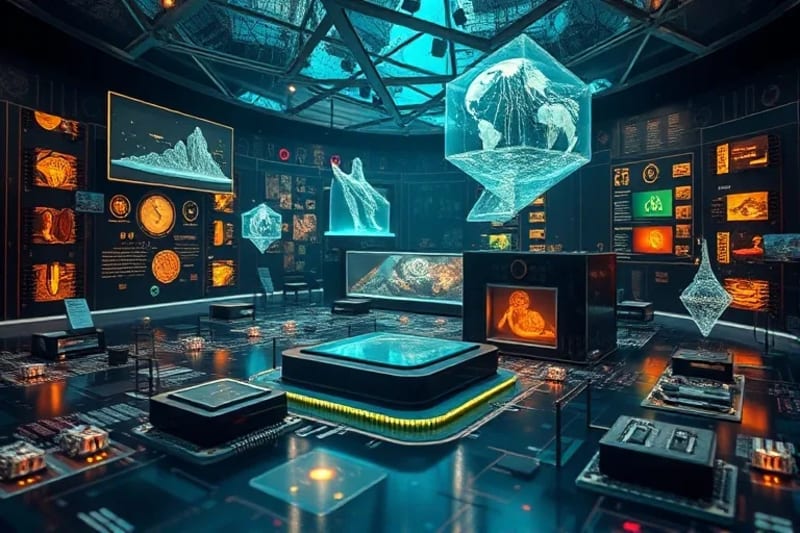 Conceptual representation of a virtual exhibition space dedicated to digitally preserved underwater archaeological sites.
This AI-generated 3D render explores the potential of digital platforms to make complex historical data accessible and engaging for a global audience.
- Technological Limitations: Developing AR hardware that is robust, waterproof, and capable of operating effectively in challenging underwater conditions (e.g., low light, pressure, battery life) remains a significant barrier.
- Data Accuracy and Interoperability: Ensuring the accuracy of AR overlays requires precise 3D models and real-time tracking. Standardizing data formats and ensuring interoperability between different systems are essential for collaborative projects.
- Cost and Infrastructure: The high cost of specialized AR equipment, software development, and the necessary technical infrastructure can be prohibitive for many archaeological institutions.
- Ethical Considerations: Questions surrounding the authenticity of digital reconstructions, the ownership of digital heritage, and potential misinterpretations of augmented views need careful consideration.
The future of AR in SCH conservation likely involves deeper integration with Artificial Intelligence (AI) and other advanced technologies. AI could enhance the automatic recognition of artifacts, improve 3D reconstruction from incomplete data, and even predict degradation patterns. Combining AR with Extended Reality for Immersive Professional Training could create even more sophisticated training simulations for archaeologists. Furthermore, advancements in Bionic Computing and Brain-Machine Interfaces might one day offer even more intuitive and seamless interaction with AR systems, pushing the boundaries of what's possible underwater.
As technology continues to evolve, we can expect AR systems to become more affordable, more powerful, and better suited for the unique demands of underwater environments. This ongoing development promises to unlock new possibilities for discovering, documenting, and preserving the invaluable submerged cultural heritage that lies hidden beneath the world's oceans and waterways, ensuring these stories are told for generations to come.
Explore More About Technology and Heritage
- Revitalizing Endangered Languages: Technology and Community Strategies
- Beads: Archaeology, Rituals, Global Context
- Sound Design in Cinema: Creating Worlds Through Audio
- Digital Human Rights: Censorship, Privacy, Freedom of Expression
- Neuroethics of Generative AI: Moral Implications of Machine Art
- Advanced Biometrics: Security and Privacy
- Astro-Genomics: Unveiling Karmic Health DNA Blueprints
Source: Hybrid content assisted by AI and human editorial supervision.


Comentarios