
Generative AI Copyright Digital Art Authorship Legal Battle
The rapid evolution of generative Artificial Intelligence (AI) has ushered in a new era of artistic creation, challenging established notions of authorship and intellectual property. As AI systems become increasingly sophisticated, capable of producing original and compelling digital art, the legal frameworks governing copyright are facing unprecedented scrutiny. This article delves into the intricate legal battle surrounding generative AI and copyright in digital art, exploring the fundamental questions of who owns AI-generated works and how existing laws adapt to this technological frontier.
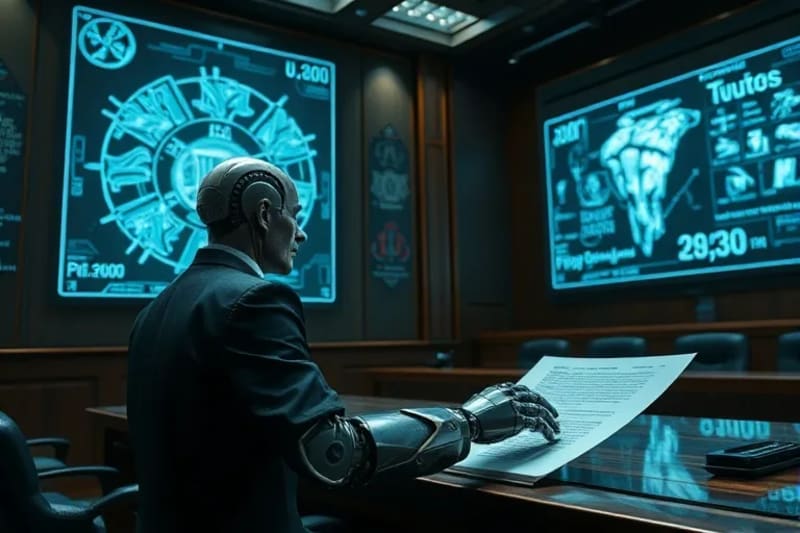 A futuristic courtroom where the intersection of AI, art, and law is debated, with holographic displays of digital creations.
At its core, generative AI refers to algorithms that can produce new content, such as images, text, or music, based on patterns learned from vast datasets. When applied to digital art, these systems can create pieces that range from photorealistic landscapes to abstract compositions, often indistinguishable from human-made works. This capability sparks a crucial debate: if a machine creates art, who holds the copyright?
The implications of this question extend beyond academic discussions, directly impacting artists, developers, legal professionals, and the broader creative industries. Understanding the nuances of this legal battle requires an exploration of traditional copyright principles and how they clash with the unique characteristics of AI-generated content.
Table of Contents
- Understanding Generative AI in Art
- The Core Conflict: Authorship and Originality
- Existing Copyright Law: A Mismatch?
- Fair Use, Transformation, and Derivative Works
- The Role of Training Data and Infringement Claims
- Challenges for Artists and AI Developers
- Potential Legal and Ethical Frameworks
- Global Perspectives on AI Copyright
- The Future of Creativity and Ownership
Understanding Generative AI in Art
Generative AI models, such as Generative Adversarial Networks (GANs) and diffusion models, have revolutionized digital content creation. These systems learn from vast datasets of existing images, styles, and concepts, enabling them to generate novel outputs. The process often involves a human "prompt engineer" who guides the AI with textual descriptions or parameters, but the AI itself performs the creative synthesis.
This technology has opened up new avenues for artistic expression, allowing individuals without traditional artistic skills to create complex visuals. It also empowers professional artists to experiment with new styles, rapidly iterate on ideas, and explore creative territories previously inaccessible. The blend of human intention and algorithmic execution blurs the lines of traditional creative processes.
The Core Conflict: Authorship and Originality
Copyright law traditionally hinges on two fundamental concepts: authorship and originality. Authorship typically refers to a human creator who conceives and executes a work. Originality implies that the work is independently created and possesses a minimal degree of creativity. These concepts are deeply rooted in humanistic traditions of art and creation.
The challenge with generative AI is that the "author" is not a human in the traditional sense. Is it the AI developer who coded the algorithm? The user who provided the prompt? Or the AI itself, if we consider it an autonomous creative entity? Most legal systems currently require a human author for copyright protection, creating a significant hurdle for AI-generated works.
 Symbolic representation of the legal challenge in balancing technological innovation with established artistic and legal principles.
Furthermore, the originality of AI-generated art is debated. While the output may be novel, some argue it is merely a recombination of its training data, lacking the "spark of creativity" attributed to human intellect. Others contend that the unique synthesis performed by AI, guided by human prompts, does indeed meet the originality threshold. This debate highlights the need for a re-evaluation of what constitutes originality in the digital age, especially in the context of advanced web development trends and technological advancements.
Existing Copyright Law: A Mismatch?
Current copyright laws, largely drafted before the advent of sophisticated AI, struggle to accommodate AI-generated content. Jurisdictions like the United States Copyright Office have explicitly stated that works created solely by AI, without human authorship, are not eligible for copyright registration. This stance reflects a human-centric view of creativity.
However, this doesn't mean AI-assisted art is entirely unprotected. If a human artist significantly contributes to the AI's output—through detailed prompting, iterative refinement, or post-processing—they may claim copyright over their specific creative contributions. The challenge lies in defining the threshold of human involvement necessary to qualify for protection, a complex task in the age of quantum computing challenges and advanced algorithms.
Fair Use, Transformation, and Derivative Works
The concepts of fair use (or fair dealing in other jurisdictions) and transformative works are frequently invoked in discussions about AI art. Fair use allows limited use of copyrighted material without permission, typically for purposes like criticism, comment, news reporting, teaching, scholarship, or research. A key factor is whether the new work is "transformative," adding new expression, meaning, or message to the original.
AI models learn by processing vast amounts of existing data, much of which is copyrighted. When an AI generates a new image, is it a transformative work, or merely a derivative copy? This question is central to determining whether the AI's output infringes on the copyrights of the original works in its training data. The legal interpretation of "transformation" for AI is still evolving and varies across different legal systems.
The Role of Training Data and Infringement Claims
A significant legal concern revolves around the training data used by generative AI models. Many models are trained on massive datasets scraped from the internet, often containing copyrighted images without explicit permission from the creators. This raises questions about whether the act of training an AI on copyrighted material constitutes infringement.
Artists and copyright holders have initiated lawsuits against AI developers, alleging that their works were used without consent to train AI models, thereby devaluing their original creations. The defense often invokes fair use, arguing that training an AI is a transformative process that does not directly compete with the original works. However, the legal landscape here is highly contested, with courts grappling with the technicalities of AI operation and the spirit of copyright law.
Challenges for Artists and AI Developers
For human artists, generative AI presents both opportunities and threats. While it can be a powerful tool, there's a growing concern that AI-generated art could dilute the value of human creativity or even directly mimic their unique styles without attribution or compensation. This leads to calls for better protection for artists and clearer guidelines on AI usage.
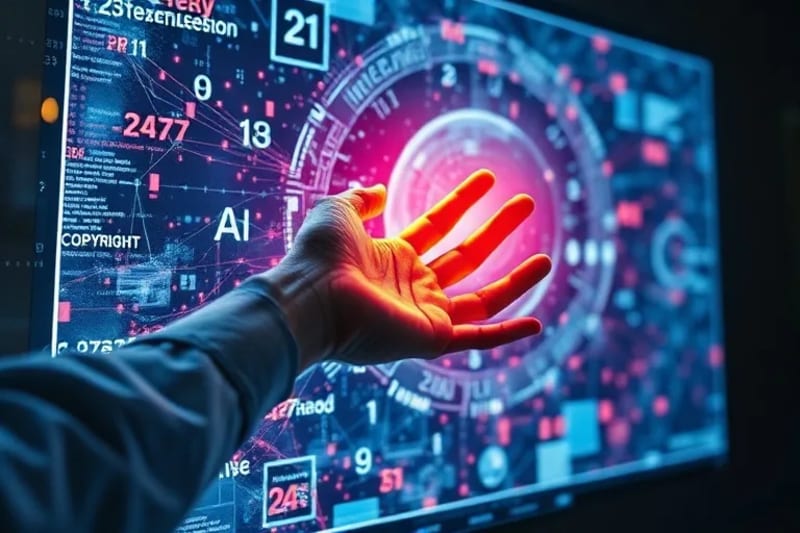 A human artist's hand reaching towards a screen displaying AI-generated art, symbolizing the evolving relationship between human creativity and artificial intelligence.
AI developers, on the other hand, face the challenge of navigating an uncertain legal environment. The risk of infringement lawsuits could stifle innovation and limit the development of new AI models. They seek clarity on what constitutes legitimate use of data for training and how to ensure their models produce non-infringing outputs. The debate also touches upon the broader ethical implications of AI, similar to discussions around post-quantum cryptography protection.
Potential Legal and Ethical Frameworks
Several solutions and frameworks are being proposed to address the AI copyright dilemma. One approach is to establish new categories of intellectual property specifically for AI-generated works, acknowledging their unique nature. Another is to adapt existing laws by reinterpreting terms like "authorship" to include human-AI collaborations or the human who initiates and directs the AI's creative process.
Licensing models could also play a crucial role. This might involve systems where artists can license their works for AI training, potentially receiving royalties when their style or elements are used. Ethical guidelines and industry standards could also help ensure transparency and fair compensation. The discussion around virtual reality in art also highlights the need for evolving legal frameworks.
Global Perspectives on AI Copyright
The legal landscape for AI and copyright is not uniform across the globe. Different countries and regions are adopting varied approaches, reflecting their unique legal traditions and cultural values. Some jurisdictions might be more open to recognizing AI as a form of authorship, while others might maintain a strict human-centric view.
For instance, some Asian countries have shown a greater willingness to consider AI as a potential author or to grant rights to the entity that owns or operates the AI. In contrast, Western legal systems, particularly those influenced by common law, tend to emphasize human creativity. This divergence creates complexities for international art markets and global AI development.
The Future of Creativity and Ownership
The legal battle over generative AI and copyright is far from over. It represents a pivotal moment in the history of intellectual property, forcing society to reconsider fundamental questions about creativity, ownership, and the role of technology in artistic expression. As AI continues to advance, these debates will only intensify, requiring innovative legal solutions that balance the interests of artists, developers, and the public.
Ultimately, the goal is to foster an environment where both human and AI-assisted creativity can thrive, ensuring fair compensation for creators while promoting technological progress. The outcomes of these legal battles will shape the future of digital art and the broader creative economy for decades to come, impacting everything from individual artists to large media corporations and even areas like quantum climate optimization.
Related Articles
- Karmic Astrology: Deep Transgenerational Patterns Past Lives
- Planetary Transits Shadow Work: Integrating Outer Planet Cycles
- Angels Archangels Invisible Geopolitics Celestial Strategies Conflicts
- Venus Taurus: Stability Sensuality Personal Value Guide
- Mysteries Holy Rosary: Complete Guide Deep Meditation
Source: Hybrid content assisted by AI and human editorial supervision.


Comentarios