
Music Neuroscience Rhythm Melody Mental Health Learning
Music, an ancient and universal human phenomenon, transcends cultural boundaries and deeply influences our emotional and cognitive states. For centuries, its power has been recognized intuitively, but modern neuroscience is now providing empirical evidence for its profound impact on the brain. This article explores the intricate relationship between music and neuroscience, uncovering how rhythm and melody can be harnessed for mental health and cognitive enhancement.
From reducing stress and anxiety to improving memory and language skills, music acts as a powerful tool for brain modulation. Understanding the underlying neurological mechanisms allows us to appreciate not only the artistic beauty of music but also its therapeutic and educational potential. We will delve into how different aspects of music, such as rhythm, melody, and harmony, engage specific brain regions and influence our well-being and learning capabilities.

Source: Visual content subject to ecosystem availability: Wikimedia Commons under license CC BY-SA 4.0 or conceptual AI rendering.
Table of Contents
- The Brain's Intricate Response to Music
- Music's Impact on Mental Health and Emotional Well-being
- Enhancing Cognitive Learning and Neuroplasticity with Music
- The Distinct Roles of Rhythm and Melody
- Clinical Applications and Future Directions
- Conclusion: The Unifying Power of Music and Neuroscience
The Brain's Intricate Response to Music
When we listen to music, our brains engage in a highly complex and distributed process, activating multiple regions simultaneously. The initial processing occurs in the auditory cortex, located in the temporal lobe, which decodes the raw acoustic information such as pitch, timbre, and loudness. However, music's influence extends far beyond mere auditory perception.
Emotional responses are primarily mediated by the limbic system, including the amygdala and hippocampus, which are crucial for processing emotions and memory formation. This explains why certain songs can evoke strong feelings or transport us back to specific moments in our lives. The release of neurotransmitters like dopamine, associated with pleasure and reward, is also a key component of music's emotional impact, contributing to its mood-enhancing effects.
Furthermore, music engages motor areas of the brain, even when we are not physically moving. The cerebellum and basal ganglia, involved in movement coordination and timing, become active, which is why we often tap our feet or nod our heads to a beat. This motor-auditory coupling is fundamental to how music influences our physical and cognitive functions.
Music's Impact on Mental Health and Emotional Well-being
The therapeutic potential of music in mental health is increasingly recognized and utilized. Research indicates that listening to music can significantly reduce levels of the stress hormone cortisol. Calming melodies and harmonies can activate the parasympathetic nervous system, promoting relaxation and reducing physiological arousal, making it a valuable tool for stress management.
For individuals struggling with anxiety and depression, music offers a non-pharmacological intervention that can alleviate symptoms. The release of dopamine and serotonin, neurotransmitters associated with mood regulation, can be stimulated by enjoyable music, leading to improved emotional states. Music therapy, a clinical and evidence-based practice, uses musical interventions to address physical, emotional, cognitive, and social needs of individuals.

Music therapy sessions can involve listening, singing, playing instruments, or composing, tailored to the individual's needs and preferences. This approach has shown efficacy in various populations, from children with developmental disorders to adults with chronic mental health conditions. It provides a safe and expressive outlet, fostering emotional processing and self-regulation. The benefits extend to reducing agitation in dementia patients and improving communication in individuals with autism spectrum disorder.
Moreover, music can serve as a powerful distraction from pain and discomfort, activating brain regions involved in pain modulation. This makes it a useful adjunct in palliative care and during medical procedures. The ability of music to shift focus and alter perception highlights its versatility as a therapeutic modality for a wide range of mental and physical challenges.
Enhancing Cognitive Learning and Neuroplasticity with Music
Beyond emotional regulation, music plays a significant role in cognitive development and learning. Its structured nature, with patterns of rhythm and melody, can enhance various cognitive functions. One of the most well-documented effects is on memory. Music can serve as a mnemonic device, helping individuals recall information more effectively, a phenomenon often observed in educational settings where songs are used to teach concepts.
Learning to play a musical instrument, in particular, has been shown to induce significant neuroplastic changes in the brain. This involves the strengthening of neural connections and even the generation of new neurons, particularly in areas associated with motor control, auditory processing, and executive functions. Such activities demand sustained attention, fine motor skills, and the ability to integrate sensory information, all of which contribute to enhanced cognitive abilities.
Music also facilitates language acquisition. The processing of pitch, rhythm, and timbre in music shares neural pathways with language processing. Studies have shown that musical training can improve phonological awareness, vocabulary, and even grammar skills, especially in children. This overlap suggests that engaging with music can prime the brain for more efficient language learning, offering new avenues for prevention in educational settings.
Attention and focus are also positively influenced by music. Certain types of music, particularly instrumental pieces without lyrics, can help individuals concentrate on tasks by providing a stimulating yet non-distracting auditory background. This effect is often utilized in study environments or workplaces to improve productivity and reduce cognitive fatigue. The rhythmic predictability of music can help organize brain activity, making it easier to sustain attention over longer periods.
The Distinct Roles of Rhythm and Melody
While often perceived as a single entity, music is composed of distinct elements, primarily rhythm and melody, each with unique neurological impacts. Rhythm, the temporal organization of sounds, is deeply ingrained in our biological systems. Our heartbeats, breathing patterns, and walking gaits are all rhythmic, suggesting an innate connection between internal and external rhythms.
The brain's ability to entrain to external rhythms is powerful. This synchronization can influence motor skills and coordination, making rhythmic exercises beneficial for individuals with movement disorders. For instance, rhythmic auditory stimulation (RAS) is a technique used in neurological rehabilitation to improve gait in patients with Parkinson's disease or stroke. The precise timing and predictability of rhythm help to re-establish and strengthen motor control pathways.
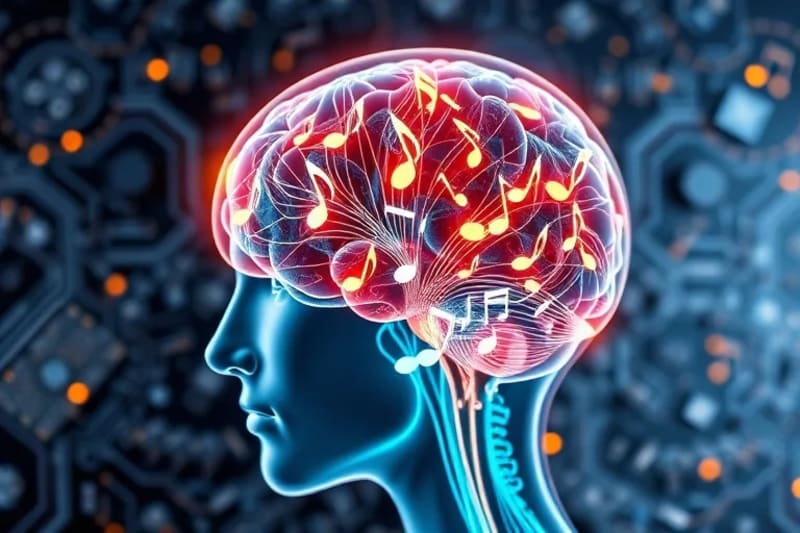
Melody, on the other hand, refers to the succession of pitches that form a recognizable musical phrase. It is primarily responsible for the emotional and aesthetic qualities of music. Melodies engage the brain's emotional centers, triggering feelings of joy, sadness, excitement, or tranquility. The contour and progression of a melody can profoundly affect our mood and level of arousal, making it a key component in emotional regulation.
The interplay between rhythm and melody is crucial for the holistic experience of music. While rhythm provides structure and drive, melody adds emotional depth and narrative. Together, they create a rich auditory landscape that engages multiple brain systems, from the most primitive to the most complex. This intricate interaction underscores why music is such a potent stimulus for brain activity and why adapted physical activity often incorporates rhythmic elements.
Clinical Applications and Future Directions
The growing understanding of music's neurological effects has led to innovative clinical applications. In addition to Parkinson's and stroke rehabilitation, music interventions are being explored for conditions like Alzheimer's disease. Familiar music can evoke memories and reduce agitation in patients with dementia, offering a way to connect and improve quality of life even when verbal communication is difficult.
In educational settings, incorporating music into curricula can enhance learning outcomes across various subjects. From improving mathematical skills through understanding musical patterns to boosting literacy through lyrical analysis, music provides a multi-sensory approach to education. The development of personalized music programs, informed by neuroscience, could revolutionize how we approach learning and cognitive development.
Future research directions include exploring the precise neural circuits involved in music perception and production using advanced neuroimaging techniques. This could lead to more targeted and effective music-based therapies. The integration of technology, such as generative AI for creating personalized musical experiences, holds immense promise for tailoring interventions to individual brain profiles and needs.
Furthermore, the field of neuro-rights and cybersecurity is becoming increasingly relevant as we delve deeper into brain-computer interfaces and the potential for direct neural modulation. Understanding how music interacts with our consciousness and cognitive processes is crucial in this evolving landscape. This intersection of music, neuroscience, and technology opens up new ethical considerations and possibilities for enhancing human capabilities and well-being.
Conclusion: The Unifying Power of Music and Neuroscience
The synergy between music and neuroscience reveals a profound and intricate relationship that impacts nearly every aspect of human experience. From its ability to soothe our anxieties and uplift our spirits to its capacity to sharpen our minds and aid in rehabilitation, music is far more than just entertainment. It is a fundamental component of our neurological architecture, capable of shaping our brains and enhancing our lives.
As scientific understanding continues to advance, the therapeutic and educational applications of music will undoubtedly expand, offering innovative solutions for mental health challenges and cognitive development. Embracing the power of rhythm and melody, informed by rigorous scientific inquiry, promises a future where music plays an even more central role in fostering human well-being and unlocking our full cognitive potential.
Explore More on Neuroscience and Well-being
- Neuro-Rights Cybersecurity Protecting Consciousness Digital Age
- Astro-Genomics: Unveiling Karmic Health Blueprints DNA Patterns
- Saturn Neptune Cycles: Life Lessons and Spiritual Truth
Source: Hybrid content assisted by AI and human editorial supervision.


Comentarios