
Astrodynamics Interplanetary Travel: Routes, AI, Solar System Conquest
Astrodynamics Interplanetary Travel: Routes, AI, Solar System Conquest
Interplanetary travel, once the exclusive domain of science fiction, is rapidly becoming a tangible reality thanks to breakthroughs in astrodynamics and the burgeoning capabilities of artificial intelligence. Astrodynamics, the application of celestial mechanics and rocket propulsion to the problems of spaceflight, forms the bedrock upon which all space missions are built.
It dictates the precise trajectories, maneuvers, and timing required to send probes, landers, and eventually humans across the vast distances of our solar system. As humanity sets its sights on Mars, the asteroid belt, and beyond, understanding these fundamental principles and embracing advanced technologies like AI becomes paramount.
This article delves into the core concepts of astrodynamics, explores the intricate routes spacecraft take, highlights the significant challenges faced, and illuminates the transformative role of AI in overcoming these hurdles to facilitate the conquest of the solar system.
Table of Contents
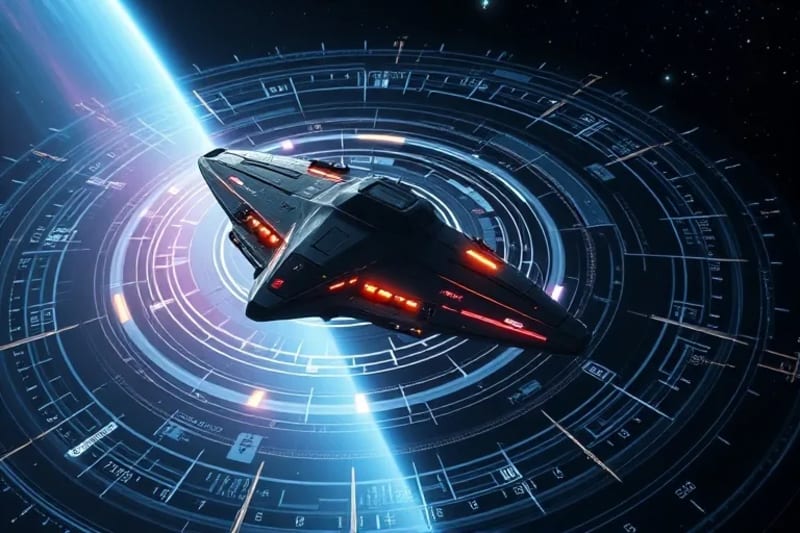
Conceptual representation of advanced astrodynamics and AI guidance for intricate interplanetary routes.
1. Introduction to Astrodynamics
Astrodynamics is a specialized field that combines principles from physics, mathematics, and engineering to predict and calculate the orbital mechanics of spacecraft and natural celestial bodies. It is essential for every phase of a space mission, from launch to orbit insertion, trajectory correction, and eventual arrival at a distant destination.
Without a deep understanding of astrodynamics, missions would simply drift aimlessly, unable to reach their targets or perform their scientific objectives. It allows engineers to design missions that are not only feasible but also fuel-efficient and safe.
The discipline relies heavily on Newton's laws of motion and universal gravitation, as well as Kepler's laws of planetary motion, which describe how objects move under the influence of gravity. These foundational concepts enable the precise calculation of trajectories, accounting for the gravitational pull of multiple celestial bodies.
2. Fundamental Principles of Interplanetary Travel
Interplanetary travel is governed by several key principles that dictate how spacecraft navigate between planets. The primary challenge is overcoming the gravitational pull of the departure planet and then accurately targeting the destination, which is itself moving through space.
- Delta-v (Δv): This is perhaps the most critical concept, representing the total change in velocity required to perform a maneuver. Every burn of a rocket engine contributes to the spacecraft's delta-v, and minimizing this value is crucial for fuel efficiency, as fuel constitutes a significant portion of a spacecraft's launch mass.
- Orbital Mechanics: Spacecraft typically follow elliptical paths around celestial bodies. To transfer from one orbit to another, or from one planet's sphere of influence to another, precise changes in velocity are needed at specific points in the orbit.
- Launch Windows: Due to the constant motion of planets, there are specific, often narrow, periods when a spacecraft can be launched to efficiently reach its target. Missing a launch window can mean waiting months or even years for the next opportune alignment.
- Gravitational Spheres of Influence: Each celestial body has a region where its gravity is the dominant force. As a spacecraft travels, it transitions from one sphere of influence to another, requiring careful trajectory planning to account for these changing gravitational fields.
These principles are applied to design trajectories that leverage natural gravitational forces, minimizing the need for propulsive maneuvers. The goal is always to achieve the mission objectives with the least amount of fuel and time.
3. Key Interplanetary Transfer Orbits
Several types of orbital transfers are employed for interplanetary missions, each with its own advantages and disadvantages regarding fuel consumption, travel time, and complexity. The choice of trajectory depends heavily on the mission's specific goals and available resources.
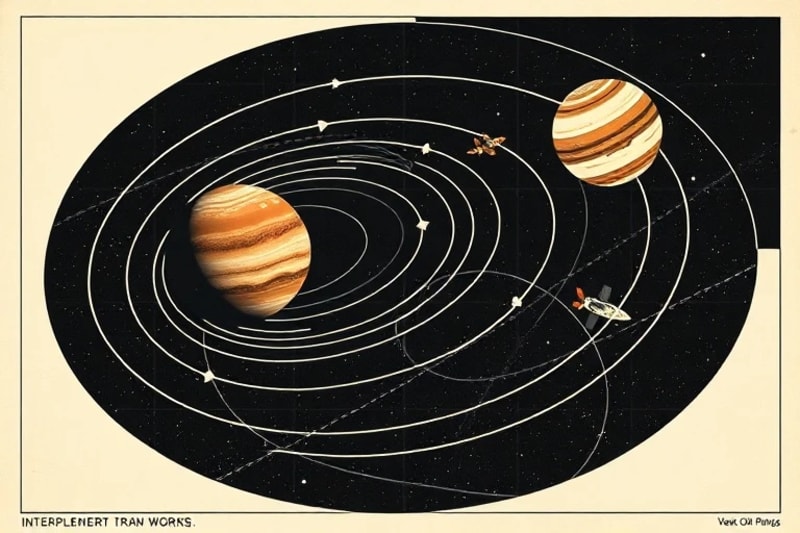
Visual representation of various orbital paths used for efficient interplanetary travel.
- Hohmann Transfer Orbit: This is the most fuel-efficient way to move between two circular orbits in the same plane. It involves two engine burns: one to enter an elliptical transfer orbit and another to circularize the orbit at the destination. While efficient, it often results in longer travel times.
- Gravitational Assist (Slingshot): This technique uses the gravitational pull of a planet or moon to accelerate or decelerate a spacecraft, changing its speed and direction without expending propellant. It's a cornerstone of deep-space missions, enabling probes like Voyager and Cassini to reach distant outer planets.
- Low-Energy Transfers (Ballistic Capture): These complex trajectories leverage gravitational interactions with multiple celestial bodies to achieve transfers with extremely low fuel consumption, often at the cost of significantly longer travel times. They are particularly useful for missions where time is not a critical factor, but fuel is scarce.
- Direct Trajectories: While possible for closer destinations like the Moon, direct trajectories to other planets require immense amounts of fuel and high velocities, making them generally impractical for most interplanetary missions.
The selection of an appropriate transfer orbit is a meticulous process, balancing factors such as mission duration, payload mass, and available propulsion systems. For instance, the Mars Science Laboratory (Curiosity rover) utilized a direct trajectory for its journey to Mars, while many outer solar system missions rely on gravitational assists.
4. Challenges in Interplanetary Missions
Despite significant advancements, interplanetary travel presents formidable challenges that demand innovative solutions. These hurdles range from the physical limitations of current technology to the vastness and hostility of space itself.
| Challenge Category | Description and Impact | Potential Solutions/Mitigation |
|---|---|---|
| Propulsion and Fuel Efficiency | Current chemical rockets are inefficient for long-duration missions, requiring massive amounts of fuel. This limits payload capacity and mission scope. | Advanced propulsion systems (e.g., nuclear-thermal, electric propulsion, solar sails), bioengineering for fuel production in space. |
| Radiation Exposure | Astronauts face harmful cosmic rays and solar particle events, posing severe health risks like cancer and neurological damage. | Improved shielding materials, advanced medical countermeasures, faster transit times. |
| Communication Delays | The vast distances cause significant time lags in communication, making real-time control impossible and increasing mission complexity. | Autonomous systems, optical communication, relay satellites, advanced artificial intelligence for decision-making. |
| Navigation and Precision | Achieving precise orbital insertion and landing at distant, moving targets requires extreme accuracy in trajectory calculations and maneuvers. | Enhanced navigation sensors, AI-driven guidance systems, improved celestial mechanics models. |
| Life Support and Resource Management | Sustaining human life for extended periods in space requires closed-loop systems for air, water, and food, as well as efficient waste management. | Bioregenerative life support, in-situ resource utilization (ISRU), advanced recycling technologies. |
Overcoming these challenges requires a multi-faceted approach, combining cutting-edge engineering, scientific research, and innovative technological solutions. The development of more robust materials and self-sustaining systems is crucial for long-duration missions.
5. The Transformative Role of Artificial Intelligence
Artificial Intelligence is poised to revolutionize interplanetary travel, addressing many of the challenges outlined above. From mission planning to autonomous operations, AI's capabilities offer unprecedented levels of efficiency, safety, and scientific discovery.
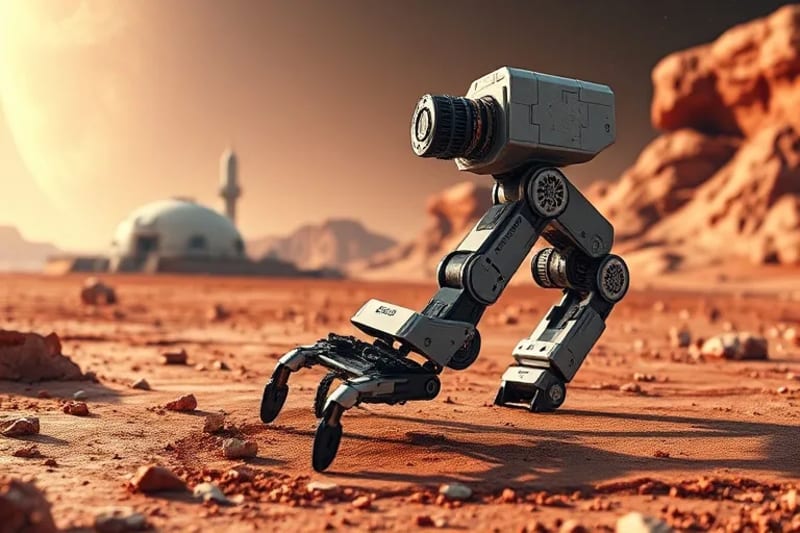
Depiction of AI-driven robotic exploration and resource management on an extraterrestrial surface.
- Trajectory Optimization: AI algorithms can analyze vast datasets of gravitational fields, planetary positions, and propulsion capabilities to identify optimal, fuel-efficient trajectories that human engineers might overlook. This includes dynamic adjustments to flight paths in response to unforeseen events.
- Autonomous Navigation: With significant communication delays, spacecraft need to make real-time decisions. AI can enable autonomous navigation, hazard avoidance, and precise landing maneuvers without constant human intervention, as seen in advanced virtual reality simulations and robotic systems.
- Fault Detection and Repair: AI systems can continuously monitor spacecraft health, predict potential failures, and even initiate self-repair protocols, significantly enhancing mission reliability and longevity, especially for uncrewed probes.
- Scientific Data Analysis: Interplanetary missions generate enormous amounts of data. AI can rapidly process and prioritize this information, identifying anomalies or patterns that warrant further investigation, thereby accelerating scientific discovery.
- Resource Management and ISRU: For future human outposts, AI will be critical in managing resources, optimizing life support systems, and directing in-situ resource utilization (ISRU) operations, such as extracting water from lunar ice or producing oxygen from Martian soil.
The synergy between human expertise in astrodynamics and the computational power of AI promises to unlock new frontiers in space exploration, making previously impossible missions achievable. AI's ability to learn and adapt will be crucial for the dynamic and unpredictable environment of deep space.
6. Future Prospects and Solar System Conquest
The ongoing advancements in astrodynamics and AI are paving the way for ambitious future endeavors, transforming the concept of solar system conquest from a distant dream into a strategic objective. This conquest involves not just exploration but also sustained presence and resource utilization.
- Human Colonization: Missions to establish permanent human bases on the Moon and Mars are becoming increasingly realistic. Astrodynamics provides the pathways, while AI will manage the complex logistics, life support, and autonomous operations required for long-term habitation.
- Asteroid Mining: The vast resources within the asteroid belt, from precious metals to water ice, represent immense economic and scientific potential. AI-guided robotic missions will be essential for prospecting, extraction, and processing these resources, fueling further expansion.
- Exploration of Outer Planets and Moons: With improved propulsion and AI-driven autonomy, missions to Jupiter's icy moons (Europa, Ganymede) and Saturn's Titan, which hold potential for extraterrestrial life, will become more frequent and sophisticated.
- Space Infrastructure: The development of orbital refueling stations, space-based manufacturing facilities, and advanced communication networks will create a robust infrastructure to support extensive interplanetary travel and settlement.
The synergy between human ingenuity and artificial intelligence will define the next era of space exploration. By meticulously charting routes, mitigating risks, and optimizing every aspect of a mission, astrodynamics and AI are not merely tools but essential partners in humanity's grand ambition to explore, settle, and ultimately thrive across the solar system.
The journey ahead is challenging, but the potential rewards—new knowledge, resources, and a multi-planetary future—make it an endeavor worth pursuing with every scientific and technological advantage at our disposal.
Related Articles
- Virtual Reality Art: Contemporary Transformative Impact
- Karmic Nodes Fixed Stars: Galactic Blueprint Soul Growth
Source: Hybrid content assisted by AI and human editorial supervision.


Comentarios