
Fungal Ecosystems: AI, Synthetic Biology, Sustainable Future
Fungal ecosystems, often hidden beneath our feet or thriving in unexpected niches, represent a vast and largely untapped reservoir of biological innovation. These intricate networks of mycelia and fruiting bodies play critical roles in nutrient cycling, decomposition, and symbiotic relationships across virtually all terrestrial and aquatic environments. Their remarkable metabolic diversity and adaptability make them prime candidates for addressing some of humanity's most pressing challenges, from environmental remediation to sustainable material production and novel pharmaceutical discovery.
The advent of advanced technologies like Artificial Intelligence (AI) and Synthetic Biology is now unlocking unprecedented opportunities to explore, understand, and harness the full potential of these microbial powerhouses. This synergistic approach promises to revolutionize how we interact with and benefit from fungal life, paving the way for a truly sustainable future.

Precursors intellectuales, diagramas fundamentales y representaciones conceptuales que forjaron la visión de los Ecosistemas Fúngicos sobre la Sostenibilidad.
Fuente visual sujeta a disponibilidad del ecosistema: Wikimedia Commons bajo licencia CC BY-SA 4.0 o renderizado conceptual IA.
Table of Contents
- Understanding Fungal Ecosystems: Nature's Hidden Architects
- The Role of Artificial Intelligence in Fungal Research
- Synthetic Biology: Engineering Fungal Solutions
- Synergies for a Sustainable Future: Fungi, AI, and SynBio
- Challenges and Ethical Considerations
- The Future Outlook: A Mycelial Revolution
The intricate world of fungi offers solutions to many global problems. From bioremediation to novel materials, their potential is vast. This article delves into how cutting-edge technologies are helping us unlock this potential.
Understanding Fungal Ecosystems: Nature's Hidden Architects
Fungi are eukaryotic organisms that form a kingdom distinct from plants and animals. They exhibit an astonishing array of forms and functions, from microscopic yeasts to vast underground mycelial networks that can span hectares. Their ecological importance cannot be overstated, as they are primary decomposers, breaking down organic matter and recycling essential nutrients back into ecosystems.
Beyond decomposition, fungi engage in complex symbiotic relationships. Mycorrhizal fungi, for instance, form crucial associations with plant roots, enhancing water and nutrient uptake for plants while receiving carbohydrates in return. Endophytic fungi live within plant tissues, often providing protection against pathogens and herbivores. Lichens, a symbiotic partnership between fungi and algae or cyanobacteria, are pioneer species capable of colonizing harsh environments.
The metabolic capabilities of fungi are equally impressive. They produce a myriad of secondary metabolites, including antibiotics (e.g., penicillin), immunosuppressants (e.g., cyclosporin), and various enzymes used in industrial processes. Their ability to synthesize complex organic compounds and degrade persistent pollutants makes them invaluable for biotechnology and environmental applications.
The Role of Artificial Intelligence in Fungal Research
Artificial Intelligence is rapidly transforming fungal research by enabling scientists to process and interpret vast datasets, identify patterns, and accelerate discovery. Machine learning algorithms can analyze genomic, proteomic, and metabolomic data to predict gene functions, identify novel enzymes, or pinpoint biosynthetic pathways for valuable compounds.
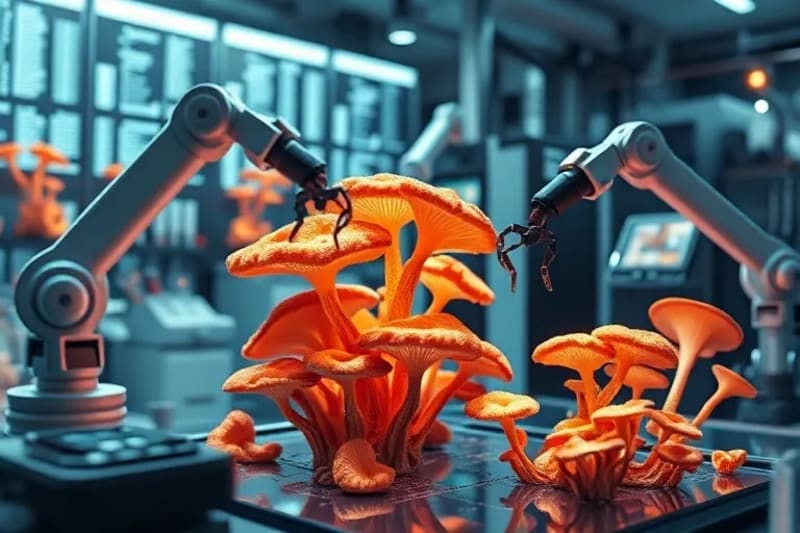
AI-driven precision in fungal bioengineering, showcasing advanced robotic manipulation of molecular structures.
For instance, AI can be used to screen thousands of fungal strains for specific enzymatic activities, significantly reducing the time and resources required for traditional laboratory screening. This is particularly useful in the search for enzymes capable of degrading plastics, breaking down lignocellulose for biofuels, or producing new antibiotics.
- Genomic Analysis: AI helps in annotating fungal genomes, identifying genes responsible for specific metabolic pathways, and understanding evolutionary relationships.
- Drug Discovery: Machine learning models predict potential drug candidates from fungal metabolites, accelerating the development of new pharmaceuticals.
- Environmental Monitoring: AI can analyze sensor data to monitor fungal growth in bioremediation sites, optimizing conditions for pollutant degradation.
- Predictive Modeling: AI models can predict how fungal populations will respond to environmental changes, aiding in conservation efforts and agricultural management.
The application of AI extends to understanding complex fungal interactions within ecosystems. By analyzing vast ecological datasets, AI can uncover subtle relationships between fungi, plants, and other microbes, offering insights into ecosystem health and resilience. This predictive capability is crucial for managing biodiversity and developing sustainable agricultural practices. For more on AI's role in complex systems, consider exploring AI Predictive Cybersecurity, which also deals with advanced data analysis.
Synthetic Biology: Engineering Fungal Solutions
Synthetic Biology takes the understanding gained from genomic and metabolic research and applies engineering principles to design and construct new biological parts, devices, and systems, or to re-design existing natural biological systems. In the context of fungi, this means genetically modifying strains to enhance desired traits or introduce entirely new functionalities.
One of the most promising applications is the engineering of fungi for enhanced bioproduction. For example, yeast strains can be engineered to produce biofuels, bioplastics, or high-value chemicals more efficiently. Filamentous fungi, with their robust growth and ability to secrete enzymes, are ideal hosts for producing industrial enzymes or therapeutic proteins.
- Biofuel Production: Engineering fungi to efficiently convert agricultural waste into ethanol or other advanced biofuels.
- Biomaterial Development: Designing fungi to grow into mycelium-based materials for packaging, construction, or textiles, offering sustainable alternatives to plastics and wood.
- Pharmaceuticals: Modifying fungal pathways to increase the yield of existing drugs or produce novel compounds with therapeutic potential.
- Bioremediation: Enhancing fungal capabilities to degrade specific pollutants, such as heavy metals, pesticides, or oil spills, making environmental clean-up more effective.
The precision offered by synthetic biology allows scientists to fine-tune metabolic pathways, optimize gene expression, and even create entirely new genetic circuits within fungal cells. This level of control opens the door to tailor-made biological solutions for a wide range of industrial and environmental challenges.
Synergies for a Sustainable Future: Fungi, AI, and SynBio
The true power lies in the convergence of fungal biology, AI, and synthetic biology. AI can guide synthetic biology efforts by predicting optimal genetic modifications or designing novel metabolic pathways. Synthetic biology, in turn, provides the tools to implement these AI-driven designs in fungal systems. This iterative feedback loop accelerates discovery and application.
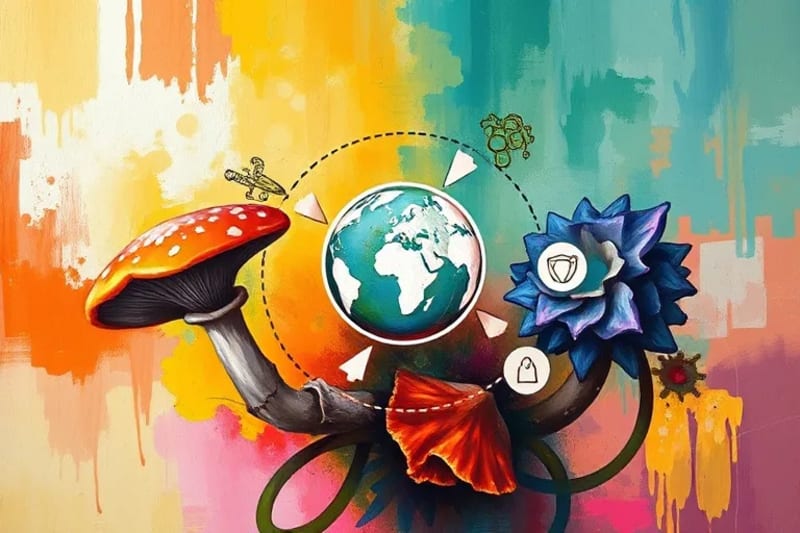
Fungi as catalysts for a circular economy, demonstrating their role in waste valorization and sustainable production.
Consider the development of mycelium-based materials. AI algorithms can analyze the structural properties of different fungal species and predict which genetic modifications would yield materials with desired strength, flexibility, or insulation properties. Synthetic biology then enables the precise engineering of these fungi, allowing for the cultivation of sustainable alternatives to traditional building materials or plastics.
Another exciting area is the use of fungi for carbon sequestration. By understanding and enhancing fungal interactions with soil and plants through AI-driven insights and synthetic biology modifications, we can potentially boost natural carbon capture processes, contributing to climate change mitigation. The design of sustainable spaces, as explored in Neuroarchitecture and Cognitive Well-being, could greatly benefit from such bio-integrated solutions.
| Application Area | Fungal Contribution | AI's Role | Synthetic Biology's Role |
|---|---|---|---|
| Bioremediation | Degradation of pollutants (plastics, oil, heavy metals). | Identifying optimal fungal strains, predicting degradation rates, optimizing environmental conditions. | Engineering fungi for enhanced degradation pathways, broader substrate specificity. |
| Sustainable Materials | Mycelium-based composites, fungal leather alternatives. | Designing material properties, predicting growth patterns, optimizing cultivation parameters. | Modifying fungal strains for desired strength, texture, color, and growth speed. |
| Biofuels & Bioproducts | Conversion of biomass into fuels, enzymes, chemicals. | Discovering novel enzymes, optimizing fermentation processes, predicting yield. | Engineering metabolic pathways for higher efficiency, novel product synthesis. |
| Agriculture | Biofertilizers, biopesticides, plant disease resistance. | Predicting plant-fungal interactions, optimizing application strategies, disease detection. | Enhancing beneficial fungal traits, engineering resistance to pathogens. |
| Medicine | Antibiotics, immunosuppressants, anti-cancer compounds. | Identifying novel bioactive compounds, predicting efficacy and toxicity. | Engineering pathways for increased production, novel compound synthesis. |
Challenges and Ethical Considerations
Despite the immense potential, the integration of AI and synthetic biology in fungal ecosystems presents several challenges. Technical hurdles include the complexity of fungal genetics, which can be more challenging to manipulate than bacteria, and the sheer diversity of fungal species, many of which remain uncharacterized.
Ethical considerations are paramount. The deliberate release of genetically modified fungi into natural ecosystems raises concerns about unintended ecological impacts, such as altering natural nutrient cycles or outcompeting native species. Robust regulatory frameworks and thorough risk assessments are essential to ensure responsible innovation.
Public perception and acceptance also play a crucial role. Educating the public about the benefits and risks of these technologies is vital to fostering trust and support for fungal biotechnology. Transparency in research and development is key to addressing potential fears and misconceptions.
The Future Outlook: A Mycelial Revolution
The future of fungal ecosystems, augmented by AI and synthetic biology, is incredibly promising. We are on the cusp of a "mycelial revolution" where fungi will play an increasingly central role in our quest for sustainability. Imagine cities built with self-healing mycelium bricks, clothes grown from fungal fibers, and farms protected by bio-engineered fungal pesticides.
Further research into fungal biodiversity, coupled with advanced computational tools, will uncover even more novel compounds and metabolic pathways. The ability to precisely engineer these biological systems will allow us to design solutions tailored to specific environmental and industrial needs, moving beyond trial-and-error approaches.
Collaboration between mycologists, computer scientists, engineers, and ethicists will be crucial to navigate this exciting frontier responsibly. By harnessing the power of fungal ecosystems through the intelligent application of AI and synthetic biology, we can build a more sustainable, resilient, and biodiverse future for all. This interdisciplinary approach mirrors the practical applications discussed in Mixed Reality: Practical Applications, where diverse fields converge for innovative solutions.
Related Articles
- Pioneering Women in AI & Robotics: Legacy, Future
- AES: Symmetric Cryptography and Quantum Resistance
- Cognitive Video Games for Children: Impact on Development
- Digital Health, Telemedicine, Wearables: Disease Prevention
- Karmic Astrology Fixed Stars Soul Purpose
- Numerology Astrology: Deeper Insights Combining Life Paths
Source: Hybrid content assisted by AI and human editorial supervision.


Comentarios