
Space Law: Sovereignty, Extraterrestrial Resources, Legal Frontier
Space law represents a fascinating and rapidly evolving field at the intersection of international relations, scientific exploration, and technological innovation. As humanity ventures further beyond Earth's atmosphere, the need for a robust and adaptive legal framework becomes increasingly critical. This discipline governs activities in outer space, addressing complex issues ranging from national sovereignty and resource exploitation to environmental protection and liability for space-related incidents.
The challenges inherent in space law are amplified by the unique environment of outer space, where traditional concepts of territory and jurisdiction often prove inadequate. The vacuum of space, the vast distances, and the potential for unprecedented discoveries necessitate a legal approach that is both forward-thinking and grounded in established international principles. This article delves into the foundational tenets of space law, explores contemporary debates surrounding extraterrestrial resources, and examines the emerging legal frontiers shaping humanity's future in the cosmos.
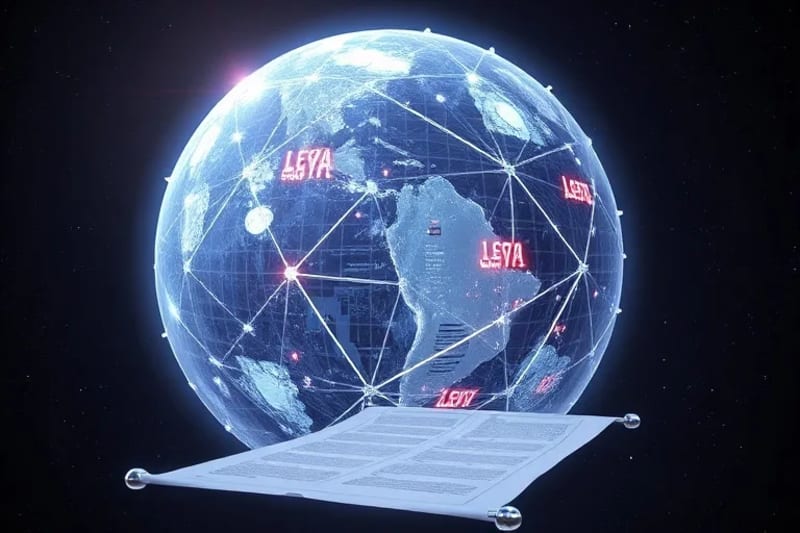
 The evolving legal landscape and the complex interplay of international agreements that define humanity's presence in the cosmos.
This conceptual rendering, possibly a creative AI interpretation, illustrates the foundational principles and future challenges of space law, drawing inspiration from historical accords and visionary proposals.
Table of Contents
- Foundational Treaties and Principles of Space Law
- Sovereignty, Jurisdiction, and the Non-Appropriation Principle
- The Legal Quagmire of Extraterrestrial Resources
- Emerging Legal Frontiers: From Tourism to Debris
- Challenges and the Future Trajectory of Space Law
- Conclusion: Charting the Course for Cosmic Governance
Foundational Treaties and Principles of Space Law
The bedrock of international space law is primarily constituted by five United Nations treaties and five sets of principles. The most significant of these is the Outer Space Treaty (OST) of 1967, formally known as the "Treaty on Principles Governing the Activities of States in the Exploration and Use of Outer Space, including the Moon and Other Celestial Bodies." This seminal document established several fundamental principles that continue to guide space activities.
Key among these principles are the freedom of exploration and use of outer space by all states, the non-appropriation of outer space by any nation, and the prohibition of placing weapons of mass destruction in orbit or on celestial bodies. The OST also stipulates that states bear international responsibility for national activities in outer space, whether carried out by governmental or non-governmental entities. This clause is particularly relevant in an era of increasing private sector involvement in space.
Other crucial treaties include the Rescue Agreement (1968), which mandates assistance to astronauts in distress; the Liability Convention (1972), which establishes liability for damage caused by space objects; and the Registration Convention (1975), requiring states to register objects launched into space. The Moon Agreement (1979), while aiming to govern the exploitation of natural resources of the Moon and other celestial bodies, has seen limited ratification and remains largely ineffective.
Sovereignty, Jurisdiction, and the Non-Appropriation Principle
The concept of sovereignty, so central to terrestrial international law, becomes highly complex in the context of outer space. The OST explicitly states that outer space, including the Moon and other celestial bodies, is not subject to national appropriation by claim of sovereignty, by means of use or occupation, or by any other means. This non-appropriation principle is a cornerstone of space law, designed to prevent a 'scramble for space' akin to historical colonial expansions.
Despite this, states retain jurisdiction and control over objects they launch into space, and over personnel thereof, while such objects are in outer space or on a celestial body. This means that a spacecraft, for instance, remains under the jurisdiction of its launching state, even if it is millions of miles from Earth. This distinction between territorial sovereignty and jurisdiction over objects is crucial for understanding the legal framework.
However, the rise of private space companies and the increasing potential for commercial exploitation of space resources challenge these established norms. While states are responsible for their national activities, the specific mechanisms for regulating private entities operating across multiple jurisdictions are still being developed. The question of how to apply national laws to activities that transcend national borders, particularly when those activities involve advanced technologies like haptic augmented reality for remote operations, remains a significant legal puzzle.
The Legal Quagmire of Extraterrestrial Resources
Perhaps the most contentious area in contemporary space law is the legal status of extraterrestrial resources. The OST declares outer space as the "province of all mankind," implying a common heritage principle. However, it does not explicitly prohibit the extraction or utilization of resources. The Moon Agreement attempted to establish an international regime for regulating resource exploitation but, as noted, received limited support.
The lack of a universally accepted framework has led to unilateral actions and the emergence of new international instruments. The Artemis Accords, led by the United States, represent a significant development. These accords, signed by numerous nations, aim to operationalize the OST by establishing principles for safe and sustainable space exploration, including the right to extract and utilize space resources. Proponents argue that the Accords provide a much-needed framework for commercial activities, while critics worry they could undermine the common heritage principle and lead to a new form of space colonialism.
 The intricate legal challenges surrounding the extraction and ownership of extraterrestrial resources.
This image, a digital rendering, visualizes the complex legal and ethical questions posed by potential asteroid mining operations, reflecting debates on resource allocation and international cooperation.
The debate over space resources is not merely academic; it has profound implications for the future of space exploration and economic development. Access to lunar water ice or asteroid metals could revolutionize space missions, making them more sustainable and cost-effective. However, without a clear and equitable legal regime, such activities risk exacerbating geopolitical tensions and creating new forms of inequality. The development of AI-driven resource management systems could offer solutions, but their implementation would also require robust legal oversight.
Emerging Legal Frontiers: From Tourism to Debris
Beyond sovereignty and resources, several other legal frontiers are rapidly emerging. Space tourism, once a futuristic dream, is now a nascent industry. This raises questions about passenger safety, liability in case of accidents, and the regulatory oversight of private spaceflight operators. National space agencies and international bodies are grappling with how to adapt existing aviation and maritime laws, or whether entirely new legal frameworks are needed for these unique activities.
Space debris is another critical concern. Thousands of defunct satellites, rocket stages, and fragments orbit Earth, posing a significant collision risk to operational spacecraft. The Liability Convention addresses damage caused by space objects, but preventing debris creation and actively removing existing debris present complex legal and technical challenges. Who is responsible for cleaning up old debris? How can future debris generation be minimized through legally binding measures?
Planetary protection, aimed at preventing biological contamination of celestial bodies by Earth organisms and vice versa, is also gaining prominence. This involves strict protocols for spacecraft sterilization and mission planning, guided by recommendations from the Committee on Space Research (COSPAR). As missions target potentially habitable environments like Mars or Europa, the legal and ethical implications of planetary protection become even more pronounced.
 An abstract representation of legal principles adapting to the vastness of space, illustrating the challenges of establishing jurisdiction beyond Earth.
This vector illustration, a conceptual artwork, depicts the theoretical extension of legal and governance structures into the extraterrestrial realm, highlighting the ongoing effort to define a new international legal frontier.
Finally, the prospect of human settlements on the Moon or Mars raises profound questions about governance, criminal jurisdiction, and human rights in extraterrestrial environments. Will Earth-based laws apply, or will new legal systems emerge? These are not distant hypotheticals but pressing issues that require proactive legal and ethical consideration.
Challenges and the Future Trajectory of Space Law
The primary challenge for space law lies in its ability to keep pace with rapid technological advancements. Space technology is evolving at an exponential rate, often outpacing the slow and deliberate process of international lawmaking. This creates regulatory gaps and uncertainties that can hinder innovation or, conversely, lead to unregulated activities with potentially detrimental consequences.
Geopolitical tensions also complicate the development of comprehensive space law. As more nations and private entities gain access to space, competition for strategic advantages and resources intensifies. Achieving consensus on new treaties or amendments to existing ones becomes increasingly difficult in an environment of competing national interests and differing interpretations of established principles.
The future trajectory of space law will likely involve a combination of multilateral treaties, bilateral agreements, and national legislation. There is a growing recognition of the need for a more comprehensive and updated legal regime that addresses the realities of a multi-stakeholder space environment. This might include frameworks for space traffic management, standardized regulations for commercial space activities, and clearer guidelines for resource utilization that balance economic interests with the common heritage principle.
International cooperation, facilitated by organizations like the United Nations Committee on the Peaceful Uses of Outer Space (COPUOS), will be paramount. Diplomacy, scientific collaboration, and shared ethical considerations must underpin efforts to develop a sustainable and equitable future for all in space. The lessons from terrestrial international law, including its successes and failures, will undoubtedly inform this ongoing cosmic legal journey.
Conclusion: Charting the Course for Cosmic Governance
Space law is no longer a niche academic pursuit; it is a vital discipline shaping the future of humanity. From the foundational principles of the Outer Space Treaty to the complex debates surrounding extraterrestrial resources and the regulation of private spaceflight, the legal framework for activities beyond Earth is under constant development. The challenges are immense, requiring innovative solutions that balance national interests with global cooperation, economic opportunity with environmental protection, and technological advancement with ethical responsibility.
As we stand on the cusp of an unprecedented era of space exploration and utilization, the need for robust, adaptable, and universally accepted space law has never been more pressing. The decisions made today regarding sovereignty, resource management, and governance in space will define the character of our cosmic future, determining whether it is one of peaceful collaboration or fragmented competition.
Explore More About Space and Technology
- Neuro-Astrology: Karmic Brain Patterns and Ancestral Legacy
- Midheaven Aspects: Advanced Career Public Image Interpretations
- Urban Ecological Mysticism: Divine Nature in the City
Source: Hybrid content assisted by AI and human editorial supervision.


Comentarios