
Black Holes Computational Modeling: Unraveling Cosmic Mysteries
Black holes, the universe's most enigmatic objects, continue to captivate scientists and the public alike. These regions of spacetime exhibit such strong gravitational effects that nothing—not even particles and electromagnetic radiation like light—can escape from inside them. Their extreme nature makes direct observation incredibly challenging, often requiring innovative approaches to understand their behavior and impact on the cosmos.
In recent decades, advanced computational modeling has emerged as an indispensable tool in astrophysics, allowing researchers to peer into the heart of these cosmic behemoths. By simulating the complex physics governing black holes, scientists can test theories, predict observable phenomena, and interpret data from telescopes and observatories. This synergy between theoretical physics, observational astronomy, and high-performance computing is rapidly unraveling some of the universe's deepest mysteries.
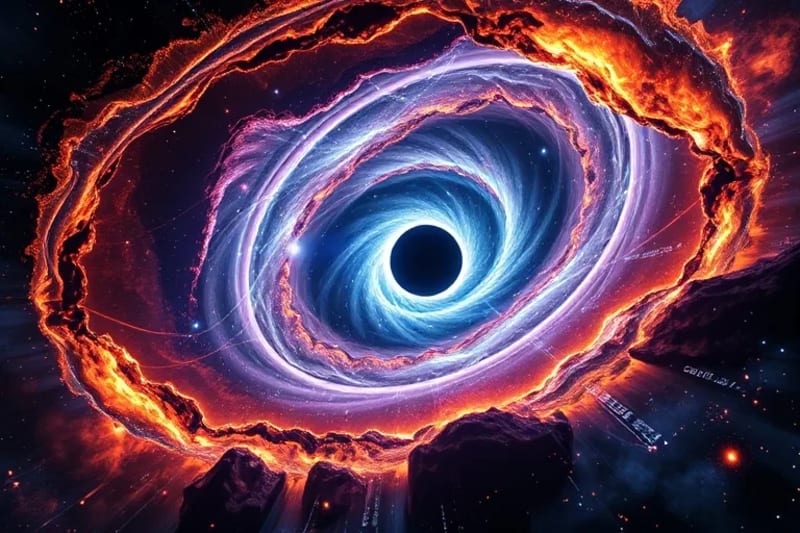
Conceptual AI rendering, exploring the intersection of cosmic phenomena and advanced data visualization.
This article delves into how advanced computational modeling is transforming our understanding of black holes, exploring the techniques, discoveries, and future prospects of this cutting-edge field. We will examine the types of simulations used, the insights gained, and the challenges that still lie ahead in our quest to comprehend these ultimate cosmic engines.
Table of Contents
- The Enigma of Black Holes: A Brief Overview
- The Power of Computational Modeling in Astrophysics
- Simulating Black Hole Dynamics and Interactions
- Unveiling the Universe: Key Discoveries from Simulations
- Challenges and Future Directions in Black Hole Modeling
The Enigma of Black Holes: A Brief Overview
Black holes are not merely empty voids; they are incredibly dense objects with gravitational fields so intense that nothing, not even light, can escape once it crosses a boundary known as the event horizon. Their existence was first predicted by Albert Einstein's theory of general relativity, and since then, astronomical observations have provided overwhelming evidence of their reality.
There are primarily two main types of black holes that astrophysicists study. Stellar-mass black holes form from the gravitational collapse of massive stars at the end of their life cycles, typically having masses several times that of our Sun. Supermassive black holes, on the other hand, reside at the centers of most galaxies, including our own Milky Way, and can have masses millions to billions of times that of the Sun.
Key properties of black holes include their mass, spin, and electric charge, though the latter is generally considered negligible in astrophysical contexts. The event horizon marks the point of no return, while the singularity is the theoretical point of infinite density at the black hole's center. Stephen Hawking's groundbreaking work also introduced the concept of Hawking radiation, suggesting that black holes are not entirely "black" but slowly evaporate over cosmic timescales, emitting thermal radiation.
Observational challenges are immense. Since black holes do not emit light, they are detected indirectly through their gravitational influence on nearby matter or through the energetic emissions from material falling into them, forming accretion disks. The Event Horizon Telescope (EHT) collaboration recently achieved a monumental feat by capturing the first direct image of a black hole's shadow, specifically that of M87* and Sagittarius A*, providing unprecedented visual evidence.
The Power of Computational Modeling in Astrophysics
Given the extreme conditions near black holes—intense gravity, relativistic speeds, and superheated plasma—direct experimentation is impossible. This is where computational modeling becomes invaluable. Simulations allow astrophysicists to create virtual laboratories where they can explore physical processes under conditions that cannot be replicated on Earth or fully observed with current telescopes.
Computational models are essentially numerical solutions to complex physical equations, primarily those derived from general relativity and magnetohydrodynamics (MHD). These equations describe how matter, energy, and spacetime interact in the vicinity of black holes. By discretizing spacetime and matter into a grid, supercomputers can calculate the evolution of these systems over time.

AI-generated artistic interpretation of cosmic phenomena and data processing.
Two primary types of simulations dominate black hole research: General Relativistic Magnetohydrodynamics (GRMHD) simulations and N-body simulations. GRMHD simulations are crucial for understanding the behavior of plasma and magnetic fields in strong gravitational environments, particularly in accretion disks and the formation of relativistic jets. N-body simulations, on the other hand, track the gravitational interactions of many individual particles or objects, useful for studying star clusters around black holes or galactic dynamics.
The development of these sophisticated models relies heavily on advances in computational science, including numerical methods and parallel computing. Supercomputers with thousands of processors are required to handle the immense computational load. Notable simulation codes like GRMHD codes (e.g., HARM, BHAC) and Einstein Toolkit for gravitational wave studies are at the forefront of this research. The historical development of computational concepts, such as those pioneered by Ada Lovelace's vision for general computation, laid the groundwork for the complex algorithms used today.
Simulating Black Hole Dynamics and Interactions
Computational modeling allows scientists to explore dynamic scenarios involving black holes that are otherwise inaccessible. These simulations provide detailed insights into processes like binary black hole mergers, the physics of accretion disks, and the role of black holes in galactic evolution.
Binary Black Hole Mergers: One of the most spectacular applications of computational modeling has been in simulating the inspiral and merger of binary black holes. These events are powerful sources of gravitational waves, ripples in spacetime predicted by Einstein. Simulations accurately predict the waveform signatures that observatories like LIGO and Virgo detect, allowing scientists to extract information about the masses, spins, and distances of the merging black holes. These models are essential for interpreting gravitational wave data and confirming general relativity in extreme gravitational regimes.
Accretion Disks and Jets: When matter falls towards a black hole, it often forms a swirling disk called an accretion disk. Friction within this disk heats the material to millions of degrees, causing it to emit intense radiation across the electromagnetic spectrum. GRMHD simulations are crucial for understanding the complex interplay of gravity, magnetic fields, and plasma within these disks. They reveal how magnetic fields can channel material into powerful, collimated jets that extend thousands of light-years into space, carrying immense energy away from the black hole.
Black Holes in Galactic Centers: Supermassive black holes at the centers of galaxies are not passive observers; they actively influence their host galaxies. Simulations help us understand how these central black holes grow, how they interact with surrounding gas and stars, and how their feedback (through jets and winds) can regulate star formation and galaxy evolution. These models often couple GRMHD simulations of the immediate vicinity of the black hole with larger-scale cosmological simulations of galaxy formation.
Unveiling the Universe: Key Discoveries from Simulations
Computational modeling has led to several groundbreaking discoveries and deepened our understanding of the universe. These insights often precede or complement direct observations, providing the theoretical framework necessary for interpretation.
- Predicting Gravitational Wave Signatures: Before the first direct detection of gravitational waves by LIGO in 2015, numerical relativity simulations had already predicted the precise waveforms expected from merging black holes. This theoretical prediction was critical for designing the detectors and identifying the signals amidst noise. The agreement between simulated waveforms and observed data has been a triumph for general relativity and computational astrophysics.
- Understanding Accretion Disk Physics: Simulations have revealed the crucial role of magnetic fields in driving accretion onto black holes through processes like the magnetorotational instability (MRI). They have shown how magnetic field lines can become twisted and amplified, leading to the formation of powerful jets and outflows that can affect galactic environments.
- Insights into Galaxy Evolution: By modeling the feedback mechanisms from supermassive black holes, simulations have demonstrated how these cosmic engines can regulate the growth of galaxies. Energy injected by black hole jets can heat gas, preventing it from cooling and forming new stars, thus shaping the evolutionary paths of galaxies.
- Interpreting Event Horizon Telescope Images: Computational models of accretion disks around black holes were instrumental in interpreting the first images of M87* and Sagittarius A* from the Event Horizon Telescope. These simulations helped distinguish between different theoretical models of accretion and provided critical context for understanding the observed "shadow" of the black hole.
Challenges and Future Directions in Black Hole Modeling
Despite the remarkable progress, significant challenges remain in black hole modeling. The extreme scales and complex physics involved push the limits of current computational capabilities and theoretical understanding.

Conceptual vector art depicting advanced computational infrastructure.
Computational Limits: Achieving sufficient resolution to capture all relevant physical processes across vast spatial and temporal scales is a persistent challenge. Simulating a black hole's immediate vicinity while also modeling its interaction with the surrounding galaxy requires immense computational power, often pushing supercomputers to their absolute limits. The integration of quantum gravity effects, which become relevant near the singularity, remains a theoretical and computational hurdle.
Integrating New Observational Data: As new observatories come online (e.g., next-generation gravitational wave detectors, advanced X-ray telescopes, future EHT observations), the volume and precision of observational data will increase. Models must continuously evolve to incorporate and explain these new findings, leading to a tighter feedback loop between theory, simulation, and observation.
Machine Learning Applications: The future of black hole modeling will likely see an increased role for machine learning and artificial intelligence. AI can be used to accelerate simulations, analyze vast datasets, identify patterns, and even develop new numerical methods. This could lead to breakthroughs in understanding complex phenomena that are currently too computationally intensive to model fully.
The quest to understand black holes is a journey into the most extreme realms of physics. Computational modeling acts as our primary guide, allowing us to explore these cosmic frontiers from the safety of our digital laboratories. As technology advances and our theoretical understanding deepens, these simulations will continue to unlock new secrets about the universe's most mysterious objects.
Explore More Cosmic Insights
- AI Ethics in Preventive Medicine: Personalized Longevity
- Cyborg Philosophy: Ethics of Artificial Consciousness and Human-Machine Integration
- Artificial Consciousness: Can Machines Feel? Deep Ethical Implications
- Neurotechnology and Intellectual Property: Digital Consciousness Legal Challenges
- Manifestation Magic: Intention, Visualization, Ritual
Source: Hybrid content assisted by AI and human editorial supervision.


Comentarios