
Ada Lovelace Algorithmic Vision Quantum Computing Legacy
Ada Lovelace, born Augusta Ada Byron in 1815, stands as a monumental figure in the annals of science and technology. Often celebrated as the world's first computer programmer, her contributions extended far beyond merely translating or documenting Charles Babbage's Analytical Engine. Lovelace possessed a profound, almost prophetic, understanding of what a machine could achieve, envisioning a future where computation transcended mere arithmetic to manipulate symbols, create music, and even generate art. Her insights laid foundational stones for the abstract concepts that underpin modern computing, principles that continue to resonate even in the nascent field of quantum computing.
This article delves into the remarkable legacy of this visionary mathematician, exploring her unique algorithmic perspective and drawing conceptual parallels between her 19th-century insights and the complex, probabilistic world of quantum computation. We will uncover how her abstract thinking about symbolic manipulation provided a blueprint for future technological advancements, positioning her as a pioneer whose influence stretches across centuries.
Table of Contents
- Ada Lovelace: A Pioneer Beyond Her Time
- The Analytical Engine and the Dawn of Programming
- Lovelace's Vision: Beyond Number Crunching
- The Algorithmic Blueprint: Bernoulli Numbers
- From Victorian Algorithms to Quantum Frontiers
- Conceptual Parallels: Lovelace's Abstraction and Quantum Logic
- The Enduring Legacy of the First Programmer
Ada Lovelace: A Pioneer Beyond Her Time
Born to the poet Lord Byron and mathematician Lady Anne Isabella Milbanke Byron, Ada Lovelace inherited a unique blend of poetic sensibility and rigorous analytical intellect. Her mother, concerned about any inherited "poetic madness" from Byron, ensured Ada received a strict education in mathematics and science, a rare privilege for women in the 19th century. This rigorous training, combined with her innate curiosity, set the stage for her groundbreaking work.
Lovelace's early life was marked by intellectual engagement with leading scientific minds of her era, including Mary Somerville, a prominent scientist and polymath who became her mentor. Somerville introduced Lovelace to Charles Babbage, the eccentric inventor and mathematician known as the "Father of the Computer." This introduction in 1833 proved to be a pivotal moment, sparking a collaboration that would forever alter the course of technological history.
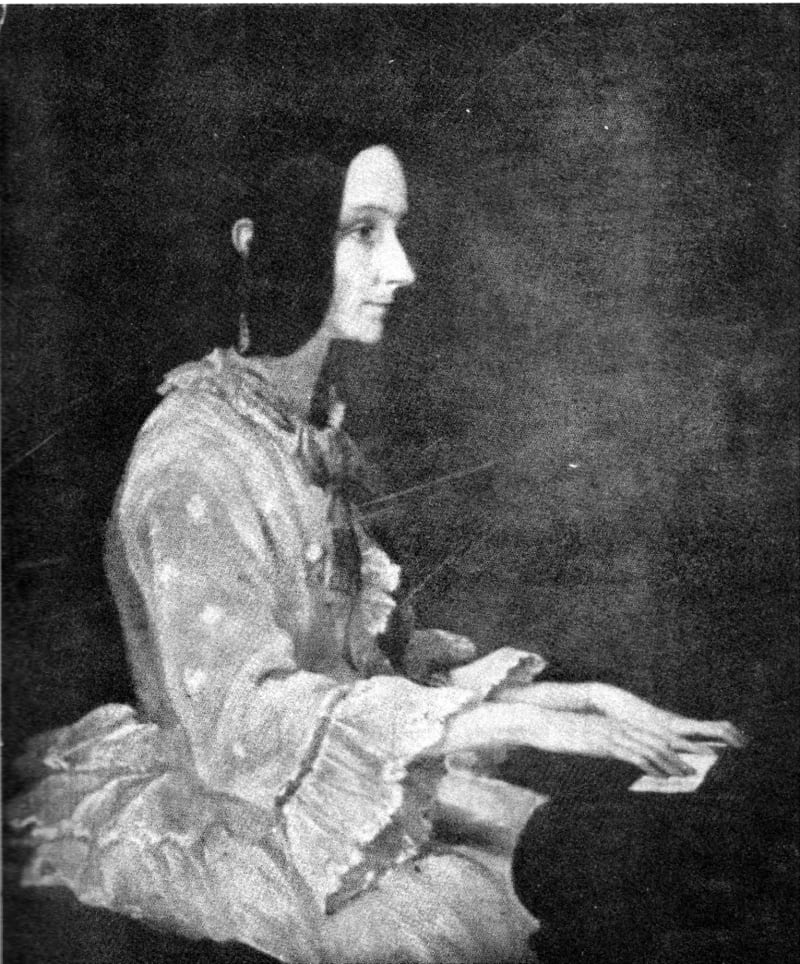
Precursors intellectuales, diagramas fundamentales y representaciones conceptuales que forjaron la visión de Ada Lovelace sobre la computación.
Fuente visual sujeta a disponibilidad del ecosistema: Wikimedia Commons bajo licencia CC BY-SA 4.0 o renderizado conceptual IA.The Analytical Engine and the Dawn of Programming
Charles Babbage's Analytical Engine was a revolutionary design for a mechanical general-purpose computer. Unlike his earlier Difference Engine, which was designed for specific calculations, the Analytical Engine was intended to be programmable, capable of performing any calculation given the right instructions. It featured an arithmetic logic unit (the "mill"), control flow in the form of conditional branching and loops, and integrated memory (the "store"). However, Babbage struggled to secure funding and complete the machine during his lifetime.
Lovelace's involvement began when she was asked to translate an article by Italian military engineer Luigi Federico Menabrea about the Analytical Engine. Her translation, published in 1843, was not merely a linguistic exercise. At Babbage's suggestion, she appended extensive notes—labeled A through G—that were three times longer than the original article. These notes are where her true genius shone, transforming a technical description into a philosophical treatise on the nature and potential of computation.
In these notes, she described how the machine could go beyond simple arithmetic to follow a sequence of operations, a concept that is now fundamental to computer programming. Her detailed explanation of how the Analytical Engine could calculate Bernoulli numbers is widely regarded as the first computer program ever written, outlining a step-by-step process for the machine to execute. This was a monumental leap in understanding the abstract capabilities of machinery.
Lovelace's Vision: Beyond Number Crunching
Perhaps Lovelace's most profound contribution was her foresight into the non-numerical applications of computing. While Babbage primarily saw his engine as a powerful calculator, Lovelace envisioned its potential to manipulate symbols of any kind, not just numbers. She famously wrote:
The Analytical Engine might act upon other things besides number, were objects found whose mutual fundamental relations could be expressed by those of the abstract science of operations, and which should be also susceptible of adaptations to the action of the operating mechanism of the engine.
Supposing, for instance, that the fundamental relations of pitched sounds in the science of harmony and of musical composition were susceptible of such expression and adaptations, the engine might compose elaborate and scientific pieces of music of any degree of complexity or extent.
This insight, often referred to as the "Lovelace objection" (though it was more of a visionary statement than an objection), highlighted the machine's capacity for symbolic manipulation. She understood that if any entity could be represented numerically or symbolically, the engine could process it. This abstract view of computation is the bedrock of modern computing, enabling everything from word processing and image manipulation to artificial intelligence and complex simulations. Her vision transcended the mechanical limitations of the Analytical Engine, anticipating a future where machines could create and innovate.

The intricate interplay of historical mechanical components with modern digital elements, reflecting the enduring impact of early computational theories.
The Algorithmic Blueprint: Bernoulli Numbers
Lovelace's Note G, detailing the method for calculating Bernoulli numbers using the Analytical Engine, is a seminal piece in the history of computer science. It meticulously outlines a sequence of operations, including loops and conditional statements, that the machine would follow. This was not just a mathematical formula; it was a demonstration of how to instruct a machine to perform a complex task algorithmically.
Her algorithm illustrated the concept of iteration, where a set of instructions is repeated multiple times, and the use of variables to store intermediate results. This level of detail and conceptual clarity was unprecedented. It showcased her deep understanding of the machine's architecture and her ability to translate abstract mathematical problems into concrete, executable steps. This is the essence of programming: breaking down a problem into a series of logical, manageable instructions that a machine can understand and execute.
The significance of this work cannot be overstated. It provided a tangible example of how a general-purpose machine could be programmed to perform tasks beyond simple arithmetic. It laid the groundwork for future generations of programmers and computer scientists, demonstrating the power of algorithms as a universal language for instructing machines. The principles she articulated are still fundamental to how we design software and interact with computers today, from simple scripts to complex AI governance models.
From Victorian Algorithms to Quantum Frontiers
The journey from Lovelace's 19th-century mechanical visions to 21st-century quantum computing is vast, yet surprising conceptual threads connect these disparate eras. Classical computing, built on the binary logic of bits (0s and 1s), directly follows the deterministic, step-by-step algorithmic paradigm Lovelace helped define. However, quantum computing operates on fundamentally different principles, leveraging quantum-mechanical phenomena like superposition and entanglement.
Quantum computers use qubits, which can exist in multiple states simultaneously (both 0 and 1 at the same time) and can be entangled with other qubits, meaning their states are interdependent regardless of distance. This allows quantum computers to process vast amounts of information in parallel, solving certain problems intractable for even the most powerful classical supercomputers. Fields like genetic engineering and advanced materials science are poised to be transformed by this new computational paradigm.
Despite the radical differences in underlying physics, the core idea of instructing a machine to perform abstract operations remains. Quantum algorithms, like Shor's algorithm for factoring large numbers or Grover's algorithm for searching unsorted databases, are still sequences of logical steps designed to manipulate quantum states to achieve a desired outcome. The "language" is different, but the algorithmic intent—to harness a machine's unique capabilities for problem-solving—is a direct descendant of Lovelace's pioneering work.
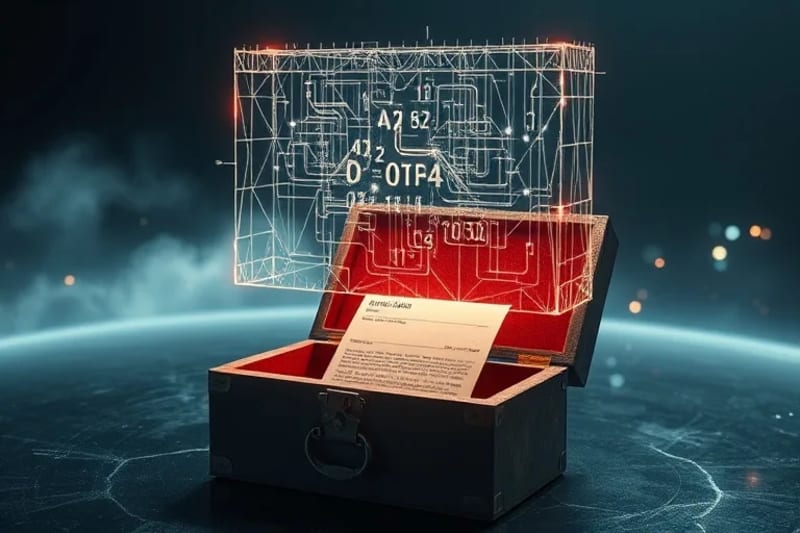
A conceptual bridge illustrating the evolution of computational thought, from the tangible punch card to the abstract, luminous patterns of quantum algorithms.
Conceptual Parallels: Lovelace's Abstraction and Quantum Logic
The most striking parallel between Lovelace's vision and quantum computing lies in the realm of abstraction. Lovelace saw beyond the mechanical gears and levers of Babbage's engine to the abstract manipulation of symbols. She understood that the specific physical implementation was secondary to the logical operations being performed. This is a crucial philosophical underpinning for quantum computing, where the "bits" are no longer simple on/off switches but complex quantum states.
- Symbolic Manipulation: Lovelace's insight that the engine could process "other things besides number" finds a modern echo in quantum computing's ability to manipulate complex probability amplitudes rather than just binary values. These amplitudes are abstract representations of quantum states, and quantum algorithms are designed to manipulate these symbols to achieve a desired measurement outcome.
- Algorithmic Thinking: Both classical and quantum computing rely on precise algorithmic thinking. While the operations (e.g., Hadamard gates, CNOT gates in quantum computing) are different from classical logic gates, they are still fundamental building blocks of an algorithm. Lovelace's structured approach to defining a computational process remains universally applicable.
- Potential for the Unforeseen: Just as Lovelace envisioned music and art from a number-crunching machine, quantum computing holds the promise of solving problems and creating applications that are currently unimaginable. Its probabilistic nature and ability to explore vast solution spaces simultaneously open doors to entirely new paradigms of computation, echoing Lovelace's belief in the engine's potential beyond its initial design.
The very concept of a universal computer, capable of simulating any other computational process, owes much to the abstract understanding of computation that Lovelace helped pioneer. Quantum computers, while operating on different physical principles, are still fundamentally universal machines in this abstract sense, capable of executing a wide range of quantum algorithms. Her "poetical science" approach, combining imaginative vision with mathematical rigor, is arguably mirrored in the highly abstract and counter-intuitive nature of quantum mechanics and its application in computing.
The Enduring Legacy of the First Programmer
Ada Lovelace's legacy is far more than just being the "first programmer." She was a visionary who saw the forest for the trees, understanding the abstract power of computation when others were still focused on its immediate numerical utility. Her notes on the Analytical Engine are not just historical curiosities; they are foundational texts that articulate principles still vital to computer science today.
Her ability to connect the abstract world of mathematics with the practical potential of machines, and to envision applications beyond the obvious, makes her an enduring inspiration. In an era where technology is rapidly advancing, from artificial intelligence to quantum computing, Lovelace's holistic and imaginative approach to science reminds us that true innovation often comes from looking beyond the immediate and understanding the deeper, more abstract implications of our tools. Her work continues to resonate, a testament to a mind that truly lived centuries ahead of its time.
Related Articles and Further Reading
- Bioingeniería Genética Ética Implicaciones Futuro Humano
- Blockchain Economía Circular: Cadena Suministro Sostenible Regenerativa
- Decentralized Finance Social Impact Governance Transparency
- Astrología Cuántica Kármica Decisiones Futuras Líneas Temporales
Source: Hybrid content assisted by AI and human editorial supervision.


Comentarios