
Generative AI Creativity Future Authorship Intellectual Property
The advent of Generative Artificial Intelligence (AI) has sparked a profound revolution across numerous industries, with its impact on artistic creativity being particularly transformative. This cutting-edge technology, capable of producing novel content such as images, music, text, and even video, is challenging long-held notions of authorship, intellectual property, and the very essence of human creativity. As AI models become increasingly sophisticated, their ability to generate compelling and original works raises critical questions that demand careful consideration from artists, legal experts, ethicists, and society at large.
This article delves into the multifaceted implications of generative AI on the creative landscape, exploring how these powerful tools are reshaping artistic practices, challenging legal frameworks, and sparking vigorous debates about the future of human ingenuity. We will examine the mechanisms behind AI art generation, the complex issue of attributing authorship, the intricate legal battles over intellectual property, and the broader ethical considerations that arise as machines increasingly participate in the creative process.
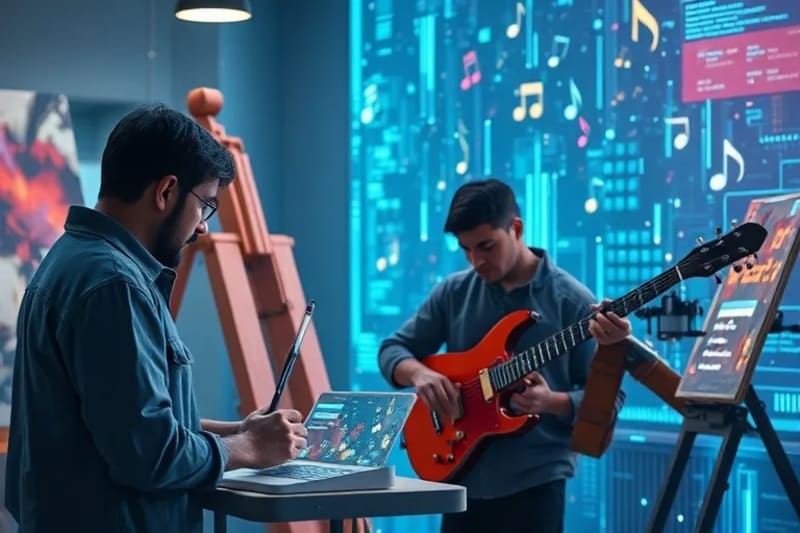
Artists and AI interfaces co-creating, symbolizing the evolving landscape of artistic expression.
The Rise of Generative AI in Art
Generative AI models, such as Generative Adversarial Networks (GANs) and Transformers, have rapidly evolved to produce remarkably sophisticated and often indistinguishable from human-made art. These systems learn from vast datasets of existing artworks, identifying patterns, styles, and compositions, which they then use to create entirely new pieces. This process moves beyond simple automation, enabling machines to exhibit a form of "creativity" that was once considered exclusively human.
The applications are diverse, ranging from generating hyper-realistic images and abstract paintings to composing musical scores and writing compelling narratives. Artists are increasingly using these tools as collaborators, extending their creative capabilities and exploring new aesthetic territories. The ability of AI to rapidly iterate on ideas, experiment with styles, and even transcend human limitations in certain aspects of creation has opened up unprecedented avenues for artistic exploration.
However, this technological leap also prompts a re-evaluation of the creative process itself. Is the artist now primarily a curator of prompts, a director of algorithms, or still the sole visionary? The shift from direct manual creation to guiding an intelligent system blurs the lines of traditional artistic roles, inviting a deeper philosophical inquiry into the nature of art and its production.
Redefining Authorship in the AI Era
Perhaps one of the most contentious issues surrounding generative AI in art is the question of authorship. In traditional legal frameworks, authorship is unequivocally attributed to a human creator. However, when an AI generates a piece of art, who is the author? Is it the individual who crafted the prompt, the developer who coded the AI model, the data scientists who curated the training data, or perhaps the AI itself as an autonomous entity?
Current intellectual property laws, particularly copyright, are largely designed around human creativity. For instance, the U.S. Copyright Office has stated that copyright protection can only extend to works created by a human author. This stance creates a significant legal vacuum for AI-generated content, leading to scenarios where such works might fall into the public domain immediately upon creation, unless there's substantial human input that qualifies as authorship.
Intellectual property symbols intertwined with digital code, symbolizing the legal complexities of AI-generated works.
The debate extends beyond legal definitions to philosophical considerations. If an AI can produce art that evokes emotion, tells a story, or demonstrates technical mastery, does it not possess a form of "creativity" that warrants recognition? This question challenges our anthropocentric view of creation and forces us to consider the evolving relationship between human ingenuity and artificial intelligence.
Some argue that the human element remains paramount, as AI is merely a tool, albeit a highly sophisticated one. The human artist provides the initial concept, refines the output, and makes the final aesthetic judgments, thus retaining authorship. Others contend that as AI becomes more autonomous, the line between tool and creator blurs, necessitating new legal and ethical frameworks to acknowledge its role. Understanding the historical context of computing and programming, as exemplified by pioneers like Ada Lovelace: Software Origin, Object-Oriented Programming, can provide valuable perspective on the evolution of intelligent systems.
Intellectual Property Challenges and Solutions
The intellectual property landscape for generative AI is fraught with challenges. One primary concern is the copyright status of AI-generated works. If no human author is recognized, these works could be freely copied and distributed, potentially devaluing the creative output and disincentivizing investment in AI art tools. This necessitates a re-evaluation of existing copyright laws or the creation of new legal categories to address AI-generated content.
Another significant challenge arises from the training data used by generative AI models. These models learn by processing vast amounts of existing copyrighted material. Questions abound regarding whether this constitutes copyright infringement, especially if the AI's output closely resembles specific works from its training set. Lawsuits have already emerged, with artists and copyright holders alleging that AI models are essentially "copying" their work without permission or compensation.
Solutions being explored include implementing licensing agreements for training data, developing mechanisms for artists to opt-out of their work being used for AI training, and establishing clear guidelines for "fair use" in the context of AI learning. Additionally, new forms of digital rights management and blockchain-based solutions could offer ways to track and attribute AI-generated works, ensuring proper compensation and recognition. The principles of Decentralized Finance Social Impact Governance Transparency might offer inspiration for transparent and equitable frameworks in this emerging domain.
The commercialization of AI art also presents complexities. Who profits from AI-generated content? If a company develops an AI that creates popular music, how are royalties distributed? These questions are critical for fostering a sustainable and equitable ecosystem for AI-assisted creativity. Furthermore, the potential for Data Leaks Famous Cases Prevention Incident Recovery in the context of sensitive artistic data highlights the need for robust security measures.
Ethical and Societal Debates
Beyond legal and technical considerations, generative AI in art ignites profound ethical and societal debates. One central concern revolves around the authenticity and value of AI-generated art. If a machine can mimic human creativity, does it diminish the unique value of human artistic expression? Some argue that AI art lacks the soul, intention, and lived experience that define human art, while others celebrate it as a new medium for expression.
A dynamic oil painting capturing the essence of ethical and philosophical debates surrounding AI in the creative sphere.
Another significant ethical dilemma is the potential displacement of human artists. As AI tools become more proficient and accessible, there are fears that they could replace human jobs in creative industries, from graphic design to illustration. This raises questions about the economic future of artists and the need for policies that support human creativity alongside technological advancement. The discussion around legal entities and their implications, such as those explored in SAS Colombia: Legal Advantages and Disadvantages, might offer parallels in considering new legal statuses for AI creations or entities.
Furthermore, AI models can inherit and amplify biases present in their training data. If AI is trained on datasets that predominantly feature certain demographics or artistic styles, its output may perpetuate or even exacerbate existing inequalities. Ensuring fairness, diversity, and inclusivity in AI art generation requires conscious effort in data curation and model development.
The concept of "deepfakes" also enters the artistic realm, where AI can generate highly convincing but fabricated images, audio, or video. This raises concerns about misinformation, manipulation, and the erosion of trust in digital media. Ethical guidelines and robust detection mechanisms are crucial to mitigate these risks and maintain the integrity of artistic expression.
The Future of Creativity: Human-AI Synergy
Despite the challenges, many see generative AI not as a threat, but as a powerful catalyst for the future of creativity. The most promising path forward appears to be one of human-AI synergy, where artificial intelligence acts as a co-creator, muse, or assistant, rather than a replacement for human artists. This collaborative model allows artists to leverage AI's computational power and pattern recognition abilities to explore ideas, generate variations, and refine their work in unprecedented ways.
New art forms are emerging that are inherently hybrid, blending traditional artistic techniques with AI-driven processes. This could lead to entirely new aesthetic languages and creative expressions that were previously unimaginable. The focus shifts from the AI as an autonomous creator to the human's ability to conceptualize, guide, and interpret the AI's output, infusing it with meaning and purpose.
To navigate this evolving landscape successfully, proactive policy-making and legal reforms are essential. Governments, legal bodies, and artistic communities must collaborate to establish clear guidelines for authorship, intellectual property, and ethical use of AI in creative fields. This includes developing frameworks that protect human artists while fostering innovation in AI technology.
Ultimately, the future of creativity in the age of generative AI will be defined by how we choose to integrate these powerful tools into our artistic practices and societal structures. By embracing a collaborative mindset, addressing ethical concerns head-on, and adapting legal frameworks, we can harness the immense potential of AI to unlock new dimensions of human expression and redefine what it means to be creative.
Explore Further: Related Insights
- Norse Mythology: Gods, Heroes, and Ragnarök
- Liability Insurance: Colombian Commercial Code Analysis
- Michael Jackson Choreography: Innovation, Legacy, Smooth Criminal
- Female Hormonal Biohacking Strategies for Longevity
- Global Supply Crisis: Impact on Current Economy
- Colombian Air Transport Law: Decree 410 Overview
- Abacus Quantum Computing: Evolution of Logical Thought
- Circular Business Models Green Startups Regenerative Economy
- Microplastics: Invisible Threat, Health and Planet Impact
- Agile Project Management: Scrum Kanban Methodologies in Practice
- Colombian Commercial Code: Bank Current Account
External Perspectives: Deepening Your Knowledge
- Mars in Jyotish: Remedies for Willpower and Obstacles
- Karmic Retrogrades Akashic Records: Unlocking Ancestral Patterns
- Natal Chart Quadrants: Purpose, Development, Life Stages
- Prophecies of Saint John Bosco: Visions of Future Church and World
- Sacramentals: Meaning and Protective Power in the Church
- Gratitude Prayers: Elevate Spirit, Attract Blessings
- Chinese Zodiac Ox: 2024 Forecast, Love, Career, Health
- Fixed Stars, Lunar Nodes: Karmic Blueprint Unveiled
- Dream Interpretation: Unlocking Subconscious Messages
Source: Hybrid content assisted by AI and human editorial supervision.


Comentarios