
Sustainable Nuclear Fusion: AIs Role in Global Energy Transition
The quest for clean, abundant, and sustainable energy has been a cornerstone of scientific and technological advancement for decades. Among the most promising candidates is nuclear fusion, the process that powers the sun and stars. Unlike nuclear fission, which involves splitting atoms, fusion combines light atomic nuclei to release enormous amounts of energy, with minimal radioactive waste and no greenhouse gas emissions. However, achieving controlled and sustained fusion on Earth has presented formidable challenges, primarily due to the extreme conditions required to initiate and maintain plasma reactions. In recent years, the advent of artificial intelligence (AI) has emerged as a transformative force, offering unprecedented capabilities to accelerate research and development in this critical field, pushing us closer to a global energy transition.
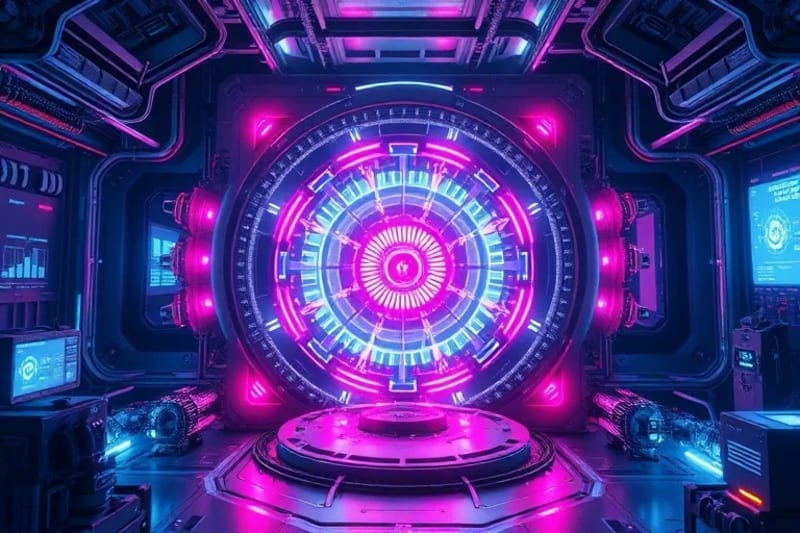 Conceptual rendering of an advanced fusion reactor core, illustrating the intricate interplay between high-energy plasma and sophisticated AI diagnostic systems, foundational for achieving sustainable energy.
This visual concept, generated by an AI, captures the essence of cutting-edge fusion research, blending scientific aspiration with technological innovation under a free-to-use license.
Nuclear fusion promises a future where energy scarcity is a relic of the past. The fuel sources, primarily deuterium and tritium, are readily available; deuterium can be extracted from seawater, and tritium can be bred from lithium, a common element. The byproducts are non-radioactive helium and a small amount of short-lived radioactive waste, a stark contrast to the long-lived waste produced by fission reactors. This inherent safety and environmental friendliness make fusion an ideal long-term solution for global energy needs, aligning perfectly with the urgent call for a sustainable circular economy and climate change mitigation efforts. The path to harnessing this power involves overcoming immense engineering and physics hurdles, where AI is proving to be an indispensable ally.
Table of Contents
- The Fundamentals of Fusion Energy
- Key Challenges in Fusion Research
- AI for Plasma Control and Stability
- AI in Experimental Design and Optimization
- Material Science Advancements with AI
- Fusion's Role in Global Energy Transition
- Future Outlook and Collaboration
The Fundamentals of Fusion Energy
Nuclear fusion occurs when two light atomic nuclei merge to form a heavier nucleus, releasing a substantial amount of energy in the process. This reaction requires extreme temperatures, typically exceeding 100 million degrees Celsius, to overcome the electrostatic repulsion between the positively charged nuclei. At these temperatures, matter exists in a plasma state, a superheated ionized gas where electrons are stripped from their atoms. Confining and controlling this plasma for long enough to achieve a net energy gain (more energy out than in) is the central challenge.
The most common approach to magnetic confinement fusion is the tokamak, a donut-shaped device that uses powerful magnetic fields to trap and control the superheated plasma. Inside a tokamak, the plasma is heated to fusion temperatures, and if conditions are met, fusion reactions occur, releasing energetic neutrons that can be used to generate electricity. This intricate dance of physics and engineering demands precise control and real-time adjustments, areas where traditional methods often fall short, making AI an invaluable tool.
Key Challenges in Fusion Research
Despite decades of research, several significant hurdles remain before fusion energy can become a commercial reality. These challenges span plasma physics, material science, and engineering:
- Plasma Instability: Plasma is inherently turbulent and prone to instabilities that can cause it to cool, escape confinement, or damage the reactor walls. Predicting and mitigating these instabilities in real-time is crucial.
- Confinement Time: Achieving sufficient confinement time for the plasma at fusion temperatures is essential to sustain reactions and produce net energy.
- Material Degradation: The extreme neutron flux produced by fusion reactions can severely damage reactor components, particularly the first wall facing the plasma. Developing materials that can withstand these conditions is vital.
- Heating Efficiency: Efficiently heating the plasma to the required temperatures while minimizing energy input is another critical factor for achieving net energy gain.
- Diagnostic Complexity: Monitoring the plasma's behavior requires an array of sophisticated diagnostic tools that generate vast amounts of data, which must be processed and interpreted rapidly.
AI for Plasma Control and Stability
One of the most impactful applications of AI in fusion research is in real-time plasma control. Deep learning algorithms can analyze vast datasets from plasma diagnostics to predict and mitigate instabilities before they lead to disruptions. For instance, AI models can learn the complex dynamics of plasma behavior and adjust magnetic fields with unprecedented speed and precision, maintaining optimal confinement conditions.
 Stylized representation of a global energy network, where AI algorithms streamline the integration of sustainable sources and optimize distribution for efficiency.
This vector art, conceptualized by an advanced AI, visualizes the future of energy management, available for use under a creative commons license.
Researchers at institutions like DeepMind and the Swiss Plasma Center have demonstrated AI's ability to control plasma in tokamak reactors, shaping it into various configurations and preventing disruptions. These AI systems can react much faster than human operators or traditional control systems, learning from millions of data points to identify subtle patterns that precede instabilities. This capability is critical for future fusion reactors, which will operate with higher power densities and more complex plasma scenarios, demanding instantaneous and adaptive control mechanisms. The integration of AI in this domain is not just an enhancement; it is a fundamental shift in how fusion experiments are managed and optimized.
AI in Experimental Design and Optimization
Beyond real-time control, AI is transforming the design and optimization of fusion experiments themselves. Machine learning algorithms can analyze historical experimental data to identify optimal operating parameters, predict outcomes of new experimental setups, and even suggest novel configurations for reactors. This significantly reduces the time and cost associated with trial-and-error experimentation, accelerating the pace of discovery.
For example, AI can be used to simulate complex plasma behavior with greater accuracy and speed than traditional physics-based models, allowing researchers to explore a wider range of scenarios virtually. This includes optimizing magnetic field configurations, injector angles for heating systems, and impurity control strategies. The ability to rapidly iterate through design choices and predict their impact is invaluable for projects like ITER (International Thermonuclear Experimental Reactor), the world's largest fusion experiment, which aims to demonstrate the scientific and technological feasibility of fusion power.
Material Science Advancements with AI
The development of advanced materials capable of withstanding the extreme conditions within a fusion reactor is another critical area where AI is making significant contributions. AI-driven computational material science can predict the properties of new alloys and composites under high temperatures and intense neutron bombardment, drastically reducing the need for costly and time-consuming physical experiments.
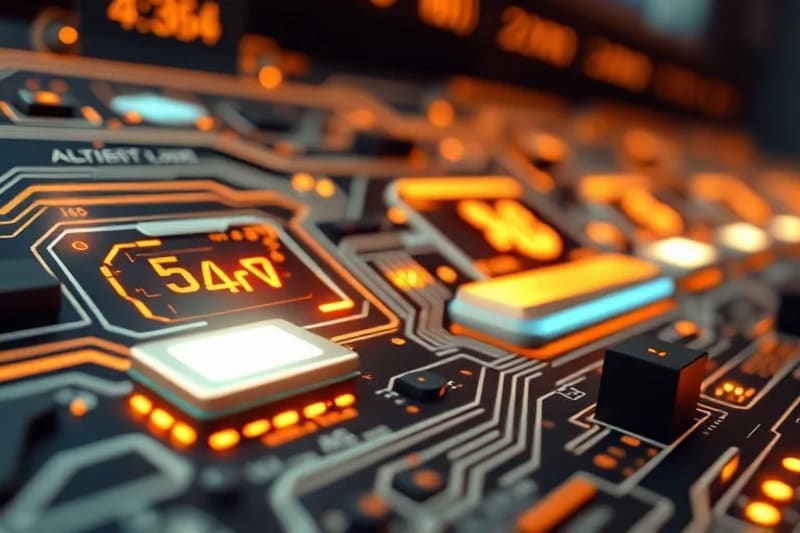 Intricate 3D render of a futuristic control panel, featuring glowing AI interfaces that process complex data for plasma stability and energy output in a fusion environment.
This detailed 3D rendering, a product of creative AI, illustrates the sophisticated control systems essential for advanced energy research, freely available for educational purposes.
Machine learning models can analyze vast databases of material properties and simulate how different atomic structures and compositions react to radiation damage, thermal stress, and chemical interactions. This allows researchers to rapidly screen potential candidates for first-wall materials, divertors, and other critical components, identifying those with the best performance characteristics. The ability to design and test materials virtually is a game-changer, accelerating the development cycle and bringing us closer to robust, long-lasting fusion reactors. This approach is similar to how AI is being used to optimize other complex systems, from augmented reality for ecosystem conservation to advanced manufacturing processes.
Fusion's Role in Global Energy Transition
The successful development of sustainable nuclear fusion would represent a monumental leap forward in the global energy transition. It offers a virtually limitless, clean energy source that is not dependent on fossil fuels, intermittent weather patterns, or geographical location. This would have profound implications for energy security, economic stability, and environmental protection worldwide.
Fusion power plants could provide baseload electricity, complementing renewable sources like solar and wind power, which are inherently variable. This combination would create a resilient and diversified energy mix, capable of meeting the increasing global demand for electricity without contributing to climate change. The shift to a fusion-powered world would also reduce geopolitical tensions over energy resources and provide developing nations with access to affordable, reliable electricity, fostering economic growth and improving quality of life. The challenges are significant, but the potential rewards are even greater, making it a critical area for continued investment and innovation.
Future Outlook and Collaboration
The synergy between nuclear fusion research and artificial intelligence is still in its early stages, but the progress made so far is incredibly promising. As AI models become more sophisticated and computational power increases, their ability to analyze complex data, predict phenomena, and optimize systems will only grow. This accelerated pace of innovation is crucial for achieving fusion power within a meaningful timeframe, potentially by mid-century.
International collaborations, such as the ITER project, are vital for pooling resources and expertise. The open sharing of data and AI models among research institutions globally can further expedite progress. Furthermore, the development of fusion energy aligns with broader technological trends, such as advancements in quantum computing, which could unlock even more powerful simulation and optimization capabilities for fusion systems. The future of energy is increasingly looking towards a blend of advanced physics and intelligent computing, where AI is not just a tool, but a co-pilot in humanity's journey towards a sustainable future.
The journey to sustainable nuclear fusion is long and arduous, but the integration of AI is providing new pathways and accelerating discoveries. From controlling turbulent plasmas to designing resilient materials and optimizing experimental setups, AI is proving to be an indispensable partner. As we continue to push the boundaries of science and technology, the dream of clean, limitless energy from fusion moves closer to becoming a reality, ushering in a new era for global energy and environmental stewardship. This transition is not just about technology; it's about a fundamental shift in how we power our world, impacting everything from longevity finance strategies to urban planning and resource allocation.
Explore More on Sustainable Innovation
- Immersive Architecture: Mental Well-being and Augmented Reality
- Adaptive Leadership: Managing Change in Volatile Environments
- Forest Fungi: Fungal Ecosystems, Vital Role in Nature
- Food Traceability Blockchain IoT: Challenges for Small Producers
- Numerology Dream Interpretation: Unlocking Subconscious Life Path
- Mesoamerican Astrology: Decoding Ancient Calendars Celestial Alignments
Source: Hybrid content assisted by AI and human editorial supervision.


Comentarios