
Cyborg Philosophy: Ethics, Consciousness, Human-Machine Integration
The concept of the cyborg, a portmanteau of "cybernetic organism," has profoundly transcended its origins in science fiction to become a pivotal subject of contemporary philosophical inquiry. This exploration extends far beyond merely envisioning a human with mechanical parts; it represents a fundamental re-evaluation of what it means to be human in an era of increasingly sophisticated technological integration. Our journey into cyborg philosophy delves into the intricate ethical, existential, and societal implications of merging human biology with advanced artificial intelligence and machinery, challenging our traditional boundaries of self, identity, and consciousness.
As technological advancements accelerate at an unprecedented pace, the once-clear line between organic and synthetic elements continues to blur, prompting urgent and complex questions about individual identity, personal autonomy, and the very definition of life itself. Understanding the philosophy of the cyborg is not merely an academic exercise; it constitutes a critical and timely endeavor to responsibly navigate the future trajectory of human evolution and technological integration. This field demands a thoughtful approach to ensure that progress aligns with human values and societal well-being.
Table of Contents
- 1. Defining the Cyborg: More Than Just a Machine
- 2. Historical Roots and Cybernetic Visions
- 3. Present-Day Cyborgs: From Therapy to Enhancement
- 4. Ethical Labyrinth: Autonomy, Identity, and Enhancement
- 5. The Consciousness Conundrum: What Makes Us "Us"?
- 6. Societal Integration: Challenges and Opportunities
- 7. The Future of Humanity: Transhumanism and Beyond

Precursors, conceptual diagrams, and artistic renderings that illuminate the philosophical landscape of human-machine integration in the digital era.
This conceptual artwork, generated by advanced AI, explores the intricate relationship between humanity and technology, reflecting potential future realities.1. Defining the Cyborg: More Than Just a Machine
The term "cyborg" was originally coined in 1960 by Manfred Clynes and Nathan Kline, who envisioned a "cybernetic organism" as a self-regulating human-machine system designed primarily for extraterrestrial survival. Their initial concept was rooted in practical engineering: to enhance human capabilities for the challenging environments of space exploration. Over time, however, this definition has significantly broadened, encompassing a much wider range of human-technology interfaces.
Philosophically, a cyborg transcends the simple notion of a person merely utilizing technology; it refers to an individual whose very being is fundamentally altered, extended, or redefined by technological components. This distinction is paramount: while wearing glasses or using a smartphone integrates technology into our daily lives, it does not typically render one a cyborg. In contrast, having a prosthetic limb that seamlessly integrates with the nervous system, or a brain implant designed to enhance cognitive function, begins to blur the traditional boundaries of what constitutes human biology.
Donna Haraway's influential "A Cyborg Manifesto" (1985) further radicalized and expanded this definition, proposing the cyborg as a powerful figure that inherently transcends traditional dualisms. Haraway argued that the cyborg challenges rigid categories such as human/animal, organism/machine, male/female, and physical/non-physical. She viewed the cyborg not as a dystopian threat, but rather as a liberating identity that actively subverts oppressive categories and opens up new possibilities for existence, political action, and reimagining societal structures.
2. Historical Roots and Cybernetic Visions
The underlying idea of augmenting human capabilities is deeply ancient, finding its roots in various myths and legends across cultures. Stories of gods and heroes possessing superhuman strength or artificial constructs like the Golem illustrate humanity's long-standing fascination with transcending natural limitations. However, the modern philosophical discourse surrounding cyborgs truly began to take shape with the emergence of cybernetics in the mid-20th century.
Cybernetics, defined as the study of control and communication mechanisms in both animal and machine systems, provided the essential theoretical framework for understanding self-regulating and adaptive systems. Norbert Wiener, a pivotal figure in the development of cybernetics, extensively explored the feedback loops and control mechanisms that are common to both biological organisms and complex machines. This intellectual convergence laid the crucial groundwork for imagining entities that could seamlessly integrate both organic and synthetic components.
The early cyberneticists envisioned a transformative future where technology would not only be capable of mimicking biological functions but also significantly enhancing them, directly leading to the conceptualization of the cyborg. From these robust theoretical foundations, practical applications gradually began to emerge, moving the cyborg from the realm of pure scientific speculation into tangible reality. This historical progression underscores the deep intellectual lineage of cyborg philosophy.
3. Present-Day Cyborgs: From Therapy to Enhancement
While the term "cyborg" often conjures images of science fiction, many individuals today already embody aspects of this concept through advanced medical technologies. Cochlear implants, for instance, restore hearing by directly stimulating the auditory nerve, effectively merging human biology with electronic components. Similarly, sophisticated prosthetic limbs, such as those with haptic feedback and neural control, allow users to interact with their environment in ways that were once unimaginable for amputees.
Brain-Computer Interfaces (BCIs) represent another frontier, enabling individuals with paralysis to control external devices, or even their own limbs, through thought alone. These therapeutic applications profoundly improve quality of life, demonstrating the immense potential of human-machine integration for restorative purposes. They highlight how technology can overcome significant physical limitations.
Beyond therapy, the discussion extends to enhancement. Experimental neural implants are being developed to boost memory or cognitive functions, pushing the boundaries of what is considered "normal" human capability. These developments compel us to consider the ethical implications of using technology not just to repair, but to upgrade, the human condition. This ongoing evolution makes the philosophical debate about cyborgs more relevant than ever.
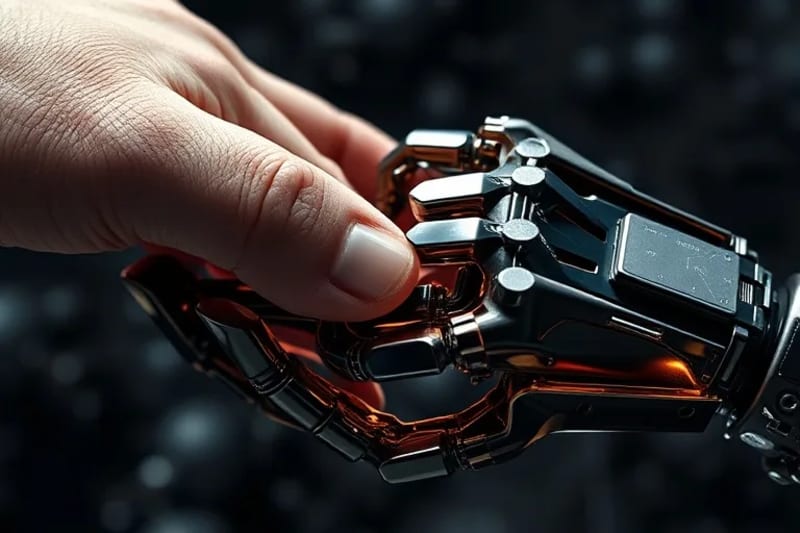
A visual representation of the delicate balance and profound ethical questions arising from the integration of human biology and advanced technology.
This digital painting captures the essence of the human-machine interface, highlighting the intricate ethical considerations involved.4. Ethical Labyrinth: Autonomy, Identity, and Enhancement
The ethical implications of cyborg technology are undeniably vast and complex, presenting a veritable labyrinth of moral considerations. One of the foremost concerns revolves around the concept of autonomy. If our cognitive functions are significantly enhanced, or even partially controlled, by external or implanted devices, how much of our decision-making process truly remains our own? This raises critical questions about the potential for technological manipulation, vulnerability to hacking, or even the unsettling prospect of corporate ownership over our enhanced faculties, thereby compromising individual freedom.
Identity emerges as another profoundly critical philosophical battleground within cyborg discourse. If significant portions of our body or mind are replaced or augmented with artificial components, does our fundamental sense of self remain intact and continuous? Is a person with extensive cybernetic enhancements still considered the "same" person in a metaphysical sense? This line of inquiry directly challenges traditional notions of personal continuity and the very essence of identity, moving beyond the body as the sole locus of self.
The ongoing debate concerning enhancement versus therapy is also central to these discussions. While the provision of advanced prosthetics for amputees is generally accepted as a therapeutic and beneficial intervention, enhancements that confer abilities far beyond typical human capacity—such as vastly improved memory or sensory perception—raise significant concerns. These include questions of fairness, potential for new forms of social stratification, and the emergence of a "post-human" elite, exacerbating existing societal inequalities.
Moreover, the legal and regulatory frameworks necessary to govern such advanced technologies are still in their nascent stages of development. As highlighted in discussions concerning Neuromorphic Computing: Ethical Regulation, Legal Dilemmas, and Brain Simulation, the urgent need for robust and foresightful guidelines is paramount. Such regulations are essential not only to prevent potential misuse but also to ensure equitable access and ethical development, safeguarding human values in a technologically advanced future.
5. The Consciousness Conundrum: What Makes Us "Us"?
Perhaps the most profound and challenging philosophical question posed by the advent of cyborg technology is that of consciousness itself. If a machine can effectively mimic human intelligence, demonstrate learning capabilities, and even simulate emotional responses with high fidelity, can it legitimately be considered conscious in the same way a biological organism is? Furthermore, if a human brain is extensively augmented with advanced artificial intelligence, does that AI seamlessly integrate into our consciousness, or does it persist as a distinct, separate entity within our cognitive architecture?
Philosophers of mind continually grapple with what is famously known as the "hard problem of consciousness"—the challenge of explaining how physical processes within the brain give rise to subjective experience, or "qualia." The concept of the cyborg introduces yet another layer of immense complexity to this problem. If we systematically replace biological neurons with sophisticated silicon chips, at what precise point does subjective experience begin to diminish, fundamentally alter, or perhaps even cease to exist? This leads to intricate thought experiments, akin to the Ship of Theseus applied to the mind, questioning what truly constitutes continuous identity and the essence of consciousness.
The deep integration of artificial intelligence directly into human biology holds the potential to lead to entirely novel forms of consciousness, transcending our current biological limitations. Alternatively, it could fundamentally reshape our very understanding of what consciousness entails, forcing us to broaden its definition. This area of inquiry is far from being purely theoretical; it carries profound implications for how we define personhood, assign rights, and structure ethical considerations in a future where human and machine intelligences are increasingly intertwined and interdependent.
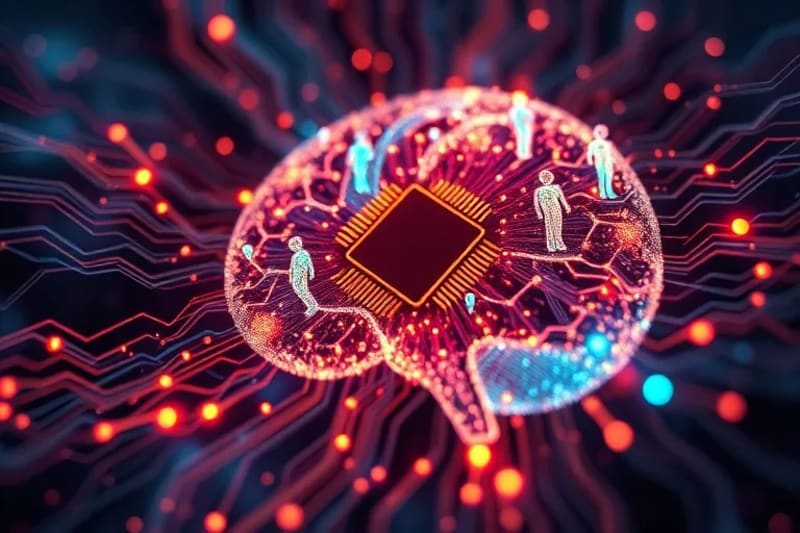
An abstract visualization exploring the intricate connection between digital data, neural networks, and the elusive nature of consciousness in a technologically advanced world.
This 3D render artistically interprets the complex interplay of technology and consciousness, offering a glimpse into future philosophical debates.6. Societal Integration: Challenges and Opportunities
Beyond the individual ethical dilemmas, the widespread adoption of cyborg technology presents a myriad of significant societal challenges and transformative opportunities. One of the most pressing concerns is the potential for the emergence of a new and profound form of social stratification. If advanced enhancements—whether physical or cognitive—remain prohibitively expensive and thus accessible only to a privileged few, it could irrevocably create a biological and cognitive divide within society. This would inevitably exacerbate existing inequalities, leading to a stark separation between the "enhanced" and the "natural" human populations.
Conversely, cyborg technology offers immense and undeniable potential for significantly improving human well-being across various domains. For individuals living with severe disabilities, advanced cybernetic prosthetics and sophisticated neural implants can not only restore lost functions but also provide entirely new capabilities, thereby profoundly enhancing their quality of life and fostering greater independence. This therapeutic aspect powerfully highlights the dual nature of these technologies: they serve as powerful tools for healing and restoration, but also as instruments for radical human enhancement.
The seamless integration of cyborgs into mainstream society also necessitates a comprehensive re-evaluation of established social norms, existing legal frameworks, and fundamental human rights. How do we ensure that individuals who choose or require cybernetic enhancements are treated with dignity, respect, and without discrimination? What specific legal protections are necessary for individuals whose bodies and minds are partly artificial, particularly concerning data privacy, ownership of their augmented faculties, and potential liabilities? These complex questions demand careful consideration, extensive public discourse, and the development of inclusive policies to prevent discrimination and ensure an equitable future for all.
Furthermore, the impact of widespread cyborg integration on global labor markets and economic structures could be nothing short of profound. As human capabilities are significantly augmented, entirely new forms of work and industries may emerge, while other traditional roles could become obsolete. This mirrors broader contemporary discussions on the future of work and the critical need for proactive policies that support Mental Well-being and Productivity in an ever-evolving technological landscape. Societies must adapt to these changes to ensure a just transition.
7. The Future of Humanity: Transhumanism and Beyond
The philosophy of the cyborg is intrinsically and deeply linked to the broader philosophical movements of transhumanism and post-humanism, acting as a crucial bridge between them. Transhumanism, as a philosophical and intellectual movement, actively advocates for the ethical and responsible use of advanced technology to enhance fundamental human intellectual, physical, and psychological capacities. Its ultimate goal is to overcome inherent human limitations such as aging, disease, and cognitive constraints. In this context, cyborg technology serves as a direct and tangible pathway to achieving many of these ambitious transhumanist objectives.
Post-humanism, building upon transhumanist ideas, takes this vision a significant step further, suggesting that humanity as we currently understand it may be entirely transcended. This could lead to the emergence of entirely new forms of existence that are no longer strictly "human" in a traditional biological sense. Potential scenarios include mind uploading, the development of artificial general intelligence that surpasses human intellect, or radically altered biological forms through genetic engineering and cybernetic integration. The cyborg, within this overarching framework, functions as a pivotal transitional figure, bridging the gap between current human existence and a potentially post-human future.
These visionary perspectives raise fundamental and often unsettling questions about the ultimate purpose of human existence, the direction of our species' evolution, and our place in the cosmos. Are we inevitably destined to merge inextricably with our technological creations, or should humanity strive to preserve a "natural" and unaugmented human state, fearing the loss of essential qualities? The philosophical debate surrounding these questions is incredibly vibrant and multifaceted, with proponents passionately arguing for the liberation and boundless expansion of human potential, while critics caution against the irreversible loss of essential human attributes and the potential for unforeseen, detrimental consequences.
Ultimately, the journey into cyborg philosophy is not merely about understanding complex technology; it is, at its core, about understanding ourselves and our evolving relationship with the tools we create. It compels us to confront our deepest assumptions about life, consciousness, and what it truly means to thrive and flourish in an increasingly integrated and technologically advanced world. As we continue to develop and integrate advanced technologies into our lives, the robust philosophical frameworks and ethical guidelines we meticulously build today will serve as indispensable guides for the responsible and thoughtful evolution of tomorrow's humanity, ensuring a future that is both innovative and humane.
Explore More on Human-Machine Integration
- Fertility Biohacking: Reproductive Optimization and Biotechnology
- Techno-Shamanism: Bridging Ancient Rituals, Digital Healing
- Digital Archaeology: Reconstructing the Past with Technology
Source: Hybrid content assisted by AI and human editorial supervision.


Comentarios