
Space Archaeology: Searching for Extraterrestrial Evidence
Space archaeology, an emerging and profoundly interdisciplinary field, extends the traditional archaeological quest beyond Earth's confines. It seeks to identify, document, and analyze material remains of human activity in space, such as satellites, probes, and landing sites, but more intriguingly, it also encompasses the search for evidence of ancient extraterrestrial civilizations. This discipline combines astronomical observation, planetary science, remote sensing, and traditional archaeological methodologies to uncover the silent narratives etched across the cosmos.
Índice de Contenidos
The concept challenges our terrestrial biases, urging us to consider that intelligent life might have left indelible marks on other celestial bodies, much as humanity has on Earth. As technology advances, our capacity to detect subtle signs of past or present alien activity grows, moving the discussion from pure speculation to a realm of scientific inquiry. This article explores the foundational principles, methodologies, and profound implications of this exciting new frontier in the search for cosmic companionship.
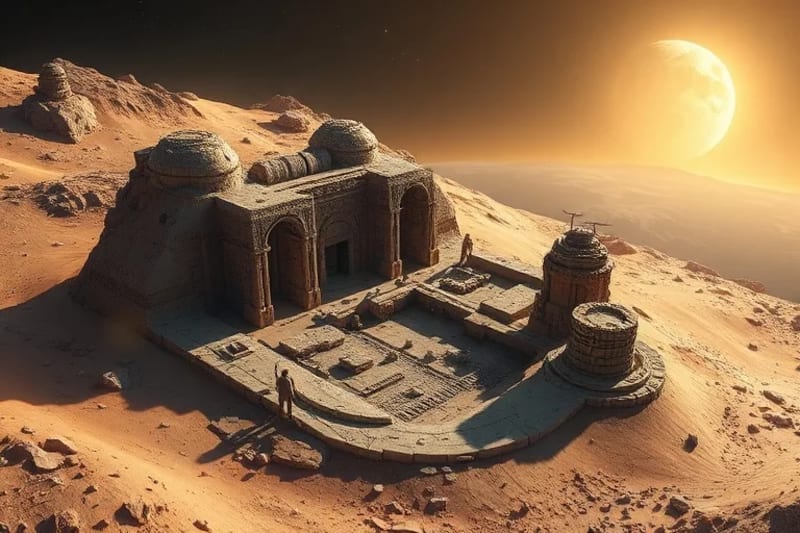 The silent echoes of ancient civilizations, whether terrestrial or cosmic, often manifest in the monumental structures they leave behind, beckoning future generations to decipher their purpose and legacy.
Conceptual AI render, crafted to evoke the profound mystery of cosmic archaeology, exploring themes of discovery and ancient alien presence.
Table of Contents
- Defining Space Archaeology and Its Scope
- Methodologies and Technologies for Cosmic Exploration
- Potential Targets and Types of Evidence
- Challenges and Ethical Considerations
- The Future of Extraterrestrial Archaeology
Defining Space Archaeology and Its Scope
Space archaeology, at its core, is the study of the material remains of human and, hypothetically, non-human activity in space. While the human aspect focuses on artifacts like defunct satellites, rocket stages, and lunar landing sites, the extraterrestrial dimension is far more speculative and ambitious. It posits that if intelligent life has existed elsewhere in the universe, it might have left detectable traces, from megastructures around stars to subtle modifications on planetary surfaces.
This field draws parallels with terrestrial archaeology, where scientists reconstruct past societies from fragmented evidence. However, the scale and environmental conditions of space present unique challenges and opportunities. The vacuum of space, extreme temperatures, and radiation can preserve artifacts differently than Earth's dynamic environment, offering a unique window into cosmic history.
Methodologies and Technologies for Cosmic Exploration
The search for extraterrestrial archaeological evidence relies heavily on advanced observational and analytical technologies. Remote sensing plays a crucial role, utilizing telescopes and orbital probes to scan celestial bodies for unusual patterns or structures. High-resolution imaging, spectroscopy, and radar mapping are essential tools for detecting anomalies that might suggest artificial origins.
 Advanced data analysis and visualization techniques are paramount in sifting through vast cosmic datasets to identify potential signs of intelligent design.
This digital painting captures the essence of scientific inquiry into cosmic anomalies, blending technological precision with the awe of discovery.
Future missions might involve robotic landers and rovers equipped with specialized archaeological instruments, capable of excavating or analyzing surface features directly. The development of artificial intelligence and machine learning algorithms is also critical for processing immense datasets and identifying subtle signatures that human observers might miss. These computational tools can discern geometric patterns, material compositions, or energy signatures that deviate from natural phenomena. The principles of quantum encryption might even play a role in securing the vast amounts of sensitive data collected during such missions.
Moreover, the field of artificial consciousness philosophy explores the theoretical underpinnings of intelligent non-human entities, which could inform our search parameters. By understanding how different forms of intelligence might express themselves technologically, we can refine our search strategies.
Potential Targets and Types of Evidence
The universe offers a myriad of potential sites for space archaeology. Moons and planets within our solar system, particularly Mars and Earth's Moon, are primary candidates due to their relative proximity and geological stability, which could preserve ancient structures. Beyond our solar system, exoplanets and their star systems are also targets, especially those within habitable zones.
Types of evidence could range from the macroscopic to the microscopic:
- Megastructures: Dyson spheres or swarms, which are hypothetical structures built around stars to capture their energy, would produce distinct infrared signatures.
- Planetary Modifications: Artificial changes to planetary surfaces, such as vast irrigation systems, mining operations, or even deliberate terraforming efforts, could be detectable through geological surveys.
- Technosignatures: Unnatural radio signals, laser emissions, or even waste heat from advanced technologies could be indicators.
- Artifacts: Remnants of spacecraft, tools, or even entire cities buried under regolith or ice on other planets or moons.
- Biosignatures with Artificial Context: Evidence of life, combined with clear signs of technological intervention, like engineered ecosystems.
The search for these technosignatures is a key component of the broader SETI (Search for Extraterrestrial Intelligence) effort, but space archaeology adds the dimension of seeking *past* intelligence, potentially long extinct.
Challenges and Ethical Considerations
Space archaeology faces immense challenges. The vast distances involved mean that even detecting potential sites is a monumental task, let alone sending probes for direct investigation. The interpretation of ambiguous data is another hurdle; distinguishing natural geological formations from artificial structures requires rigorous scientific scrutiny and the avoidance of pareidolia.
 The study of alien artifacts, suspended in a state of scientific reverence, offers a tangible connection to civilizations beyond our understanding.
This 3D render encapsulates the delicate and profound nature of examining extraterrestrial relics in a controlled, scientific environment.
Ethical considerations are also paramount. If evidence of an extinct civilization is found, how should it be treated? Should we disturb it? What are the implications for humanity's place in the universe? The concept of "planetary protection" already guides missions to prevent Earth contamination of other bodies, but the discovery of alien artifacts would introduce new layers of ethical debate. The philosophical implications of such a discovery touch upon themes explored in ethical artificial intelligence, particularly regarding the respect for non-human intelligence and its remnants.
Moreover, the legal framework for managing such discoveries is nascent. International treaties like the Outer Space Treaty provide some guidance, but they were not drafted with the discovery of alien archaeological sites in mind. Questions of ownership, preservation, and access would need to be addressed on a global scale. This aligns with broader discussions on neurotechnology intellectual property, as the very concept of "property" might need redefinition in a cosmic context.
The Future of Extraterrestrial Archaeology
Despite the challenges, the future of space archaeology is bright, driven by relentless technological innovation and humanity's innate curiosity. Missions like the James Webb Space Telescope are already pushing the boundaries of what we can observe in deep space, and future telescopes will offer even greater resolution and analytical capabilities. Concepts for interstellar probes, though decades away, hold the promise of direct exploration of exoplanets.
The integration of disciplines will also be key. Astronomers, planetary scientists, archaeologists, ethicists, and legal scholars will need to collaborate closely to navigate the complexities of this field. Public engagement and education will also be vital to prepare humanity for the profound implications of discovering evidence of other intelligent life, past or present.
Ultimately, space archaeology is not just about finding alien ruins; it's about understanding the universal principles of civilization, technology, and existence itself. It compels us to look beyond our immediate terrestrial concerns and consider our place within a potentially vast and ancient cosmic tapestry. The silent stones of distant worlds may yet hold the answers to some of humanity's deepest questions.
Explore More Cosmic Mysteries
- Robotics Ethics: Social Implications of Autonomous Robots
- Cosmic Sociology Celestial Mechanics Mapping Global Consciousness
Source: Hybrid content assisted by AI and human editorial supervision.
🌐 Descubre nuestro Ecosistema de Contenidos
Amplía tu perspectiva explorando estas guías recomendadas de nuestra red:
- Althox: Brevete: Licencias de Conducir en Latinoamérica y Marco Legal | Althox
- Althox: Contaminación Aire Enfermedades Autoinmunes: Evidencias Recientes | Althox
- Astrofuturo: Piscis Conexión Espiritual: Intuición, Compasión y Sueños | AstroFuturo
- Profecias: Mujeres Mártires: Fortaleza Espiritual, Devoción Inquebrantable, Legado Eterno | Profecías de la Virgen
- Red Global: Numerology Dream Interpretation Unlocking Life Path Messages


Comentarios