
Greek Abacus Legacy: Ancient Computing to Quantum AI
The Greek abacus, a seemingly simple device of antiquity, represents one of humanity's earliest and most profound innovations in the realm of computation. Far from being a mere historical curiosity, its underlying principles laid the groundwork for complex mathematical operations and algorithmic thinking that resonate even in today's advanced technological landscape. Understanding its legacy provides a unique perspective on the continuous evolution of how we process information.
This ancient tool, often overlooked in the grand narrative of computing history, serves as a conceptual bridge between rudimentary counting methods and the sophisticated digital systems we rely on today. Its journey from a practical calculation aid to a symbolic precursor of modern computing paradigms like Artificial Intelligence and Quantum Computing is a testament to the enduring power of fundamental ideas.
Table of Contents
1. Origins and Functionality of the Greek Abacus
The Greek abacus, distinct from its Babylonian or Roman counterparts, was primarily a counting board or table, often made of wood, stone, or metal, with grooves or lines drawn on it. Pebbles, stones, or small counters (calculi) were moved along these lines to represent numbers and perform arithmetic operations. This system leveraged a decimal or sexagesimal positional notation, allowing for efficient addition, subtraction, multiplication, and division.
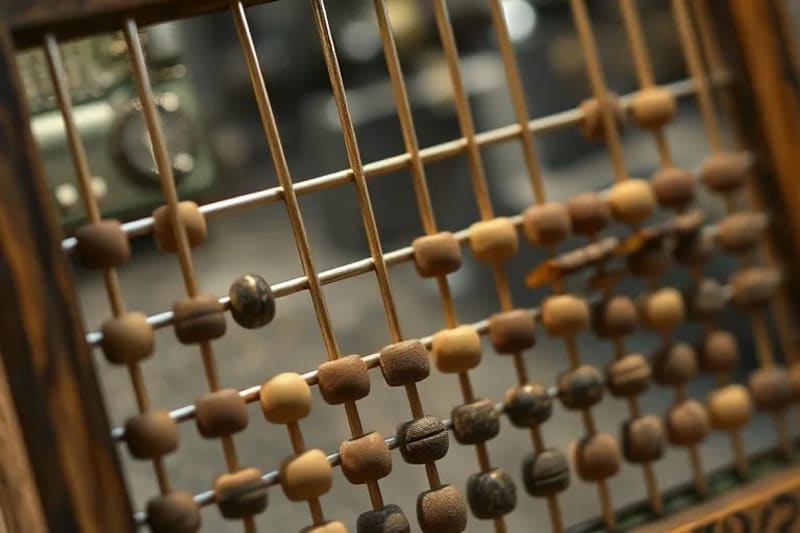 Conceptual interplay of ancient calculating tools, foundational mathematical principles, and the abstract visions that paved the way for modern computational thought.
This conceptual image, a render assisted by AI, explores the deep historical roots of computation, linking the tangible past with the abstract future of technology.
Archaeological evidence, such as the Salamis Tablet dating back to 300 BC, provides concrete proof of its existence and use in ancient Greece. This marble slab, divided into columns and rows, illustrates the sophisticated design employed for complex calculations, particularly in commercial transactions, engineering, and astronomy. The abacus was not merely a tool for basic counting; it facilitated advanced arithmetic in a society that valued intellectual pursuit and practical application.
Its genius lay in its simplicity and the direct manipulation of discrete units. Each pebble represented a specific numerical value based on its position, allowing users to visualize and execute calculations step-by-step. This tactile and visual approach to mathematics fostered a deep understanding of numerical relationships, which was crucial in an era without widespread access to written numerals or sophisticated algorithms.
2. From Abacus to Analytical Engines: A Conceptual Evolution
The conceptual leap from the Greek abacus to mechanical calculators and, eventually, to Charles Babbage's analytical engine, represents a continuous thread in computational history. The abacus introduced the idea of discrete states and operations, where physical objects (pebbles) could represent numerical values and be manipulated according to a set of rules. This fundamental concept of state-based computation is a cornerstone of all subsequent computing devices.
Early mechanical calculators, such as Pascal's Pascaline or Leibniz's Stepped Reckoner, automated the movement of these "pebbles" through gears and levers, but the underlying principle of positional value and sequential operations remained. Babbage's analytical engine, though never fully built in his lifetime, envisioned a programmable machine capable of executing complex sequences of operations, essentially an automated, generalized abacus.
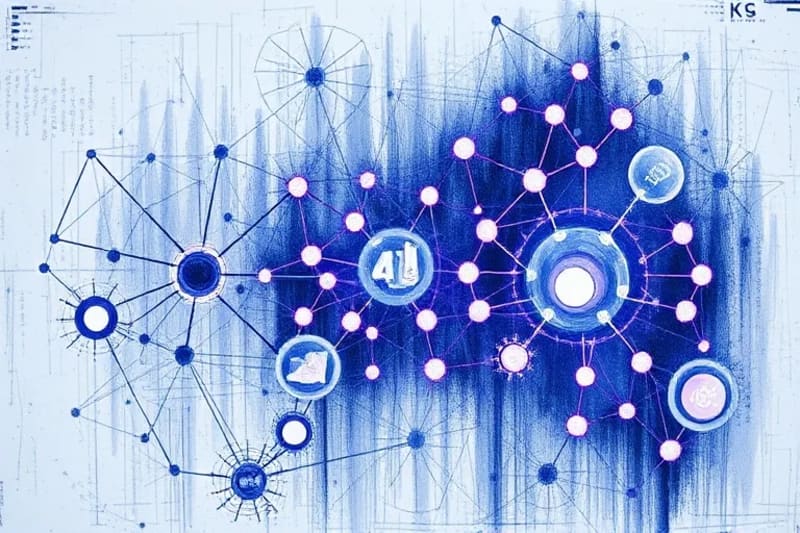 A digital representation of an artificial intelligence neural network, showcasing the complex interplay of nodes and connections that process information, conceptually linked to the discrete manipulations of an abacus.
This AI-generated digital painting visualizes the abstract structures of modern AI, drawing subtle parallels to historical computational methods.
The transition from manual to mechanical computation highlights a crucial shift: the externalization of the computational process. While the abacus required human intervention for each step, mechanical devices began to automate these steps, leading to greater speed and accuracy. This evolution underscores the human drive to enhance computational efficiency, a goal that continues to propel advancements in fields like DevOps Multicloud: Scalable Software Development Strategies.
The abacus, in its simplicity, taught humanity that complex problems could be broken down into a series of elementary, repeatable steps. This algorithmic thinking is the bedrock of all computer programming and computational theory. Without this foundational understanding, the development of modern computing would have been significantly delayed.
3. The Abacus's Influence on Modern Artificial Intelligence
While the Greek abacus predates modern Artificial Intelligence by millennia, its core principles offer fascinating conceptual parallels to how AI systems process information. At its heart, AI involves the manipulation of discrete data units (bits, neurons, tensors) according to predefined or learned rules to achieve specific outcomes, much like moving beads on an abacus to solve a mathematical problem. The abacus, with its clear states and transitions, can be seen as a very early, albeit manual, form of a state machine.
Consider the concept of pattern recognition, a cornerstone of many AI applications. An abacus user learns to recognize patterns in bead configurations to quickly perform operations or verify results. Similarly, neural networks in AI learn to identify complex patterns in vast datasets by adjusting the "weights" and "biases" of their connections, effectively manipulating internal "states" to arrive at a desired output. This ability to learn from data and adapt its internal structure is what makes modern AI so powerful, but the underlying principle of systematic manipulation of information states echoes ancient practices.
The abacus also embodies a deterministic approach to problem-solving: given an input and a set of rules, the output is predictable. While many AI systems, especially those involving machine learning, operate on probabilistic models, the foundational logic gates and computational steps within their hardware and software are ultimately deterministic. The clarity and precision of abacus operations highlight the importance of well-defined rules in any computational system, whether ancient or cutting-edge, including the algorithmic decoding seen in AI Dream Interpretation: Algorithmic Decoding Subconscious Symbolism.
The Greek abacus, through its systematic manipulation of discrete units, demonstrated an early form of algorithmic thinking. This foundational concept, where complex tasks are broken down into simpler, repeatable steps, is a direct precursor to the logic gates and computational processes that power modern Artificial Intelligence.
Its ability to represent numerical values in distinct positions and allow for their precise alteration laid the groundwork for understanding how information can be encoded, processed, and transformed within a structured system.
Furthermore, the development of AI raises critical questions about the nature of consciousness and digital rights. As AI systems become more autonomous and capable, understanding their computational underpinnings, from the simplest abacus-like operations to complex neural networks, becomes even more vital. This is particularly relevant in discussions surrounding Neuro-rights Digital Consciousness Artificial Intelligence Protection.
4. Abacus Principles in Quantum Computing
The connection between the Greek abacus and quantum computing might seem tenuous at first glance, given the vast differences in their operational principles and underlying physics. However, at a highly abstract level, both involve the manipulation of discrete informational units to perform calculations. While the abacus uses physical beads representing classical bits (0 or 1), quantum computers employ qubits, which can exist in a superposition of states (both 0 and 1 simultaneously) and exhibit entanglement.
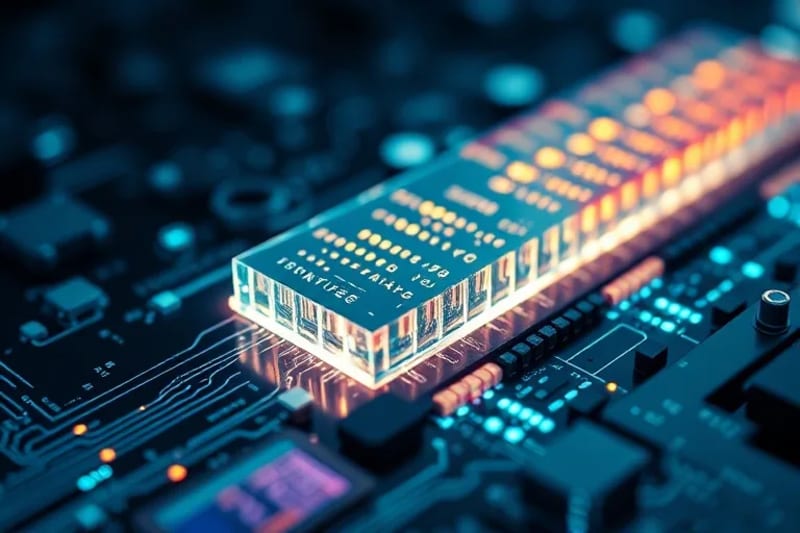 A sophisticated 3D render of a quantum computing processor, illustrating the complex and interconnected nature of qubits, representing the cutting edge of computational science.
This AI-generated 3D render provides a conceptual view of quantum computing, a field that redefines the very nature of calculation.
The abacus teaches us about the power of combinatorial states and the systematic application of operations. In quantum computing, the number of possible states grows exponentially with the number of qubits, allowing for the exploration of vast computational spaces simultaneously. While the abacus's states are distinct and observable, qubits introduce probabilistic outcomes, fundamentally altering the nature of computation from deterministic to probabilistic.
Despite these differences, the conceptual framework of manipulating fundamental units to solve problems persists. Just as ancient Greeks developed algorithms for their abacus, quantum physicists and computer scientists are developing quantum algorithms to leverage the unique properties of qubits. These algorithms are essentially sequences of operations designed to put qubits into specific superpositions and entangled states, ultimately yielding a computational result.
The progression from the abacus's simple, tangible states to the complex, abstract states of quantum mechanics highlights humanity's continuous quest to find more efficient and powerful ways to process information. Both represent breakthroughs in their respective eras, pushing the boundaries of what is computationally possible.
5. The Enduring Legacy of the Abacus in the Digital Age
The legacy of the Greek abacus extends far beyond its direct use as a calculating device. It instilled fundamental principles of computation that remain relevant today. Its emphasis on discrete units, positional value, and systematic manipulation laid the conceptual groundwork for the binary system, digital logic, and algorithmic thinking that underpin all modern computers. Every transistor switching between on and off states, every bit representing a 0 or 1, can be traced back to the simple idea of moving a pebble to represent a number.
Moreover, the abacus fostered a culture of analytical thought and problem-solving. It encouraged users to break down complex mathematical challenges into manageable steps, a skill that is indispensable in software development, data science, and indeed, any field requiring logical reasoning. This intellectual heritage is arguably its most profound contribution, shaping the way human minds approach computational tasks.
In an era dominated by instantaneous digital calculations, the abacus serves as a powerful reminder of the origins of computing and the ingenuity of ancient civilizations. It demonstrates that the core ideas of information processing are timeless, adapting and evolving with technological advancements. From the simple movement of beads to the intricate dance of qubits, the quest for better computation continues, always building upon the foundational insights of the past.
The principles learned from the abacus are not confined to theoretical computer science. They are implicitly present in the design of efficient data structures, the optimization of algorithms, and even in the conceptualization of complex systems like Blockchain Medicine Traceability Pharmaceutical Supply Chain: Complete Guide. Its legacy is a testament to the fact that innovation often stems from understanding and refining basic, yet profound, concepts.
Explore More of Our Content Ecosystem
Dive deeper into related topics and expand your knowledge with our curated selection of articles:
- Quantum Genealogical Tree Healing: Releasing Attachments
- Past Lives Karmic Transits Soul Healing
- Storytelling Marketing: Emotional Connection and Strategy
- Extreme Weather Phenomena: Science Behind Tornadoes Hurricanes
Source: Hybrid content assisted by AI and human editorial supervision.


Comentarios