
Black Hole Physics AI Computational Cosmology
The Physics of Black Holes and the Role of AI in Computational Cosmology
Black holes, enigmatic cosmic entities, represent some of the most extreme predictions of Albert Einstein's theory of General Relativity. These regions of spacetime exhibit such strong gravitational effects that nothing—not even particles and electromagnetic radiation such as light—can escape from inside them. The study of black holes has evolved significantly, moving from purely theoretical constructs to observable phenomena, largely thanks to advancements in observational astronomy and, increasingly, computational methods powered by Artificial Intelligence (AI).
Computational cosmology, a field dedicated to simulating the universe's evolution and its constituent components, faces immense challenges due to the complexity of gravitational interactions and the vast scales involved. The integration of AI into this domain is revolutionizing how scientists approach these challenges, offering unprecedented tools for data analysis, simulation enhancement, and even theoretical discovery. This article delves into the fundamental physics of black holes and explores the transformative impact of AI on computational cosmology.
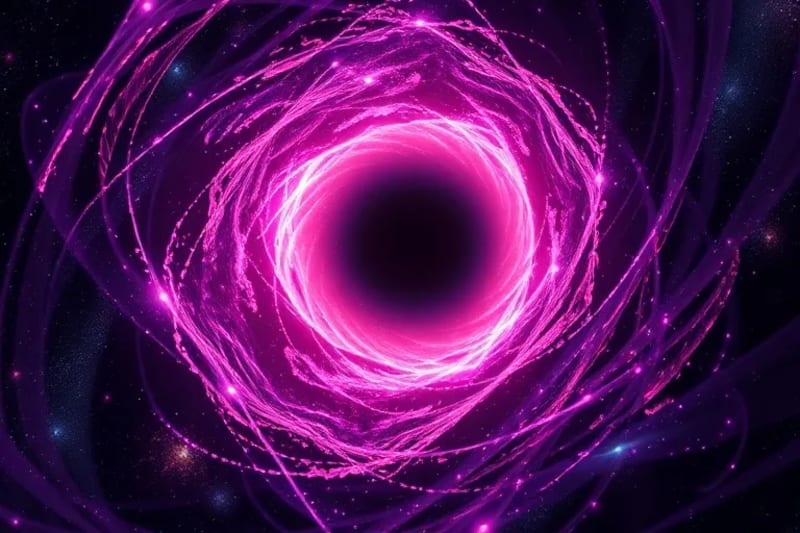 Visualizing the profound interplay between the gravitational forces of a black hole and the intricate data processing capabilities of artificial intelligence, shaping our understanding of the cosmos.
This conceptual render, generated by AI, illustrates the synergy between theoretical physics and advanced computation.
Table of Contents
- Fundamentals of Black Hole Physics
- Computational Cosmology and Its Challenges
- AI Revolutionizing Black Hole Research
- Specific AI Techniques in Cosmology
- Future Challenges and Outlook
Fundamentals of Black Hole Physics
At the heart of black hole physics lies General Relativity, which describes gravity not as a force, but as a curvature of spacetime caused by mass and energy. A black hole forms when a sufficient amount of mass is concentrated into an incredibly small volume, warping spacetime so intensely that it creates a boundary beyond which escape is impossible. This boundary is known as the event horizon.
Within the event horizon lies the singularity, a point of infinite density where the known laws of physics break down. While the singularity itself remains a theoretical construct, the event horizon is a critical concept for understanding how black holes interact with their environment. The properties of black holes are remarkably simple, described by just three parameters: mass, angular momentum (spin), and electric charge, as famously encapsulated by the "no-hair theorem."
Black holes are categorized primarily by their mass. Stellar-mass black holes, typically 3 to 100 times the mass of the Sun, are formed from the gravitational collapse of massive stars. Supermassive black holes, millions to billions of solar masses, reside at the centers of most galaxies, including our own Milky Way, influencing galactic evolution. There's also theoretical speculation about primordial black holes, which might have formed in the early universe, though their existence is yet to be confirmed.
A groundbreaking theoretical concept associated with black holes is Hawking radiation, proposed by Stephen Hawking. This theory suggests that black holes are not entirely "black" but emit a faint thermal radiation due to quantum effects near the event horizon. While incredibly difficult to detect directly, Hawking radiation implies that black holes can eventually evaporate over astronomically long timescales, profoundly impacting our understanding of quantum gravity and information paradoxes.
Computational Cosmology and Its Challenges
Computational cosmology employs numerical simulations to model the universe's structure, evolution, and the dynamics of its components, from the Big Bang to the formation of galaxies and large-scale structures. These simulations are essential for testing theoretical models against observational data and for making predictions about phenomena that are inaccessible to direct observation.
The primary challenge in this field stems from the immense complexity and scale of the universe. Simulating the gravitational interactions of billions of particles (representing stars, dark matter, and gas) over cosmic timescales requires extraordinary computational power. Furthermore, incorporating complex physical processes such as gas dynamics, star formation, feedback from supernovae, and the growth of black holes adds layers of intricacy.
 A visualization of complex cosmological simulations, where AI algorithms process vast datasets to model cosmic evolution.
Conceptual artwork by Althox Labs.
Numerical relativity, a subfield of computational cosmology, specifically focuses on solving Einstein's field equations in highly dynamic and strong-gravity regimes, such as black hole mergers and neutron star collisions. These simulations are crucial for predicting the gravitational wave signals detected by observatories like LIGO and Virgo, which provide invaluable insights into the nature of spacetime and extreme astrophysical events.
The sheer volume of data generated by these simulations, coupled with the data from observational facilities like the Event Horizon Telescope (EHT) and various space telescopes, presents a "big data" problem. Traditional analysis methods often fall short in extracting meaningful patterns and insights from these datasets, paving the way for AI to play a crucial role.
AI Revolutionizing Black Hole Research
Artificial Intelligence is rapidly transforming the landscape of black hole research and computational cosmology by offering powerful tools to address previously intractable problems. Its capabilities extend across various stages of scientific inquiry, from data processing to theoretical exploration.
Data Analysis and Feature Extraction: Observatories like LIGO generate terabytes of gravitational wave data, often buried in noise. AI algorithms, particularly deep learning models, excel at identifying subtle gravitational wave signals, classifying black hole mergers, and extracting parameters like mass and spin with high precision. The Event Horizon Telescope, which captured the first image of a black hole, also relies heavily on AI for image reconstruction from sparse and noisy interferometer data.
Simulation Enhancement and Acceleration: Running high-resolution cosmological simulations is computationally expensive. AI can accelerate these simulations by learning the underlying physics from lower-resolution runs and then predicting outcomes for higher resolutions or different parameter spaces. Machine learning models can also be used to create "emulators" that quickly approximate the results of complex simulations, saving vast amounts of supercomputing time.
Pattern Recognition and Anomaly Detection: AI is adept at finding hidden patterns in large datasets that might elude human inspection. This is crucial for discovering new types of astrophysical phenomena, identifying rare events like binary black hole mergers, or detecting anomalies that could point towards new physics beyond the standard model. For instance, AI can help in the search for extraterrestrial life by analyzing complex astronomical signals.
Theoretical Development and Hypothesis Generation: While still in its nascent stages, AI is beginning to assist in the generation of new scientific hypotheses. By analyzing vast bodies of scientific literature and experimental data, AI models can identify correlations and suggest new avenues for theoretical exploration, potentially leading to breakthroughs in our understanding of quantum gravity or the nature of dark matter.
Visualization and Interpretation: AI can transform complex simulation outputs into intuitive and interactive visualizations, making it easier for researchers to understand the dynamics of black holes and cosmic structures. This aids in both scientific discovery and public outreach.
Specific AI Techniques in Cosmology
Several branches of AI are particularly relevant to black hole physics and computational cosmology:
| AI Technique | Application in Cosmology | Key Benefits |
|---|---|---|
| Machine Learning (ML) | Classifying galaxies, identifying gravitational lenses, predicting cosmological parameters, anomaly detection in observational data. | Efficient data categorization, pattern discovery, predictive modeling. |
| Deep Learning (DL) | Gravitational wave signal detection and parameter estimation, image reconstruction (EHT), accelerating N-body simulations, identifying dark matter halos. | Handling complex, high-dimensional data; superior feature extraction; robust noise reduction. |
| Reinforcement Learning (RL) | Optimizing simulation parameters, guiding adaptive mesh refinement in numerical relativity, autonomous telescope scheduling. | Self-optimization of complex systems, efficient resource allocation. |
| Generative Adversarial Networks (GANs) | Generating synthetic cosmological data for training, enhancing resolution of low-res images, filling in missing data. | Realistic data synthesis, improved data augmentation for training other models. |
The foundational principles of modern computing, pioneered by figures like Alan Turing, laid the groundwork for the complex algorithms and architectures that underpin today's AI systems. Without these computational advances, the sophisticated simulations and data processing required for black hole research would be impossible.
 The historical progression of computational tools, from ancient methods to advanced AI, reflecting humanity's quest to understand the universe.
Conceptual artwork by Althox Labs.
Future Challenges and Outlook
Despite the immense potential, the integration of AI into black hole physics and computational cosmology faces several challenges. One significant hurdle is the interpretability of AI models, especially deep neural networks. Understanding why an AI makes a particular prediction or identifies a specific pattern is crucial for scientific validation and building trust in AI-driven discoveries.
Another challenge is the ever-increasing demand for computational resources. Training sophisticated AI models on vast cosmological datasets requires powerful supercomputers and specialized hardware. Furthermore, ensuring the robustness and generalizability of AI models—that they perform well on new, unseen data—is paramount for their scientific utility.
The future of AI in cosmology is bright, promising a new era of discovery. As AI algorithms become more sophisticated and computational power continues to grow, we can expect AI to play an even more central role in:
Developing more accurate and efficient numerical relativity simulations.
Unraveling the mysteries of dark matter and dark energy through advanced data analysis.
Accelerating the search for new gravitational wave sources and exotic compact objects.
Potentially leading to the formulation of new physical theories that reconcile General Relativity with quantum mechanics.
The synergy between black hole physics, computational cosmology, and AI is not just about automating tasks; it's about augmenting human intellect, enabling scientists to explore the universe with unprecedented depth and precision, pushing the boundaries of knowledge, and ultimately helping us understand our place in the cosmos.
Explore More Cosmic Insights
Antivirus PF: Packet Filter Registration and Traffic Analysis
Gratitude Economy: Purpose-Driven Sustainable Business Models
Ethnobotany Bioinnovation: Medicinal Plants Future Nutrition
Forgotten Inventions: Technologies That Potentially Changed the World
Katherine Johnson: NASA Mathematician Who Sent Men to the Moon
Decentralized Cryptocurrencies Global Inequality: Impact Analysis
Abductor Definition: Anatomy, Alien Abduction, Cultural Impact
I Ching: Chinese Oracle for Decision Making and Self-Knowledge
Medieval Mystics: Visions, Spiritual Impact, Historical Legacy
Source: Hybrid content assisted by AI and human editorial supervision.


Comentarios