
greek-abacus-legacy-ancient-computation-to-ai-quantum
The Greek abacus, an ancient device for arithmetic calculations, stands as a monumental precursor in the vast tapestry of computational history. Far more than a simple counting tool, it embodied fundamental principles of numerical representation and algorithmic processing that would resonate through millennia. Its legacy extends beyond mere historical curiosity, influencing the very architecture of thought that underpins modern computing, from the symbolic logic of early artificial intelligence to the complex probabilistic states of quantum mechanics.
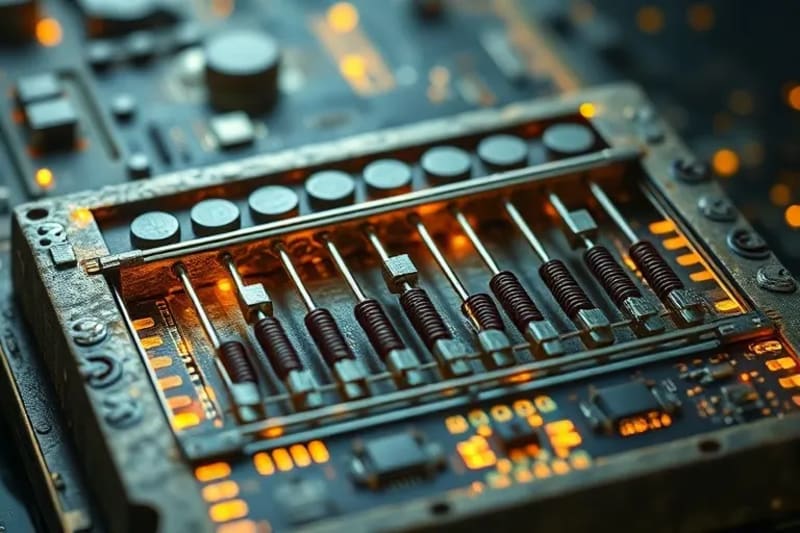 The enduring influence of ancient Greek computational methods, bridging historical tools with the abstract principles driving today's advanced technologies.
This conceptual render illustrates the profound connection between the foundational logic of early calculation and the sophisticated paradigms of modern computing, a testament to humanity's continuous quest for understanding and mastery of numbers.
Understanding the Greek abacus requires delving into an era where mathematical operations were often laborious and prone to error. This ingenious device provided a systematic and reliable method for performing addition, subtraction, multiplication, and division, empowering ancient scholars, merchants, and administrators. Its conceptual framework, though rudimentary by today's standards, laid essential groundwork for the abstract manipulation of data, a cornerstone of all subsequent computational advancements.
The journey from these early mechanical aids to the sophisticated digital processors of today is not a linear progression but a complex interplay of innovation, theoretical breakthroughs, and practical applications. This article explores how the core ideas embedded in the Greek abacus continue to echo in the most cutting-edge fields, including artificial intelligence and the nascent realm of quantum computing.
Table of Contents
- The Greek Abacus: Design and Functionality
- From Mechanical Aids to Electronic Brains
- Algorithmic Foundations and Early AI
- The Abacus and Quantum Computing Paradigms
- Enduring Principles: The Abacus's Lasting Legacy
The Greek Abacus: Design and Functionality
The most famous example of a Greek abacus is the Salamis Tablet, discovered in 1846 on the island of Salamis. Dating back to approximately 300 BCE, this marble slab provides tangible evidence of a sophisticated counting board. Its design featured parallel grooves or lines, typically with columns representing powers of ten, and rows for different numerical values. Small pebbles or counters, known as calculi (from which we derive the word "calculate"), were moved along these lines to perform arithmetic operations.
The functionality of the Greek abacus was based on a decimal system, although variations existed. Each column represented a specific power of ten (units, tens, hundreds, thousands, etc.), and within each column, counters would represent individual digits. For instance, five counters in the units column would represent the number five, while one counter in the tens column would represent ten. Operations were performed by adding or removing counters and carrying over values between columns, much like modern arithmetic algorithms.
- Representation: Numbers were represented spatially, with the position and quantity of counters conveying value. This spatial encoding is a fundamental concept in digital computing, where bits are arranged in memory locations.
- Manipulation: Operations involved systematic movement and exchange of counters, following predefined rules. These rules are analogous to the instructions executed by a central processing unit (CPU).
- Efficiency: For its time, the abacus significantly sped up complex calculations, reducing human error and enabling more advanced commerce and engineering.
The abacus was not merely a passive tool; it required a skilled operator who understood the underlying mathematical principles. This human-machine interaction, where the user inputs data and follows a procedure to obtain a result, mirrors the interaction with modern computers. The abacus effectively externalized cognitive load, allowing complex problems to be broken down into manageable, repeatable steps.
From Mechanical Aids to Electronic Brains
The conceptual leap from the Greek abacus to modern electronic computers spans centuries, marked by incremental innovations. The abacus, with its manual manipulation of counters, gave way to more automated mechanical calculators in the 17th century. Figures like Blaise Pascal and Gottfried Leibniz developed machines capable of performing arithmetic operations using gears and levers. These devices, while still far from programmable, further refined the idea of a machine executing a sequence of steps to solve a mathematical problem.
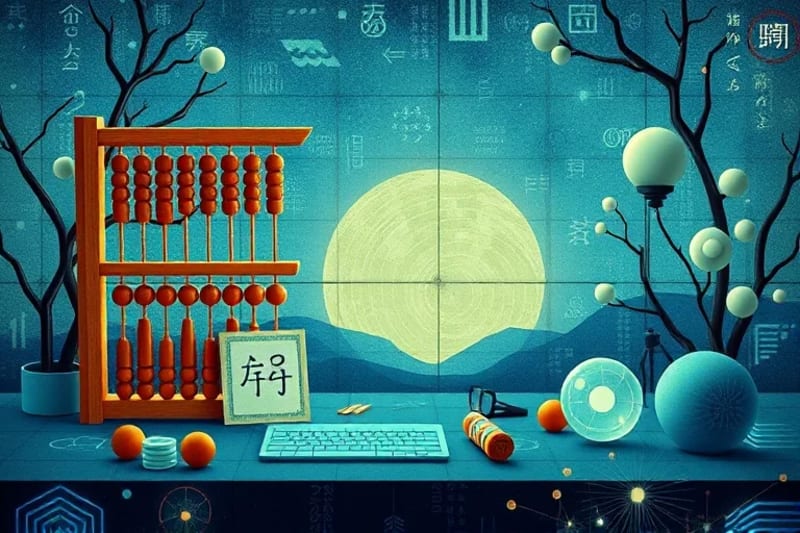 Conceptual art illustrating the intricate connection between early mathematical principles and the complex structures of artificial intelligence.
This visual metaphor highlights how foundational concepts of logic and symbolic manipulation, once embodied in ancient tools, now form the bedrock of sophisticated AI systems.
The 19th century brought the visionary work of Charles Babbage and Ada Lovelace. Babbage's Analytical Engine, though never fully built, was a conceptual blueprint for a general-purpose programmable computer. Lovelace, recognizing its potential beyond mere calculation, foresaw its capacity to manipulate symbols and execute complex sequences of instructions – essentially, algorithms. Her insights are a direct lineage from the structured operations of the abacus, elevating them to a higher level of abstraction and programmability. For more on her pioneering work, you can explore Ada Lovelace: Vision of General Computing.
The 20th century witnessed the advent of electronic computers, initially driven by vacuum tubes and later by transistors. These machines leveraged the principles of binary logic, where information is represented by two states (0 or 1), analogous to the presence or absence of a counter on an abacus line. The ability to switch these states rapidly allowed for calculations at unprecedented speeds, leading to the digital revolution. The core idea remained: a physical system (beads, gears, electrical signals) manipulated according to rules to represent and process information.
Algorithmic Foundations and Early AI
The Greek abacus fundamentally operated on a set of well-defined rules for manipulating counters to achieve a desired numerical outcome. This systematic approach is the very essence of an algorithm: a finite sequence of well-defined, computer-implementable instructions, typically to solve a class of problems or to perform a computation. Every operation on the abacus, from adding two numbers to carrying over a ten, followed an implicit algorithm. This procedural thinking is the bedrock of all computer programming.
When artificial intelligence began to emerge as a field in the mid-20th century, its early approaches, particularly symbolic AI, drew heavily on these algorithmic and logical foundations. Symbolic AI aimed to represent human knowledge in explicit, declarative forms (symbols) and then manipulate these symbols using logical rules to solve problems, much like the abacus manipulates counters. Early expert systems, for instance, used rule-based reasoning that can be conceptually traced back to the structured decision-making inherent in using an abacus.
The very concept of a "state" in computing – the current configuration of data at a given moment – finds a rudimentary parallel in the configuration of beads on an abacus. Each arrangement of beads represents a specific numerical state, and each operation transitions the abacus from one state to another. This state-transition model is critical to understanding how computers process information and how AI algorithms navigate problem spaces. The foundational idea that information can be encoded, processed, and transformed through discrete steps is a direct inheritance from such ancient tools.
| Feature | Greek Abacus | Modern Digital Computer | Artificial Intelligence |
|---|---|---|---|
| Information Unit | Counters (calculi) | Bits (0s and 1s) | Symbols, Data Points |
| Processing Mechanism | Manual movement of counters | Electronic switching of transistors | Algorithms, Neural Networks |
| Algorithm Concept | Implicit rules for calculation | Explicit code instructions | Learning rules, inference engines |
| State Representation | Configuration of beads | Memory contents (binary patterns) | Current knowledge base, network weights |
The Abacus and Quantum Computing Paradigms
The leap to quantum computing represents a radical departure from classical computational models, yet even here, the abstract principles first touched upon by the abacus find a distant, conceptual echo. Classical computers, like the abacus, operate on discrete, definite states (a bead is either there or not, a bit is 0 or 1). Quantum computers, however, leverage quantum mechanical phenomena such as superposition and entanglement to process information. Instead of bits, they use qubits, which can exist in a superposition of both 0 and 1 simultaneously.
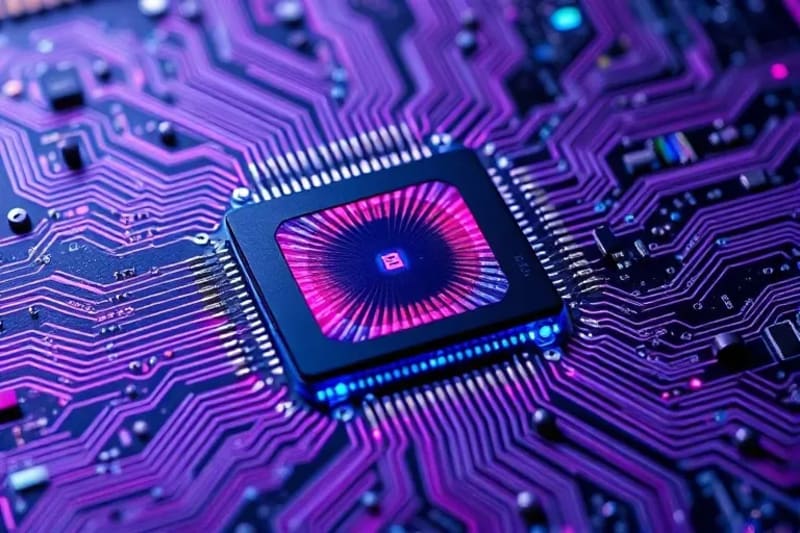 A visual exploration of how the fundamental concepts of computation, first articulated by ancient tools, resonate within the complex world of quantum mechanics.
This artistic rendering bridges the vast temporal and technological gap, suggesting that the essence of information processing remains a constant across different computational paradigms.
Despite this fundamental difference, the underlying goal remains the same: to manipulate information to solve problems. The abacus provided a physical model for representing numbers and performing operations. Quantum computers provide a new physical model, using the properties of subatomic particles to represent and process information in ways classical computers cannot. The 'algorithms' for quantum computers, known as quantum algorithms, are also sequences of operations, albeit far more complex and probabilistic, designed to exploit quantum phenomena.
The abstraction of computation from its physical substrate is a key thread connecting these disparate technologies. Whether it's moving beads on a board, flipping electrical switches, or manipulating quantum states, the core idea is to create a system that can reliably represent and transform information according to a set of rules. The Greek abacus, in its simplicity, taught humanity that complex calculations could be systematized and externalized, a lesson that continues to drive innovation in fields like Homomorphic Encryption and the development of quantum-resistant cryptography.
While the abacus operates deterministically, quantum computing introduces inherent probabilities. However, both require a precise understanding of the input, the process, and the expected output. The abacus laid the groundwork for thinking about computation as a process, a series of steps leading to a result. This procedural thinking is indispensable, even when dealing with the probabilistic nature of quantum mechanics, where the "steps" involve quantum gates and measurements.
Enduring Principles: The Abacus's Lasting Legacy
The Greek abacus, a seemingly humble tool from antiquity, embodies principles that are surprisingly relevant to the most advanced computational paradigms of today. Its ability to represent numerical data spatially, to perform operations through systematic manipulation, and to externalize cognitive tasks laid the groundwork for centuries of innovation. From the mechanical calculators of the Renaissance to the digital computers of the information age, and now to the emerging era of quantum computing, the fundamental concept of processing information through structured operations remains constant.
The legacy of the abacus is not in its physical form, but in the abstract ideas it introduced: the concept of an algorithm, the systematic manipulation of symbols, and the externalization of complex thought processes into a mechanical or electronic system. These ideas are the intellectual ancestors of everything from the basic logic gates in a microprocessor to the intricate algorithms driving artificial intelligence and the complex operations governing quantum qubits. It reminds us that even the most revolutionary technologies often have roots in simple, yet profound, ancient discoveries.
The continuous evolution of computing, from the tangible beads of the abacus to the ethereal quantum states, highlights humanity's persistent drive to master computation. Each new paradigm builds upon the foundational understanding established by its predecessors, refining the methods of information processing while adhering to the core principles of structured logic and systematic manipulation. This historical continuity underscores the timeless nature of computational thinking, a journey that began with simple counters and continues to unfold into realms of unimaginable complexity.
Explore More About Computing and Technology
- DevSecOps Multicloud Environments: Integrating Cybersecurity Software Lifecycle
- Predictive Cybersecurity: Shielding Digital Finance from Quantum Threats
- Augmented Reality in Education: Beyond Gaming, Innovation
- E-box Unified Network Server: Essential for SMEs
- AI Oracles Mesoamerican Astrology: Deciphering Ancient Wisdom
Source: Hybrid content assisted by AI and human editorial supervision.


Comentarios