
Aerospace Circular Economy: Sustainable Business Models
The aerospace industry, traditionally characterized by its linear "take-make-dispose" model, is increasingly recognizing the imperative of sustainability. As space exploration and satellite deployment accelerate, the environmental footprint, both on Earth and in orbit, becomes a critical concern. This has led to a growing interest in the principles of the circular economy, offering a transformative framework for sustainable growth within the space sector.
A circular economy aims to decouple economic growth from resource consumption by designing out waste and pollution, keeping products and materials in use, and regenerating natural systems. For the aerospace industry, this means rethinking everything from spacecraft design and manufacturing to operations, maintenance, and end-of-life management.

Envisioning a future where space exploration and industry operate within closed-loop systems, integrating advanced recycling and modular design for sustainable orbital presence.
This conceptual render, generated by AI, illustrates the intricate systems and visionary architecture essential for a circular economy in the vastness of space.
Table of Contents
- Core Principles of Circular Economy in Aerospace
- Unique Challenges for Aerospace
- Sustainable Business Models and Innovations
- Benefits of Adopting Circular Practices
- The Future of Sustainable Space Operations
Core Principles of Circular Economy in Aerospace
Applying circular economy principles to aerospace involves several key strategies that diverge significantly from traditional manufacturing and operational paradigms. These strategies are designed to maximize resource efficiency and minimize environmental impact throughout the entire lifecycle of aerospace products and services.
- Design for Durability and Longevity: Creating components and systems that are built to last longer, reducing the frequency of replacement and the associated resource consumption.
- Design for Modularity and Repairability: Engineering spacecraft and aircraft with easily replaceable or upgradeable parts, facilitating maintenance, repair, and technological advancements without discarding entire systems.
- Material Recovery and Recycling: Developing advanced techniques to recover valuable materials from end-of-life assets, both on Earth and potentially in space, for reuse in new products. This includes everything from rare earth elements in electronics to structural alloys.
- Component Reuse and Refurbishment: Extending the life of individual components through rigorous testing, refurbishment, and reintegration into new or existing systems, rather than simply discarding them.
- Servitization Models: Shifting from selling products to selling performance or services. For example, instead of selling a satellite, a company might sell "data as a service," retaining ownership of the hardware and being incentivized to maintain and upgrade it for maximum lifespan and efficiency.
Unique Challenges for Aerospace
While the circular economy offers immense potential, its implementation in the aerospace sector faces unique and formidable challenges. The extreme operating environments, stringent safety requirements, and high costs involved demand innovative solutions.
- Harsh Operating Environments: Spacecraft operate in vacuum, extreme temperatures, and radiation, which can degrade materials and make repair or recovery difficult.
- Stringent Safety and Reliability Standards: The high stakes of space missions mean that components must meet unparalleled reliability standards, often making the reuse of "used" parts a complex regulatory and engineering hurdle.
- Logistical Complexity of In-Orbit Servicing: Repairing or recycling assets in space requires advanced robotics, autonomous systems, and significant logistical infrastructure, which are still in nascent stages of development.
- Cost and Economic Viability: The initial investment in circular economy infrastructure, such as in-orbit servicing capabilities or advanced material recovery facilities, can be substantial. Demonstrating a clear return on investment is crucial for adoption.
- Regulatory Frameworks: Existing space law and regulations are primarily designed for a linear model. New frameworks are needed to address issues like ownership of space debris, liability for in-orbit servicing, and standards for recycled space materials.
Visualizing the journey of a satellite component through its extended life, from launch to in-orbit operation, and ultimately to its return for remanufacturing and reuse.
This digital artwork, created by AI, imaginatively depicts the closed-loop material flow central to sustainable space endeavors.
Sustainable Business Models and Innovations
Despite the challenges, innovative business models are emerging to integrate circular economy principles into the aerospace industry. These models leverage technological advancements and strategic partnerships to create value while minimizing waste.
- Product-as-a-Service (PaaS): Companies offer satellites or propulsion systems as a service, maintaining ownership and responsibility for their upkeep and end-of-life. This incentivizes durability and efficient resource use.
- Material Banks and Exchanges: Platforms are being developed to track and exchange high-value aerospace materials and components, ensuring they remain in circulation rather than being discarded. This approach aligns with the principles of Blockchain for Circular Economy, offering transparency and traceability.
- In-Orbit Servicing and Manufacturing (IOSM): This includes satellite refueling, repair, assembly, and even manufacturing in space. IOSM reduces the need for new launches, extends mission life, and could eventually lead to the recycling of space debris into new components.
- Sustainable Aviation Fuel (SAF) Development: While not strictly "circular" in the material sense, SAFs represent a significant step towards reducing the carbon footprint of air travel by utilizing renewable feedstocks, thus closing the carbon loop.
- Advanced Recycling Technologies: Investment in technologies that can efficiently separate and process complex aerospace materials, such as composites and specialized alloys, is crucial for high-value material recovery.
The adoption of these models requires a shift in mindset, moving away from short-term gains towards long-term sustainability and resilience. Companies embracing these concepts are also finding new avenues for growth and competitive advantage, much like how Adaptive Leadership is vital for navigating complex transitions.
Benefits of Adopting Circular Practices
The transition to a circular economy in aerospace offers a multitude of benefits, extending beyond environmental protection to economic and strategic advantages. These benefits underscore why this paradigm shift is not just an ecological necessity but also a smart business decision.
- Reduced Environmental Impact: Minimizing waste, conserving natural resources, and lowering greenhouse gas emissions associated with manufacturing and disposal.
- Enhanced Resource Security: Decreasing reliance on virgin materials and volatile supply chains by reusing and recycling valuable resources, which is crucial for strategic industries like aerospace.
- Cost Savings: Over the long term, reducing material consumption, extending product life, and recovering high-value materials can lead to significant operational cost reductions.
- Innovation and New Business Opportunities: Fostering the development of new technologies for recycling, in-orbit servicing, and sustainable design, thereby creating new markets and job opportunities.
- Improved Brand Reputation and Investor Appeal: Companies committed to sustainability are increasingly favored by consumers, investors, and regulatory bodies, enhancing their market position.
- Space Debris Mitigation: By focusing on end-of-life solutions and in-orbit servicing, circular economy principles directly contribute to reducing the proliferation of dangerous space debris, ensuring the long-term viability of space operations.

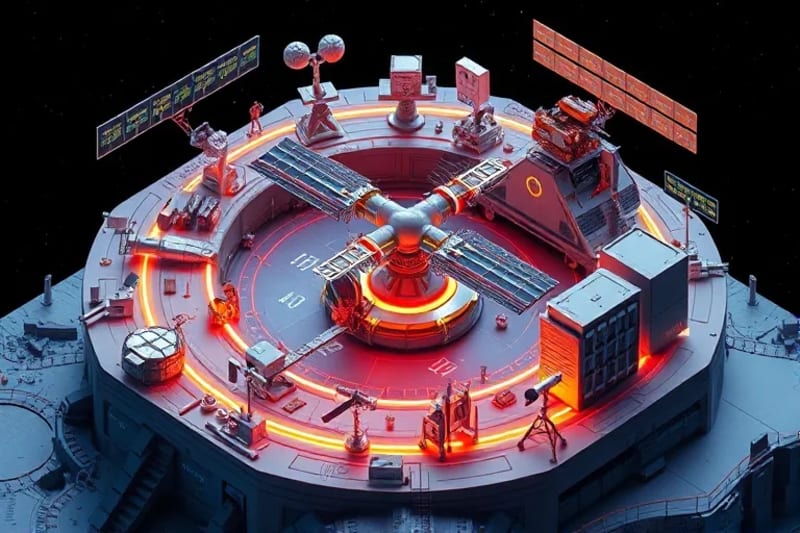
An intricate web of collaboration between terrestrial and orbital facilities, illustrating the integrated approach to resource management and waste elimination in a sustainable space economy.
This AI-generated 3D render symbolizes the complex, yet harmonious, future of industrial operations beyond Earth.
The Future of Sustainable Space Operations
The future of aerospace is inextricably linked to its ability to embrace circular economy principles. As humanity ventures further into space and relies more heavily on orbital assets, the need for sustainable practices will only intensify. The development of advanced Artificial Intelligence for Business Decisions and robotic technologies will play a crucial role in enabling in-orbit servicing, autonomous recycling, and efficient resource management.
Collaboration between governments, private companies, and research institutions will be essential to overcome the technical and regulatory hurdles. Investing in research and development for new materials, manufacturing processes, and recycling technologies will accelerate the transition. Furthermore, fostering a culture of sustainability within the aerospace workforce, from engineers to policymakers, is paramount.
The aerospace circular economy is not merely an aspiration but a strategic imperative for ensuring the long-term viability and responsible expansion of our presence in space. By adopting these forward-thinking models, the industry can lead the way in demonstrating how innovation and sustainability can go hand-in-hand, creating a resilient and thriving space ecosystem for generations to come.
Explore More Sustainable Innovations
Organizational Resilience: Companies Overcoming Crises, Adapting to Change
Ethical Artificial Intelligence: Avoiding Bias, Algorithm Transparency
Source: Hybrid content assisted by AI and human editorial supervision.


Comentarios