
Geopolitics of Water: Hydric Security & Global Startups
Water, often dubbed "blue gold," is increasingly recognized not just as a fundamental human right but as a critical geopolitical asset. Its scarcity, exacerbated by climate change, population growth, and pollution, is reshaping international relations, driving conflicts, and spurring unprecedented innovation. The global quest for water security has moved beyond national borders, becoming a central theme in diplomatic discourse and economic development. Understanding the intricate interplay between water resources, political power, and economic stability is paramount in our rapidly changing world.
Índice de Contenidos
- Table of Contents
- The Geopolitical Landscape of Water: A Growing Crisis
- Water Scarcity: Drivers and Global Impact
- The Rise of Hydric Startups: Innovation as a Solution
- Key Technological Innovations in Water Management
- Investment and Policy: Fostering a Sustainable Water Future
- Case Studies: Hydric Startups Making a Difference
- Challenges and Opportunities for Water Security
- Explore More on Global Innovation and Sustainability
This article delves into the complex landscape of water geopolitics, exploring how access, control, and distribution of this vital resource influence global power dynamics. We will examine the drivers of water scarcity, its far-reaching impacts, and the burgeoning role of hydric startups—innovative enterprises dedicated to developing sustainable solutions for water management. These pioneering companies are not only addressing immediate challenges but are also shaping the future of global water security through groundbreaking technologies and business models.
Table of Contents
- The Geopolitical Landscape of Water: A Growing Crisis
- Water Scarcity: Drivers and Global Impact
- The Rise of Hydric Startups: Innovation as a Solution
- Key Technological Innovations in Water Management
- Investment and Policy: Fostering a Sustainable Water Future
- Case Studies: Hydric Startups Making a Difference
- Challenges and Opportunities for Water Security
The Geopolitical Landscape of Water: A Growing Crisis
Water's strategic importance has never been more pronounced. As populations swell and climate patterns become more erratic, the availability of freshwater is diminishing in many regions, transforming it from a readily available commodity into a contested resource. This shift has profound implications for international relations, national security, and regional stability. Transboundary rivers and shared aquifers, which account for a significant portion of the world's freshwater, often become flashpoints for diplomatic tension and, in some cases, conflict.
Nations reliant on shared water sources face the complex challenge of balancing their own needs with those of their neighbors. Upstream countries have the power to control flow and quality, directly impacting downstream nations. This power dynamic can lead to disputes over water allocation, dam construction, and pollution. The Nile, Mekong, Jordan, and Indus rivers are just a few examples of waterways where water rights and management are central to geopolitical stability. International agreements and treaties are often fragile, struggling to keep pace with escalating demand and environmental degradation.

The intricate web of global water resources, illustrating the complex interplay between supply, demand, and international relations.
Conceptual rendering of global water dynamics, highlighting areas of scarcity and potential cooperation, created through advanced AI synthesis.
Beyond direct conflict, water scarcity can trigger mass migrations, internal displacement, and humanitarian crises, further destabilizing regions. Food security is directly tied to water availability, as agriculture is the largest consumer of freshwater globally. When water supplies dwindle, crop yields fall, leading to food shortages and price hikes, which can ignite social unrest. Energy production, particularly for hydropower and thermal power plants, also depends heavily on water, creating a critical water-energy nexus that adds another layer of complexity to geopolitical considerations.
Water Scarcity: Drivers and Global Impact
Water scarcity is a multifaceted problem driven by a combination of natural and anthropogenic factors. Understanding these drivers is crucial for developing effective mitigation strategies. The primary culprits include:
- Climate Change: Altered precipitation patterns, increased frequency and intensity of droughts, glacier melt, and rising temperatures all contribute to reduced freshwater availability.
- Population Growth and Urbanization: A growing global population demands more water for drinking, sanitation, food production, and industrial processes. Rapid urbanization concentrates this demand in specific areas, often straining local water resources.
- Pollution: Industrial discharge, agricultural runoff (pesticides, fertilizers), and untreated sewage contaminate freshwater sources, rendering them unusable for human consumption and ecological health.
- Inefficient Water Management: Outdated infrastructure, leaky pipes, wasteful irrigation practices, and lack of proper water pricing mechanisms lead to significant water loss and inefficient use.
- Over-extraction: Pumping groundwater faster than it can be replenished leads to aquifer depletion, land subsidence, and saltwater intrusion in coastal areas.
The impacts of water scarcity are pervasive and devastating. Economically, it can cripple agricultural sectors, disrupt industrial production, and hinder economic growth. Socially, it leads to health crises due to lack of clean drinking water and sanitation, increased poverty, and forced migration. Environmentally, it causes desertification, loss of biodiversity, and ecosystem collapse. Addressing these challenges requires a concerted global effort, leveraging both traditional resource management and innovative technological solutions.
The Rise of Hydric Startups: Innovation as a Solution
In response to the escalating global water crisis, a new wave of entrepreneurship has emerged: hydric startups. These innovative companies are at the forefront of developing and deploying cutting-edge technologies and business models aimed at improving water management, conservation, purification, and distribution. They represent a dynamic force in the battle for water security, bringing fresh perspectives and agile solutions to a sector traditionally dominated by large utilities and government agencies.
Hydric startups are characterized by their focus on efficiency, sustainability, and scalability. They often leverage advanced technologies such as Artificial Intelligence (AI), the Internet of Things (IoT), advanced materials science, and biotechnology to create solutions that are more effective and less resource-intensive than conventional methods. Their agility allows them to quickly adapt to specific regional needs and pilot new approaches, often in partnership with local communities, NGOs, and established corporations. This entrepreneurial drive is crucial for bridging the innovation gap in the water sector.
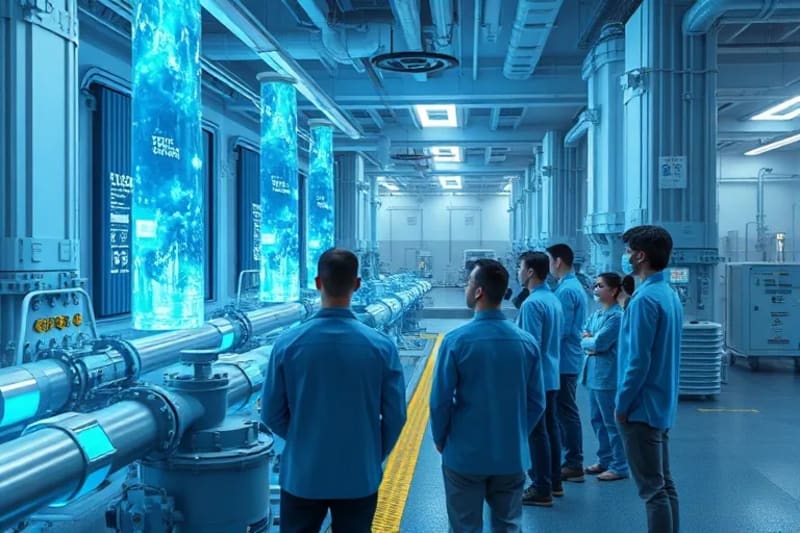
A futuristic water treatment plant, showcasing advanced technology and human oversight in ensuring water quality and distribution.
3D conceptualization of next-generation water infrastructure, reflecting the role of innovation in addressing global water challenges.
The impact of these startups extends beyond technological advancements. Many are also pioneering new business models, such as Water-as-a-Service (WaaS), decentralized water treatment, and community-led water management initiatives. These models aim to make clean water more accessible and affordable, particularly in underserved regions. The rise of these enterprises signifies a paradigm shift: from viewing water as a static resource to be managed, to seeing it as a dynamic system that can be optimized and innovated upon. For more on how innovation drives business models, consider exploring concepts like Gratitude Economy: Social Impact Business Models, which often align with the goals of hydric startups.
Key Technological Innovations in Water Management
Hydric startups are driving innovation across several key technological areas:
- Advanced Filtration and Purification: New membrane technologies (e.g., graphene, nanofiltration) are making desalination more energy-efficient and cost-effective. Electrocoagulation, photocatalysis, and advanced oxidation processes are also being developed to remove a wider range of contaminants, including microplastics and pharmaceuticals.
- Smart Water Management Systems: IoT sensors, AI-powered analytics, and machine learning algorithms are being used to monitor water quality in real-time, detect leaks in distribution networks, optimize irrigation schedules, and predict demand. This data-driven approach leads to significant water savings and improved operational efficiency. The application of Artificial Intelligence in such critical infrastructure is transforming resource management.
- Wastewater Treatment and Reuse: Startups are developing innovative biological and chemical processes to treat wastewater to a high standard, making it suitable for irrigation, industrial use, and even potable reuse. This circular economy approach reduces reliance on fresh water sources and minimizes pollution.
- Atmospheric Water Generation (AWG): Technologies that extract potable water directly from the air, particularly in humid regions, are gaining traction. These systems offer decentralized water solutions, especially valuable in areas lacking traditional water infrastructure.
- Water Conservation Technologies: Innovations in smart irrigation, leak detection for residential and commercial buildings, and water-efficient appliances are helping reduce overall water consumption.
These technologies are not just theoretical; many are already being deployed globally, demonstrating tangible results in improving water access and sustainability. The continuous evolution of these solutions is critical for building resilience against future water shocks.
Investment and Policy: Fostering a Sustainable Water Future
The growth and impact of hydric startups depend heavily on supportive investment and policy environments. Venture capital, impact investors, and corporate venture arms are increasingly recognizing the vast market potential and social returns of water technology companies. Investments are flowing into areas such as smart water infrastructure, advanced purification, and water reuse. However, significant funding gaps remain, especially for scaling innovative solutions in developing regions.
Government policies play a crucial role in accelerating innovation and adoption. This includes:
- Regulatory Frameworks: Clear, predictable regulations for water quality, wastewater discharge, and water reuse provide certainty for investors and innovators.
- Incentives and Subsidies: Tax breaks, grants, and subsidies for adopting water-efficient technologies or investing in water infrastructure can stimulate market demand.
- Public-Private Partnerships (PPPs): Collaborations between governments, utilities, and startups can accelerate the deployment of new technologies and share risks.
- International Cooperation: Cross-border initiatives and funding mechanisms are essential for addressing transboundary water issues and scaling solutions globally.
- Water Pricing Reform: Implementing realistic water pricing that reflects its true value can encourage conservation and generate revenue for infrastructure improvements.
Furthermore, education and re-skilling initiatives are vital to build a workforce capable of developing, implementing, and maintaining these advanced water technologies. A holistic approach that combines financial support, robust policy, and human capital development is necessary to secure a sustainable water future.
Case Studies: Hydric Startups Making a Difference
While specific company names can vary rapidly in the startup landscape, several archetypes of successful hydric startups illustrate the breadth of innovation:
- Decentralized Water Purification: Startups developing compact, modular water treatment units that can be deployed rapidly in remote villages or disaster zones. These often use solar power and require minimal maintenance, providing clean water where traditional infrastructure is absent.
- Smart Leak Detection for Utilities: Companies utilizing acoustic sensors, satellite imagery, and AI to pinpoint leaks in vast municipal water networks, drastically reducing non-revenue water loss.
- Industrial Water Recycling: Startups offering bespoke solutions for industries (e.g., textile, mining, food processing) to treat and reuse their wastewater, significantly cutting their freshwater consumption and discharge.
- AI-Powered Irrigation Optimization: Firms providing farmers with real-time data on soil moisture, weather forecasts, and crop needs to optimize irrigation, saving vast amounts of water and improving yields.
- Atmospheric Water Harvesters: Companies producing devices that condense humidity from the air into potable water, offering a sustainable source of drinking water in arid or water-stressed regions.
These examples highlight how targeted innovation can address specific water challenges, demonstrating the potential for startups to create significant positive impact on both local and global scales. Their success stories inspire further investment and development in the water tech sector.

A harmonious community thriving with innovative, eco-friendly water systems, embodying the vision of global water security.
Artistic interpretation of a sustainable future where water is managed responsibly, fostering community well-being and environmental balance.
Challenges and Opportunities for Water Security
Despite the progress, significant challenges remain in achieving global water security. These include the high capital costs of new infrastructure, the fragmented nature of water governance, resistance to adopting new technologies, and the sheer scale of the problem in many regions. Geopolitical tensions over shared water resources also continue to pose a threat to collaborative solutions.
However, these challenges also present immense opportunities. The growing awareness of water scarcity is driving increased political will and investment. The digital transformation offers unprecedented tools for monitoring, managing, and optimizing water use. The rise of hydric startups, coupled with a global push for sustainability, creates a fertile ground for innovation and impact. Furthermore, the integration of water management with other sustainability efforts, such as sustainable architecture and renewable energy, can lead to synergistic benefits.
Ultimately, ensuring global water security requires a multi-stakeholder approach involving governments, international organizations, private sector innovators, civil society, and local communities. By fostering collaboration, embracing technological advancements, and implementing sound policies, we can move towards a future where water is a source of peace and prosperity, not conflict and scarcity.
Explore More on Global Innovation and Sustainability
Dive deeper into related topics that shape our future, from cutting-edge technologies to sustainable practices and global challenges.
- CRISPR-Cas9 Gene Therapy: Advances, Ethics, Future
- Longevity Startups: Biohacker Business Models for Active Aging
- Minimalism Philosophy of Life: Less is More
- Sustainable Urban Geomancy AI: Resilient Cities Future
- Bio-Acoustic Therapy Planetary Well-being Celestial Harmonics
Source: Hybrid content assisted by AI and human editorial supervision.
🌐 Descubre nuestro Ecosistema de Contenidos
Amplía tu perspectiva explorando estas guías recomendadas de nuestra red:
- Althox: Estrategias Precios: Valor, Rentabilidad, Competitividad | Althox
- Althox: Blockchain Propiedad Intelectual: Arte Digital, NFTs y Marco Legal | Althox
- Astrofuturo: Plutón Retrógrado Natal: Transformación Interna y Sombra | AstroFuturo
- Profecias: Plegarias Paz Mundial: Clamor Corazón Fe Esperanza | Profecías de la Virgen
- Red Global: Pallas Athena Astrology: Wisdom, Strategy, Intellect | StarPluto


Comentarios