
Advanced Quantum Cybersecurity: Critical Infrastructure
The rapid advancements in quantum computing herald a new era of computational power, promising breakthroughs across various scientific and technological domains. However, this transformative power also casts a long shadow over existing cybersecurity paradigms. Traditional cryptographic methods, which form the backbone of digital security for critical infrastructures worldwide, are inherently vulnerable to the immense processing capabilities of future quantum computers. This impending threat necessitates a proactive and robust shift towards advanced quantum cybersecurity, specifically designed to shield vital systems from the "harvest now, decrypt later" attacks that could compromise sensitive data and operational integrity.
Critical infrastructures, encompassing sectors such as energy, transportation, finance, and healthcare, are particularly at risk. Their disruption could lead to catastrophic societal and economic consequences. Consequently, understanding the nature of quantum threats and implementing resilient, quantum-resistant cryptographic solutions is no longer a futuristic concern but an immediate imperative for national and global security.

Conceptual illustration of a quantum encryption network safeguarding critical digital infrastructure, symbolizing the fusion of advanced physics and cybersecurity to ensure future resilience.
Image generated by AI, reflecting the intricate interplay between quantum mechanics and digital defense, under a conceptual rendering license.The Dawn of the Post-Quantum Era
The "post-quantum era" refers to the period when sufficiently powerful quantum computers become available, capable of breaking currently used public-key cryptography algorithms. While a fully fault-tolerant quantum computer is still some years away, the threat is considered imminent due to the long shelf-life of encrypted data and the time required to transition to new cryptographic standards. Adversaries could be collecting encrypted data today, intending to decrypt it once quantum capabilities mature.
This "harvest now, decrypt later" strategy underscores the urgency for organizations, especially those managing critical infrastructures, to begin their transition to post-quantum cryptography (PQC). The National Institute of Standards and Technology (NIST) has been leading a global effort to standardize quantum-resistant algorithms, with several candidates now in the final stages of selection. These new algorithms are designed to withstand attacks from both classical and quantum computers, providing a future-proof foundation for digital security.
Understanding Quantum Threats to Critical Infrastructure
The primary quantum threats to critical infrastructure stem from Shor's algorithm and Grover's algorithm. Shor's algorithm can efficiently break widely used public-key cryptosystems like RSA and Elliptic Curve Cryptography (ECC), which are fundamental for secure communications, digital signatures, and key exchange protocols. These are used extensively in securing everything from financial transactions to control systems in power grids.

The conceptual breakdown of a digital lock under quantum stress, illustrating the potential for advanced algorithms to compromise existing security protocols.
AI-generated image, depicting the fragile nature of classical encryption against the formidable power of quantum computational methods, distributed under a creative license.Grover's algorithm, while not breaking symmetric-key ciphers (like AES) directly, significantly reduces their effective key length, making brute-force attacks more feasible. This means that even algorithms considered robust today would require longer key sizes to maintain the same level of security in a post-quantum world. The implications for critical infrastructure are profound, as the compromise of these systems could lead to widespread service outages, data theft, and even physical damage.
- Data Confidentiality: Long-term sensitive data, such as national security secrets, intellectual property, and personal health records, could be decrypted.
- Data Integrity: Digital signatures could be forged, allowing malicious actors to impersonate legitimate entities and inject false commands into critical systems.
- Authentication: Secure authentication mechanisms could be bypassed, granting unauthorized access to control systems and networks.
The interconnected nature of modern critical infrastructures further amplifies these risks. A single point of failure or compromise could cascade across multiple systems, leading to systemic disruption. For instance, a successful attack on a power grid's control systems could cripple energy supply, impacting hospitals, communication networks, and transportation systems simultaneously. The urgency to address these vulnerabilities is paramount, requiring a comprehensive strategy that integrates advanced quantum cybersecurity measures. For more insights into emerging technologies and their societal impact, consider exploring topics like Bioengineering and Human Space Future.
Key Principles of Quantum-Resistant Cryptography
Quantum-resistant cryptography, also known as post-quantum cryptography (PQC), refers to cryptographic algorithms that are secure against attacks by both classical and quantum computers. These algorithms are typically based on hard mathematical problems that are believed to be intractable even for quantum computers. The main families of PQC candidates include:
- Lattice-based Cryptography: These algorithms rely on the difficulty of solving certain problems in high-dimensional lattices. They offer strong security guarantees and are often efficient.
- Code-based Cryptography: Based on error-correcting codes, these systems have a long history of study and are well-understood.
- Multivariate Polynomial Cryptography: These schemes use systems of multivariate polynomial equations over finite fields.
- Hash-based Signatures: Built on cryptographic hash functions, these provide robust digital signatures, though often with larger signature sizes and stateful properties.
- Isogeny-based Cryptography: Leveraging properties of elliptic curve isogenies, these offer compact key sizes but can be more complex to implement.
The selection and standardization of these algorithms by NIST are crucial steps towards widespread adoption. Organizations must stay informed about these developments and prepare for the eventual migration. This preparation involves not only understanding the algorithms but also assessing their performance characteristics, such as key size, signature size, and computational overhead, which can vary significantly between different PQC schemes. The integration of such advanced security measures is as vital as advancements in other complex fields like 3D Organoids and Regenerative Medicine.
Implementing Advanced Quantum Cybersecurity Solutions
Migrating critical infrastructure to quantum-resistant cryptography is a complex, multi-year undertaking. It requires a strategic approach that includes inventorying cryptographic assets, assessing risks, piloting new solutions, and gradually deploying them across the entire infrastructure. A "crypto-agility" framework is essential, allowing organizations to easily switch between cryptographic algorithms as new threats emerge or better solutions become available.
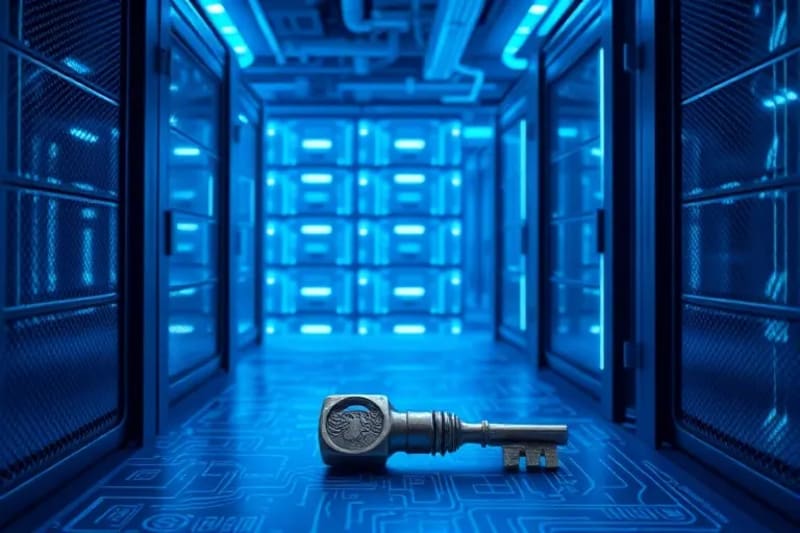
A secure data center, augmented with luminous quantum components, represents the fortified environment necessary for protecting sensitive data in the post-quantum era.
Conceptual AI render, illustrating the blend of physical and quantum security measures for critical data storage, licensed for educational use.Key steps for implementation include:
- Discovery and Inventory: Identify all cryptographic instances, protocols, and algorithms currently in use across the infrastructure. This includes hardware, software, and firmware components.
- Risk Assessment: Evaluate the exposure of each cryptographic asset to quantum attacks, prioritizing systems that handle long-lived sensitive data or control critical operations.
- Pilot Programs: Begin testing PQC algorithms in non-critical environments to understand performance implications, compatibility issues, and integration challenges.
- Hybrid Mode Deployment: Implement a hybrid approach where both classical and quantum-resistant algorithms are used simultaneously. This provides a fallback in case of unforeseen issues with the new PQC schemes and ensures continued security during the transition.
- Quantum Key Distribution (QKD): While not a replacement for PQC, QKD can complement it by providing a method for secure key exchange based on the laws of quantum mechanics. It offers a high level of security for point-to-point communications, particularly valuable for highly sensitive links within critical infrastructure.
- Education and Training: Train cybersecurity personnel on the principles of quantum computing, quantum threats, and the implementation of PQC solutions.
The transition to quantum-resistant cryptography also presents an opportunity to review and modernize overall cybersecurity postures. This includes adopting zero-trust architectures, enhancing incident response capabilities, and fostering a culture of continuous security improvement. The ethical considerations surrounding advanced technologies, such as those in Gene Therapy, also highlight the importance of responsible innovation in cybersecurity.
Challenges and Future Outlook in Quantum Cybersecurity
Despite the clear imperative, several challenges lie ahead in the widespread adoption of quantum cybersecurity. These include the complexity of integrating new cryptographic primitives into legacy systems, the potential for increased computational overhead, and the ongoing evolution of both quantum computing technology and PQC algorithms. The supply chain for cryptographic components also needs to be secured, ensuring that PQC implementations are not compromised before deployment.
Standardization efforts by NIST and other international bodies are critical to ensure interoperability and broad adoption. However, the cryptographic landscape is dynamic, and continuous research and development are necessary to anticipate new threats and refine existing solutions. The collaboration between government, academia, and industry will be vital in overcoming these challenges and building a truly quantum-safe digital future. The principles of traceability and sustainability, as seen in Blockchain for Circular Supply Chains, can offer valuable lessons in managing complex transitions.
Looking ahead, quantum cybersecurity will likely involve a multi-layered approach, combining PQC algorithms with other advanced security measures. This might include quantum key distribution for specific high-security links, enhanced physical security, and advanced threat detection systems. The goal is not just to react to quantum threats but to proactively build resilient and adaptable security architectures capable of evolving with the technological landscape. The integration of AI and ethical considerations, as explored in Modern Spirituality and AI Guidance, will also play a role in shaping future security strategies.
In conclusion, the transition to advanced quantum cybersecurity is an unavoidable and critical journey for protecting global critical infrastructures. While challenging, the proactive adoption of quantum-resistant solutions and a commitment to continuous innovation will ensure that the benefits of the quantum era can be harnessed without compromising the security and stability of our most vital systems.
Explore More on Cybersecurity and Future Technologies
Source: Hybrid content assisted by AI and human editorial supervision.


Comentarios