
Metaverse Space Law Virtual Sovereignty Challenges
The rapid evolution of digital realms, collectively known as the metaverse, and the accelerating pace of space exploration are converging to create unprecedented legal and philosophical challenges. As humanity extends its presence into both virtual and cosmic frontiers, fundamental questions of sovereignty, property rights, and governance demand urgent attention. This article explores the intricate interplay between metaverse law and space law, highlighting the complexities that arise when virtual assets and digital identities intersect with the physical realities of extraterrestrial colonization.
The concept of sovereignty, traditionally tied to physical territory and national borders, faces significant redefinition in these new domains. In the metaverse, users create and inhabit persistent virtual worlds, often forming communities and economies that operate independently of traditional state control. Simultaneously, nations and private entities are increasingly eyeing celestial bodies for resource extraction and permanent human settlements, raising questions about who owns what in the vast expanse of space.

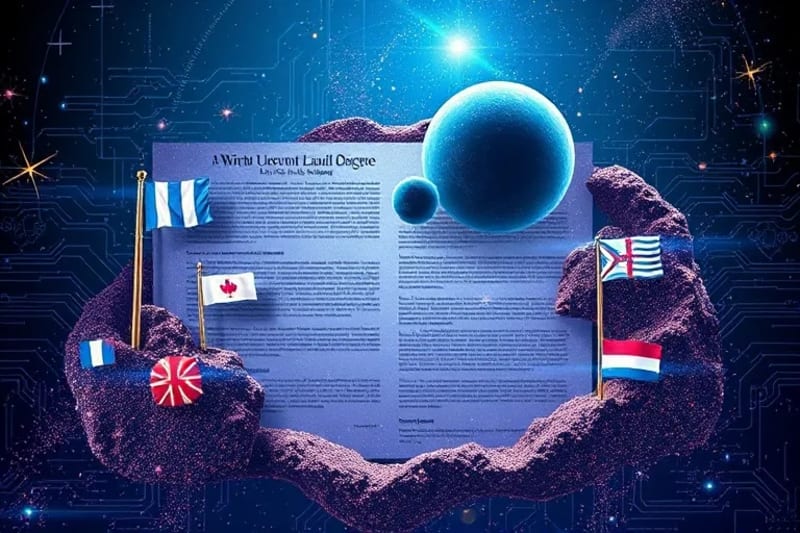
Conceptual representation of legal frameworks navigating the complex intersection of virtual sovereignty and cosmic expansion.
This image, a conceptual render, visualizes the intricate legal landscape emerging from the convergence of digital realms and outer space, exploring themes of governance and jurisdiction in new frontiers.This intersection creates a novel legal landscape, where established principles of international law, property law, and digital rights must adapt or be entirely reimagined. Understanding these challenges is crucial for developing robust legal frameworks that can foster innovation, ensure equitable access, and prevent conflict in both the metaverse and outer space.
Table of Contents
- The Dawn of Digital and Cosmic Frontiers
- Defining Sovereignty in the Metaverse
- Legal Frameworks for Space Colonization
- Intersecting Jurisdictions: Virtual Assets in Space
- Property Rights and Resource Allocation
- Governance and Dispute Resolution
- Ethical and Societal Implications
- The Path Forward: International Cooperation
The Dawn of Digital and Cosmic Frontiers
The 21st century marks a pivotal era where humanity is simultaneously expanding its presence into two distinct, yet conceptually linked, frontiers: the digital metaverse and outer space. The metaverse, often envisioned as a persistent, interconnected network of virtual 3D worlds, promises immersive experiences, new forms of social interaction, and burgeoning digital economies. It blurs the lines between physical and virtual realities, creating spaces where individuals can own virtual land, trade digital assets, and form self-governing communities.
Concurrently, advancements in aerospace technology are making space colonization an increasingly tangible prospect. Private companies and national space agencies are developing plans for lunar bases, Martian settlements, and asteroid mining operations. These endeavors push the boundaries of human habitation and resource utilization beyond Earth, necessitating robust legal and ethical frameworks to manage these new territories.
The convergence of these two frontiers presents a unique set of challenges. For instance, how would property rights for virtual assets be enforced if the server hosting the metaverse is located on a lunar colony? What legal jurisdiction applies when a digital avatar commits a virtual crime from a space station? These questions highlight the urgent need for innovative legal thinking that transcends traditional terrestrial boundaries.
Defining Sovereignty in the Metaverse
Sovereignty, traditionally understood as the supreme authority within a territory, becomes highly complex in the context of the metaverse. Unlike physical nations with defined borders and centralized governments, the metaverse is often decentralized, global, and lacks a clear physical location. This raises fundamental questions about who holds ultimate authority over virtual spaces and their inhabitants.
Various models for metaverse governance are emerging, ranging from centralized platforms controlled by corporations to decentralized autonomous organizations (DAOs) governed by their users. Each model presents different implications for sovereignty. In centralized metaverses, the platform owner effectively exercises a form of corporate sovereignty, dictating rules and terms of service. In contrast, DAOs aim to distribute power among participants, creating a form of digital self-governance that challenges traditional state authority.
The legal implications are profound. If a virtual world operates across multiple national jurisdictions, which nation's laws apply to disputes or criminal activities within that metaverse? The concept of digital citizenship and the rights of avatars are also nascent areas requiring careful legal consideration. As discussed in the context of Cosmic Sociology Digital Age AI Consciousness Shifts, the digital age profoundly alters our understanding of identity and community, which directly impacts notions of virtual sovereignty.
Legal Frameworks for Space Colonization
The legal regime governing outer space is primarily rooted in the 1967 Outer Space Treaty (OST), which establishes space as the "province of all mankind" and prohibits national appropriation. While the OST has been instrumental in preventing militarization and promoting peaceful exploration, it predates the current ambitions for extensive space colonization and resource utilization. Its provisions are often vague on issues like property rights for extracted resources or the governance of permanent settlements.
Artistic interpretation of legal documents intertwining digital property rights with claims over celestial bodies.
This digital painting abstractly illustrates the convergence of legal principles, from virtual land ownership to extraterrestrial resource allocation, under a framework of emerging space law.Several nations have enacted domestic space laws to address these gaps, such as the U.S. SPACE Act of 2015, which grants U.S. citizens rights to resources they obtain from asteroids. However, the international community largely views such unilateral declarations with skepticism, fearing they could lead to a new "scramble for space." The ongoing debate highlights the need for a comprehensive international legal framework that can accommodate both exploration and commercial exploitation while upholding the principle of shared benefit.
The principles governing commercial contracts, as seen in the Colombian Commercial Code or the Mexican Civil Code, provide a foundation for understanding property and contractual agreements. However, these terrestrial laws require significant adaptation when applied to the unique environment and challenges of outer space, where concepts like "real estate" or "jurisdiction" take on entirely new dimensions.
Intersecting Jurisdictions: Virtual Assets in Space
The true complexity emerges when we consider the intersection of these two domains. Imagine a scenario where a space colony on Mars hosts a thriving metaverse economy. Who has jurisdiction over virtual crimes committed within this Martian metaverse? Is it the law of the nation that launched the colony, the international space law, or the emergent legal norms of the metaverse itself?
This hybrid scenario necessitates a multi-layered approach to jurisdiction. The physical location of the server infrastructure (on Earth, in orbit, or on a celestial body) could play a role, as could the nationality of the individuals involved and the nature of the virtual assets. Furthermore, the legal status of digital assets, such as non-fungible tokens (NFTs) representing virtual land or unique items, becomes even more ambiguous when their underlying technology operates across different physical jurisdictions.
The lack of a unified international legal framework for both the metaverse and space creates a potential "wild west" scenario, where legal disputes could be difficult to resolve and enforcement mechanisms are unclear. This legal vacuum poses significant risks for investors, developers, and users alike, underscoring the urgency for proactive legal development.
Property Rights and Resource Allocation
Property rights are a cornerstone of economic activity, and their definition is critical for both virtual and cosmic frontiers. In the metaverse, the ownership of virtual land, avatars, and digital goods is typically governed by platform terms of service or smart contracts on blockchain networks. While these provide a degree of certainty within specific platforms, their legal enforceability in traditional courts can be challenging, especially across international borders.
In outer space, the Outer Space Treaty explicitly prohibits national appropriation of celestial bodies. However, it does not explicitly forbid the appropriation of resources extracted from them. This ambiguity has led to differing interpretations, with some nations arguing for a "first come, first served" approach to resource utilization, while others advocate for a common heritage regime where benefits are shared equitably among all nations.

A conceptual still life symbolizing the application of legal authority in the digital and extraterrestrial realms.
This 3D render represents the challenge of establishing legal order and dispute resolution mechanisms in the emerging frontiers of virtual worlds and space exploration.The intersection of these two areas could see virtual property rights being claimed over resources extracted from space. For example, a company might mine rare minerals from an asteroid and then tokenize these resources as NFTs within a metaverse. The legal validity and enforceability of such virtual claims over physical extraterrestrial resources would require novel legal interpretations and international agreements.
Governance and Dispute Resolution
Effective governance structures and robust dispute resolution mechanisms are essential for the sustainable development of both the metaverse and space. In the metaverse, governance ranges from centralized platform moderation to decentralized community-driven decision-making. Disputes often involve issues like intellectual property infringement, harassment, or fraudulent transactions, which are currently handled through platform-specific rules or, in some cases, traditional legal systems.
For space, the Outer Space Treaty assigns responsibility for national activities in space to the launching state, which also retains jurisdiction over its personnel and objects in space. However, this framework is ill-equipped to handle complex disputes arising from multi-national space settlements or commercial activities involving private entities from various countries. The absence of a dedicated international space court or arbitration body further complicates matters.
When these two realms merge, the challenges multiply. Who adjudicates a dispute between two avatars from different nations, operating within a metaverse hosted on a privately-owned space station? The development of hybrid legal frameworks, potentially involving a combination of international treaties, national laws, and decentralized autonomous organizations (DAOs), will be crucial for establishing order and justice in these new frontiers.
Ethical and Societal Implications
Beyond the purely legal aspects, the convergence of the metaverse and space colonization raises profound ethical and societal questions. Issues of digital inequality, access to virtual resources, and the potential for exploitation in virtual economies are already prevalent in the metaverse. These concerns could be exacerbated if access to space-based metaverses or resources becomes limited to a privileged few, creating new forms of digital and cosmic divides.
The psychological impact of living in persistent virtual worlds while physically residing in isolated space habitats also needs consideration. How will human identity, social norms, and mental well-being be affected by such dual existence? Ensuring equitable access, protecting digital rights, and fostering inclusive governance models will be paramount to prevent the replication of terrestrial inequalities in these new domains.
Moreover, the environmental impact of both metaverse infrastructure (e.g., energy consumption of data centers) and space activities (e.g., space debris) must be addressed. Sustainable practices and responsible development are essential to ensure that humanity's expansion into these frontiers does not come at an unacceptable cost to our planet or the cosmic environment.
The Path Forward: International Cooperation
Addressing the complex legal challenges posed by the metaverse and space colonization requires a concerted effort from the international community. Unilateral actions or fragmented legal approaches will likely lead to conflict and inefficiency. Instead, a collaborative, multi-stakeholder approach is needed, involving governments, international organizations, private industry, legal scholars, and civil society.
Key areas for international cooperation include:
- Developing New Treaties and Protocols: Updating the Outer Space Treaty and creating new international agreements specifically for metaverse governance and its intersection with space.
- Harmonizing National Laws: Encouraging nations to align their domestic laws regarding digital assets, data privacy, and space activities to reduce jurisdictional conflicts.
- Establishing International Bodies: Creating dedicated international organizations or arbitration panels to resolve disputes related to virtual assets in space and extraterrestrial resource allocation.
- Promoting Ethical Guidelines: Developing universally accepted ethical principles for the development and use of both the metaverse and space technologies, ensuring human rights and sustainability.
- Fostering Public-Private Partnerships: Encouraging collaboration between governments and private entities to share expertise, resources, and best practices in regulatory development.
The future of human expansion, both digitally and cosmically, hinges on our ability to establish clear, equitable, and enforceable legal frameworks. By embracing international cooperation and innovative legal thinking, humanity can navigate these new frontiers responsibly, ensuring that the benefits of the metaverse and space colonization are shared widely and sustainably for generations to come.
Explore Our Content Ecosystem
Delve deeper into related topics and expand your understanding of the evolving digital and physical worlds:
- Dark Matter Dark Energy Cosmology Philosophical Implications
- Plant-Based Nutrition: Health and Planet Benefits
- Water Crisis: Impact on Food Production, National Security
- Curious Sleep Facts: Myths and Realities of Mental Health
- Digital Trinity: Faith, Technology, Future Alliance
- Love Compatibility Universal Language Venus Mars Astrology
Source: Hybrid content assisted by AI and human editorial supervision.


Comentarios