
Predictive Cybersecurity Smart Cities: AI Federated Learning
The rapid urbanization and technological integration characterizing modern smart cities present unprecedented opportunities for efficiency, sustainability, and quality of life. However, this interconnectedness also introduces a complex attack surface, making these urban environments prime targets for sophisticated cyber threats. Predictive cybersecurity, powered by Artificial Intelligence (AI) and reinforced by Federated Learning, emerges as a critical paradigm shift from reactive defense to proactive threat anticipation and mitigation. This advanced approach is essential for safeguarding critical infrastructure, ensuring data privacy, and maintaining the operational integrity of smart city ecosystems.

A visionary depiction of a smart city fortified by advanced AI-driven cybersecurity systems, illustrating the seamless integration of technology for urban protection.
Smart cities rely on vast networks of sensors, IoT devices, autonomous systems, and data analytics platforms to manage everything from traffic flow and energy grids to public safety and waste management. Each connected device and data point represents a potential vulnerability. Traditional cybersecurity models, often reliant on signature-based detection and perimeter defense, struggle to keep pace with the evolving sophistication and volume of modern cyberattacks. Predictive cybersecurity, conversely, utilizes machine learning algorithms to analyze historical data, identify patterns of malicious activity, and forecast potential threats before they materialize, enabling preemptive action.
Table of Contents
- AI Foundations of Predictive Cybersecurity
- Federated Learning: A Paradigm Shift for Urban Security
- Proactive Threat Detection Mechanisms
- Implementation Challenges and Ethical Considerations
- Future Outlook: Towards Resilient Smart Cities
AI Foundations of Predictive Cybersecurity
At the core of predictive cybersecurity are advanced AI techniques, primarily machine learning (ML) and deep learning (DL). These algorithms are trained on massive datasets comprising network traffic logs, system events, threat intelligence feeds, and user behavior patterns. By learning from this data, AI models can identify anomalies that deviate from normal operational baselines, often indicative of an impending or ongoing attack. This capability moves beyond simple rule-based detection to discern subtle, complex patterns that human analysts or traditional systems might miss.
Key AI techniques employed include:
- Supervised Learning: Used for classifying known threats. Models are trained on labeled datasets of malicious and benign activities, enabling them to recognize similar patterns in new data.
- Unsupervised Learning: Crucial for detecting novel or zero-day attacks. Algorithms identify deviations from normal behavior without prior labels, clustering similar data points and flagging outliers as suspicious.
- Reinforcement Learning: Enables security systems to learn optimal defense strategies through trial and error, adapting to new threats and improving response mechanisms over time.
- Natural Language Processing (NLP): Applied to analyze unstructured data from threat intelligence reports, social media, and dark web forums to identify emerging attack vectors and attacker motivations.
These AI models can predict various cyber events, from phishing campaigns and malware propagation to denial-of-service (DoS) attacks and insider threats. The effectiveness of these models, however, heavily depends on the quality, volume, and diversity of the training data. In a smart city context, this data is often distributed across numerous municipal departments, private entities, and IoT devices, posing significant challenges for centralized data collection and privacy compliance.
Federated Learning: A Paradigm Shift for Urban Security
Federated Learning (FL) offers a groundbreaking solution to the data privacy and distribution challenges inherent in smart city cybersecurity. Instead of centralizing raw data for model training, FL allows multiple entities (e.g., city departments, utility companies, transportation authorities) to collaboratively train a shared AI model while keeping their local data private and on-premises. Only model updates (e.g., weights and gradients) are exchanged, not the raw data itself. This decentralized approach has profound implications for enhancing urban security without compromising sensitive information.
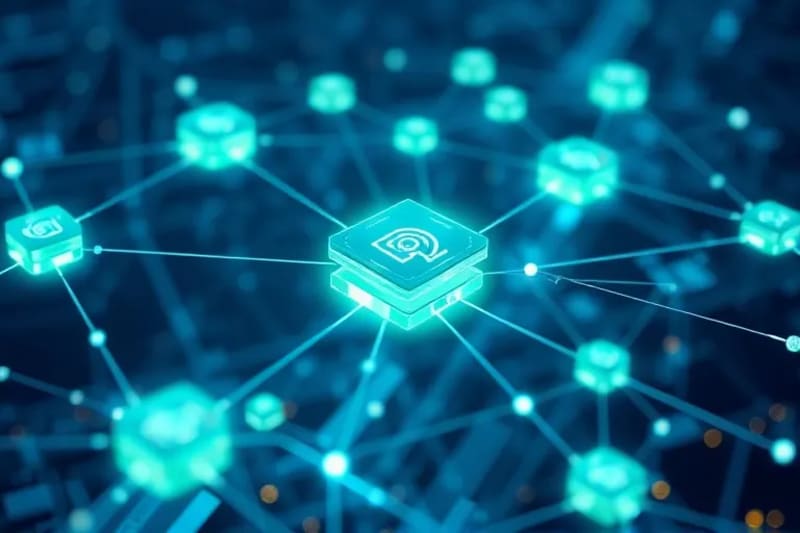
A conceptual 3D render illustrating the decentralized, collaborative nature of federated learning, where multiple nodes contribute to a shared AI model while preserving data privacy.
The benefits of integrating Federated Learning into smart city cybersecurity are manifold:
- Enhanced Privacy: Critical for handling sensitive citizen data (e.g., public transport usage, energy consumption, health-related IoT data). FL ensures that individual data points never leave their source, complying with stringent privacy regulations.
- Improved Threat Intelligence: By collaboratively training models, each participant benefits from the collective intelligence derived from diverse datasets, leading to more robust and generalized threat detection capabilities. This is particularly valuable for identifying sophisticated, distributed attacks.
- Reduced Data Transfer Costs and Latency: Training models locally reduces the need to transfer vast amounts of raw data to a central server, saving bandwidth and minimizing latency in threat detection and response.
- Resilience and Robustness: A federated model is less susceptible to single points of failure. If one node is compromised, the overall model can still function effectively, drawing insights from other participating entities.
- Regulatory Compliance: FL inherently supports data localization requirements and privacy-by-design principles, making it easier for smart city initiatives to adhere to regulations like GDPR or CCPA.
For instance, traffic management systems could share model updates to detect unusual traffic patterns indicative of a cyberattack on critical transportation infrastructure, while energy grids could contribute to a shared model to identify anomalies suggesting an attempted compromise of smart meters or power distribution networks. This collaborative intelligence forms a stronger, more adaptive defense posture for the entire urban ecosystem. The principles of secure data handling and advanced analytics are also crucial in fields like hyper-personalized preventive medicine, where data privacy and effective pattern recognition are paramount.
Proactive Threat Detection Mechanisms
Predictive cybersecurity in smart cities, augmented by federated learning, enables a suite of proactive detection mechanisms:
- Behavioral Anomaly Detection: AI models learn the normal behavior of users, devices, and systems. Any significant deviation, such as unusual login times, data access patterns, or device communication frequencies, triggers an alert.
- Vulnerability Prediction: By analyzing historical vulnerability data, software configurations, and network topologies, AI can predict which systems are most likely to be exploited and recommend proactive patching or hardening measures.
- Threat Intelligence Fusion: AI aggregates and correlates data from various threat intelligence feeds (e.g., dark web monitoring, malware repositories, security research) with local network data to identify emerging threats relevant to the city's infrastructure.
- Early Warning Systems: Machine learning models can detect precursor activities to larger attacks, such as reconnaissance scans, port scanning, or attempts at credential stuffing, allowing security teams to intervene before an attack escalates.
- Automated Incident Response: Beyond detection, AI can automate initial response actions, such as isolating compromised devices, blocking malicious IP addresses, or triggering alerts to human operators, significantly reducing response times.
The integration of these mechanisms creates a dynamic, self-learning security posture that continuously adapts to new threats. For example, if a new type of malware is detected in one part of the city's IoT network, the federated model can quickly learn its characteristics and disseminate this intelligence (as model updates) to all other participating nodes, enabling widespread protection without sharing the original infection data. This proactive stance is a significant leap from traditional reactive security measures, mirroring the forward-thinking approaches seen in navigating the metaverse, where anticipating future interactions is key.

A stylized vector illustration depicting a digital lock at the core of a network, with AI algorithms actively intercepting and neutralizing malicious cyber threats.
Implementation Challenges and Ethical Considerations
Despite its immense promise, deploying predictive cybersecurity with federated learning in smart cities faces several challenges:
- Data Heterogeneity: Data from different city sectors (e.g., traffic, energy, waste) can vary significantly in format, quality, and volume, making it challenging to train a cohesive federated model.
- Computational Resources: Training complex AI models, even locally, requires substantial computational power, which might be a constraint for some city departments or IoT devices.
- Model Poisoning Attacks: Malicious actors could attempt to inject corrupted data or model updates into the federated learning process, subtly poisoning the shared model to degrade its performance or introduce backdoors. Robust validation mechanisms are crucial.
- Trust and Governance: Establishing trust among diverse stakeholders (public and private) and defining clear governance frameworks for data sharing, model updates, and incident response is paramount.
- Interpretability and Explainability: Black-box AI models can make it difficult for human operators to understand why a particular threat was flagged or a decision was made. Explainable AI (XAI) is essential for building confidence and enabling effective human oversight.
Ethical considerations are equally critical. The extensive data collection and analysis inherent in smart city cybersecurity raise concerns about surveillance, algorithmic bias, and the potential for misuse of predictive capabilities. Ensuring transparency, accountability, and fairness in AI algorithms is not just a technical challenge but a societal imperative. Clear policies must be established to prevent discriminatory outcomes and protect civil liberties. The need for skilled professionals who understand both technology and ethics is growing, highlighting the importance of future skills like critical thinking and collaboration.
Future Outlook: Towards Resilient Smart Cities
The future of smart city cybersecurity lies in the continuous advancement and integration of AI and federated learning. As urban environments become more complex and digitally intertwined, the ability to predict and prevent cyberattacks will be a defining factor in their resilience and sustainability. Future developments will likely include:
- Edge AI and TinyML: Deploying AI models directly on IoT devices (edge computing) for real-time, localized threat detection, further reducing latency and enhancing privacy.
- Quantum-Resistant Cryptography: Integrating new cryptographic techniques to secure federated learning communications against future quantum computing threats.
- Digital Twins for Cybersecurity: Creating virtual replicas of smart city infrastructure to simulate cyberattack scenarios, test defense strategies, and train AI models in a safe environment.
- Human-AI Collaboration: Developing advanced interfaces and workflows that enable security analysts to effectively collaborate with AI systems, leveraging the strengths of both human intuition and machine processing power.
- Interoperability Standards: Establishing universal standards for data formats, API integrations, and communication protocols to facilitate seamless information exchange and federated learning across diverse urban systems.
Ultimately, predictive cybersecurity with federated learning is not just a technological solution; it is a foundational component for building truly intelligent, secure, and trustworthy smart cities. By fostering collaboration, safeguarding privacy, and leveraging the power of collective intelligence, urban centers can proactively defend against the ever-evolving cyber threat landscape, ensuring a safer and more prosperous future for their inhabitants.
Related Searches & Further Reading
- Digital Preventive Health: Advances in Apps and Wearables
- Hyper-Personalized Preventive Medicine: AI, Big Data, Early Detection
- Precision Biohacking: AI, Genomics, Wearables, Longevity
- Biomagnetic Alignment: Healing Energetic Imbalances Natal Chart
- Future Skills: Creativity, Critical Thinking, Collaboration
Source: Hybrid content assisted by AI and human editorial supervision.


Comentarios