
NFTs Intellectual Property Legal Challenges Art AI
NFTs and Intellectual Property: Legal Challenges in Art and AI
The emergence of Non-Fungible Tokens (NFTs) has revolutionized the digital landscape, offering new paradigms for ownership, authenticity, and monetization of digital assets. While NFTs promise unprecedented opportunities for creators, they also introduce a complex web of legal challenges, particularly concerning intellectual property (IP) rights. The intersection of blockchain technology, digital art, and artificial intelligence (AI) is creating new frontiers that existing legal frameworks struggle to address adequately.
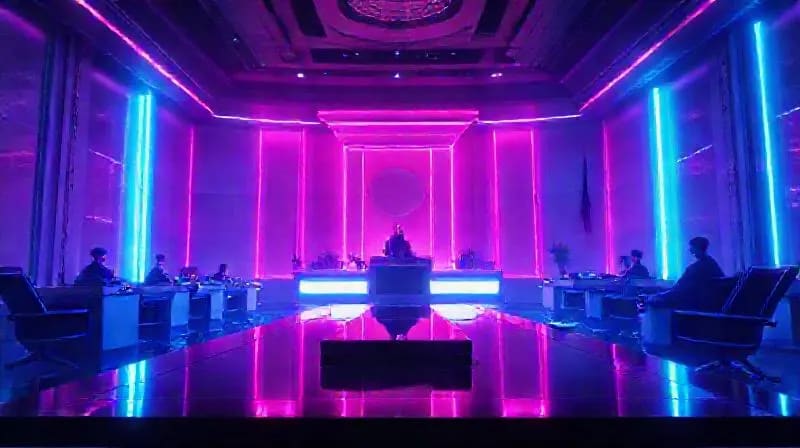 A futuristic courtroom scene where a holographic projection of a digital artwork (an NFT) is being analyzed by judges and lawyers, emphasizing the intersection of technology and law.
Visual source subject to ecosystem availability: Wikimedia Commons under CC BY-SA 4.0 license or conceptual AI rendering.
This article delves into the intricate legal challenges posed by NFTs and AI in the realm of intellectual property. We will explore how traditional IP laws, designed for physical assets and human-created works, are being tested and reshaped by these innovative technologies. Understanding these challenges is crucial for creators, collectors, legal professionals, and policymakers alike.
- Understanding NFTs: Digital Ownership
- Foundations of Intellectual Property in the Digital Age
- Copyright Challenges in NFT Art
- Authorship and Ownership in AI-Generated Content
- Navigating Legal Precedents and Future Frameworks
- Strategies for Protecting Digital Assets
- The Future of NFTs, AI, and IP Law
Understanding NFTs: Digital Ownership
Non-Fungible Tokens, or NFTs, are unique digital assets recorded on a blockchain. Unlike cryptocurrencies, which are fungible (interchangeable), each NFT possesses distinct characteristics that make it one-of-a-kind. This uniqueness allows NFTs to represent ownership of various digital items, including art, music, videos, collectibles, and even virtual real estate.
The core appeal of NFTs lies in their ability to provide verifiable proof of ownership and authenticity in the digital realm. This is achieved through blockchain technology, which acts as an immutable ledger, recording every transaction and ownership transfer. However, it is crucial to distinguish between owning an NFT and owning the underlying intellectual property rights associated with the digital asset it represents.
- Uniqueness: Each NFT has a unique identifier and metadata that distinguishes it from others.
- Verifiable Ownership: Blockchain technology provides a public, immutable record of ownership.
- Scarcity: Creators can set the number of NFTs for a particular asset, creating digital scarcity.
- Interoperability: NFTs can theoretically be transferred across different platforms and marketplaces.
Foundations of Intellectual Property in the Digital Age
Intellectual property refers to creations of the mind, such as inventions, literary and artistic works, designs, and symbols, names, and images used in commerce. It is protected by law through patents, copyrights, and trademarks, enabling people to earn recognition or financial benefit from what they invent or create. In the digital age, these protections extend to software, digital art, and online content.
Copyright, in particular, is highly relevant to NFTs and digital art. It grants creators exclusive rights to reproduce, distribute, perform, display, and create derivative works of their original creations. The challenge arises when a digital asset is tokenized as an NFT, as the act of minting and selling an NFT does not automatically transfer these underlying copyright protections. For innovators looking to secure their creations in this evolving landscape, understanding the nuances of intellectual property protection is paramount.
Copyright Challenges in NFT Art
The primary legal challenge with NFT art revolves around the distinction between owning the NFT and owning the copyright to the artwork it represents. When someone buys an NFT, they typically acquire ownership of the token itself, which points to a digital file. This does not automatically grant them the copyright to the artwork, meaning they cannot legally reproduce, adapt, or commercially exploit the art without explicit permission from the copyright holder.
 A conceptual still-life depicting fragmented legal documents and code snippets merging with artistic brushstrokes and pixelated patterns, symbolizing the complex layers of law and technology.
Another significant issue is the unauthorized minting of NFTs. Individuals can mint NFTs of copyrighted works without the original creator's permission, leading to infringement claims. This is exacerbated by the decentralized nature of blockchain, making it difficult to identify infringers and enforce rights effectively. The lack of clear legal precedents means that each case often navigates uncharted territory.
Furthermore, the concept of moral rights, which protect the personal relationship between creators and their works (e.g., right of attribution, right of integrity), can be complicated in the NFT space. When an NFT is sold and resold, ensuring the original artist's attribution and preventing derogatory treatment of their work becomes a complex task. These challenges highlight the urgent need for a more robust legal framework to govern digital ownership and creative rights.
Authorship and Ownership in AI-Generated Content
The rise of artificial intelligence capable of generating art, music, and text introduces even more profound questions about authorship and ownership. Traditional copyright law typically requires a human author. When an AI creates a piece of art, who holds the copyright? Is it the programmer who developed the AI, the user who provided the prompt, or the AI itself? Most jurisdictions currently lean towards requiring human authorship, leaving AI-generated works in a legal grey area.
The training data used for AI models also presents significant IP challenges. Many AI systems are trained on vast datasets that may include copyrighted material. If an AI generates content that is substantially similar to copyrighted works in its training data, it could lead to claims of infringement. This issue is particularly relevant in fields like music, where AI can reconstruct and generate new compositions. The advancements in AI music reconstruction exemplify both the potential and the legal pitfalls.
The concept of "derivative works" also becomes blurred. Is an AI-generated artwork a derivative of the works it was trained on, or is it an entirely new creation? The answer has significant implications for copyright protection and licensing. As AI continues to evolve, legal systems must adapt to define authorship and ownership for these new forms of creativity, potentially requiring new categories of IP rights.
Navigating Legal Precedents and Future Frameworks
Current legal frameworks are struggling to keep pace with the rapid evolution of NFTs and AI. Many existing laws were not designed with decentralized digital assets or autonomous creative machines in mind. This has led to a fragmented legal landscape, with different jurisdictions approaching these issues with varying interpretations and regulations. Some countries are beginning to explore specific legislation for blockchain and AI, but a unified global approach is still distant.
 An extreme close-up macro photography of a miniature blockchain ledger, intricately detailed, with tiny glowing nodes representing NFTs, intertwined with scales of justice and a stylized paintbrush.
Several high-profile legal disputes involving NFTs have emerged, testing the boundaries of copyright law. These cases often involve unauthorized minting, disputes over licensing terms embedded in smart contracts, and challenges to the authenticity of digital assets. The outcomes of these early cases will likely set important precedents for future litigation and policy development.
The legal community is actively engaged in discussions about how to adapt. This includes considering new forms of licensing, clearer definitions of digital ownership, and potentially new categories of intellectual property rights specifically tailored for AI-generated content. The growth of legal tech startups is also playing a role, offering innovative solutions for contract management and IP protection on the blockchain.
Strategies for Protecting Digital Assets
For creators and businesses operating in the NFT and AI art space, proactive strategies are essential for protecting intellectual property. These include:
- Clear Licensing Agreements: When selling an NFT, explicitly define what rights are being transferred to the buyer (e.g., display rights, commercial use rights) and what rights are retained by the creator.
- Smart Contract Clauses: Utilize the programmable nature of smart contracts to embed IP rights, royalty structures, and usage restrictions directly into the NFT's code.
- Digital Watermarking and Registration: Employ digital watermarks or blockchain-based registration services to establish proof of creation and ownership.
- Monitoring and Enforcement: Actively monitor NFT marketplaces for unauthorized use of copyrighted works and be prepared to issue takedown notices or pursue legal action.
- Educating Buyers: Ensure that buyers understand the distinction between NFT ownership and copyright ownership to prevent misunderstandings and disputes.
These measures, while not foolproof, can significantly strengthen a creator's position in potential IP disputes. As the creator economy expands, new monetization strategies, including subscription models and direct fan engagement, will also need robust legal frameworks to ensure fair compensation and IP protection.
The Future of NFTs, AI, and IP Law
The convergence of NFTs and AI is pushing the boundaries of intellectual property law, forcing a re-evaluation of fundamental concepts like authorship, ownership, and originality. While the challenges are significant, they also present an opportunity to develop more dynamic and technologically informed legal frameworks. Future solutions may involve hybrid legal systems that combine traditional IP principles with blockchain-native mechanisms for rights management and enforcement.
Collaboration between legal experts, technologists, artists, and policymakers will be crucial in shaping a future where innovation can thrive without undermining creators' rights. The goal is to establish clear guidelines that foster creativity, protect intellectual property, and ensure fair compensation in an increasingly digital and AI-driven world. The journey towards a comprehensive legal framework for NFTs and AI is ongoing, promising to redefine the very nature of creative ownership.
The evolution of these technologies will undoubtedly continue to challenge our understanding of property and creativity. Adapting to these changes requires not just legal innovation but also a broader societal consensus on how we value and protect digital works. The dialogue around these issues is just beginning, and its outcome will have lasting implications for the digital economy.
Explore Related Insights
Source: Hybrid content assisted by AI and human editorial supervision.


Comentarios