
Space Law Extraterrestrial Resources Legal Frontier
The vast expanse of space, once a realm of pure scientific curiosity, is rapidly transforming into a new frontier for economic activity and resource acquisition. As humanity sets its sights on celestial bodies beyond Earth, the need for robust legal frameworks governing these endeavors becomes increasingly critical. Space law, a specialized branch of international law, grapples with unprecedented questions regarding sovereignty, property rights, environmental protection, and the ethical implications of exploiting extraterrestrial resources.
This burgeoning field seeks to establish order and prevent conflict in an environment that defies traditional terrestrial legal concepts. From the Moon to asteroids, the potential for valuable minerals, water ice, and other resources presents both immense opportunities and complex challenges for international cooperation and sustainable development. Understanding the foundational principles and evolving debates within space law is essential for navigating this exciting, yet precarious, new era.
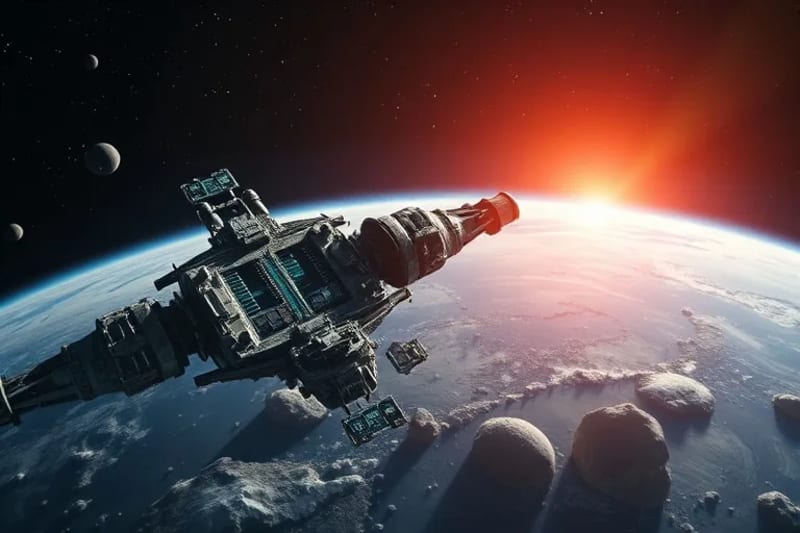
Conceptual representation of the legal and resource challenges in deep space exploration, blending advanced technology with foundational legal principles.
Fuente visual sujeta a disponibilidad del ecosistema: Wikimedia Commons bajo licencia CC BY-SA 4.0 o renderizado conceptual IA.
Table of Contents
- Foundations of Space Law: The Outer Space Treaty
- Challenges of Extraterrestrial Resource Exploitation
- Ethical and Environmental Considerations
- The Future of Space Governance
- International Cooperation and Dispute Resolution
Foundations of Space Law: The Outer Space Treaty
The cornerstone of international space law is the Treaty on Principles Governing the Activities of States in the Exploration and Use of Outer Space, including the Moon and Other Celestial Bodies, commonly known as the Outer Space Treaty (OST) of 1967. This landmark agreement, ratified by over 100 nations, establishes fundamental principles that guide all space activities.
Freedom of Exploration: Outer space, including the Moon and other celestial bodies, is free for exploration and use by all States without discrimination of any kind, on a basis of equality and in accordance with international law.
Non-Appropriation: Outer space is not subject to national appropriation by claim of sovereignty, by means of use or occupation, or by any other means. This principle directly impacts discussions around resource ownership.
Peaceful Use: States undertake not to place in orbit around the Earth any objects carrying nuclear weapons or any other kinds of weapons of mass destruction, install such weapons on celestial bodies, or station such weapons in outer space in any other manner.
International Responsibility: States bear international responsibility for national activities in outer space, whether carried out by governmental agencies or by non-governmental entities. This includes responsibility for damage caused by space objects.
While the OST provides a robust framework for many aspects of space activity, its provisions regarding resource exploitation are ambiguous. The non-appropriation clause is interpreted differently by various nations and legal scholars, leading to ongoing debates about whether it prohibits the extraction and commercialization of resources, or merely the claim of sovereign territory.
Challenges of Extraterrestrial Resource Exploitation
The prospect of mining asteroids, the Moon, or even Mars for valuable resources like platinum, rare earth elements, or water ice is increasingly within technological reach. However, the legal and practical challenges are immense. One of the primary hurdles is the absence of clear international consensus on property rights in space.

A diverse group of experts engaged in a critical discussion about the future of lunar resource regulation.
Several countries, including the United States and Luxembourg, have enacted national laws granting their citizens and companies the right to extract and own space resources. These laws, however, are viewed with skepticism by some nations, who argue that they may violate the spirit, if not the letter, of the Outer Space Treaty's non-appropriation principle. This creates a potential for conflict and legal uncertainty, hindering investment and long-term planning.
Beyond ownership, other challenges include liability for environmental damage, safety regulations for space mining operations, and the equitable distribution of benefits derived from space resources. The concept of "common heritage of mankind," enshrined in the Moon Agreement (which has few signatories), suggests that space resources should benefit all humanity, not just those with the technological capability to extract them. This philosophical divide remains a significant barrier to comprehensive international agreements.
Ethical and Environmental Considerations
As humanity expands its presence into space, it carries with it the responsibility to protect celestial environments from contamination and degradation. The ethical implications of altering pristine extraterrestrial bodies, even for resource extraction, are profound. Planetary protection protocols, designed to prevent biological contamination, are already in place for scientific missions, but resource exploitation introduces new complexities.
The long-term environmental impact of large-scale mining operations on the Moon or asteroids is largely unknown. Concerns include the generation of space debris, alteration of celestial surfaces, and the potential for irreversible changes to extraterrestrial ecosystems, however rudimentary they might be. Furthermore, the ethical question of who decides the fate of these celestial bodies, and for whose benefit, is a central tenet of the debate.
Addressing these concerns requires a proactive approach to international law, integrating principles of Resilient Cities: Urban Planning and Climate Change into a cosmic context. While the challenges of space law are unique, the underlying principles of sustainability and responsible governance remain universal. The development of robust legal frameworks is crucial to ensure that space exploration and resource utilization benefit all of humanity without compromising future generations or celestial environments.
The Future of Space Governance
The rapid pace of technological innovation in space, from reusable rockets to advanced robotics, demands an equally dynamic evolution of space law. Current legal instruments, primarily developed during the Cold War era, struggle to adequately address the complexities of commercial space ventures, space tourism, and resource exploitation.

Abstract representation of legal authority extending to celestial bodies, symbolizing the need for cosmic justice.
Future space governance will likely involve a multi-layered approach, combining international treaties with national legislation, industry standards, and potentially new international organizations. The goal is to create a predictable and stable legal environment that encourages innovation and investment while upholding principles of peace, sustainability, and equitable access.
Discussions are ongoing within the United Nations Committee on the Peaceful Uses of Outer Space (COPUOS) and other forums to develop new norms and guidelines. These efforts aim to address issues such as space traffic management, orbital debris mitigation, and the long-term sustainability of space activities. The challenge lies in achieving consensus among diverse national interests and technological capabilities.
International Cooperation and Dispute Resolution
Given the global nature of space activities, international cooperation is paramount. Collaborative efforts in scientific research, infrastructure development, and regulatory harmonization are crucial for ensuring a safe and productive future in space. Mechanisms for dispute resolution, whether through diplomatic channels, arbitration, or international courts, will become increasingly important as space activities intensify.
The complexities of space law echo other emerging legal fields, such as the ethical dilemmas posed by Quantum Encryption Challenges: Post-Quantum Era and Security, where technological advancement outpaces legal frameworks. Establishing clear rules of engagement and a common understanding of rights and responsibilities will be key to preventing conflicts and fostering a cooperative environment.
Ultimately, the success of humanity's venture into the cosmos will depend not only on technological prowess but also on its ability to forge effective legal and ethical frameworks. By balancing national interests with global responsibilities, and by embracing principles of transparency and inclusivity, space law can pave the way for a new era of exploration and sustainable resource utilization that benefits all of humankind. Even understanding diverse cultural perspectives, like those found in Chinese Zodiac Elements: Cycles and Influence, can offer insights into different approaches to governance and resource management.
The development of space law is an ongoing process, requiring continuous dialogue, adaptation, and a shared vision for humanity's future beyond Earth. As new technologies emerge and new frontiers are explored, the legal landscape will continue to evolve, shaping how we interact with the cosmos and its vast potential.
Explore More Topics
Source: Hybrid content assisted by AI and human editorial supervision.


Comentarios