
Artificial Intelligence Marine Ecosystem Conservation Solutions
Artificial Intelligence: A Cornerstone for Marine Ecosystem Conservation
Marine ecosystems are vital to the planet's health, regulating climate, providing food, and supporting immense biodiversity. However, these invaluable environments face unprecedented threats from climate change, pollution, overfishing, and habitat destruction. The sheer scale and complexity of these challenges often overwhelm traditional conservation methods, necessitating innovative approaches. This is where Artificial Intelligence (AI) emerges as a transformative force, offering powerful tools to monitor, analyze, and protect our oceans with unprecedented efficiency and insight.
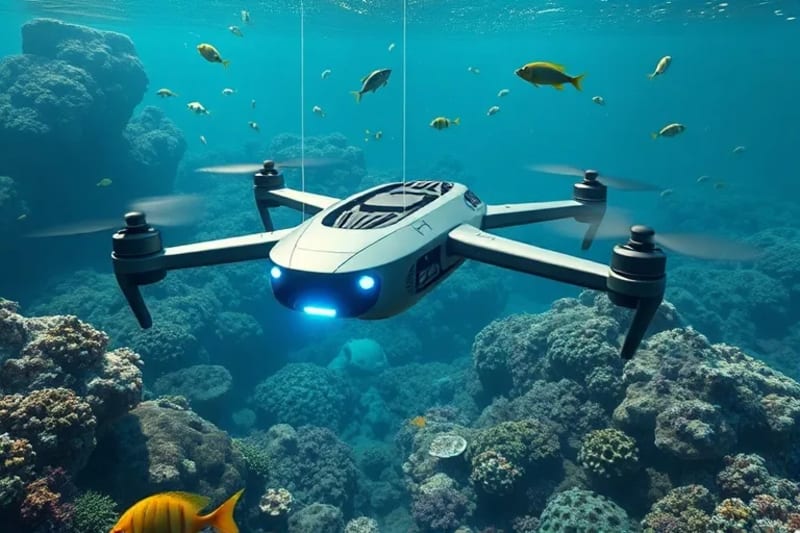
Precursors intellectuales, diagramas fundamentales y representaciones conceptuales que forjaron la visión de la Inteligencia Artificial sobre la conservación marina.
Fuente visual sujeta a disponibilidad del ecosistema: Wikimedia Commons bajo licencia CC BY-SA 4.0 o renderizado conceptual IA.
The application of AI in marine conservation is rapidly expanding, moving beyond theoretical concepts to practical, real-world solutions. From autonomous underwater vehicles (AUVs) that survey vast stretches of ocean to machine learning algorithms that detect illegal fishing activities, AI is revolutionizing our capacity to understand and safeguard marine life. This article explores the multifaceted role of AI in marine ecosystem conservation, highlighting its key applications, benefits, and future potential.
Table of Contents
- AI for Enhanced Marine Monitoring and Data Collection
- Predictive Modeling and Early Warning Systems
- Combating Illegal, Unreported, and Unregulated (IUU) Fishing
- Restoration and Habitat Management with AI
- Challenges and Ethical Considerations
- The Future of AI in Ocean Conservation
AI for Enhanced Marine Monitoring and Data Collection
One of the most significant contributions of AI to marine conservation lies in its ability to process and interpret vast amounts of data collected from the ocean. Traditional monitoring methods are often labor-intensive, costly, and limited in scope. AI-powered systems, however, can analyze data from diverse sources, including satellite imagery, underwater sensors, hydrophones, and remotely operated vehicles (ROVs), providing a comprehensive picture of marine health.
Machine learning algorithms can identify and classify marine species from visual and acoustic data with remarkable accuracy. This capability is crucial for tracking population dynamics, migration patterns, and the presence of endangered species. For instance, AI can distinguish individual whales by their unique fluke patterns or identify specific fish species from underwater video footage, automating tasks that once required countless hours of human observation.

AI's analytical prowess transforms raw ocean data into actionable insights, revealing patterns vital for conservation efforts.
Furthermore, AI facilitates the detection and mapping of marine pollution, such as plastic debris and oil spills. By analyzing satellite images and drone footage, AI models can pinpoint pollution hotspots, track their movement, and even estimate their volume. This information is invaluable for rapid response efforts and for understanding the sources and pathways of marine contaminants. The integration of such advanced analytical tools is a testament to how proactive cybersecurity strategies are also becoming essential to protect these sensitive data streams from malicious interference.
Acoustic monitoring, a non-invasive method, greatly benefits from AI. Hydrophones capture underwater sounds, which AI algorithms then process to detect the presence of marine mammals, identify specific vocalizations, and even monitor noise pollution from shipping. This allows researchers to understand how human activities impact marine soundscapes and animal behavior, leading to more targeted conservation strategies.
Predictive Modeling and Early Warning Systems
Beyond current monitoring, AI excels in predictive analytics, enabling scientists to forecast environmental changes and their potential impact on marine ecosystems. Machine learning models can analyze historical data on ocean temperatures, currents, weather patterns, and marine life to predict phenomena like coral bleaching events, harmful algal blooms, and shifts in species distribution. These predictions provide crucial lead time for conservationists to implement mitigation measures or prepare for ecological shifts.
For example, AI-driven systems can predict the likelihood of a coral bleaching event based on rising ocean temperatures and other environmental stressors. This allows authorities to issue early warnings, enabling local communities and conservation organizations to take protective actions, such as shading vulnerable reefs or relocating coral fragments to cooler waters. Such foresight is critical in the face of accelerating climate change impacts.
Similarly, AI can predict the movement of marine debris or oil spills, helping to deploy resources efficiently for cleanup operations. By integrating various data sources—oceanographic models, wind patterns, and satellite observations—AI provides dynamic forecasts that enhance response effectiveness. This proactive approach mirrors the principles of sustainable growth hacking, where data-driven insights are used to achieve long-term positive impact.
Combating Illegal, Unreported, and Unregulated (IUU) Fishing
IUU fishing is a major global problem, depleting fish stocks, damaging marine habitats, and undermining sustainable fisheries management. AI offers powerful solutions to detect and deter these illicit activities. By analyzing vast datasets from vessel tracking systems (like AIS), satellite imagery, and even social media, AI algorithms can identify suspicious patterns of behavior indicative of IUU fishing.
Machine learning models can learn to distinguish between legitimate fishing activities and those that are illegal or unreported. They can detect vessels operating in protected areas, identify ships that "go dark" by turning off their transponders, or flag unusual rendezvous at sea. This intelligence empowers enforcement agencies to deploy their limited resources more effectively, targeting high-risk areas and vessels.
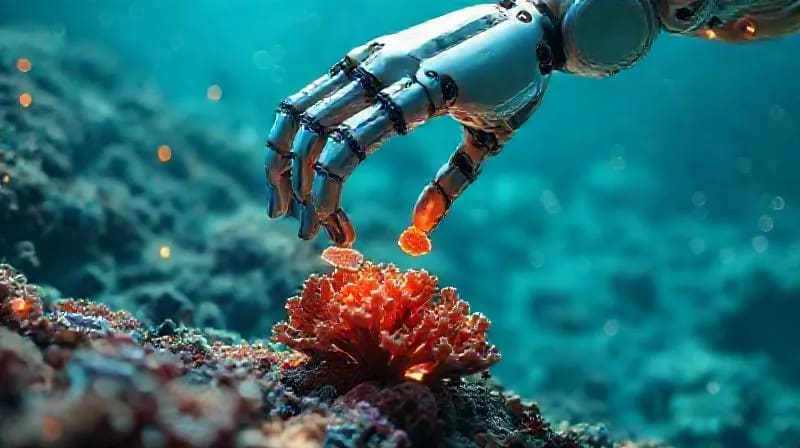
AI-driven robotics offer precise, scalable solutions for restoring damaged marine habitats, from coral reefs to oyster beds.
Organizations like Global Fishing Watch use AI to provide transparency into commercial fishing activities, making it harder for illegal operators to hide. This increased surveillance not only helps to catch offenders but also acts as a deterrent. The ability to process and visualize complex data sets is also enhanced by technologies like augmented reality in education, which can make these intricate patterns more accessible for training and public awareness.
Restoration and Habitat Management with AI
AI is not only about monitoring and detection; it also plays a crucial role in active restoration and habitat management. Robotics, guided by AI, can perform tasks that are dangerous or impractical for humans, such as planting coral fragments on damaged reefs or removing invasive species. These robotic systems can operate for extended periods underwater, precisely executing complex tasks with minimal human intervention.
For example, AI-powered underwater robots can identify suitable locations for coral outplanting, assess the health of existing corals, and even cultivate new coral fragments in specialized nurseries. This accelerates the restoration process, particularly in large-scale projects where manual labor would be prohibitive. Similarly, AI can guide robots to remove marine debris from sensitive ecosystems, minimizing disturbance to the surrounding environment.
Furthermore, AI can optimize the design and placement of marine protected areas (MPAs). By analyzing ecological data, oceanographic conditions, and human activity patterns, algorithms can identify the most effective locations and boundaries for MPAs to maximize biodiversity protection and ecosystem resilience. This data-driven approach ensures that conservation efforts are strategically placed for the greatest impact.
Challenges and Ethical Considerations
Despite its immense potential, the deployment of AI in marine conservation is not without challenges. The development and maintenance of sophisticated AI systems require significant financial investment and technical expertise. Data quality and availability can also be limiting factors, as AI models are only as good as the data they are trained on. Remote and deep-sea environments pose particular difficulties for data collection and sensor deployment.
Ethical considerations also come into play. The use of AI for surveillance, particularly in detecting illegal activities, raises questions about privacy and data governance. Ensuring that AI systems are used responsibly, transparently, and without bias is paramount. There is also a need to avoid over-reliance on technology, ensuring that human expertise and local knowledge remain central to conservation efforts. The vision of pioneers like Nikola Tesla reminds us that technological advancement must always be coupled with a deep understanding of its societal and environmental implications.
Moreover, the energy consumption of large-scale AI operations and data centers needs to be considered. As AI becomes more prevalent, ensuring that its computational footprint is minimized and powered by renewable energy sources is crucial to maintain its overall positive environmental impact. Balancing technological progress with ecological responsibility is a continuous challenge.
The Future of AI in Ocean Conservation
The future of AI in marine ecosystem conservation is bright and continues to evolve rapidly. Advances in machine learning, robotics, and sensor technology will further enhance our capabilities. We can expect more sophisticated autonomous systems capable of complex decision-making and adaptive learning in dynamic ocean environments. The integration of AI with other emerging technologies, such as biotechnology and advanced materials, will unlock new possibilities for restoration and protection.
For instance, AI-driven biotechnologies could help develop more resilient coral species or identify genetic markers for disease resistance in marine organisms. Furthermore, the increasing accessibility of AI tools will empower a broader range of stakeholders, from local communities to citizen scientists, to participate in conservation efforts. This democratization of technology can foster a more collaborative and effective global conservation movement.
Ultimately, AI is not a standalone solution but a powerful enabler that amplifies human efforts in marine conservation. By providing unparalleled insights, automating laborious tasks, and offering predictive capabilities, AI allows us to address the urgent challenges facing our oceans with greater precision, speed, and scale. The synergy between human ingenuity and artificial intelligence holds the key to a healthier, more resilient marine future.
Explore Related Topics
Source: Hybrid content assisted by AI and human editorial supervision.


Comentarios