
Collaborative Robotics Evolution Human-Machine Industry 4.0
The landscape of modern manufacturing and industrial operations is undergoing a profound transformation, largely driven by the advent of Industry 4.0. At the heart of this revolution lies the evolution of robotics, specifically the emergence and widespread adoption of collaborative robots, or cobots. These intelligent machines are redefining the traditional boundaries between human labor and automation, fostering an era of unprecedented human-machine interaction.
Table of Contents
Unlike their predecessors, which typically operated in caged environments due to safety concerns, cobots are designed to work alongside humans, sharing the same workspace and often collaborating on tasks. This shift marks a significant departure from the fully automated, human-less factories once envisioned, moving towards a more symbiotic relationship where the strengths of both humans and machines are leveraged for optimal efficiency and innovation.

A modern factory environment where humans and cobots collaborate seamlessly, enhancing productivity and safety.
Evolution of Collaborative Robotics
The journey of robotics began with rudimentary machines performing repetitive tasks, primarily in heavy industries. These early industrial robots, while revolutionary for their time, were characterized by their lack of sensory perception and inability to adapt to dynamic environments. They required strict segregation from human workers to prevent accidents, limiting their application to tasks that could be fully automated.
The concept of collaborative robotics first emerged in the late 1990s, with researchers at Northwestern University pioneering the idea of robots designed to assist humans rather than replace them. However, it was the rapid advancements in sensor technology, artificial intelligence, and computing power in the 21st century that truly propelled cobots into practical application. This era saw the development of sophisticated algorithms enabling robots to perceive their surroundings, understand human intent, and respond safely.
Industry 4.0, characterized by the integration of cyber-physical systems, the Internet of Things (IoT), and cloud computing, provided the perfect ecosystem for cobots to thrive. Within this framework, cobots are not merely standalone machines but interconnected components of a larger, intelligent manufacturing system. Their ability to communicate with other machines and systems, facilitated by IoT, allows for unprecedented levels of flexibility and efficiency in production processes.
Key Characteristics and Benefits of Cobots
Cobots distinguish themselves from traditional industrial robots through several core characteristics that enable safe and effective human-machine collaboration. These attributes are fundamental to their role in modern industrial settings and contribute significantly to their growing adoption across various sectors.
One of the most critical features is their inherent safety mechanisms. Cobots are equipped with advanced sensors that detect human presence and proximity, allowing them to slow down or stop completely to avoid collisions. This eliminates the need for safety cages, freeing up valuable floor space and enabling more flexible workstation layouts. Their force-limited capabilities ensure that any contact with a human is gentle and non-injurious.

Visual representation of data flow and connectivity, highlighting the role of IoT in modern industrial environments.
Another significant characteristic is their ease of programming and deployment. Many cobots feature intuitive interfaces, often utilizing "teach pendant" programming or even hand-guided teaching, where an operator physically moves the robot arm to demonstrate a task. This reduces the need for specialized robotics engineers, making automation accessible to a wider range of businesses, including small and medium-sized enterprises (SMEs).
The benefits of integrating cobots are multifaceted. They enhance productivity by taking over dull, dirty, and dangerous tasks, allowing human workers to focus on more complex, value-added activities that require cognitive skills, problem-solving, and creativity. This leads to improved job satisfaction and reduced ergonomic strain for employees. For instance, in tasks requiring precise repetitive movements or heavy lifting, cobots can perform consistently without fatigue, thereby improving overall output quality and speed.
Furthermore, cobots offer unparalleled flexibility and adaptability. They can be easily reprogrammed and redeployed for different tasks or production lines, making them ideal for high-mix, low-volume manufacturing environments. This agility is crucial in today's fast-paced markets, where product cycles are short and customization is increasingly demanded. This adaptability aligns perfectly with the principles of change management in corporations, allowing businesses to pivot quickly.
Here's a comparison highlighting the key differences and advantages:
| Feature | Traditional Industrial Robots | Collaborative Robots (Cobots) |
|---|---|---|
| Interaction with Humans | Operate in isolated, caged environments; no direct interaction. | Designed for direct human-robot collaboration in shared workspaces. |
| Safety Measures | Physical barriers (cages, fences) for human safety. | Integrated sensors, force/power limiting, speed reduction for inherent safety. |
| Programming Complexity | Requires specialized programming skills (e.g., G-code, proprietary languages). | Intuitive interfaces, teach pendant, hand-guided programming. |
| Flexibility & Deployment | Fixed, large-scale automation; difficult to reconfigure. | Highly flexible, easily redeployed for various tasks and production lines. |
| Cost & ROI | Higher initial investment, longer ROI for specific, high-volume tasks. | Lower initial cost, faster ROI for flexible, diverse tasks. |
| Typical Applications | Welding, painting, heavy material handling, high-speed assembly. | Assembly, packaging, quality inspection, machine tending, pick-and-place. |
Human-Robot Interaction (HRI) Principles
The success of collaborative robotics hinges on effective Human-Robot Interaction (HRI). This field of study focuses on designing robots and interfaces that enable seamless, intuitive, and safe communication between humans and machines. Key principles guide the development of HRI, ensuring that cobots are not just tools but partners in the workplace.
One fundamental principle is the concept of shared understanding. For humans and cobots to work effectively together, both must have a clear understanding of the task, the environment, and each other's capabilities and intentions. This is achieved through advanced sensing, predictive algorithms, and intuitive feedback mechanisms. For example, a cobot might use visual cues or auditory signals to indicate its next movement or the status of a task.
Safety and trust are paramount. As discussed, physical safety is engineered into cobots through force and speed limitations. However, psychological safety and trust are equally important. Workers must feel confident that the cobot will not harm them and that it will perform its tasks reliably. This trust is built through consistent, predictable behavior from the cobot and clear communication of its operational status.
Adaptability and flexibility are also crucial. Cobots should be able to adapt to variations in human workflow, unexpected obstacles, and changes in task requirements. This often involves machine learning capabilities that allow the cobot to learn from human demonstrations and adjust its movements accordingly. Such adaptability ensures that the human-cobot team can handle dynamic production environments efficiently.
The Role of IoT and AI in Cobotics
The synergy between collaborative robotics, the Internet of Things (IoT), and Artificial Intelligence (AI) is a cornerstone of Industry 4.0. These technologies collectively empower cobots to operate with unprecedented levels of intelligence, connectivity, and autonomy, transforming them from mere tools into integral components of smart factories.
IoT provides the connective tissue for cobots, enabling them to communicate and exchange data with a vast network of devices, sensors, and systems within the manufacturing environment. This interconnectedness allows cobots to receive real-time information about production schedules, inventory levels, machine status, and even human worker locations. For example, a cobot can dynamically adjust its task based on the availability of materials from an automated storage system, or coordinate its movements with other machines to optimize throughput. This is a critical aspect of modern industrial ecosystems, much like the broader discussions around Metaverse and Web3's impact on daily life, where interconnectedness drives new paradigms.
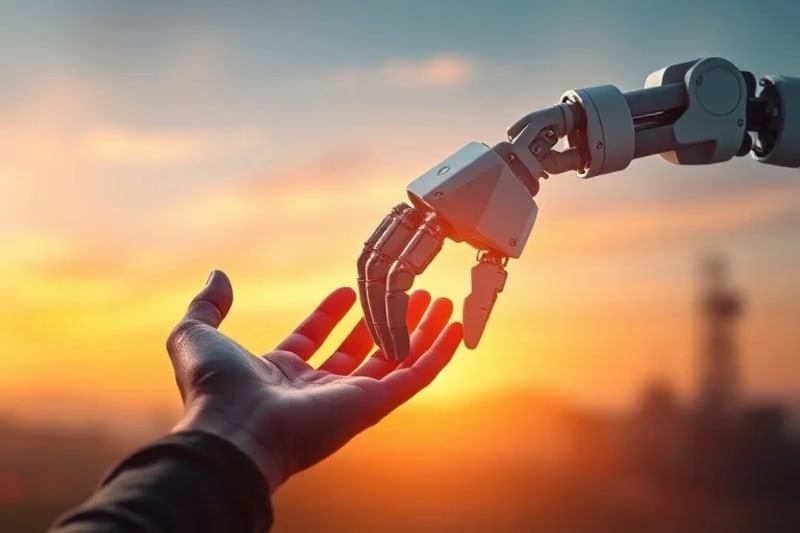
A conceptual artwork emphasizing the trust and partnership between human and robotic elements in future industrial settings.
AI, particularly machine learning and computer vision, imbues cobots with intelligence. AI algorithms enable cobots to learn from experience, recognize patterns, and make decisions autonomously. Computer vision allows them to interpret visual data from their surroundings, identifying objects, recognizing gestures, and detecting anomalies. This intelligence is vital for tasks requiring precision, adaptability, and real-time problem-solving, such as quality inspection or complex assembly.
Predictive maintenance, an IoT-driven application, is significantly enhanced by AI in cobotics. By continuously monitoring their own performance and health, cobots can predict potential failures before they occur, scheduling maintenance proactively and minimizing downtime. This contributes to the overall efficiency and reliability of the production line. The integration of these technologies also raises important discussions about ethical considerations in AI, ensuring responsible deployment.
Furthermore, AI-powered natural language processing (NLP) is beginning to enable more intuitive human-cobot communication, allowing workers to issue commands or ask questions using natural speech. This advancement further reduces the learning curve for operators and makes cobots more accessible and user-friendly.
Challenges and Future Outlook for Cobots
Despite their numerous advantages and rapid adoption, the evolution of collaborative robotics faces several challenges that need to be addressed for their full potential to be realized. These challenges span technological, ethical, and societal dimensions, requiring concerted efforts from researchers, industry, and policymakers.
One significant challenge is the ongoing development of more sophisticated safety standards and certification processes. While current cobots are designed to be inherently safe, the complexity of human-robot interaction in dynamic environments necessitates continuous refinement of safety protocols. Ensuring that cobots can reliably interpret human intent and react appropriately in unpredictable situations remains a key area of research.
Another hurdle is the integration of cobots into existing legacy systems. Many older factories operate with outdated infrastructure that may not be readily compatible with advanced IoT and AI-driven cobotic systems. The cost and complexity of upgrading these systems can be prohibitive for some businesses, slowing down the widespread adoption of Industry 4.0 technologies. This highlights the importance of sustainable technologies and innovations that can bridge the gap between old and new.
From an ethical perspective, concerns about job displacement and the future of work are often raised. While cobots are intended to augment human capabilities rather than replace them, there is a need for proactive strategies to retrain and upskill the workforce. Education and vocational training programs must adapt to equip workers with the skills necessary to collaborate with intelligent machines, fostering a smooth transition into the new industrial paradigm.
Looking ahead, the future of collaborative robotics is bright and promising. We can anticipate several key trends that will shape their development:
- Enhanced Dexterity and Sensory Capabilities: Future cobots will likely possess even greater dexterity, allowing them to handle delicate and complex tasks with human-like precision. Advanced tactile sensors and improved vision systems will enable them to perceive and interact with their environment more intelligently.
- Increased Autonomy and Learning: Driven by advancements in AI and machine learning, cobots will become more autonomous, capable of learning new tasks from minimal human input and adapting to novel situations without explicit programming.
- Cloud Robotics and Edge Computing: The integration of cloud robotics will allow cobots to access vast amounts of data and computational power, enabling more complex decision-making. Edge computing will ensure low-latency processing for real-time interactions, crucial for safety and responsiveness.
- Human-Centric Design: The focus will increasingly shift towards designing cobots that are not only efficient but also intuitive and pleasant for humans to work with. This includes improvements in ergonomics, aesthetics, and user interfaces.
- Wider Application Areas: Beyond manufacturing, cobots are expected to find applications in diverse sectors such as healthcare (e.g., assisting surgeons, patient care), logistics (e.g., order picking), and even service industries.
The evolution of collaborative robotics is a testament to humanity's ongoing quest for efficiency, safety, and innovation. As these intelligent machines become more sophisticated and integrated into our daily work lives, they will continue to redefine the boundaries of what is possible, fostering a future where humans and machines work hand-in-hand to achieve common goals.
Explore More Insights
- Personalized Medicine Pharmacogenomics: Individual Genetics Learn about tailored medical treatments based on genetic profiles.
- Microplastic Pollution: Effects on Human Health Investigate the pervasive threat of microplastics to our well-being.
- Sustainable Banking: ESG Investment Financial Transformation Explore ethical finance and environmentally conscious investments.
- Sovereign Digital Identity Law: Blockchain, AI, Privacy Understand the legal framework for digital self-sovereignty.
Source: Hybrid content assisted by AI and human editorial supervision.


Comentarios