
Circular Business Models: Sustainable Startups, Regenerative Economy
In an era defined by environmental challenges and resource scarcity, the traditional linear "take-make-dispose" economic model is proving increasingly unsustainable. This paradigm has led to significant ecological degradation, waste accumulation, and social inequities. Consequently, there is a growing imperative for businesses, particularly startups, to adopt more resilient and responsible approaches.
Circular business models offer a transformative framework, shifting away from linear consumption towards systems designed for longevity, reuse, and regeneration. These models are not merely about recycling; they represent a fundamental reimagining of how products are designed, produced, distributed, and consumed. For startups, embracing these principles can unlock new market opportunities, foster innovation, and build a more sustainable future.
This article explores the core tenets of circular business models, their application for sustainable startups, and how they integrate with the broader concept of a regenerative economy. We will delve into various model types, practical implementation strategies, and the compelling benefits they offer. Understanding these concepts is crucial for any new venture aiming to thrive in a rapidly evolving global landscape.

Conceptual representation of natural processes mirroring regenerative economic principles and sustainable resource cycles.
Table of Contents
- Understanding Circular Economy Fundamentals
- Core Principles of Circularity
- Benefits for Sustainable Startups
- Types of Circular Business Models
- Implementing Circularity in Startups
- Circular Models and Regenerative Economy Synergy
- Challenges and Future Outlook
Understanding Circular Economy Fundamentals
The circular economy is an economic system aimed at eliminating waste and the continual use of resources. It is restorative and regenerative by design, contrasting sharply with the linear model. This concept moves beyond mere waste management, focusing on holistic system-wide changes.
It envisions products, components, and materials maintaining their highest utility and value at all times. This involves distinguishing between technical and biological cycles. Technical cycles involve products designed for reuse, repair, remanufacturing, and recycling. Biological cycles involve materials designed to re-enter the biosphere safely, such as compostable packaging.
The Ellen MacArthur Foundation, a leading advocate for the circular economy, emphasizes three core principles. These principles serve as a guiding framework for businesses seeking to transition to more sustainable practices. They provide a clear roadmap for designing products and processes that minimize environmental impact.
Core Principles of Circularity
At its heart, the circular economy is built upon three fundamental principles:
- Design out waste and pollution: This principle emphasizes that waste and pollution are not accidents but rather the result of design flaws. By rethinking product design from the outset, businesses can eliminate waste before it is created. This includes selecting non-toxic materials, designing for disassembly, and creating products that last longer.
- Keep products and materials in use: This involves extending the lifespan of products and their components through strategies like repair, reuse, remanufacturing, and upgrading. When a product reaches the end of its useful life, its materials should be recovered and recirculated, rather than discarded. This minimizes the need for new raw materials and reduces landfill waste.
- Regenerate natural systems: Beyond minimizing harm, the circular economy aims to actively improve and restore natural capital. This means returning valuable biological materials to the earth, supporting biodiversity, and reducing reliance on finite resources. Practices like regenerative agriculture and sustainable forestry are integral to this principle.
These principles are interconnected and work in concert to create a resilient and sustainable economic system. They challenge businesses to innovate not just in products, but in their entire operational philosophy. Applying these principles can lead to significant environmental and economic advantages.
Benefits for Sustainable Startups
For startups, adopting circular business models offers a multitude of strategic advantages, positioning them for long-term success and resilience. These benefits extend beyond environmental impact, touching upon financial performance, brand reputation, and market competitiveness.
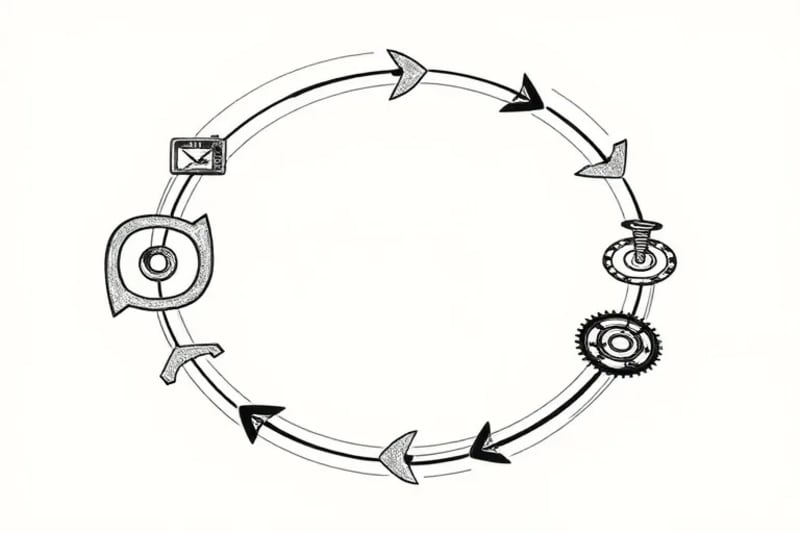
Visualizing the interconnected stages of a circular business model, from design to regeneration.
One significant advantage is enhanced resource efficiency and cost reduction. By keeping materials in use longer, startups can reduce their reliance on virgin raw materials, which often fluctuate in price and availability. This leads to more stable supply chains and lower operational costs. For instance, remanufacturing components can be significantly cheaper than producing new ones.
Another key benefit is increased customer loyalty and brand value. Consumers are increasingly conscious of environmental issues and are willing to support businesses that demonstrate a commitment to sustainability. A circular approach can differentiate a startup in a crowded market, attracting a growing segment of ethically-minded customers. This resonates with the broader societal shift towards responsible consumption.
Furthermore, circular models foster innovation and new revenue streams. Designing for circularity often requires creative problem-solving, leading to the development of novel products, services, and technologies. Startups can generate revenue from repair services, leasing models, or selling recovered materials, diversifying their income sources beyond traditional product sales. This adaptability is crucial in a dynamic market.
Regulatory compliance and reduced risk are also important factors. As governments worldwide introduce stricter environmental regulations, businesses with circular practices are better positioned to meet these requirements, avoiding potential fines and reputational damage. This proactive approach can provide a competitive edge. For example, understanding regulations around data privacy and ethical technology, as discussed in "Regulación Datos Personales Unión Europea: GDPR Alcance Global", can also inform responsible business practices beyond just material flows. You can learn more about this at Regulación Datos Personales Unión Europea: GDPR Alcance Global | Althox.
Types of Circular Business Models
Circular business models manifest in various forms, each offering a distinct approach to resource optimization and value retention. Startups can choose the model that best aligns with their product, industry, and strategic goals. Here are some prominent types:
- Product-as-a-Service (PaaS): Instead of selling products, businesses lease them to customers, retaining ownership and responsibility for maintenance, repair, and end-of-life management. This incentivizes durability and ease of repair. Examples include leasing office equipment or subscription clothing services.
- Resource Recovery and Recycling: This model focuses on collecting waste materials and transforming them into new products or valuable inputs for other industries. It requires efficient collection, sorting, and processing infrastructure. Startups in this space often innovate in material science or waste-to-resource technologies.
- Extension of Product Lifespan: Businesses design products for durability, repairability, and upgradability. They also offer services for maintenance, repair, and refurbishment, keeping products in use for longer. This directly counters planned obsolescence.
- Sharing Platforms: Facilitating the sharing of products or assets among multiple users, thereby maximizing utilization and reducing the need for individual ownership. This can apply to anything from tools to vehicles.
- Circular Sourcing: Using renewable, recyclable, or bio-based materials as inputs, and ensuring that suppliers adhere to circular principles. This upstream approach minimizes environmental impact from the very beginning of the supply chain.
Each model requires careful consideration of design, logistics, and customer engagement. The choice of model can significantly influence a startup's operational structure and market positioning. Integrating these models can also be enhanced by leveraging advanced technologies. For instance, the principles behind "Blockchain Cadena Suministro: Transformación Global" could be applied to track materials and products throughout their circular journey, ensuring transparency and efficiency. You can explore this further at Blockchain Cadena Suministro: Transformación Global | Althox.
Implementing Circularity in Startups
For a startup, integrating circular principles requires a strategic and holistic approach. It's not an add-on but a foundational element of the business model. The journey often begins with a thorough assessment of the product lifecycle and value chain.
The first step involves 'circular design'. This means designing products with their end-of-life in mind, ensuring they are durable, repairable, and easily disassembled for material recovery. Material selection is critical, prioritizing renewable, recycled, or non-toxic components. This early-stage thinking can prevent future waste and pollution.
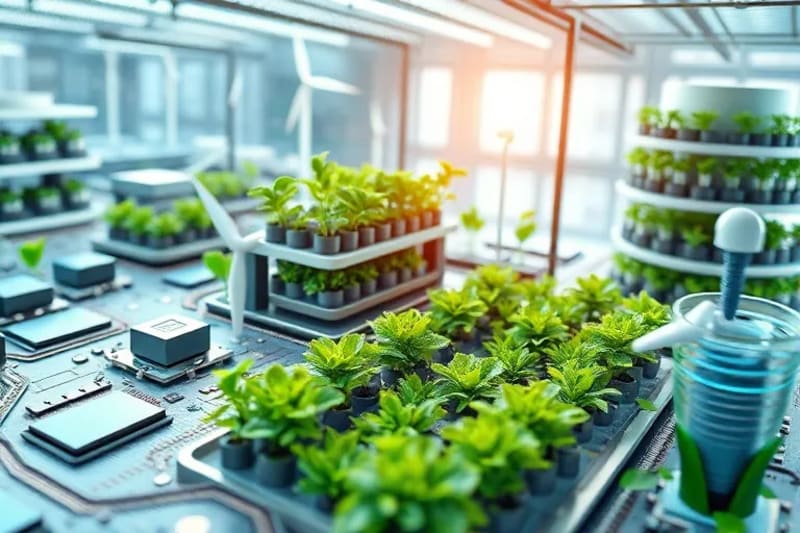
A conceptual vision of urban agriculture utilizing advanced resource management and renewable energy.
Secondly, startups need to establish robust reverse logistics. This involves creating systems for collecting used products or materials from customers, partners, or waste streams. Efficient collection, sorting, and processing are vital for ensuring materials re-enter the production cycle. This can be a complex undertaking, often requiring partnerships and innovative logistical solutions.
Thirdly, fostering a 'circular culture' within the organization and among customers is paramount. Educating employees about circular principles and encouraging customer participation in return or repair programs is essential. Clear communication about the environmental benefits and ease of participation can drive adoption. This cultural shift is as important as the technical implementation.
Finally, startups should leverage technology to optimize their circular processes. Digital tools can track material flows, manage inventory of recovered components, and facilitate communication with customers for product returns. This digital integration can significantly enhance the efficiency and scalability of circular operations. The rapid advancements in areas like "Realidad Extendida Metaverso: Innovaciones Inmersión Multisensorial" also suggest future possibilities for virtual prototyping and lifecycle management of circular products. Discover more about immersive technologies at Realidad Extendida Metaverso: Innovaciones Inmersión Multisensorial | Althox.
Circular Models and Regenerative Economy Synergy
While the circular economy focuses on eliminating waste and keeping resources in use, the concept of a regenerative economy takes this a step further. A regenerative economy aims not just to minimize harm but to actively restore and enhance natural and social systems. Circular business models are a crucial pathway to achieving regenerative outcomes.
The synergy lies in their shared goal of creating positive impacts. Circular models, by design, reduce extraction of virgin resources and minimize pollution, which directly contributes to regenerating natural capital. For example, a startup using compostable packaging from agricultural waste is not only circular but also supports soil health when the packaging breaks down.
Regenerative principles encourage businesses to think beyond their immediate operations and consider their broader ecosystem. This includes fair labor practices, community engagement, and supporting local economies, alongside environmental restoration. A truly regenerative startup would embed these social and ecological considerations into its core mission.
For startups, adopting a regenerative mindset means viewing their business as an integral part of a larger living system. This involves designing products and services that not only function efficiently but also contribute positively to the environment and society. It's about creating value that cycles back to benefit all stakeholders, including nature itself. This holistic view aligns with the growing understanding of interconnectedness, much like how "Neurociencia Humor: Risa Transforma Cerebro, Salud Mental" explores the profound links between mental well-being and physiological responses. Read more about the science of humor at Neurociencia Humor: Risa Transforma Cerebro, Salud Mental.
Challenges and Future Outlook
Despite the compelling advantages, implementing circular business models presents several challenges for startups. These can range from initial investment costs to overcoming established linear mindsets. However, the future outlook for these models remains overwhelmingly positive, driven by increasing consumer demand and regulatory pressures.
One primary challenge is the upfront investment required for redesigning products, establishing reverse logistics, and developing new material recovery processes. Startups often operate with limited capital, making these initial expenditures a significant hurdle. Additionally, securing funding from investors who understand and value circularity can be difficult, although this is changing rapidly.
Another obstacle is the complexity of managing diverse material streams and ensuring quality control for recycled or remanufactured components. Building a reliable network of suppliers and partners for collection and processing is crucial but can be time-consuming. Consumer education is also vital, as many customers are still accustomed to disposable products and may need to be convinced of the value of circular alternatives.
Looking ahead, the momentum towards a circular and regenerative economy is undeniable. Technological advancements, such as advanced recycling techniques and digital platforms for material tracking, are making circularity more feasible and efficient. Policy support, including extended producer responsibility schemes and incentives for sustainable innovation, is also growing. Startups that embrace these models are not just building businesses; they are contributing to a more resilient and equitable global system.
The transition to a fully circular and regenerative economy will require collaborative efforts from businesses, governments, and consumers alike. Startups, with their agility and capacity for innovation, are uniquely positioned to drive this transformation. By integrating circular principles from their inception, they can lead the way towards a future where economic growth is decoupled from resource depletion and environmental degradation.
Explore More on Althox
- GDPR Global Reach
- Deep Sea Biodiversity
- Bionic Computing
- Blockchain Supply Chain
- Dirty Diana Analysis
- Female Hormonal Biohacking
- Extended Reality Metaverse
- Financial Well-being
- Neuroscience of Humor
- Quantum Cryptography
- Mary Barra's Leadership
- Street Art Activism
Related Topics Across Our Network
Source: Hybrid content assisted by AI and human editorial supervision.


Comentarios