
Augmented Reality Ecosystem Conservation: Monitoring Education
Augmented Reality (AR) is rapidly transforming various sectors, and environmental conservation is no exception. By overlaying digital information onto the real world, AR offers innovative tools for monitoring ecosystems, engaging the public, and enhancing environmental education. This technology moves beyond passive observation, providing interactive and immersive experiences that can deepen understanding and foster proactive engagement with ecological challenges. From visualizing complex data in real-time to creating interactive learning environments, AR holds significant promise for a more effective and engaging approach to protecting our planet's biodiversity and natural resources.
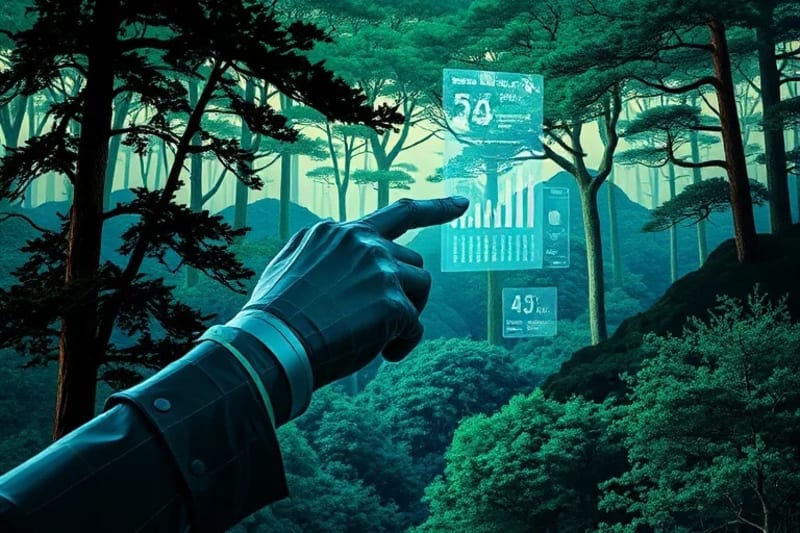
Augmented Reality transforms passive observation into interactive engagement, offering new ways to visualize complex ecological data and foster deeper environmental understanding.
The application of AR in conservation efforts is a relatively new but rapidly expanding field. Traditional methods often involve extensive fieldwork, data collection, and subsequent analysis, which can be time-consuming and resource-intensive. AR streamlines many of these processes, offering real-time data visualization and immediate access to contextual information. This efficiency not only accelerates decision-making but also makes complex scientific data more accessible to a broader audience, including policymakers and local communities.
Furthermore, AR's ability to create immersive experiences is particularly valuable for environmental education. It can transport users to remote ecosystems, illustrate the impact of climate change, or allow interactive exploration of endangered species, all without leaving a classroom or visitor center. This educational dimension is crucial for raising awareness and inspiring the next generation of environmental stewards. The blend of real-world context with digital enhancement makes learning both effective and memorable, addressing the critical need for increased environmental literacy globally.
Table of Contents
- Augmented Reality in Ecosystem Monitoring
- Enhanced Data Visualization and Analysis
- Real-time Species Tracking and Identification
- Dynamic Habitat Mapping and Assessment
- Augmented Reality in Environmental Education
- Immersive Learning Experiences
- Virtual Field Trips and Remote Exploration
- Gamification for Environmental Awareness
- Benefits, Challenges, and Future Outlook
Augmented Reality in Ecosystem Monitoring
Ecosystem monitoring is foundational to conservation, providing crucial data on environmental health, species populations, and habitat changes. Augmented Reality significantly enhances these monitoring capabilities by offering new ways to interact with and interpret complex ecological data in situ. This integration allows field researchers and conservationists to gain immediate insights, improving the accuracy and efficiency of their work.
Enhanced Data Visualization and Analysis
One of the most powerful applications of AR in monitoring is its ability to visualize data directly within the physical environment. Instead of relying on maps or digital screens back at the lab, field scientists can wear AR glasses or use AR-enabled tablets to see overlays of historical data, real-time sensor readings, or predictive models projected onto the landscape. This might include visualizing temperature gradients, soil moisture levels, or pollution dispersion patterns directly over a river or forest area.
This immediate, contextual visualization aids in identifying anomalies, understanding spatial relationships, and making informed decisions on the spot. For instance, a conservationist could walk through a wetland and see augmented markers indicating areas of invasive species, water quality measurements, or the historical flood plain boundaries. This reduces the cognitive load of translating abstract data into real-world implications, making analysis more intuitive and efficient.
Real-time Species Tracking and Identification
AR technology can revolutionize how species are tracked and identified in the wild. By integrating with GPS, camera systems, and artificial intelligence, AR devices can help field biologists identify flora and fauna instantly. Imagine pointing a device at an unfamiliar plant or animal, and an AR overlay provides its species name, conservation status, ecological role, and even historical sighting data.
For elusive or endangered species, AR can connect to remote sensing technologies, such as camera traps or acoustic sensors. This allows researchers to visualize the movement patterns of animals in their natural habitat as holographic projections, or to pinpoint the exact location of a rare bird's call, enhancing both research and anti-poaching efforts. This capability significantly improves the speed and accuracy of biodiversity assessments.
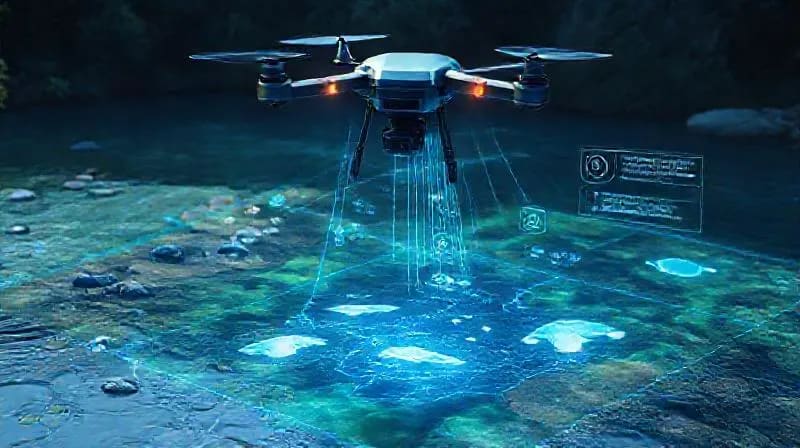
Drones equipped with AR capabilities can project real-time environmental data directly onto natural landscapes, aiding in immediate analysis of pollution and ecological health.
Dynamic Habitat Mapping and Assessment
Mapping and assessing habitats are critical for understanding ecosystem dynamics and planning conservation interventions. AR allows for dynamic, interactive mapping that goes beyond static paper or digital maps. Field teams can use AR to overlay topographical maps, soil composition data, vegetation indices, and historical land-use changes directly onto the terrain they are surveying.
This enables real-time comparison of current conditions with baseline data, facilitating rapid identification of habitat degradation, deforestation, or areas vulnerable to erosion. Furthermore, AR can be used to plan restoration projects by visualizing proposed changes, such as reforestation patterns or water flow modifications, in a realistic, on-site context. This interactive planning process can lead to more effective and sustainable conservation strategies.
Augmented Reality in Environmental Education
Environmental education is vital for fostering a sense of responsibility and encouraging sustainable practices. Augmented Reality offers powerful new avenues for engaging learners of all ages, transforming abstract concepts into tangible, interactive experiences. By making environmental issues more personal and understandable, AR can inspire greater action and advocacy.
Immersive Learning Experiences
Traditional classroom learning often struggles to convey the scale and complexity of ecological systems. AR overcomes this by creating immersive learning experiences that bring ecosystems directly into the learning environment. Students can use AR apps on tablets or smartphones to project 3D models of rainforests, coral reefs, or polar ice caps onto their desks, exploring them from every angle.
These experiences can include interactive elements, such as tapping on a virtual animal to learn about its diet or habitat, or observing the effects of pollution on a simulated ecosystem. This hands-on, exploratory approach makes learning more engaging and effective, helping students develop a deeper connection to the natural world and its challenges. It bridges the gap between theoretical knowledge and real-world impact.
Virtual Field Trips and Remote Exploration
Access to diverse ecosystems can be limited by geographical, financial, or safety constraints. AR offers a solution through virtual field trips, allowing users to explore remote or inaccessible environments from anywhere. Through AR headsets or devices, students can "visit" the Amazon rainforest, dive into the Great Barrier Reef, or trek across the Arctic tundra, experiencing these environments as if they were physically there.
These virtual excursions can be enhanced with interactive elements, such as guided tours by virtual naturalists, real-time data feeds from remote sensors, or challenges to identify species. This not only broadens access to environmental education but also minimizes the ecological footprint associated with physical travel, aligning perfectly with conservation principles. It democratizes access to environmental understanding.
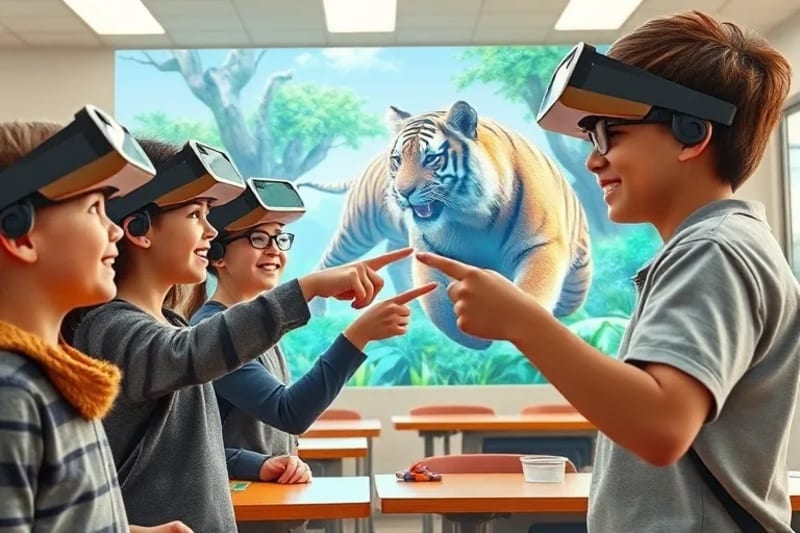
AR headsets enable immersive educational experiences, allowing students to interact with virtual endangered species and their habitats in a dynamic classroom setting.
Gamification for Environmental Awareness
Gamification, the application of game-design elements and game principles in non-game contexts, is a powerful tool for environmental awareness, especially among younger audiences. AR can integrate gamified experiences directly into the real world, turning environmental learning into an interactive quest.
For example, AR games could challenge users to "collect" virtual endangered species by identifying real-world clues, or to "restore" a degraded virtual ecosystem by completing tasks that promote sustainable behaviors in their local environment. These games can provide immediate feedback, reward positive actions, and foster a sense of accomplishment, making environmental stewardship a fun and rewarding activity. This approach leverages the inherent appeal of games to drive meaningful behavioral change and increase engagement with complex issues.
Benefits, Challenges, and Future Outlook
The integration of Augmented Reality into ecosystem conservation and environmental education offers a multitude of benefits, but also presents several challenges that need to be addressed for its widespread adoption and maximum impact. Understanding these aspects is crucial for guiding future development and implementation strategies.
Key Benefits of AR in Conservation:
- Enhanced Data Comprehension: Visualizing complex data in context makes it easier to understand and interpret.
- Increased Engagement: Interactive and immersive experiences capture attention and foster deeper connection.
- Improved Efficiency: Real-time information and on-site analysis streamline fieldwork and decision-making.
- Broader Accessibility: Virtual field trips and educational tools make remote ecosystems accessible to everyone.
- Behavioral Change: Gamified experiences can motivate sustainable actions and foster environmental stewardship.
- Cost-Effectiveness: Reduces the need for extensive physical travel for educational purposes and some monitoring tasks.
Despite these compelling advantages, the widespread adoption of AR in conservation faces several hurdles. The primary challenges include the high cost of advanced AR hardware, such as specialized headsets, which can be prohibitive for many conservation organizations and educational institutions. Furthermore, the development of high-quality AR content requires significant technical expertise and resources, including 3D modeling, programming, and ecological data integration.
Technical limitations, such as battery life, outdoor visibility of displays, and the accuracy of spatial tracking in diverse natural environments, also need further improvement. Data privacy and security, especially when dealing with sensitive ecological data or personal user information, are critical considerations. Finally, ensuring equitable access to AR technology across different socioeconomic contexts is essential to prevent a digital divide in environmental literacy and action.
The future of Augmented Reality in ecosystem conservation looks promising. As AR technology becomes more affordable, powerful, and user-friendly, its applications are expected to expand significantly. Advances in AI and machine learning will further enhance AR's ability to process and interpret environmental data, leading to more sophisticated monitoring tools and personalized educational experiences. The development of open-source AR platforms and collaborative content creation initiatives could also help overcome resource limitations.
Ultimately, AR has the potential to become an indispensable tool for conservationists, educators, and the general public, fostering a more informed, engaged, and proactive global community committed to protecting our planet. By bridging the gap between the digital and physical worlds, AR can help us see, understand, and interact with our environment in ways that were once unimaginable, driving a new era of ecological stewardship.
Fuente: Contenido híbrido asistido por IAs y supervisión editorial humana.


Comentarios