
Quantum Computing Crypto Security Finance
The advent of quantum computing represents a paradigm shift across numerous sectors, with its potential impact on cryptography and financial markets being particularly profound. As quantum computers grow in power and sophistication, they pose a significant threat to the cryptographic foundations underpinning modern digital security, including the integrity of crypto-assets and global financial transactions. Understanding this evolving landscape is crucial for policymakers, financial institutions, and individual investors alike.
This article delves into the core principles of quantum computing, elucidates the specific vulnerabilities it introduces to current cryptographic standards, and explores the emerging field of post-quantum cryptography (PQC) as a defensive measure. Furthermore, we will analyze the broader implications for financial markets, from the security of digital currencies to the stability of the global economic system, and discuss the challenges and timelines associated with this technological transition.

The intricate dance between quantum bits and cryptographic symbols, illustrating the looming quantum threat to digital finance.
Understanding Quantum Computing: A Brief Overview
Quantum computing harnesses the principles of quantum mechanics to perform computations far beyond the capabilities of classical computers. Unlike classical bits, which can only exist in a state of 0 or 1, quantum bits (qubits) can exist in multiple states simultaneously through a phenomenon called superposition. This allows quantum computers to process vast amounts of information in parallel.
Another key quantum phenomenon is entanglement, where two or more qubits become linked in such a way that the state of one instantly influences the state of the others, regardless of distance. These properties enable quantum algorithms, such as Shor's algorithm and Grover's algorithm, to solve certain computational problems exponentially faster than their classical counterparts. While still in their nascent stages, quantum computers are rapidly advancing, with significant investments from governments and private corporations worldwide.
The Quantum Threat to Current Cryptography
The primary concern for crypto-assets and financial security stems from quantum computers' ability to break widely used public-key cryptography. This includes algorithms like RSA and Elliptic Curve Cryptography (ECC), which form the backbone of secure communication, digital signatures, and blockchain technology. These algorithms rely on the computational difficulty of certain mathematical problems, such as integer factorization and discrete logarithms, which are intractable for classical computers.
Shor's algorithm, discovered in 1994, provides a polynomial-time solution for integer factorization and discrete logarithms. This means a sufficiently powerful quantum computer could efficiently break RSA and ECC, compromising the confidentiality and authenticity of digital communications and transactions. The implications for crypto-assets are particularly severe:
- Private Key Compromise: Quantum computers could derive private keys from public keys, allowing attackers to steal crypto-assets.
- Transaction Forgery: Digital signatures could be forged, leading to unauthorized transactions and double-spending.
- Historical Transaction Decryption: Encrypted historical blockchain data could become vulnerable, exposing sensitive information.
Grover's algorithm, another significant quantum algorithm, offers a quadratic speedup for searching unsorted databases. While it doesn't break symmetric-key cryptography (like AES) or hash functions (like SHA-256) entirely, it significantly reduces their effective key length. For instance, a 128-bit AES key would effectively become a 64-bit key against a quantum attack, necessitating a doubling of key sizes to maintain current security levels.
Post-Quantum Cryptography (PQC): The Solution
To counter the quantum threat, cryptographers are developing Post-Quantum Cryptography (PQC), a new class of cryptographic algorithms designed to be resistant to attacks by both classical and quantum computers. The National Institute of Standards and Technology (NIST) has been leading a global standardization effort for PQC algorithms, which are expected to replace current vulnerable standards.
Several families of PQC algorithms are under consideration, each based on different hard mathematical problems that are believed to remain intractable even for quantum computers. These include:
- Lattice-based Cryptography: Relies on the difficulty of solving problems in high-dimensional lattices. Examples include Kyber (key encapsulation) and Dilithium (digital signatures).
- Code-based Cryptography: Based on the difficulty of decoding general linear codes, such as McEliece and Classic McEliece.
- Hash-based Cryptography: Uses cryptographic hash functions to construct digital signatures. Examples include XMSS and SPHINCS+.
- Multivariate Polynomial Cryptography: Based on the difficulty of solving systems of multivariate polynomial equations over finite fields.
- Isogeny-based Cryptography: Utilizes the mathematics of elliptic curve isogenies, like SIKE.
The transition to PQC is a massive undertaking, often referred to as a "crypto-agile" migration. It requires significant research, development, and deployment efforts across all digital infrastructures. The goal is to ensure that when fault-tolerant quantum computers become a reality, the world's digital assets and communications are already secured against quantum attacks.

A visual representation of quantum computation's power challenging traditional digital security mechanisms.
Impact on Crypto-Assets and Blockchain Technology
Crypto-assets, including cryptocurrencies like Bitcoin and Ethereum, are fundamentally built on public-key cryptography. Their security relies on the assumption that it is computationally infeasible to reverse engineer a private key from a public key or to forge a digital signature. A quantum computer capable of running Shor's algorithm would invalidate this assumption, posing an existential threat to the current designs of many blockchains.
The immediate vulnerability lies in the transaction signing process. When a user sends cryptocurrency, they sign the transaction with their private key, and others verify it using their public key. If an attacker can derive the private key from the public key (which is often exposed after the first transaction), they can steal funds. Furthermore, the immutability of blockchain, a core feature, could be compromised if historical transactions become decryptable or if the hashing algorithms used for block integrity are weakened by Grover's algorithm.
However, the crypto community is actively researching and developing quantum-resistant solutions. Some strategies include:
- Migration to PQC: Integrating PQC algorithms into blockchain protocols to secure digital signatures and key exchanges.
- Quantum-Resistant Wallets: Developing new wallet technologies that use PQC for key generation and transaction signing.
- Hybrid Cryptography: Employing a combination of classical and post-quantum cryptographic methods to provide a layered defense during the transition period.
- Increased Key Sizes: Doubling the key lengths for symmetric encryption and hash functions to mitigate the impact of Grover's algorithm.
The challenge lies in coordinating a global upgrade across decentralized networks, which is inherently complex. Early adoption and continuous research are vital to safeguard the future of crypto-assets.
Broader Implications for Financial Markets
Beyond crypto-assets, the quantum threat extends to the entire financial ecosystem. Banks, stock exchanges, and payment systems rely heavily on public-key cryptography for securing sensitive data, authenticating transactions, and ensuring privacy. A quantum attack could lead to widespread disruption and catastrophic financial losses.
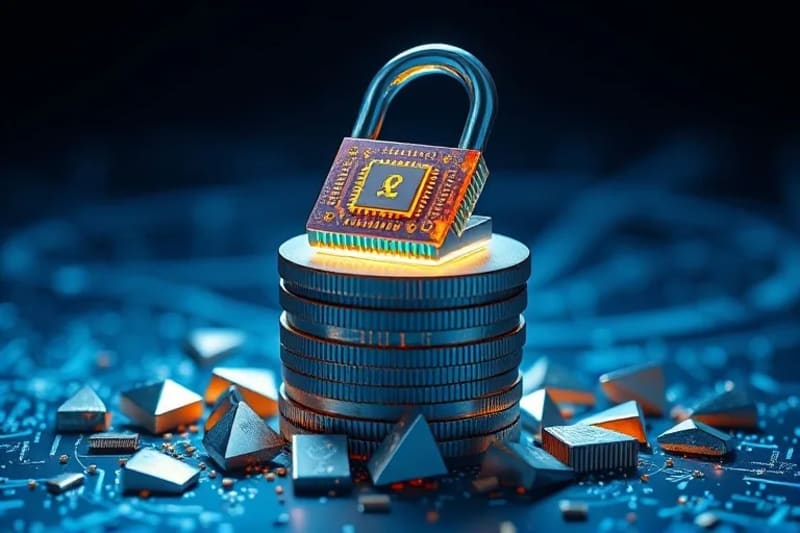
A futuristic quantum chip poised to disrupt traditional financial assets, symbolizing the transition to a new era of digital security.
Key areas of impact include:
- Data Confidentiality: Personal financial data, trade secrets, and intellectual property currently protected by encryption could be exposed.
- Transaction Integrity: The ability to forge digital signatures could lead to fraudulent transfers, impacting payment systems and interbank communications.
- Central Bank Digital Currencies (CBDCs): While CBDCs are still evolving, their security architecture will need to be quantum-resistant from inception to avoid future vulnerabilities.
- Market Stability: A loss of trust in cryptographic security could trigger widespread panic and instability in financial markets, leading to significant economic downturns.
- Regulatory Compliance: Financial institutions will face new regulatory pressures to implement quantum-resistant security measures to protect consumer data and market integrity.
The "harvest now, decrypt later" threat is also a major concern. Adversaries could be collecting encrypted data today, intending to decrypt it once powerful quantum computers become available. This emphasizes the urgency of transitioning to PQC, even before quantum computers reach their full potential.
Challenges and Timeline for Quantum Transition
The transition to a quantum-resistant cryptographic infrastructure presents several significant challenges:
- Algorithm Standardization: While NIST has made progress, the finalization and widespread adoption of PQC standards are still ongoing.
- Implementation Complexity: Integrating new cryptographic algorithms into existing hardware and software systems is a complex and costly endeavor.
- Performance Overhead: Some PQC algorithms may have larger key sizes, slower computation times, or increased bandwidth requirements compared to their classical counterparts.
- Interoperability: Ensuring seamless communication and transaction processing between systems using different PQC implementations is crucial.
- Talent Gap: A shortage of cybersecurity professionals with expertise in quantum cryptography could hinder the transition.
Estimates for when fault-tolerant quantum computers will be able to break current cryptography vary, but many experts predict this could happen within the next decade or two. This "quantum-safe window" necessitates proactive measures rather than reactive responses. Organizations are advised to begin inventorying their cryptographic assets, assessing their quantum risk, and developing migration roadmaps.
Regulatory Landscape and International Cooperation
Governments and international bodies are increasingly recognizing the urgency of the quantum threat. Initiatives like NIST's Post-Quantum Cryptography Standardization project are pivotal in providing globally recognized standards. Regulatory frameworks are expected to evolve, mandating the adoption of quantum-resistant cryptography for critical infrastructure and sensitive data.
The National Institute of Standards and Technology (NIST) has been at the forefront of the global effort to standardize quantum-resistant cryptographic algorithms. Their process involves rigorous evaluation and selection of candidate algorithms to replace current public-key cryptography standards vulnerable to quantum attacks.
This initiative is critical for ensuring the long-term security of digital information across government, industry, and academia. International cooperation is essential for a harmonized transition to post-quantum cryptography, preventing fragmentation and ensuring global interoperability of secure systems.
International cooperation is also crucial to ensure a harmonized approach to PQC adoption. A fragmented landscape, where different regions or industries adopt incompatible standards, could create new vulnerabilities and hinder global trade and communication. Collaborative research, information sharing, and joint development efforts are key to a successful worldwide transition.
In conclusion, while quantum computing promises revolutionary advancements, its potential to undermine current cryptographic security poses a significant challenge to crypto-assets and financial markets. Proactive development and adoption of Post-Quantum Cryptography are not merely a technical upgrade but a strategic imperative to safeguard the future of digital finance and maintain global economic stability.
Source: Hybrid content assisted by AIs and human editorial supervision.


Comentarios