
Fungal Ecosystems Vital Role Nature Biology
Fungi represent one of Earth's most diverse and vital kingdoms, often overlooked despite their pervasive presence and indispensable roles in nearly every ecosystem. From the microscopic yeasts that ferment our bread and beverages to the vast subterranean networks of mycelium that underpin entire forests, these organisms are fundamental to life as we know it. Understanding fungal biology is crucial for appreciating the intricate balance of nature and harnessing their potential for various human applications.
This exploration delves into the fascinating world of fungi, uncovering their unique characteristics, ecological significance, and the profound ways they interact with other life forms and their environment. We will examine their diverse forms, reproductive strategies, and the critical services they provide, from decomposition and nutrient cycling to symbiotic relationships that sustain plant life.
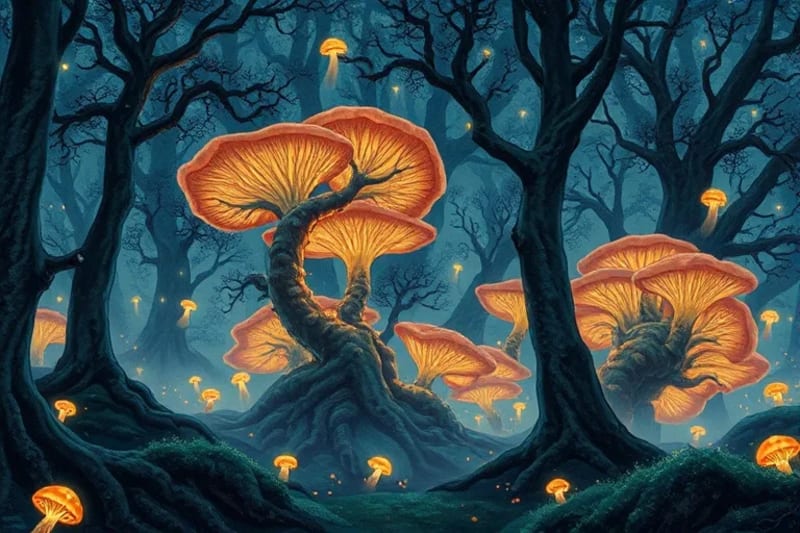
Precursors intellectuales, diagramas fundamentales y representaciones conceptuales que forjaron la visión de los ecosistemas fúngicos sobre su rol en la naturaleza.
Fuente visual sujeta a disponibilidad del ecosistema: Wikimedia Commons bajo licencia CC BY-SA 4.0 o renderizado conceptual IA.
The study of fungi, known as mycology, continually reveals new species and unprecedented insights into their complex behaviors and genetic makeup. These organisms challenge traditional biological classifications, possessing features that distinguish them from both plants and animals, yet sharing evolutionary ties with both. Their adaptability allows them to thrive in extreme environments, from polar ice caps to hydrothermal vents, highlighting their resilience and ecological versatility.
Table of Contents
- The Hidden Kingdom: An Introduction to Fungi
- Fungal Diversity: A World of Forms and Functions
- The Intricate Structure of Fungi
- Reproduction Strategies: The Cycle of Life
- Ecological Pillars: Fungi's Vital Roles
- Mycorrhizal Networks: The "Wood Wide Web"
- Fungi in Human Society: From Medicine to Industry
- Challenges and Future Perspectives in Mycology
The Hidden Kingdom: An Introduction to Fungi
Fungi belong to the Kingdom Fungi, a vast and complex group of eukaryotic organisms that includes yeasts, molds, and mushrooms. Unlike plants, fungi do not perform photosynthesis; instead, they are heterotrophs, meaning they obtain nutrients by absorbing organic compounds from their environment. This mode of nutrition makes them primary decomposers in most ecosystems, breaking down dead organic matter and recycling essential nutrients.
Their evolutionary history places them closer to animals than to plants, a fact supported by genetic studies and shared biochemical pathways. This close relationship is evident in their cell wall composition, which contains chitin (also found in insect exoskeletons), and their storage of glycogen as an energy reserve, similar to animals. The sheer number of fungal species is staggering, with estimates ranging from 2.2 to 3.8 million, though only about 148,000 have been formally described.
Fungi play crucial roles in maintaining ecological balance, facilitating the growth of plants, and even influencing global climate patterns through carbon cycling. Their ability to form intricate symbiotic relationships with other organisms, such as lichens (fungi and algae/cyanobacteria) and mycorrhizae (fungi and plant roots), underscores their importance in structuring biological communities. These interactions are not merely beneficial but often essential for the survival of their partners.
Fungal Diversity: A World of Forms and Functions
The fungal kingdom exhibits an astonishing array of forms and ecological strategies. This diversity is broadly categorized into several major phyla, each with distinct characteristics and life cycles. Understanding these classifications helps in appreciating the vast scope of fungal biology and their specialized roles within ecosystems.
- Chytridiomycota: Often aquatic, these are among the most primitive fungi, characterized by motile spores with flagella. They play roles in decomposing organic matter in water and can also be parasites of plants and animals, including amphibians.
- Zygomycota: Known for forming zygospores during sexual reproduction, this group includes common bread molds and some insect pathogens. They are typically fast-growing and important decomposers.
- Ascomycota (Sac Fungi): This is the largest phylum, encompassing yeasts, truffles, morels, and many plant pathogens. They produce spores in sac-like structures called asci. Their diversity in form and function is immense, including many economically important species.
- Basidiomycota (Club Fungi): Familiar as mushrooms, puffballs, and bracket fungi, this phylum is characterized by basidia, club-shaped structures that produce spores. They are crucial decomposers of wood and form vital mycorrhizal associations with trees.
- Glomeromycota: This group forms arbuscular mycorrhizae with plant roots, a symbiotic relationship essential for nutrient uptake in over 80% of plant species. They are obligate symbionts, unable to survive independently.
Each phylum contributes uniquely to the global ecosystem, demonstrating the intricate web of life. For instance, the saprophytic fungi, primarily Basidiomycota and Ascomycota, are the primary agents responsible for breaking down complex organic compounds like cellulose and lignin, which are abundant in plant matter. Without their activity, nutrient cycles would grind to a halt, and dead organic material would accumulate indefinitely.
The Intricate Structure of Fungi
Despite their diverse appearances, most fungi share fundamental structural components. The vegetative body of a fungus is typically composed of filamentous structures called hyphae (singular: hypha). These microscopic threads grow by extending their tips, forming a vast, branching network known as a mycelium.
- Hyphae: These are the basic building blocks of most fungi. They can be septate (divided by cross-walls called septa, which often have pores allowing cytoplasmic streaming) or coenocytic (lacking septa, forming a continuous multinucleate cytoplasm).
- Mycelium: The collective mass of hyphae, often hidden beneath the substrate, is the primary feeding and growing structure of a fungus. It maximizes surface area for absorption of nutrients.
- Cell Walls: Fungal cell walls are primarily composed of chitin, a strong and flexible polysaccharide. This provides structural support and protection against osmotic pressure.
- Spores: Fungi reproduce primarily through spores, which are reproductive cells capable of developing into a new individual without fusion with another cell. Spores can be produced sexually or asexually and are adapted for dispersal by wind, water, or animals.
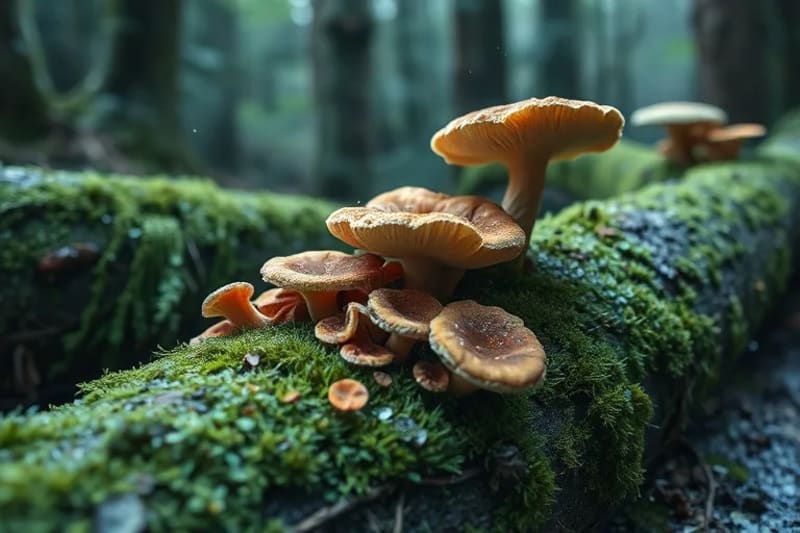
The intricate process of decomposition by fungi, showcasing their essential role in nutrient recycling within forest ecosystems.
The visible part of many fungi, such as a mushroom, is merely the fruiting body, a temporary reproductive structure that emerges from the much larger, hidden mycelial network. This network can extend for vast distances, with some individual mycelia covering hundreds of acres, making them among the largest organisms on Earth. The efficiency of nutrient absorption by this expansive network is a key to fungal success.
Reproduction Strategies: The Cycle of Life
Fungi employ a remarkable variety of reproductive strategies, allowing them to adapt to diverse environments and ensure their survival. Both asexual and sexual reproduction are common, often occurring within the same species depending on environmental conditions.
- Asexual Reproduction:
- Fragmentation: A piece of mycelium breaks off and grows into a new individual.
- Budding: Common in yeasts, a small outgrowth forms on the parent cell, detaches, and grows into a new organism.
- Asexual Spores (Conidia, Sporangiospores): Produced by mitosis, these spores are genetically identical to the parent and allow for rapid colonization of new substrates.
- Sexual Reproduction: This involves the fusion of two haploid nuclei to form a diploid zygote, followed by meiosis to produce genetically diverse haploid spores. The process typically involves several stages:
- Plasmogamy: Fusion of cytoplasm from two parent mycelia.
- Karyogamy: Fusion of the two haploid nuclei, forming a diploid zygote nucleus.
- Meiosis: The diploid nucleus undergoes meiosis to produce haploid spores.
Sexual reproduction introduces genetic variation, which is crucial for adaptation to changing environments. The spores, whether asexual or sexual, are typically lightweight and designed for efficient dispersal, enabling fungi to colonize new habitats rapidly. This adaptability is a key factor in their ecological success and widespread distribution across the globe. The study of these reproductive cycles can be complex, often requiring advanced microscopy and genetic analysis, similar to the detailed investigations in Astro-Genomics: Unveiling Karmic Health Blueprints and DNA Patterns, which also explores intricate biological patterns.
Ecological Pillars: Fungi's Vital Roles
Fungi are ecological linchpins, performing several critical functions that are indispensable for the health and stability of virtually all terrestrial and aquatic ecosystems. Their roles can be broadly categorized into decomposers, symbionts, and pathogens, each with profound implications for environmental dynamics.
- Decomposers (Saprophytes): As primary decomposers, fungi break down dead organic matter, including fallen leaves, wood, and animal remains. They release essential nutrients like carbon, nitrogen, and phosphorus back into the soil, making them available for plants and other organisms. This nutrient cycling is fundamental to ecosystem productivity.
- Symbionts: Fungi form mutualistic relationships with a wide array of organisms:
- Mycorrhizae: Associations with plant roots, enhancing water and nutrient uptake for plants in exchange for carbohydrates.
- Lichens: Symbiotic relationships with algae or cyanobacteria, allowing them to colonize harsh environments and act as pioneer species.
- Endophytes: Fungi living within plant tissues, often providing protection against herbivores and pathogens, or enhancing stress tolerance.
- Pathogens and Parasites: While many fungi are beneficial, some are significant pathogens of plants, animals, and humans. Plant diseases caused by fungi (e.g., rusts, smuts, blights) can devastate crops, impacting food security. Fungal infections in humans (mycoses) range from superficial skin conditions to life-threatening systemic diseases.
The balance between these roles is delicate. For example, while some fungi cause plant diseases, others act as biocontrol agents, suppressing harmful pests and pathogens. This complex interplay highlights the need for a holistic understanding of fungal ecology to manage ecosystems effectively. The intricate relationships within fungal communities mirror the complex interactions observed in human organizational structures, such as those analyzed in Evaluación 360 Grados: Implementación y Beneficios en Empresas, where different components interact to achieve a larger goal.
Mycorrhizal Networks: The "Wood Wide Web"
Perhaps one of the most astonishing discoveries in mycology is the extent and importance of mycorrhizal networks, often dubbed the "wood wide web." These are symbiotic associations between fungi and plant roots, where the fungal mycelium extends far beyond the plant's root system, vastly increasing its access to water and nutrients, particularly phosphorus and nitrogen.
In return, the plant provides the fungus with carbohydrates produced through photosynthesis. This mutualistic exchange is critical for the survival and growth of most terrestrial plants, especially in nutrient-poor soils. There are two main types of mycorrhizae:
- Ectomycorrhizae (EM): These fungi form a sheath around the root tips and grow into the spaces between root cells, but do not penetrate the cell walls. They are common in temperate and boreal forests, associating with trees like pines, oaks, and beeches.
- Arbuscular Mycorrhizae (AM): These fungi penetrate the plant root cell walls, forming highly branched structures called arbuscules within the cells, which are the primary sites of nutrient exchange. AM fungi are the most widespread, associating with about 80% of all plant species, including many agricultural crops.
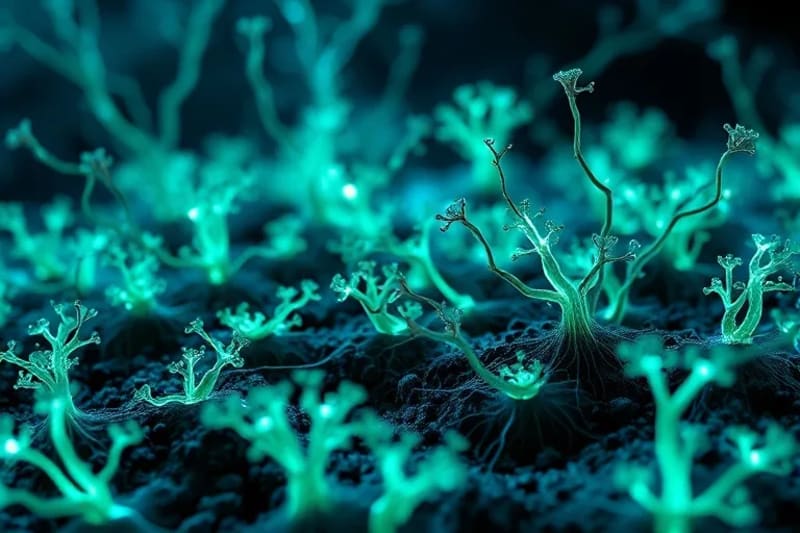
A conceptual visualization of the vast, intricate mycelial networks that form the "wood wide web," connecting plant life beneath the soil.
Beyond nutrient exchange, these networks can connect multiple plants, even of different species, allowing for the transfer of resources and communication signals. This phenomenon suggests a level of interconnectedness within forest ecosystems that was previously unimaginable, akin to a biological internet. The health and integrity of these networks are vital for forest resilience and productivity, making them a key focus in ecological research and conservation efforts. Understanding such complex biological systems can sometimes draw parallels to the study of advanced computational models, such as those explored in Gemelos Digitales Salud Personal: Medicina Predictiva, where intricate data networks are used to model and predict biological outcomes.
Fungi in Human Society: From Medicine to Industry
The impact of fungi extends far beyond their ecological roles, significantly influencing human society in numerous ways. From ancient times to modern biotechnology, fungi have been utilized for food, medicine, industrial processes, and even bioremediation.
- Food and Beverages: Yeasts (e.g., Saccharomyces cerevisiae) are essential for baking bread and fermenting alcoholic beverages like beer and wine. Edible mushrooms, such as shiitake, oyster, and portobello, are valued for their culinary properties and nutritional benefits. Some fungi are also used in cheese production.
- Medicine: Fungi are a rich source of bioactive compounds. The discovery of penicillin from the mold Penicillium notatum revolutionized medicine, leading to the era of antibiotics. Other fungal compounds are used as immunosuppressants (e.g., cyclosporine), cholesterol-lowering drugs (statins), and anti-cancer agents.
- Biotechnology and Industry: Fungi produce a wide range of enzymes used in various industrial applications, including detergents, textiles, and biofuels. They are also employed in bioremediation to break down pollutants in contaminated environments. The production of organic acids, such as citric acid, relies heavily on fungal fermentation.
- Agriculture: Beyond mycorrhizal associations, some fungi are used as biological pesticides to control insect pests or plant diseases, offering environmentally friendly alternatives to chemical treatments. This mirrors the precision required in modern agricultural techniques, such as those used in Abejorros Polinización Comercial: Técnicas, Éxito Agrícola, Tecnología.
The ongoing research into fungal biochemistry and genetics promises even more breakthroughs. From developing new antibiotics to engineering fungi for sustainable industrial processes, their potential is vast and largely untapped. However, alongside these benefits, the challenge of managing pathogenic fungi remains a significant concern for both human health and agricultural productivity.
Challenges and Future Perspectives in Mycology
Despite significant advancements in mycology, numerous challenges persist, alongside exciting avenues for future research and application. One of the primary challenges is the identification and classification of the vast number of undescribed fungal species. Many ecosystems, particularly tropical rainforests and marine environments, are still largely unexplored for fungal diversity.
Another critical challenge lies in combating fungal pathogens. The rise of antifungal resistance in human pathogens and the increasing prevalence of devastating crop diseases pose serious threats to global health and food security. Developing new antifungal drugs and sustainable agricultural practices that integrate fungal biology is paramount. This requires a deep understanding of fungal genetics and biochemistry, akin to the complex ethical considerations in Ética Cuántica IA: Superinteligencia, Seguridad Post-Cuántica, where advanced knowledge must be applied responsibly.
Future perspectives in mycology are incredibly promising. Advances in genomics and bioinformatics are accelerating the discovery of novel fungal enzymes and metabolites with potential applications in medicine, bioenergy, and materials science. The use of fungi in bioremediation, particularly for plastic degradation and heavy metal removal, is gaining traction as environmental concerns grow. Furthermore, understanding mycorrhizal networks could lead to more sustainable agricultural practices, reducing the need for synthetic fertilizers and improving soil health.
The study of fungal ecosystems is a dynamic field, continually revealing the intricate connections that bind life on Earth. As we face global challenges such as climate change, biodiversity loss, and food scarcity, the vital role of fungi will only become more apparent. Continued investment in mycological research is essential to unlock their full potential and ensure a sustainable future for our planet.
Explore More Insights
- Quincy Jones' Impact
- Competency Recruitment
- Fan Phenomenon Impact
- Florence Nightingale
- MJ Digital Music
- Quantum vs Post-Quantum
- Colombian Commerce Code
- Adolescent Mental Health
- Black or White Analysis
- Neuro-Astrology
- Traditional Astrology
- Marian Advocations
- Charismatic Renewal
- Saint Michael Archangel
- 1st House Astrology
- Quantum Entanglement Synastry
Source: Hybrid content assisted by AI and human editorial supervision.


Comentarios