
Black Holes AI Physics Unraveling Cosmic Computational Mysteries
Black Holes AI Physics Unraveling Cosmic Computational Mysteries
The universe, a canvas of unfathomable wonders, holds some of its most profound secrets within the enigmatic embrace of black holes. These cosmic behemoths, regions of spacetime where gravity is so strong that nothing—not even light—can escape, have long captivated the human imagination and challenged the limits of scientific understanding.
From their theoretical prediction by Albert Einstein's general relativity to their recent direct observation, black holes represent the ultimate cosmic laboratories, pushing the boundaries of physics. However, the sheer complexity of their physics and the immense volume of data generated by modern observatories demand tools far beyond traditional human capabilities.
Enter Artificial Intelligence (AI), a transformative technology that is rapidly becoming indispensable in the quest to unravel these cosmic computational mysteries. AI is not merely a supplementary tool but a fundamental component, enabling scientists to process, analyze, and interpret data at unprecedented scales, thereby accelerating our understanding of these extreme objects.
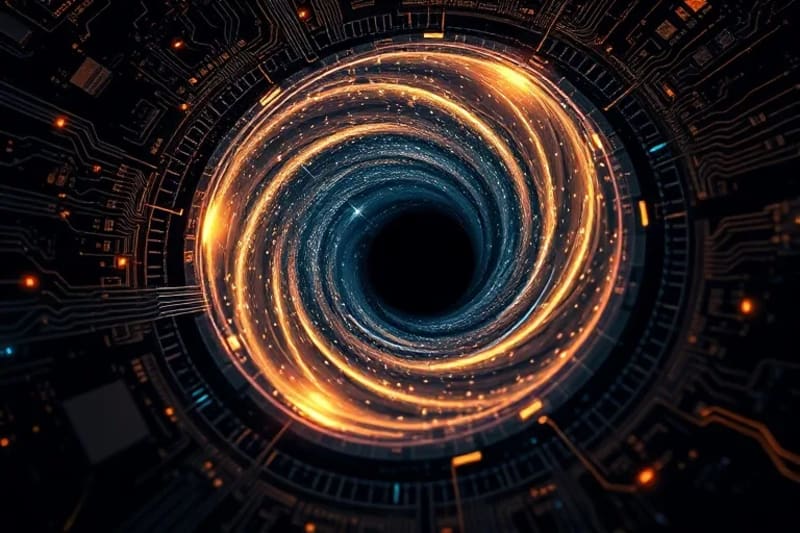
Precursors intellectuales, diagramas fundamentales y representaciones conceptuales que forjaron la visión de la física de los agujeros negros y la IA sobre los misterios cósmicos.
Fuente visual sujeta a disponibilidad del ecosistema: Wikimedia Commons bajo licencia CC BY-SA 4.0 o renderizado conceptual IA.
Table of Contents
- Understanding Black Holes: A Cosmic Enigma
- Artificial Intelligence: A New Lens for Astrophysics
- AI in Black Hole Data Analysis and Observation
- Simulating the Extreme: AI and Theoretical Models
- Computational Challenges and Ethical Considerations
- The Future of Black Hole Research with AI
Understanding Black Holes: A Cosmic Enigma
Black holes are not "holes" in the conventional sense but rather incredibly dense concentrations of matter. They form from the remnants of massive stars that collapse under their own gravity, or through other mechanisms leading to supermassive black holes at galactic centers. The boundary beyond which nothing can escape is known as the event horizon.
Their properties are primarily described by just three parameters: mass, angular momentum (spin), and electric charge. Despite their simplicity in description, their effects on spacetime and surrounding matter are profoundly complex. Observing them directly is challenging due to their light-absorbing nature, requiring indirect methods like detecting their gravitational influence or the radiation from accreting matter.
The study of black holes involves various branches of physics, including general relativity, quantum mechanics, and thermodynamics. Phenomena such as Hawking radiation, predicted by Stephen Hawking, suggest that black holes are not entirely "black" but emit thermal radiation, albeit at extremely low temperatures for astrophysical black holes. This theoretical prediction highlights the intricate interplay between different physical theories at the extreme conditions near a black hole.
Recent breakthroughs, such as the direct detection of gravitational waves from merging black holes by LIGO and the imaging of the M87* and Sagittarius A* black holes by the Event Horizon Telescope (EHT), have ushered in a new era of black hole astronomy. These observations provide invaluable data that can be used to test theoretical predictions and uncover new physics.
Artificial Intelligence: A New Lens for Astrophysics
The advent of artificial intelligence, particularly machine learning and deep learning, has provided astrophysicists with powerful new tools. AI algorithms excel at pattern recognition, anomaly detection, and processing vast datasets—tasks that are crucial for modern astronomical research. This computational prowess allows researchers to extract subtle signals from noisy data and identify features that might be missed by human analysis.
AI's application extends across the entire spectrum of astrophysical investigation, from classifying galaxies and stars to detecting exoplanets and, critically, studying black holes. The ability of AI to learn from data and make predictions or classifications makes it an ideal partner for exploring the universe's most extreme environments.
The sheer volume and complexity of data from instruments like the EHT, gravitational wave detectors, and X-ray telescopes necessitate advanced computational methods. AI offers a scalable solution, enabling scientists to sift through terabytes of information, identify potential black hole candidates, and characterize their properties with greater precision.
The intricate web of data processing and machine learning algorithms revolutionizing cosmic discoveries.
AI in Black Hole Data Analysis and Observation
One of the most significant contributions of AI to black hole physics is in the realm of data analysis. Observatories generate massive amounts of raw data, which often contain subtle signals embedded in significant noise. Machine learning algorithms, particularly convolutional neural networks (CNNs), are adept at filtering this noise and identifying patterns indicative of black hole phenomena.
For instance, in gravitational wave astronomy, AI helps to detect the faint chirps of merging black holes and neutron stars within the continuous stream of detector noise. These algorithms are trained on simulated gravitational wave signals, allowing them to rapidly and accurately identify real events. This capability has dramatically increased the number of detected gravitational wave events.
The Event Horizon Telescope, which captures radio waves from the immediate vicinity of black holes, relies heavily on computational techniques to reconstruct images. AI algorithms are being developed to enhance image reconstruction, fill in missing data, and provide clearer views of the black hole shadow and accretion disk. This allows for more precise measurements of black hole properties and tests of general relativity.
Furthermore, AI is used in classifying different types of black holes, identifying active galactic nuclei (AGN) powered by supermassive black holes, and studying the jets of high-energy particles they emit. By automating these processes, scientists can dedicate more time to interpreting results and developing new theories, rather than manual data inspection.
Simulating the Extreme: AI and Theoretical Models
Beyond observation, AI plays a crucial role in theoretical black hole physics. Simulating the extreme gravitational environments around black holes, including the dynamics of accretion disks and the effects of spacetime curvature, requires immense computational power. Numerical relativity simulations, which solve Einstein's field equations, are computationally intensive.
AI can accelerate these simulations by learning the underlying physics and predicting outcomes, or by optimizing the simulation parameters. Machine learning models can be trained on existing simulation data to quickly generate new scenarios or to refine approximations, significantly reducing the time and resources needed for complex calculations. This is particularly valuable for exploring a wide parameter space of black hole mergers or accretion processes.
Moreover, AI is being used to develop surrogate models that can mimic the behavior of full numerical simulations with much less computational cost. These surrogates are essential for rapid parameter estimation in gravitational wave astronomy, where thousands of comparisons between observed signals and theoretical waveforms are needed to pinpoint the properties of the merging black holes.
The integration of AI into theoretical modeling allows for a deeper exploration of fundamental physics questions, such as the nature of singularities, the information paradox, and the interplay between quantum mechanics and gravity near the event horizon. These advanced computational techniques are paving the way for breakthroughs in understanding the most extreme objects in the cosmos.
The convergence of advanced computational power and theoretical models to unlock cosmic secrets.
Computational Challenges and Ethical Considerations
While AI offers immense promise, its application in black hole physics is not without challenges. The sheer scale of data, the need for high computational resources, and the complexity of developing robust AI models are significant hurdles. Training sophisticated deep learning models requires vast amounts of labeled data, which can be scarce or difficult to generate for rare astrophysical phenomena.
Furthermore, the interpretability of AI models remains a concern. "Black box" algorithms, while effective, can sometimes make it difficult for scientists to understand why a particular prediction or classification was made. This lack of transparency can hinder scientific discovery, as understanding the underlying physics is paramount. Researchers are actively working on developing more interpretable AI models to address this issue.
The increasing reliance on AI also raises broader ethical considerations, particularly concerning bias in data and algorithms. If training data contains biases, the AI model may perpetuate or even amplify them, leading to skewed scientific conclusions. Ensuring the integrity and fairness of AI systems is crucial for maintaining scientific rigor. These challenges are not unique to astrophysics; they are part of a wider discussion about AI's impact on digital reality and the need for careful development.
Addressing these computational challenges often involves leveraging high-performance computing and exploring new paradigms like quantum encryption challenges for secure and efficient data processing. The development of specialized AI hardware and software tailored for scientific applications is also a key area of ongoing research. The discussion around digital privacy and AI consciousness also extends to how scientific data is handled and interpreted by autonomous systems.
The Future of Black Hole Research with AI
The synergy between black hole physics and artificial intelligence is still in its nascent stages, yet it promises a future filled with groundbreaking discoveries. As AI technologies continue to evolve, their capabilities in processing complex data, simulating extreme phenomena, and even generating new hypotheses will only grow. This will enable astrophysicists to tackle questions that are currently intractable.
Future applications may include autonomous observatories that use AI to make real-time decisions about what to observe and how to optimize data collection, or AI systems that can independently identify new types of black hole phenomena. The combination of human intuition and AI's analytical power will undoubtedly lead to a more comprehensive understanding of these cosmic enigmas.
The ongoing development of next-generation telescopes and gravitational wave detectors will produce even larger and more complex datasets, making AI an even more critical component of future research. The journey to fully comprehend black holes, their formation, evolution, and their role in shaping the universe, is inextricably linked with the advancement of artificial intelligence.
Ultimately, AI is not replacing human scientists but augmenting their abilities, allowing them to explore the universe with unprecedented depth and precision. The collaboration between astrophysicists and AI researchers is poised to unlock the deepest secrets of the cosmos, bringing us closer to understanding the fundamental laws that govern our existence.
Further Reading and Related Concepts:
Cybersecurity for SMEs: Protecting Your Digital Business
Regenerative Medicine: Future of Tissue & Organ Healing
Patron Saints of Animals: Honoring Divine Creation
Houses in Astrology Natal Chart: Understanding Life's Twelve Domains
Source: Hybrid content assisted by AI and human editorial supervision.


Comentarios