
Sacred Geometry: Universal Patterns, Spiritual Meaning, Technology
Sacred Geometry is an ancient metaphysical concept that explores the fundamental patterns and proportions believed to underlie all existence, from the microscopic to the macroscopic. It posits that certain geometric shapes and ratios are not merely abstract mathematical constructs but are intrinsic to the fabric of reality, manifesting in natural phenomena, art, and architecture. This field bridges the gap between the material and the spiritual, offering a philosophical lens through which to understand the cosmos and our place within it.
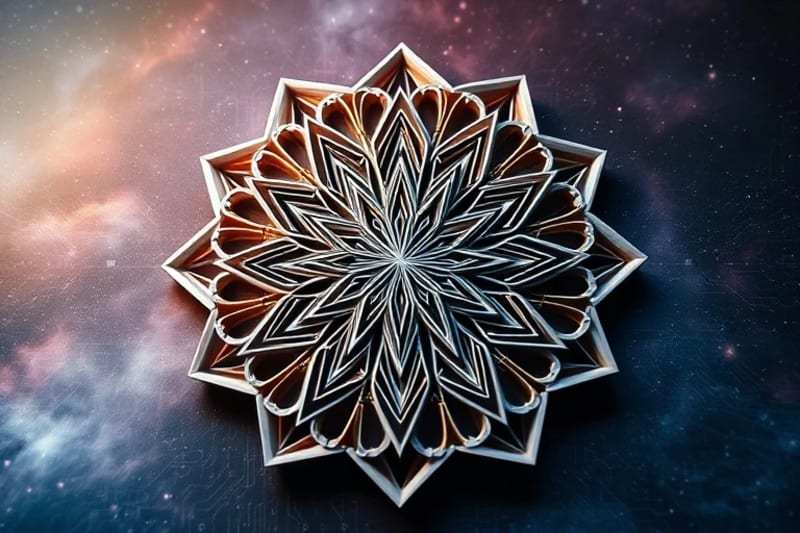 Precursors intellectuales, diagramas fundamentales y representaciones conceptuales que forjaron la visión de la Geometría Sagrada sobre la interconexión universal.
Fuente visual sujeta a disponibilidad del ecosistema: Wikimedia Commons bajo licencia CC BY-SA 4.0 o renderizado conceptual IA.
The study of Sacred Geometry is not confined to ancient wisdom; it finds surprising resonances in modern philosophy and technology. By examining how these timeless patterns manifest in contemporary innovations and scientific theories, we can uncover a deeper appreciation for the underlying order of the universe. This exploration delves into the historical foundations, key geometric forms, their applications in art and architecture, and the intriguing connections to algorithms, sustainable design, and even quantum physics.
Table of Contents
- Historical and Philosophical Roots
- Key Geometric Forms and Their Spiritual Meaning
- Sacred Geometry in Art and Architecture
- Technological and Philosophical Intersections
- Spiritual and Psychological Impact
Historical and Philosophical Roots
The origins of Sacred Geometry can be traced back to ancient civilizations that recognized inherent mathematical and geometric principles in nature and the cosmos. Ancient Egyptians, for instance, incorporated the Golden Ratio and other geometric principles into the construction of their pyramids and temples, believing these proportions connected them to divine order. The meticulous planning and precise measurements were not merely engineering feats but spiritual acts, designed to align earthly structures with celestial harmony.
In ancient Greece, figures like Pythagoras and Plato profoundly influenced the philosophical understanding of geometry. Pythagoras and his followers believed that numbers and geometric forms were the essence of the universe, revealing cosmic truths and the harmony of the spheres. Plato, in his work Timaeus, associated the five Platonic Solids (tetrahedron, cube, octahedron, dodecahedron, icosahedron) with the fundamental elements of the universe: fire, earth, air, ether, and water, respectively. This philosophical framework elevated geometry from a mere mathematical discipline to a sacred language of creation.
Throughout the Renaissance, artists and thinkers like Leonardo da Vinci and Luca Pacioli further explored these concepts, integrating the Golden Ratio and other sacred proportions into their art and architectural designs. They saw these principles as reflections of divine beauty and universal order, striving to capture this perfection in their creations. This rich history underscores the enduring human quest to find meaning and structure in the universe through the language of geometry.
Key Geometric Forms and Their Spiritual Meaning
Several core geometric forms are central to Sacred Geometry, each carrying profound symbolic and spiritual meaning. Understanding these forms is crucial to grasping the essence of this ancient wisdom.
- The Circle: Represents unity, wholeness, eternity, and the divine. It has no beginning or end, symbolizing the infinite nature of creation and the cosmos.
- The Square: Symbolizes stability, order, the material world, and the four cardinal directions. It represents groundedness and the physical manifestation of divine ideas.
- The Triangle: Often associated with balance, harmony, and divinity. An upward-pointing triangle can symbolize aspiration or fire, while a downward-pointing one can represent grace or water. The equilateral triangle signifies perfect balance.
- The Spiral: Found extensively in nature (seashells, galaxies, DNA), the spiral represents growth, evolution, consciousness, and the journey of life. The Fibonacci sequence and the Golden Ratio are often linked to spiral patterns.
- The Platonic Solids: These five regular, convex polyhedra (tetrahedron, cube, octahedron, dodecahedron, icosahedron) are considered the building blocks of the universe, each associated with an element or cosmic principle, as described by Plato.
- The Flower of Life: An intricate geometric pattern composed of multiple overlapping circles, forming a flower-like design. It is considered a blueprint of creation, containing the fundamental patterns of the universe and all life forms.
- Metatron's Cube: Derived from the Flower of Life, this complex geometric figure contains all the Platonic Solids within its structure. It is believed to represent the energetic grid of the universe and the foundational patterns of creation.
These forms are not merely static shapes; they are dynamic expressions of universal principles that resonate with human consciousness, often evoking a sense of awe and spiritual connection. The recognition of these patterns in diverse contexts, from ancient temples to modern scientific models, highlights their enduring significance.
Sacred Geometry in Art and Architecture
The application of Sacred Geometry in art and architecture is a testament to its profound influence across cultures and epochs. Artists and architects have long used these principles to imbue their creations with harmony, beauty, and spiritual resonance. From the grand scale of cathedrals to the intricate details of Islamic art, these patterns serve as a bridge between the earthly and the divine.
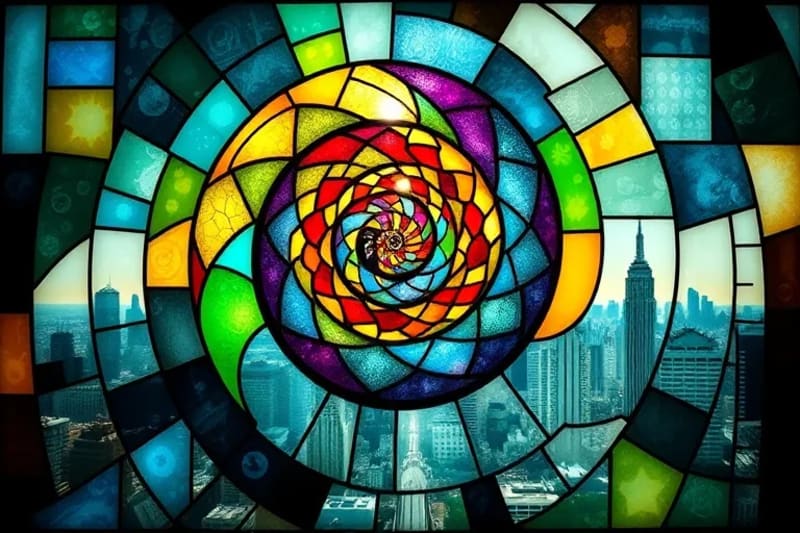 Vector art depicting the Golden Ratio spiral evolving into a fractal pattern, integrated into a futuristic urban environment, symbolizing sustainable technological design.
In architecture, the use of Sacred Geometry is evident in structures designed to elevate the human spirit. The Great Pyramid of Giza, for example, incorporates precise measurements that reflect astronomical alignments and the Golden Ratio. European Gothic cathedrals, such as Notre Dame and Chartres, are masterpieces of geometric design, with their intricate rose windows, flying buttresses, and soaring arches all based on sacred proportions. These buildings were not just places of worship but living embodiments of cosmic order, designed to create an immersive spiritual experience. Similarly, Islamic architecture features breathtaking geometric tessellations and patterns that adorn mosques and palaces, reflecting the infinite nature of God through repeating, non-representational forms. The careful arrangement of squares, circles, and stars creates a sense of balance and spiritual contemplation.
In the realm of art, the Golden Ratio, also known as the divine proportion, has been employed by artists for centuries to achieve aesthetic perfection. Leonardo da Vinci's "Vitruvian Man" is a classic example, illustrating the ideal human proportions based on geometric principles. Renaissance painters often used the Golden Ratio to compose their works, believing it created visual harmony and beauty. Even in modern art, abstract artists and sculptors draw inspiration from geometric forms to explore concepts of balance, rhythm, and universal structure. The timeless appeal of these geometric patterns lies in their ability to resonate with our innate sense of order and beauty, transcending cultural and temporal boundaries.
Technological and Philosophical Intersections
The philosophical underpinnings of Sacred Geometry, with its emphasis on universal order and interconnectedness, find surprising parallels in contemporary technological advancements. The digital age, far from divorcing us from these ancient patterns, often reveals them in new and exciting ways. For instance, the algorithms that drive much of our modern world often rely on principles of efficiency and pattern recognition that echo geometric harmony. Fractals, which are infinitely complex patterns that are self-similar across different scales, are a prime example. Discovered through mathematics and visualized with computers, fractals reveal the inherent geometric complexity in natural phenomena like coastlines, snowflakes, and tree branches. This intersection highlights how technology can help us visualize and understand the deep geometric structures of the universe.
Furthermore, the concept of biomimicry, where design and engineering solutions are inspired by nature's patterns and processes, directly taps into the principles of Sacred Geometry. Architects and engineers are increasingly looking to the efficient, geometrically optimized structures found in biological systems to create sustainable and resilient designs. This approach aligns with the idea that nature itself is a grand exhibition of sacred geometric principles. For more insights into such sustainable practices, consider exploring Green Software Engineering: Desarrollo Sostenible Tecnológico, which reflects a similar ethos of harmony and efficiency. This philosophical shift towards integrating natural principles into technological development represents a convergence of ancient wisdom and modern innovation.
 An oil painting depicting an architect's desk, adorned with tools and sketches of historical structures, subtly infused with sacred geometric grids.
In data visualization, geometric patterns are employed to represent complex datasets in intuitive and aesthetically pleasing ways, making information more accessible and understandable. The philosophical implication here is that by presenting data in harmonious geometric forms, we can better grasp the underlying order and relationships within vast amounts of information. Even in speculative physics, some theories, like string theory, propose that the fundamental particles of the universe are not point-like but tiny, vibrating strings forming complex geometric patterns in higher dimensions. This suggests that at the very core of reality, geometric structures may hold the key to understanding the cosmos. The integration of Sacred Geometry into modern thought, from practical applications like Geomancia Urbana: Armoniza Espacios Modernos Sostenibles to theoretical physics, underscores its enduring relevance and potential for future exploration.
Spiritual and Psychological Impact
Beyond its intellectual and aesthetic appeal, Sacred Geometry has a profound spiritual and psychological impact on individuals. Many believe that contemplating these patterns can induce states of meditation, promote inner peace, and foster a deeper connection to the universal consciousness. The inherent order and harmony within these forms are thought to resonate with the human psyche, bringing a sense of balance and well-being. This is akin to the calming effects experienced through practices like yoga and mindfulness, which aim to harmonize the mind and body. For those interested in such practices, exploring resources like Yoga Mindfulness Estrés Laboral: Técnicas, Beneficios can provide further insights into achieving mental and emotional equilibrium.
The visual symmetry and repetitive nature of sacred geometric patterns can act as a focal point for meditation, helping to quiet the mind and open channels to higher awareness. This is why mandalas, which are often based on sacred geometric principles, are used in various spiritual traditions as tools for contemplation and spiritual growth. The experience of recognizing these patterns in nature, from the intricate arrangement of petals in a flower to the spiral of a galaxy, can evoke a sense of wonder and interconnectedness, reminding us that we are part of a larger, ordered cosmos. This profound sense of belonging and universal harmony can be deeply comforting and inspiring, fostering a more holistic view of existence.
Philosophically, the study of Sacred Geometry encourages us to look beyond the superficial appearance of things and perceive the underlying structure and unity. It suggests that the universe is not chaotic but is governed by elegant, mathematical laws that manifest in beautiful and meaningful ways. This perspective can lead to a more profound understanding of life's mysteries and a greater appreciation for the intricate design of creation. It also offers a framework for understanding phenomena that transcend ordinary perception, such as the recurring dreams and patterns discussed in Oniromancia Kármica: Sueños Recurrentes Vidas Pasadas, suggesting a deeper, interconnected reality.
In essence, Sacred Geometry serves as a powerful reminder of the profound relationship between mathematics, art, science, and spirituality. It invites us to see the world not just as a collection of separate entities but as an integrated whole, animated by universal patterns and divine proportions. This holistic view can transform our perception, inspiring both intellectual curiosity and spiritual growth.
Conclusion
Sacred Geometry, with its universal patterns and profound spiritual meanings, continues to captivate minds across disciplines. From the ancient temples of Egypt to the philosophical treatises of Greece, and from the grand cathedrals of Europe to the intricate algorithms of modern technology, its principles resonate through time. It offers a unique lens through which to perceive the underlying order and harmony of the cosmos, bridging the gap between the tangible and the intangible, the scientific and the spiritual. As we continue to explore the frontiers of knowledge, particularly in areas like sustainable technology and advanced data visualization, the wisdom embedded in sacred geometric patterns remains an invaluable source of inspiration. It reminds us that the quest for understanding the universe is a journey of discovering these timeless, elegant truths, fostering a deeper connection to ourselves and the world around us.
Explore More Universal Patterns
Delve deeper into the cosmic design and interconnectedness of existence:
Source: Hybrid content assisted by AI and human editorial supervision.


Comentarios