
Haptic Augmented Reality: Immersive Interactions Medicine Industry 4.0
The digital revolution has profoundly reshaped how we interact with information and the world around us. Augmented Reality (AR) has emerged as a pivotal technology, overlaying digital content onto our real-world view, enhancing perception and interaction. While visual and auditory elements have dominated this immersive landscape, a new frontier is rapidly expanding: Haptic Augmented Reality. This cutting-edge field integrates the sense of touch, allowing users to feel, manipulate, and experience virtual objects with unprecedented realism.
Haptic AR promises to bridge the gap between the digital and physical realms, offering a truly immersive experience that goes beyond sight and sound. By adding tactile feedback, it transforms passive observation into active engagement, opening up a myriad of possibilities across diverse sectors. From precision surgery to advanced industrial training, the ability to "feel" virtual environments is set to redefine human-computer interaction and operational efficiency.
This article delves into the fascinating world of Haptic Augmented Reality, exploring its foundational principles, technological components, and its transformative applications. We will examine how this technology is revolutionizing critical fields like medicine and Industry 4.0, while also considering the challenges and the exciting future that lies ahead for tactile immersive interactions.
Table of Contents
- 1. What is Haptic Augmented Reality?
- 2. The Mechanics Behind Tactile Immersion
- 3. Haptic AR in Medicine: Revolutionizing Healthcare
- 4. Industry 4.0: Enhancing Precision and Efficiency
- 5. Challenges and the Road Ahead
- 6. The Future of Tactile Interaction
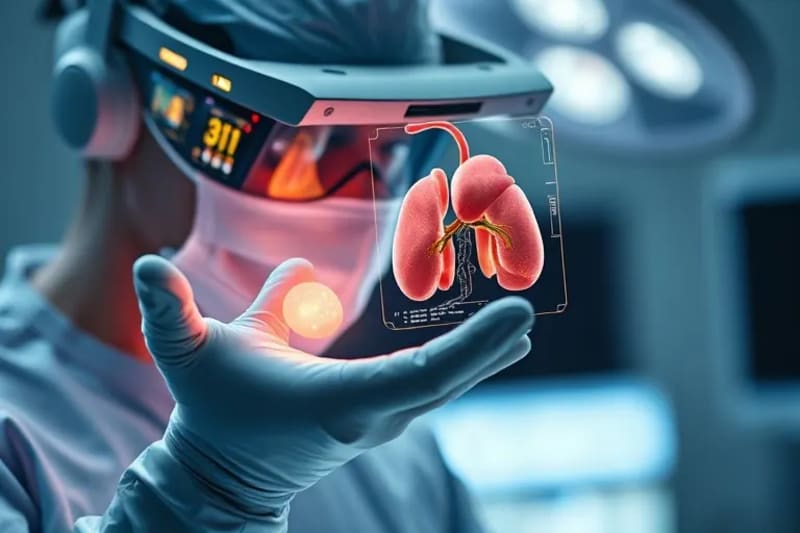
Haptic Augmented Reality is transforming surgical training and execution, offering unparalleled tactile feedback for enhanced precision and realism.
What is Haptic Augmented Reality?
Haptic Augmented Reality refers to the integration of tactile feedback with augmented reality environments. While traditional AR overlays digital information onto the real world visually, Haptic AR adds the sense of touch, allowing users to physically interact with and "feel" these virtual objects as if they were real. This technology leverages haptics, the science of transmitting and understanding information through touch, to create a more profound and intuitive user experience.
The core idea is to simulate physical properties such as texture, shape, temperature, resistance, and vibration of virtual objects. This simulation is achieved through specialized devices that apply forces, vibrations, or motions to the user's body, typically their hands or fingers. When a user reaches out to touch a virtual button or manipulate a digital component, the haptic device provides the corresponding sensation, making the interaction feel tangible and immediate.
This fusion of visual overlay and tactile feedback creates a truly immersive and interactive environment. It moves beyond mere visual perception, engaging another primary human sense to enhance understanding, precision, and engagement with digital content. The implications are vast, from making virtual training more effective to enabling remote manipulation with a sense of physical presence.
The Mechanics Behind Tactile Immersion
The creation of realistic haptic feedback in an AR environment is a complex interplay of hardware, software, and sophisticated algorithms. At its heart, the system must accurately track user movements, render virtual objects, detect interactions, and then translate those interactions into physical sensations. This process requires several key components working in unison.
The primary hardware components include AR headsets or smart glasses for visual overlay, and haptic devices for tactile feedback. These haptic devices can range from gloves and sleeves embedded with actuators to more complex robotic arms or styluses. The choice of device often depends on the specific application and the type of tactile feedback required.
Software plays a crucial role in rendering the virtual environment, processing sensor data, and controlling the haptic actuators. Advanced algorithms are necessary to model the physical properties of virtual objects, calculate interaction forces in real-time, and translate these forces into precise commands for the haptic hardware. This real-time processing is essential to maintain the illusion of seamless physical interaction.
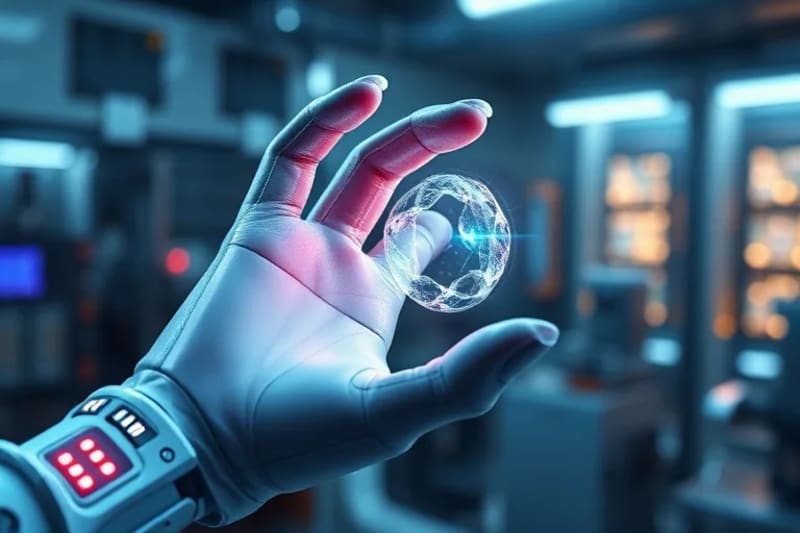
Cutting-edge haptic gloves provide intricate tactile sensations, allowing users to feel the texture and shape of virtual objects.
There are various types of haptic feedback mechanisms employed. Vibrotactile feedback uses small motors to create vibrations, simulating textures or impacts. Force feedback systems apply resistance or pressure, allowing users to feel the weight or stiffness of virtual objects. Thermal feedback can even simulate temperature changes. The combination of these methods creates a rich and convincing tactile experience.
| Component | Function | Examples |
|---|---|---|
| AR Display | Visually overlays digital information onto the real world. | Smart glasses, AR headsets (e.g., HoloLens, Magic Leap). |
| Haptic Devices | Provide tactile feedback to the user. | Haptic gloves, sleeves, styluses, robotic arms. |
| Tracking Systems | Monitor user's position, orientation, and gestures. | Optical sensors, IMUs (Inertial Measurement Units), external cameras. |
| Software & Algorithms | Render virtual objects, process interactions, control haptic feedback. | Physics engines, haptic rendering libraries, real-time operating systems. |
| Actuators & Sensors | Convert electrical signals into physical motion/force and detect user input. | Vibration motors, pneumatic systems, electromagnets, force sensors, accelerometers. |
Haptic AR in Medicine: Revolutionizing Healthcare
The medical field stands to gain immensely from the advancements in Haptic Augmented Reality. The ability to precisely feel and manipulate virtual anatomical structures or medical instruments offers unprecedented opportunities for training, surgical planning, and even remote procedures. This technology is poised to enhance patient safety, improve surgical outcomes, and accelerate medical education.
One of the most significant applications is in surgical training. Medical students and residents can practice complex procedures on virtual patients, experiencing realistic tissue resistance, organ textures, and instrument feedback without any risk. This allows for repeated practice and mastery of skills before operating on real patients, significantly reducing the learning curve and potential for errors. Such immersive training can lead to better prepared surgeons and ultimately, better patient care.
In surgical planning, Haptic AR allows surgeons to "pre-operate" on a patient's specific anatomy, derived from MRI or CT scans. They can explore different approaches, feel the consistency of tumors, or practice delicate dissections in a virtual environment. This detailed rehearsal can help identify potential challenges and optimize surgical strategies, leading to more efficient and safer operations. The tactile feedback provides a deeper understanding of the patient's unique physiological landscape.
Beyond surgery, Haptic AR is also finding its way into rehabilitation. Patients recovering from injuries or strokes can engage in interactive physical therapy exercises where they receive tactile guidance and feedback. For example, a virtual object might guide their hand movements, providing resistance or vibrations to encourage correct muscle activation. This gamified and immersive approach can increase patient engagement and accelerate recovery.
The potential for telesurgery and remote assistance is also immense. Surgeons could potentially operate on patients in remote locations, guiding robotic instruments while receiving real-time haptic feedback from the surgical site. This would democratize access to specialized medical expertise, especially in underserved areas. Furthermore, medical professionals can collaborate in real-time on complex cases, sharing tactile insights into a patient's condition.
Surgical Simulation: Realistic training for complex procedures, reducing risks and improving skill acquisition.
Pre-operative Planning: Surgeons can practice on patient-specific virtual models, feeling tissue properties and optimizing approaches.
Medical Education: Enhanced learning of anatomy and physiology through interactive, tactile exploration.
Rehabilitation Therapy: Engaging and effective exercises with tactile guidance for physical recovery.
Remote Assistance & Telesurgery: Enabling expert guidance and surgical procedures across geographical distances with tactile feedback.
Industry 4.0: Enhancing Precision and Efficiency
Industry 4.0, characterized by the integration of cyber-physical systems, IoT, and AI, is ripe for disruption by Haptic Augmented Reality. The ability to interact with digital twins of machinery, perform virtual assembly, or conduct remote maintenance with tactile feedback significantly boosts efficiency, reduces errors, and enhances safety across various industrial sectors. This technology is a game-changer for manufacturing, engineering, and logistics.
In manufacturing and assembly, Haptic AR allows engineers and technicians to practice complex assembly sequences on virtual models. They can feel the fit of components, the resistance of fasteners, or the texture of materials before any physical parts are produced. This reduces prototyping costs, accelerates design cycles, and minimizes errors on the production line. It also facilitates the rapid training of new personnel on intricate machinery.
For maintenance and repair operations, Haptic AR offers a powerful tool. Technicians can visualize internal components of machinery overlaid onto the physical device. With haptic feedback, they can "feel" for anomalies, guide their tools precisely, or practice disassembly and reassembly in a virtual space. This is particularly useful for complex or hazardous environments, where hands-on training might be impractical or dangerous. The integration of such advanced tools can significantly impact the future of work in an era of automation and AI, requiring new skill sets and approaches.

Haptic AR is a cornerstone of Industry 4.0, enabling intuitive control and interaction with complex cyber-physical systems.
Product design and prototyping also benefit immensely. Designers can not only visualize their creations in 3D but also feel their texture, weight, and ergonomic properties. This tactile feedback allows for more intuitive design iterations and a deeper understanding of how a product will feel in a user's hand, leading to superior product development. This kind of immersive feedback loop is crucial for innovation and can even influence how digital brands leverage AI strategies for content marketing, by creating more tangible product experiences.
Remote collaboration in industrial settings is another key area. Engineers from different geographical locations can work together on a virtual model, each experiencing the same tactile feedback as they manipulate components. This fosters better communication, faster problem-solving, and more efficient project execution, regardless of physical distance. The ability to share a tactile experience adds a new dimension to remote teamwork, enhancing both productivity and the overall mental well-being in hybrid work environments.
Virtual Assembly & Manufacturing: Practice complex assembly sequences, reduce errors, and accelerate production.
Remote Maintenance & Repair: Guide technicians with tactile feedback for precise operations in challenging environments.
Product Design & Prototyping: Feel product ergonomics, textures, and weight in virtual space, leading to better designs.
Industrial Training: Immersive, hands-on training for operating complex machinery without physical risk.
Collaborative Engineering: Teams can jointly manipulate and feel virtual models from different locations, enhancing teamwork.
Challenges and the Road Ahead
Despite its immense potential, Haptic Augmented Reality faces several technical and practical challenges that need to be addressed for widespread adoption. Overcoming these hurdles is crucial for the technology to fully realize its transformative capabilities across medicine and industry.
One significant challenge is the development of more sophisticated and less intrusive haptic devices. Current devices can sometimes be bulky, expensive, or limited in the range of sensations they can produce. Miniaturization, increased fidelity, and affordability are key areas of ongoing research. Creating devices that can provide nuanced feedback across the entire hand or body, without hindering natural movement, remains a complex engineering task.
Another critical aspect is the latency of the system. For haptic feedback to feel realistic, the tactile response must be almost instantaneous with the visual and user input. Any noticeable delay can break the immersion and make the interaction feel unnatural. Achieving ultra-low latency requires powerful processing capabilities, optimized algorithms, and efficient data transmission, especially in wireless setups.
The realism of haptic rendering also needs continuous improvement. Accurately simulating the diverse physical properties of real-world materials—from the softness of human tissue to the rigidity of metal—is computationally intensive. Developing advanced material models and rendering techniques that can provide convincing tactile sensations for a wide range of virtual objects is an active area of research.
Standardization and interoperability are also important. As the field grows, establishing common protocols for haptic data exchange and device compatibility will be essential for developers and users. This will foster innovation and enable broader integration of haptic AR solutions across different platforms and applications.
The Future of Tactile Interaction
The future of Haptic Augmented Reality is incredibly promising, with ongoing research and development pushing the boundaries of what's possible. As hardware becomes more advanced, software more intelligent, and algorithms more refined, we can expect increasingly seamless and realistic tactile interactions with digital content. This will pave the way for entirely new paradigms of human-computer interaction and remote presence.
We can anticipate a future where haptic feedback is integrated into everyday AR experiences, from consumer applications like gaming and entertainment to professional tools. Imagine being able to virtually "try on" clothes and feel the fabric, or remotely inspect a piece of art and feel its texture. The potential for education is also immense, allowing students to physically interact with abstract concepts or historical artifacts.
The convergence of Haptic AR with other emerging technologies, such as Artificial Intelligence and advanced robotics, will unlock even greater capabilities. AI can enhance the realism of haptic feedback by intelligently adapting sensations based on user input and context. Robotics can extend our reach, allowing us to manipulate distant objects with both visual and tactile fidelity, creating a true sense of telepresence.
Ultimately, Haptic Augmented Reality is not just about adding another sense to our digital interactions; it's about making those interactions more intuitive, effective, and human. By engaging our sense of touch, it deepens our connection to the digital world, transforming how we learn, work, and create. The journey towards fully immersive, tactile digital experiences is well underway, promising a future where the virtual and physical realms are indistinguishable to our senses.
Explore Related Concepts
Source: Hybrid content assisted by AI and human editorial supervision.


Comentarios