
Generative AI Music Composition Authorship Challenges
Generative AI: Revolutionizing Music Composition and Confronting Authorship Challenges
The landscape of music composition is undergoing a profound transformation, driven by the rapid advancements in generative Artificial Intelligence (AI). Once the exclusive domain of human creativity, the act of composing music is now increasingly augmented, and in some cases, autonomously performed by sophisticated algorithms. This technological revolution promises unprecedented opportunities for artistic expression, personalization, and efficiency, democratizing music creation in ways previously unimaginable. However, this paradigm shift also introduces a complex web of legal, ethical, and philosophical questions, particularly concerning the very definition of authorship and the future of intellectual property rights in the digital age.
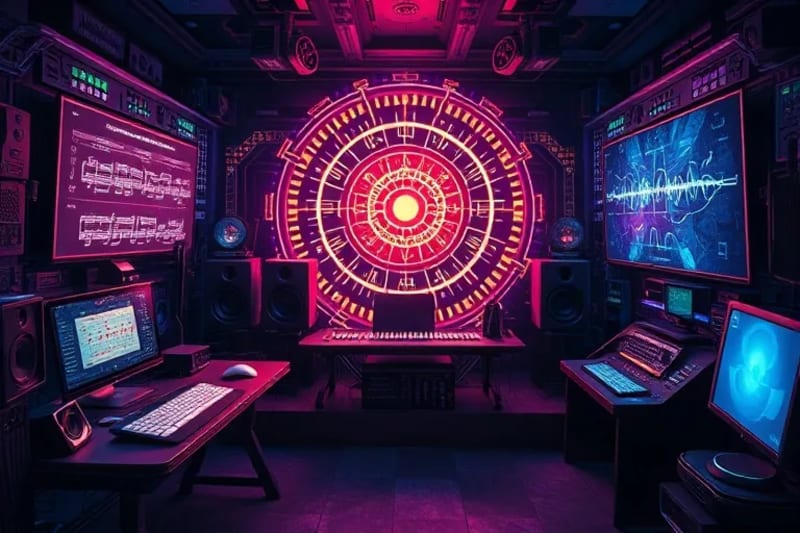
Precursors intellectuales, diagramas fundamentales y representaciones conceptuales que forjaron la visión de la IA Generativa sobre la composición musical y sus desafíos.
Fuente visual sujeta a disponibilidad del ecosistema: Wikimedia Commons bajo licencia CC BY-SA 4.0 o renderizado conceptual IA.This article delves into the mechanisms of generative AI in music, explores its transformative potential, and critically examines the intricate challenges it poses to established notions of authorship, copyright, and ethical responsibility. As AI systems become more adept at mimicking and even innovating upon human creative processes, understanding these implications becomes paramount for artists, legal professionals, and the wider society.
Table of Contents
- The Rise of Generative AI in Music
- How Generative AI Composes Music
- Benefits and Creative Potential
- The Authorship Dilemma: Who Owns AI-Generated Music?
- Copyright Challenges and Legal Frameworks
- Ethical Considerations and Future Outlook
- Navigating the Future of Music and AI
The Rise of Generative AI in Music
Generative AI refers to algorithms capable of producing novel content, such as images, text, or music, that resembles human-created works. In music, this has evolved from early rule-based systems to sophisticated neural networks that can learn from vast datasets of existing compositions. These systems analyze patterns, structures, harmonies, and melodies, enabling them to generate new pieces that adhere to specific styles or even create entirely new genres.
The initial forays into algorithmic composition date back decades, but the advent of deep learning and increased computational power has propelled generative AI into the mainstream. Today, AI tools are used by professional composers, hobbyists, and even major music production houses to assist in various stages of the creative process, from generating background scores to crafting intricate solos. This shift represents a significant milestone in the intersection of emerging technologies and creative fields, pushing the boundaries of what is considered artistic expression.
How Generative AI Composes Music
At its core, generative AI for music relies on machine learning models trained on extensive musical corpora. These models learn statistical relationships and structural elements within the data. Key techniques include:
- Recurrent Neural Networks (RNNs) and Long Short-Term Memory (LSTMs): These models are adept at processing sequential data, making them ideal for understanding and generating melodies and rhythms over time. They can predict the next note or chord based on preceding sequences.
- Generative Adversarial Networks (GANs): GANs consist of two neural networks, a generator and a discriminator, that compete against each other. The generator creates new musical pieces, while the discriminator evaluates their authenticity against real human compositions. This adversarial process refines the generator's ability to produce increasingly realistic and creative outputs.
- Transformers: Originally developed for natural language processing, transformers have proven highly effective in music generation due to their ability to capture long-range dependencies in sequences. They can model complex musical structures and harmonies with remarkable coherence.
- Reinforcement Learning: Some systems use reinforcement learning, where an AI agent learns to compose by receiving feedback (rewards or penalties) based on the quality or adherence to specific criteria of its generated music.

Conceptual representation of AI algorithms generating complex musical structures.
These techniques allow AI to generate various musical elements, including melodies, harmonies, rhythms, and even full orchestrations. Users can often guide the AI by providing parameters such as genre, mood, instrumentation, or even a short melodic motif, allowing for a collaborative creative process between human and machine.
Benefits and Creative Potential
The integration of generative AI into music composition offers a multitude of benefits:
- Enhanced Creativity: AI can serve as a powerful creative partner, helping composers overcome creative blocks, explore new sonic territories, and generate ideas that might not arise from traditional methods.
- Democratization of Music Creation: Tools powered by AI can lower the barrier to entry for aspiring musicians, allowing individuals without formal training to create sophisticated musical pieces.
- Efficiency and Speed: AI can rapidly generate multiple variations or complete compositions, significantly accelerating the production pipeline for film scores, video game soundtracks, and commercial jingles.
- Personalization: AI can create highly personalized music experiences, adapting to listener preferences, moods, or even biometric data, leading to dynamic and adaptive soundtracks for various applications.
- Preservation and Exploration of Styles: AI can learn and reproduce the styles of historical composers or endangered musical traditions, offering new ways to engage with and preserve cultural heritage. This also opens avenues for studying the cognitive benefits of classical music, even when generated by AI.
The Authorship Dilemma: Who Owns AI-Generated Music?
Perhaps the most contentious issue surrounding generative AI in music is the question of authorship. Traditional copyright law is predicated on the concept of a human author who creates an original work. When an AI system generates a piece of music, the line between creator and tool becomes blurred. Several scenarios arise:
- AI as a Tool: If a human composer uses AI as a sophisticated instrument or assistant, providing significant creative input and making final editorial decisions, then the human author typically retains authorship.
- AI as an Autonomous Creator: If an AI system generates music with minimal or no human intervention, the question of who (or what) holds authorship becomes problematic. Current legal frameworks struggle to attribute personhood or creative intent to an algorithm.
- The Developer/Owner of the AI: Some argue that the entity that developed or owns the AI system should be considered the author, as they are responsible for creating the "creative" agent. However, this conflates the creation of the tool with the creation of the output.
- The Data Providers: Since AI learns from existing music, there's an argument that the original human composers whose works comprise the training data should have some claim. This raises complex issues of data licensing and derivative works.

The intricate relationship between traditional authorship, digital content, and intellectual property in the age of AI.
The lack of clear legal precedent creates uncertainty for artists, developers, and consumers alike. As AI-generated content becomes indistinguishable from human-created works, the need for a robust and adaptive legal framework grows increasingly urgent.
Copyright Challenges and Legal Frameworks
Current copyright laws, such as those in the United States or the Berne Convention, generally require human authorship for a work to be protected. This poses significant challenges for purely AI-generated music:
- Originality Requirement: While AI can produce novel compositions, the legal concept of "originality" often implies a minimal degree of human creativity and intellectual effort. Whether an algorithm can possess such "effort" is debatable.
- Infringement and Derivative Works: If an AI is trained on copyrighted music, is its output a derivative work? How much "transformation" is required for the AI's output to be considered original and non-infringing? This is a critical area where the regulation of AI content becomes highly relevant.
- Licensing and Royalties: If AI-generated music is used commercially, how are royalties distributed? Who benefits financially if there is no human author?
- International Harmonization: Different jurisdictions may adopt varying approaches, leading to a fragmented global legal landscape for AI-generated intellectual property.
Several approaches are being considered to address these issues:
| Approach | Description | Pros | Cons |
|---|---|---|---|
| No Copyright Protection | AI-generated works without human intervention are not eligible for copyright. | Simplifies legal framework; encourages human creativity. | Disincentivizes AI development; economic value of works unprotected. |
| Developer/Owner as Author | Copyright is granted to the individual or entity that created/owns the AI. | Clear attribution; incentivizes AI investment. | Ignores AI's "creative" contribution; potential for monopolization. |
| New "Related Rights" Category | Establish a new category of intellectual property rights specifically for AI-generated works, distinct from traditional copyright. | Tailored protection; acknowledges AI's unique nature. | Complex implementation; potential for legal fragmentation. |
| Human Intervention Threshold | Copyright requires a minimum level of human creative input or supervision. | Maintains human-centric view of creativity; aligns with existing law. | Defining "minimal level" is subjective; limits fully autonomous AI. |
The debate is ongoing, with legal scholars, policymakers, and industry stakeholders grappling with how to adapt existing laws or create new ones that foster innovation while protecting creators and ensuring fair compensation.
Ethical Considerations and Future Outlook
Beyond legal frameworks, generative AI in music raises several ethical questions:
- Authenticity and Value of Art: Does AI-generated music diminish the perceived value of human creativity? How do audiences differentiate and appreciate art when its origin is ambiguous?
- Bias in Training Data: If AI models are trained on biased datasets, they may perpetuate or amplify existing biases in musical styles, representation, or cultural appropriation.
- Displacement of Human Artists: While AI can augment human creativity, there are concerns about job displacement for composers, session musicians, and sound designers, especially in areas like background music or jingle production. This echoes broader concerns about ethical considerations in human-industrial interaction with advanced technology.
- Transparency: Should consumers be informed if a piece of music is AI-generated? The lack of transparency could lead to misrepresentation or erode trust.
Looking ahead, generative AI is poised to become an indispensable tool in the music industry. It will likely foster new forms of collaboration between humans and machines, leading to hybrid creative processes. The development of more sophisticated AI models will continue to challenge our understanding of creativity and artistry. Moreover, the integration of AI with other technologies, such as virtual reality and augmented reality, could lead to immersive and interactive musical experiences that are dynamically generated in real-time.
Navigating the Future of Music and AI
The revolution brought about by generative AI in music composition is undeniable. It presents a dual-edged sword: immense creative potential alongside profound challenges to established norms. For the music industry, artists, and legal systems, the path forward requires careful consideration and proactive adaptation. This involves:
- Developing New Legal Frameworks: Crafting copyright laws that acknowledge the unique nature of AI-generated works, potentially through new categories of rights or clear guidelines for human-AI collaboration.
- Promoting Ethical AI Development: Ensuring that AI tools are developed with transparency, fairness, and a commitment to augmenting, rather than replacing, human creativity.
- Educating Artists and the Public: Fostering understanding of AI's capabilities and limitations, encouraging artists to embrace AI as a creative partner, and informing audiences about the origins of the music they consume.
- Fostering Collaboration: Encouraging interdisciplinary dialogue between technologists, artists, legal experts, and policymakers to navigate these complex issues collectively.
Ultimately, the future of music in the age of generative AI will be shaped not just by technological progress, but by our collective ability to define new rules of engagement, ensuring that innovation serves human creativity and cultural enrichment.
Related Articles
Source: Hybrid content assisted by AI and human editorial supervision.


Comentarios