
Decentralized Finance Governance Crypto Assets Future
Decentralized Finance, commonly known as DeFi, represents a paradigm shift in the global financial landscape, leveraging blockchain technology to create an open, permissionless, and transparent ecosystem. Unlike traditional finance, which relies on centralized intermediaries like banks and brokers, DeFi operates on peer-to-peer networks, empowering individuals with greater control over their assets and financial decisions. This revolutionary approach is reshaping how we perceive and interact with money, credit, and investment opportunities.
At its core, DeFi aims to democratize finance by making services accessible to anyone with an internet connection, bypassing geographical and institutional barriers. It encompasses a broad range of applications, from lending and borrowing platforms to decentralized exchanges and stablecoins. The underlying principles of transparency, immutability, and programmability offered by blockchain technology are critical to DeFi's functionality and its promise of a more equitable financial system.
 Conceptual representation of a decentralized financial network and its underlying blockchain infrastructure.
The concept of autonomous governance is central to the long-term vision of DeFi. It refers to the ability of a decentralized protocol or application to be managed and upgraded by its community of token holders, rather than a single entity or small group. This mechanism ensures that the system remains truly decentralized and resistant to censorship or undue influence, fostering a more resilient and user-driven environment for crypto assets.
This article will delve into the intricate world of Decentralized Finance, exploring its foundational technologies, the critical role of autonomous governance, and its potential to redefine the future of crypto assets. We will examine the benefits and risks associated with this nascent but rapidly evolving sector, providing an educational and informed perspective for both newcomers and seasoned enthusiasts.
Understanding Decentralized Finance (DeFi)
Decentralized Finance is an umbrella term for financial applications built on blockchain technology, primarily Ethereum. Its primary goal is to recreate traditional financial services—like lending, borrowing, trading, and insurance—in a decentralized, transparent, and permissionless manner. This means anyone can access these services without needing approval from a central authority, fostering financial inclusion globally.
The core innovation of DeFi lies in its use of smart contracts, self-executing agreements with the terms of the agreement directly written into code. These contracts automate processes, remove the need for intermediaries, and reduce the potential for human error or manipulation. The transparency of blockchain ensures that all transactions are publicly verifiable, albeit pseudonymously, adding a layer of trust that traditional systems often lack.
The growth of DeFi has been exponential, attracting significant capital and innovation. It offers a new frontier for financial services, promising efficiency, lower costs, and greater accessibility. However, its nascent stage also presents unique challenges, including scalability issues, security vulnerabilities, and regulatory uncertainties, which are actively being addressed by developers and policymakers alike.
The Pillars of DeFi: Blockchain and Smart Contracts
Blockchain technology serves as the immutable ledger upon which all DeFi applications are built. It provides a secure, transparent, and distributed database that records all transactions across a network of computers. This distributed nature eliminates single points of failure, making the system highly resilient to attacks and censorship. The cryptographic security ensures that once a transaction is recorded, it cannot be altered.
Smart contracts are the operational backbone of DeFi. These are programs stored on a blockchain that run when predetermined conditions are met. They automate the execution of agreements, such as releasing funds when a loan is repaid or swapping tokens on a decentralized exchange. The code dictates the terms, and once deployed, the contract operates autonomously without human intervention, ensuring fairness and predictability.
The combination of blockchain's immutable ledger and smart contracts' automated execution creates a powerful infrastructure for building complex financial instruments. This technological synergy allows for the creation of innovative products and services that were previously impossible or highly inefficient in traditional finance. The impact of this technological evolution can be compared to the transformative power of digital photography on visual arts, as discussed in Historia Fotografía: Cámara Oscura Era Digital Impacto, demonstrating how foundational technologies can reshape entire industries.
Autonomous Governance: The Core of Decentralization
Autonomous governance is a defining characteristic of advanced DeFi protocols. It refers to the system by which a protocol's rules, parameters, and future development are controlled by its community, typically through the ownership of governance tokens. These tokens grant holders voting rights, allowing them to propose and vote on changes, such as adjusting interest rates, upgrading smart contracts, or allocating treasury funds.
Decentralized Autonomous Organizations (DAOs) are the primary mechanism through which autonomous governance is implemented. DAOs are organizations represented by rules encoded as a transparent computer program, controlled by the organization's members, and not influenced by a central government. This structure ensures that decisions are made collectively and transparently, aligning the incentives of all participants.
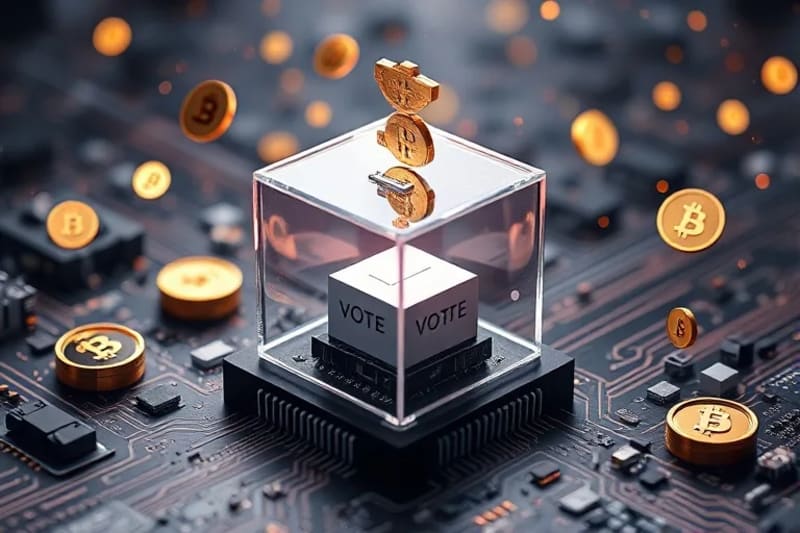 A conceptual depiction of transparent voting mechanisms within a decentralized network.
The benefits of autonomous governance are manifold. It fosters community engagement, ensures the protocol's long-term sustainability, and reduces the risk of single points of failure or malicious control. By distributing decision-making power, DAOs embody the true spirit of decentralization, making protocols more robust and resistant to external pressures. This distributed model echoes the shifts seen in modern work environments, where concepts like Teletrabajo y Empleo Remoto: Beneficios, Desafíos y el Futuro Laboral highlight the advantages of decentralized operations.
However, autonomous governance also faces challenges, including voter apathy, potential for whale dominance (where large token holders can disproportionately influence votes), and the complexity of managing large, diverse communities. Designing effective governance models that balance efficiency with true decentralization remains a key area of research and development within the DeFi space.
Key Components of DeFi Ecosystems
The DeFi ecosystem is composed of several interconnected components, each playing a vital role in its functionality and growth. Understanding these elements is crucial for grasping the full scope of decentralized finance.
- Decentralized Exchanges (DEXs): These platforms allow users to trade crypto assets directly with each other without the need for a centralized intermediary. DEXs operate on smart contracts, providing greater security and control over funds compared to centralized exchanges.
- Lending and Borrowing Protocols: DeFi lending platforms enable users to lend their crypto assets to earn interest or borrow assets by providing collateral. These protocols automate the lending process, often offering better rates than traditional banks and instant access to liquidity.
- Stablecoins: Cryptocurrencies designed to minimize price volatility relative to a "stable" asset, like the U.S. dollar. Stablecoins are crucial for DeFi, providing a stable medium of exchange and store of value within the volatile crypto market.
- Yield Farming and Staking: These strategies involve locking up crypto assets in a protocol to earn rewards, often in the form of additional tokens or transaction fees. They incentivize users to provide liquidity and participate in the network's security.
- Insurance Protocols: DeFi insurance aims to protect users against smart contract bugs, hacks, or other unforeseen events. These protocols are often community-driven, with policyholders and underwriters participating in risk assessment and claims processing.
Each of these components contributes to a robust and diverse financial ecosystem, offering alternatives to traditional financial services. The interoperability between these protocols, often referred to as "money legos," allows for the creation of complex and innovative financial products.
Benefits and Risks of Decentralized Finance
DeFi offers a compelling set of benefits that drive its rapid adoption and innovation:
- Accessibility and Financial Inclusion: Anyone with an internet connection can access DeFi services, regardless of their location, income, or credit history. This opens up financial opportunities for the unbanked and underbanked populations worldwide.
- Transparency: All transactions on a public blockchain are verifiable, fostering trust and reducing the potential for fraud. Smart contract code is often open-source, allowing for public scrutiny.
- Efficiency and Lower Costs: By removing intermediaries, DeFi can offer lower fees and faster transaction times compared to traditional financial systems. Automated smart contracts streamline processes.
- Innovation: The open-source nature of DeFi allows developers to build upon existing protocols, fostering rapid innovation and the creation of novel financial products and services.
- User Control: Users maintain full custody of their assets through non-custodial wallets, eliminating counterparty risk associated with centralized entities.
 An abstract visualization of a decentralized autonomous organization (DAO) as a network.
Despite its advantages, DeFi also carries significant risks that users must be aware of:
- Smart Contract Vulnerabilities: Bugs or exploits in smart contract code can lead to significant financial losses. Audits help mitigate this, but risks remain.
- Impermanent Loss: A risk associated with providing liquidity to DEXs, where the value of deposited assets can decrease compared to simply holding them.
- Regulatory Uncertainty: The lack of clear regulatory frameworks creates legal and operational risks, as governments worldwide grapple with how to classify and oversee DeFi.
- Market Volatility: The underlying crypto assets in DeFi are highly volatile, which can impact the value of investments and collateral.
- User Error: The self-custodial nature of DeFi means users are solely responsible for securing their private keys. Loss of keys results in irreversible loss of funds.
Navigating these risks requires a deep understanding of the technology and careful due diligence. Just as individuals must protect their wealth during periods of economic instability, as explored in Inflación Recesión: Proteger Patrimonio Incertidumbre Económica, users in DeFi must adopt robust security practices and informed decision-making.
The Future Landscape of Crypto Assets and DeFi
The future of crypto assets and DeFi is poised for continued evolution and expansion. As the technology matures, we can expect several key trends to shape its trajectory. Scalability solutions, such as Layer 2 networks and alternative blockchain architectures, will address current transaction speed and cost limitations, making DeFi more efficient and user-friendly. This will be crucial for broader mainstream adoption.
Interoperability between different blockchains is another critical area of development. Projects focused on cross-chain communication will allow assets and data to flow seamlessly between various networks, unlocking new possibilities for financial innovation and liquidity. This will create a more unified and robust decentralized financial ecosystem.
The integration of real-world assets (RWAs) into DeFi is also gaining momentum. Tokenizing assets like real estate, commodities, or traditional equities could bridge the gap between conventional finance and decentralized protocols, bringing vast amounts of capital and utility into the DeFi space. This convergence promises to unlock new investment opportunities and enhance global liquidity.
Regulatory Challenges and Evolution
One of the most significant hurdles for DeFi's widespread adoption is the evolving regulatory landscape. Governments and financial authorities worldwide are grappling with how to classify, regulate, and oversee decentralized protocols. The pseudonymous nature of blockchain transactions, combined with the global and borderless reach of DeFi, presents unique challenges for traditional regulatory frameworks.
Regulators are concerned about consumer protection, anti-money laundering (AML), and combating the financing of terrorism (CFT). Striking a balance between fostering innovation and mitigating risks is a delicate act. Different jurisdictions are adopting varied approaches, leading to a patchwork of regulations that can create complexity and uncertainty for DeFi projects and users.
However, as the DeFi market matures, a clearer regulatory path is likely to emerge. This could involve new legislative frameworks specifically designed for decentralized technologies, or the adaptation of existing laws to accommodate crypto assets. Collaboration between regulators, industry experts, and developers will be crucial in shaping a future where DeFi can thrive within a compliant and secure environment.
Conclusion: Shaping the Financial Paradigm
Decentralized Finance, with its emphasis on autonomous governance and blockchain-powered innovation, is fundamentally reshaping the global financial paradigm. It offers a compelling vision of a more open, accessible, and efficient financial system, empowering individuals and fostering unprecedented levels of innovation. While significant challenges remain, particularly in areas of scalability, security, and regulation, the momentum behind DeFi is undeniable.
The continuous development of smart contracts, the evolution of governance models, and the increasing interoperability of blockchain networks are paving the way for a future where crypto assets play an even more central role in our daily financial lives. As this ecosystem matures, it promises to democratize access to financial services, foster economic growth, and create a more resilient and transparent global economy.
Understanding DeFi is no longer just for tech enthusiasts; it is becoming essential for anyone interested in the future of finance. Its principles of decentralization and user empowerment are not merely technological advancements but represent a philosophical shift towards greater financial autonomy and collective decision-making. The journey of DeFi is just beginning, and its impact will undoubtedly resonate across industries for decades to come.
Related Searches and Further Reading
Source: Hybrid content assisted by AI and human editorial supervision.


Comentarios