
Dark Matter Dark Energy Cosmology Philosophical
The cosmos, in its vast and enigmatic grandeur, holds secrets that continue to challenge our understanding of reality. Among the most profound of these are dark matter and dark energy, two mysterious components that collectively constitute approximately 95% of the universe's total mass-energy density. Despite their overwhelming presence, they remain elusive, unobservable directly, yet their gravitational and expansive influences are undeniable.
This article delves into the scientific frontiers of cosmology, exploring the evidence for these cosmic enigmas and their profound philosophical implications. We will embark on a journey from the observational clues that first hinted at their existence to the cutting-edge research attempting to unravel their true nature.
Understanding dark matter and dark energy is not merely an academic exercise; it reshapes our perception of the universe, our place within it, and the very laws of physics that govern existence. Their study pushes the boundaries of human knowledge, inviting us to contemplate the unseen forces that orchestrate the cosmic dance.

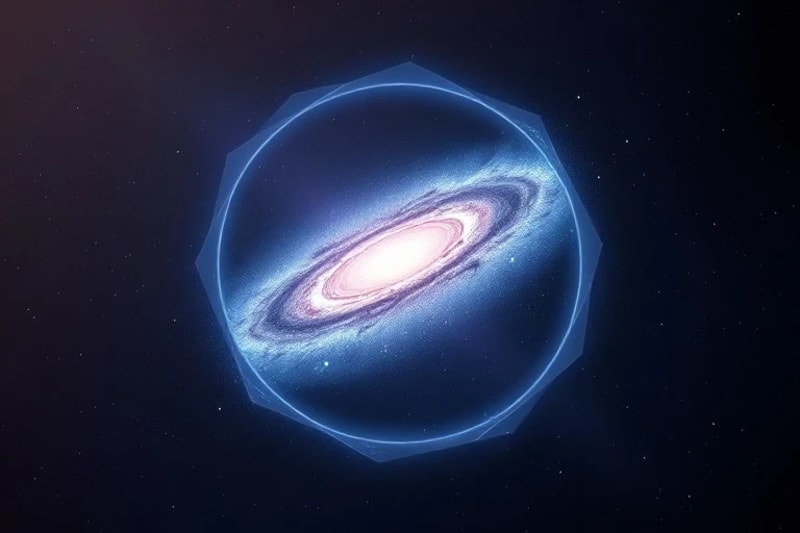
Conceptual visualization of the cosmic web, where luminous galaxies are cradled within the unseen embrace of dark matter filaments.
Table of Contents
- Unveiling the Cosmic Enigma: Dark Matter and Dark Energy
- The Invisible Architect: Understanding Dark Matter
- The Accelerating Force: Deciphering Dark Energy
- The Standard Model of Cosmology: Lambda-CDM
- Searching the Shadows: Detection Methods
- Profound Questions: Philosophical Implications
- The Cosmic Horizon: Future Research and Unanswered Mysteries
Unveiling the Cosmic Enigma: Dark Matter and Dark Energy
The terms "dark matter" and "dark energy" emerged from compelling observational evidence that could not be explained by the visible matter and known forces of the universe. For decades, astronomers and physicists have grappled with discrepancies between theoretical predictions and observed cosmic phenomena.
These invisible components represent a significant challenge to our current understanding of physics, particularly the Standard Model of particle physics and Einstein's theory of general relativity. Their existence implies that the universe is far more complex and mysterious than what meets the eye, or indeed, what our current instruments can directly detect.
The Invisible Architect: Understanding Dark Matter
Dark matter is a hypothetical form of matter that does not interact with electromagnetic radiation, meaning it neither emits nor absorbs light, making it truly "dark." Its presence is inferred solely through its gravitational effects on visible matter, radiation, and the large-scale structure of the universe.
The first strong evidence for dark matter came in the 1930s from astronomer Fritz Zwicky, who observed that galaxies within the Coma Cluster were moving too fast to be held together by the gravity of their visible mass alone. This suggested a significant amount of unseen mass.
An abstract depiction of gravitational lensing, illustrating how unseen mass warps spacetime and distorts light.
Further evidence accumulated over decades, including galaxy rotation curves, where stars at the outer edges of galaxies orbit much faster than expected based on the visible matter. Gravitational lensing, the bending of light around massive objects, also provides compelling proof, as the observed lensing effects are much stronger than what visible matter can account for.
The cosmic microwave background (CMB), the afterglow of the Big Bang, also shows patterns that are best explained by a universe containing a substantial amount of dark matter. Without it, the structures we observe today, like galaxies and galaxy clusters, would not have had enough time to form.
Scientists hypothesize that dark matter is composed of exotic particles not yet discovered, such as Weakly Interacting Massive Particles (WIMPs) or axions. These particles would interact very feebly with normal matter, explaining why they are so difficult to detect. The search for these particles is a major focus of experimental physics, often conducted in underground laboratories to shield from cosmic rays.
The Accelerating Force: Deciphering Dark Energy
While dark matter acts as a gravitational glue, dark energy is thought to be a repulsive force, driving the accelerated expansion of the universe. Its discovery in the late 1990s revolutionized cosmology and earned the Nobel Prize in Physics in 2011 for Saul Perlmutter, Brian Schmidt, and Adam Riess.
The evidence for dark energy primarily comes from observations of Type Ia supernovae, which are standard candles used to measure cosmic distances. By observing these supernovae in distant galaxies, astronomers found that the universe's expansion is not slowing down due to gravity, as previously expected, but is actually speeding up.

A dynamic visualization of cosmic expansion, illustrating the accelerating separation of galaxies driven by a mysterious force.
This acceleration implies the existence of a pervasive, unknown energy density with negative pressure, which acts against gravity. The leading candidate for dark energy is the cosmological constant, first introduced by Albert Einstein, representing the energy of empty space itself. However, theoretical predictions for the value of this energy are vastly different from what is observed, leading to one of the biggest puzzles in physics.
Other theories for dark energy include quintessence, a dynamic energy field that changes over time, or modifications to Einstein's theory of general relativity on cosmic scales. The nature of dark energy remains one of the most pressing questions in modern science, with implications for the ultimate fate of the universe.
The Standard Model of Cosmology: Lambda-CDM
The prevailing cosmological model, known as Lambda-CDM (ΛCDM), incorporates both dark matter and dark energy to explain the observed universe. In this model, Lambda (Λ) represents the cosmological constant (dark energy), and CDM stands for Cold Dark Matter.
According to ΛCDM, the universe is composed of approximately 68% dark energy, 27% dark matter, and only about 5% ordinary (baryonic) matter. This model successfully explains a wide range of cosmological observations, including the large-scale structure of the universe, the distribution of galaxies, and the fluctuations in the cosmic microwave background.
Despite its success, the ΛCDM model is not without its challenges. The fundamental nature of dark matter particles and the origin of dark energy are still unknown, representing significant gaps in our physical understanding. Researchers are actively working to refine this model and explore alternative theories that might offer a more complete picture.
Searching the Shadows: Detection Methods
The quest to directly detect dark matter and understand dark energy involves a multi-pronged approach, combining astronomical observations with sophisticated laboratory experiments. For dark matter, experiments fall into several categories:
Direct Detection: These experiments aim to observe the rare interactions of dark matter particles (like WIMPs) with ordinary matter in highly sensitive detectors, often located deep underground to minimize interference from cosmic rays. Examples include XENONnT, LUX-ZEPLIN (LZ), and PandaX.
Indirect Detection: Scientists look for the products of dark matter annihilation or decay, such as gamma rays, neutrinos, or antimatter particles, which could be produced when dark matter particles collide. Space telescopes like Fermi-LAT and ground-based observatories like H.E.S.S. are used for this purpose.
Collider Experiments: Particle accelerators like the Large Hadron Collider (LHC) attempt to produce dark matter particles in high-energy collisions. If produced, these particles would escape the detectors, leaving behind a signature of "missing energy."
For dark energy, the approach is primarily observational, focusing on refining measurements of the universe's expansion history and large-scale structure. Projects like the Dark Energy Survey (DES), the Euclid mission, and the Nancy Grace Roman Space Telescope are designed to map billions of galaxies and supernovae to precisely measure the expansion rate and its evolution. The insights gained from these studies are crucial for understanding the fundamental properties of the universe, much like how Rosalind Franklin's bioinformatics legacy continues to inform our understanding of genomics.
Profound Questions: Philosophical Implications
The existence of dark matter and dark energy extends beyond the realm of physics, prompting deep philosophical inquiries about the nature of reality, knowledge, and the universe itself. These phenomena challenge our anthropocentric view, revealing that the visible world we inhabit is but a small fraction of cosmic reality.
One major implication is the re-evaluation of what constitutes "matter" and "energy." Our traditional definitions, rooted in observable interactions, are insufficient to describe these dominant cosmic components. This forces us to consider that our current scientific frameworks might be incomplete, necessitating new paradigms.
The mystery of dark energy, in particular, raises questions about the ultimate fate of the universe. Will the accelerated expansion continue indefinitely, leading to a "Big Rip" where even atoms are torn apart? Or will dark energy evolve, perhaps leading to a different cosmic destiny? These questions touch upon existential concerns about the longevity and meaning of the cosmos.
Furthermore, the ongoing search for dark matter particles and the elusive nature of dark energy underscore the limits of human perception and instrumentation. It highlights the humility required in scientific pursuit, acknowledging that vast portions of reality may lie beyond our current grasp. This pursuit of the unknown can be seen as a form of urban shamanism, seeking connection with unseen forces, albeit through scientific rigor rather than spiritual practice.
The Cosmic Horizon: Future Research and Unanswered Mysteries
The future of dark matter and dark energy research is vibrant and filled with potential breakthroughs. New generations of experiments and telescopes are being developed with unprecedented sensitivity and resolution. The hope is that direct detection experiments will finally capture a dark matter particle, or that cosmological surveys will reveal subtle variations in dark energy's behavior.
One of the most exciting avenues is the potential for new physics beyond the Standard Model. If dark matter is indeed composed of new particles, their discovery would open up an entirely new sector of particle physics. Similarly, understanding dark energy could require a fundamental revision of general relativity or a deeper understanding of quantum gravity.
The implications for technology and society are also significant. The advanced computational methods and data analysis techniques developed for these cosmic quests contribute to fields like neuro-rights and digital consciousness research, pushing the boundaries of what we can measure and understand. The pursuit of these mysteries drives innovation and collaboration on a global scale.
Ultimately, the mysteries of dark matter and dark energy remind us that our universe is a dynamic, evolving entity, constantly revealing new layers of complexity. The journey to unravel these enigmas is a testament to human curiosity and the relentless pursuit of knowledge, promising to redefine our cosmic narrative.
As we continue to probe the depths of space, we are not just discovering new phenomena; we are also discovering more about the universe's fundamental laws and, by extension, about ourselves. The universe's secrets, though dark and energetic, continue to inspire and challenge us to expand the frontiers of our understanding.
Explore Further: Related Cosmic Insights
- Cryptoassets Generation Z: Strategic Savings for Retirement
- Skin Microbiome Biohacking: Advanced Skin Health and Longevity
- Asymmetric Cryptography: Public and Private Keys in Digital Security
- Corporate Social Responsibility: Impact, Reputation, and Sustainability
- Economy of the Common Good: Sustainable Model for the 21st Century
- Vocal Biohacking Michael Jackson: Science of Range and Control
- Antivirus History: Primitive Detectors to Multi-Layer Solutions
- History of Space Travel: From Gagarin to Mars Colonization
- Microplastics Marine Pollution: Global Problem, Solutions
- Sustainable Software: Reducing Digital Carbon Footprint Strategies
- Workplace Well-being: Mental and Physical Health Strategies for Employees
- Animal Hybridization: Evolution, Adaptation, and Health
- Akashic Records: Universal Soul Library | AstroFuturo
- Tiger Chinese Horoscope: 2025 Predictions and Secrets | AstroFuturo
- Wood Dragon 2024: Strategies, Opportunities, and Success | AstroFuturo
- Sacramentals and Relics: Deep Protection and Healing Guide
- Saint Gemma Galgani: Mystic, Passion, Stigmata of Christ
- Angels Archangels: Invisible Geopolitics and World Peace Strategies
- Spirit Guides: Connecting with Celestial Team Guidance | StarPluto
- Parenting Stars: Understanding a Child's Birth Chart: A Cosmic Guide | StarPluto
Source: Hybrid content assisted by AI and human editorial supervision.


Comentarios