
AI Autonomy Legal Framework: Responsibility, Control
The rapid advancement of Artificial Intelligence (AI), particularly in its autonomous forms, presents a profound paradigm shift across various sectors, from transportation and healthcare to finance and defense. As AI systems gain the ability to operate, learn, and make decisions independently, the traditional legal frameworks designed for human and corporate accountability face unprecedented challenges. This evolution necessitates a comprehensive re-evaluation of legal concepts such as responsibility, control, and liability, pushing jurisdictions worldwide to develop new regulatory mechanisms.
The core issue revolves around how to assign legal responsibility when an autonomous AI system causes harm or makes a detrimental decision without direct human intervention. This complexity is compounded by the "black-box" nature of many advanced AI models, where even their creators may not fully understand the precise reasoning behind certain outputs. Establishing clear lines of control and accountability is paramount not only for legal certainty but also for fostering public trust and ensuring the ethical development and deployment of these powerful technologies.

A holographic AI interface stands trial in a futuristic courtroom, symbolizing the complex legal challenges of autonomous systems.
This article delves into the intricate legal framework surrounding AI autonomy, exploring the fundamental questions of responsibility, control, and the mechanisms being developed to govern intelligent systems. We will examine the philosophical underpinnings of AI legal personality, the practical difficulties in attributing blame, and the emerging regulatory landscapes attempting to strike a balance between innovation and protection. The goal is to provide a detailed and technical overview of this critical area of digital law.
Understanding AI Autonomy in Legal Context
AI autonomy refers to an AI system's capacity to operate and make decisions without constant human supervision or intervention. This spectrum ranges from simple automation, where AI executes predefined rules, to advanced forms of machine learning where systems can adapt, learn from experience, and even generate novel solutions. The legal implications intensify as AI moves further along this spectrum, particularly when it operates in safety-critical environments.
From a legal standpoint, understanding the degree of autonomy is crucial. A fully autonomous system might be one that initiates actions, selects objectives, and executes tasks without human input, such as an autonomous weapon system or a self-driving car navigating complex urban environments. Conversely, a semi-autonomous system might require human approval for critical decisions or operate within strictly defined parameters. The distinction directly impacts how liability can be assigned.
The concept of "control" in this context is multifaceted. It encompasses not only direct human override capabilities but also the design choices, training data, algorithmic biases, and operational environment defined by human developers and deployers. The legal challenge is to delineate where human control ends and AI autonomy begins, and how to bridge this gap with appropriate accountability mechanisms. This requires a deep dive into the technical capabilities and limitations of AI.
Defining Legal Personality and Liability for AI
One of the most contentious debates in AI law concerns whether AI systems should be granted some form of legal personality. Traditionally, legal personality is attributed to natural persons (humans) and legal persons (corporations, states), allowing them to hold rights and obligations. Proponents for AI legal personality argue that highly autonomous AI, capable of independent action and decision-making, might warrant a similar status to facilitate liability attribution.
However, the prevailing view among legal scholars and policymakers is that granting AI legal personality is premature and unnecessary. Instead, the focus remains on assigning liability to existing legal persons: the developer, manufacturer, deployer, or user of the AI system. This approach leverages established legal principles, primarily product liability and negligence law, but requires significant adaptation.

Human hands guide the intricate network of AI decision-making, highlighting the critical role of human oversight in autonomous systems.
Liability models under consideration include:
- Strict Liability: This model holds a party responsible for damages regardless of fault. It is often applied to defective products. For AI, this could mean holding manufacturers strictly liable for harms caused by their autonomous systems, shifting the burden of proof away from the injured party.
- Fault-Based Liability (Negligence): This traditional model requires proving that a party acted negligently (e.g., failed to exercise reasonable care in design, testing, or deployment). Applying this to AI necessitates defining "reasonable care" in the context of complex, evolving algorithms and emergent behaviors.
- Risk-Based Liability: Some proposals suggest a hybrid approach, where liability is assessed based on the inherent risk level of the AI system and its application. High-risk AI (e.g., in medical diagnostics or autonomous weapons) would face stricter liability regimes.
The European Parliament, for instance, has explored a civil liability regime for AI, suggesting a mandatory insurance scheme for high-risk autonomous AI systems to compensate victims, reflecting a move towards strict liability for certain applications. This acknowledges the difficulty of proving fault in complex AI-driven incidents.
Challenges in Attributing Responsibility to Autonomous AI
Attributing responsibility for actions taken by autonomous AI systems is fraught with challenges. The multi-layered development and deployment process of AI, involving data providers, algorithm designers, software engineers, integrators, and end-users, complicates the identification of a single responsible party. This "responsibility gap" is a major concern for policymakers.
Key challenges include:
- The Black-Box Problem: Many advanced AI models, particularly deep learning networks, operate as "black boxes" where their internal decision-making processes are opaque and difficult to interpret, even for their creators. This makes it challenging to pinpoint why a specific decision was made or why a failure occurred.
- Emergent Behavior: Autonomous AI systems, especially those capable of continuous learning, can develop behaviors not explicitly programmed or foreseen by their developers. This emergent behavior complicates predictions of system actions and makes pre-emptive risk assessment difficult.
- Distributed Control: In complex AI ecosystems, control may be distributed across multiple actors. For example, a self-driving car involves the car manufacturer, the software developer, the map provider, and the owner/operator. Determining who had effective control at the moment of an incident is a significant legal hurdle.
- Data Dependency: AI performance is heavily reliant on the quality and bias of its training data. If biased data leads to discriminatory or harmful outcomes, who is responsible? The data provider, the model trainer, or the deployer?
These challenges necessitate a shift from traditional linear causality models to more complex, systemic approaches to responsibility, potentially involving shared liability or new forms of collective accountability. The goal is to ensure that victims of AI-induced harm are compensated, and incentives for safe AI development are maintained.
Regulatory Approaches and Emerging Legal Frameworks
Governments and international bodies are actively working to establish legal frameworks for AI. The European Union has taken a leading role with its proposed AI Act, which adopts a risk-based approach to AI regulation. This landmark legislation categorizes AI systems based on their potential to cause harm, imposing stricter requirements on "high-risk" AI.
The EU AI Act outlines several key obligations for high-risk AI systems, including:
- Robust Risk Management Systems: Continuous identification and mitigation of risks throughout the AI system's lifecycle.
- Data Governance: Ensuring high-quality training, validation, and testing datasets to minimize biases and errors.
- Technical Documentation and Record-Keeping: Comprehensive records to enable traceability and accountability.
- Transparency and Provision of Information to Users: Clear communication about the AI system's capabilities and limitations.
- Human Oversight: Mechanisms to ensure human control and intervention capabilities.
- Accuracy, Robustness, and Cybersecurity: Measures to ensure the AI system performs reliably and is resilient to attacks.
Other jurisdictions are also developing their strategies. The United States has generally favored a sector-specific approach, relying on existing regulatory bodies to adapt rules for AI within their domains. The White House has issued executive orders on AI safety and ethics, emphasizing responsible innovation. Internationally, organizations like UNESCO have adopted recommendations on the ethics of AI, promoting principles such as fairness, transparency, and accountability.
"The European Parliament's resolution of 20 October 2020 with recommendations to the Commission on a civil liability regime for artificial intelligence states that "the future civil liability framework for AI should guarantee that those who suffer harm caused by AI systems enjoy the same level of protection as those who suffer harm caused by other technologies." This highlights the legislative intent to ensure equivalent protection for victims, regardless of the technology involved.
Furthermore, the proposed EU AI Act, specifically Article 9, mandates that high-risk AI systems shall be designed and developed in such a way that they allow for effective human oversight during the period when the AI system is in use. This includes the ability for natural persons to intervene and correct the system's actions, or to interrupt or stop the system, to prevent or minimize risks."
These diverse approaches underscore the global recognition of AI's transformative power and the urgent need for robust legal and ethical guardrails to manage its risks effectively. The aim is to create a predictable legal environment that encourages innovation while protecting fundamental rights and public safety.
Ethical Dimensions of AI Control and Accountability
Beyond legal statutes, the ethical dimensions of AI autonomy are critical. Ethical principles often precede and inform legal frameworks, guiding the development of responsible AI. Core ethical considerations include fairness, transparency, human dignity, privacy, and non-discrimination. Ensuring AI systems adhere to these principles is a shared responsibility of developers, policymakers, and users.
Fairness and Non-Discrimination: Autonomous AI systems, if trained on biased data, can perpetuate or even amplify societal biases, leading to discriminatory outcomes in areas like hiring, lending, or criminal justice. Ethical guidelines emphasize the need for rigorous testing and auditing to identify and mitigate such biases, ensuring equitable treatment for all individuals.
Transparency and Explainability (XAI): The "black-box" problem not only poses legal challenges but also ethical ones. For AI to be trustworthy, its decisions should be explainable to humans, especially in critical applications. Explainable AI (XAI) aims to develop methods and techniques that allow human users to understand, trust, and manage AI systems more effectively. This includes understanding the rationale behind an AI's output and its potential implications.
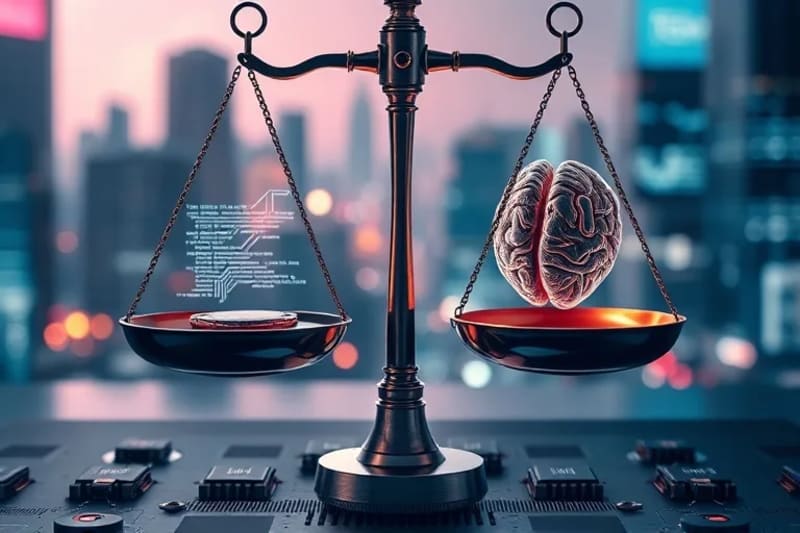
Legal scales balance glowing digital code with a symbolic human brain, representing the critical interplay between AI ethics and legal frameworks.
Human Dignity and Autonomy: The widespread deployment of autonomous AI raises concerns about its impact on human dignity and autonomy. For example, AI systems that make life-or-death decisions without human intervention, or those that manipulate human behavior, challenge fundamental ethical boundaries. Maintaining human control and oversight is often seen as a safeguard against such ethical infringements.
The interplay between ethics and law is dynamic. Ethical principles provide the normative foundation, while legal frameworks translate these principles into enforceable rules and mechanisms for accountability. As AI technology evolves, so too must our ethical considerations and legal responses.
Mechanisms for Ensuring Human Oversight and Control
Effective human oversight is a cornerstone of responsible AI governance. It ensures that humans remain ultimately in control of autonomous systems, even as AI capabilities expand. Various mechanisms are being developed and implemented to achieve this, ranging from technical safeguards to organizational protocols.
Key mechanisms include:
- Human-in-the-Loop (HITL): This approach integrates human judgment and intervention points into the AI's operational cycle. For instance, an AI might flag a complex case for human review or require explicit human approval before executing a critical action. This ensures that humans retain decision-making authority in high-stakes scenarios.
- Human-on-the-Loop (HOTL): In this model, humans monitor the AI system's performance and intervene only when necessary, such as when the system deviates from expected behavior or encounters an unforeseen situation. This is common in highly automated systems where continuous human intervention is impractical.
- Human-in-Command (HIC): This principle asserts that a human operator must always have the ultimate authority to activate, monitor, and deactivate an AI system. It emphasizes the hierarchical control structure, where AI acts as a tool under human command, not an independent agent.
- Technical Safety Switches and Kill Switches: Implementing clear, accessible mechanisms for humans to immediately shut down or override an autonomous AI system in emergencies. These physical or software-based controls are vital for preventing catastrophic failures or unintended consequences.
- Auditing and Monitoring Tools: Developing sophisticated tools to continuously monitor AI system performance, detect anomalies, and audit its decision-making processes. These tools can provide insights into the AI's behavior, helping human operators understand and manage its operations.
- Regulatory Sandboxes: Controlled environments where new AI technologies can be tested and developed under regulatory supervision. These sandboxes allow for experimentation and learning, helping regulators understand the technology's risks and benefits before full-scale deployment.
These mechanisms are not mutually exclusive and are often combined to create a layered approach to human oversight. The specific combination depends on the AI system's autonomy level, its application domain, and the potential risks involved. The overarching goal is to ensure that AI remains a beneficial tool that augments human capabilities rather than replaces human responsibility.
The Future of AI Legal Governance
The legal governance of AI autonomy is an evolving field, characterized by continuous adaptation and innovation. As AI technology advances, legal frameworks must remain agile and responsive to new challenges. The future will likely see a combination of international cooperation, national legislation, and industry self-regulation to create a comprehensive and effective governance ecosystem.
Key trends and future directions include:
- International Harmonization: Given AI's global nature, international cooperation is essential to prevent regulatory fragmentation and ensure a consistent approach to AI governance. Efforts by organizations like the OECD, G7, and UN will continue to shape global norms and standards.
- Dynamic Regulation: Traditional legislative processes can be slow. Future AI regulation may incorporate more dynamic mechanisms, such as adaptive regulatory frameworks, "soft law" guidelines, and technical standards that can be updated more frequently to keep pace with technological change.
- Focus on AI Ethics and Values: There will be an increased emphasis on embedding ethical principles directly into AI design and development. This includes "ethics by design" and "value-aligned AI," where systems are inherently built to reflect human values and societal norms.
- Specialized AI Courts and Legal Expertise: The complexity of AI-related disputes may necessitate specialized courts or tribunals and a new generation of legal professionals with expertise in both law and AI technology.
- Data Governance and Privacy: As AI relies heavily on data, robust data governance frameworks and privacy protections will remain central to legal discussions. Regulations like GDPR provide a foundation, but specific AI-driven data challenges will require further attention.
- Cybersecurity for AI: The security of AI systems against malicious attacks and manipulation will be a growing concern. Future legal frameworks will need to address cybersecurity obligations for AI developers and deployers to prevent AI from being weaponized or compromised.
The journey towards a stable and effective legal framework for AI autonomy is ongoing. It requires continuous dialogue between technologists, legal experts, ethicists, and policymakers to navigate the complex interplay of innovation, risk, and societal values. Ultimately, the goal is to harness the immense potential of AI while safeguarding human rights and ensuring accountability in an increasingly automated world.
The development of AI represents one of humanity's greatest technological achievements, promising advancements across nearly every facet of life. However, with this power comes significant responsibility. Establishing a robust legal and ethical framework for AI autonomy is not merely a technical exercise but a societal imperative. It is about defining the boundaries of machine intelligence, preserving human agency, and ensuring that the future of AI serves the best interests of humanity. The ongoing global discourse and legislative efforts reflect a collective commitment to navigating this complex terrain thoughtfully and proactively, laying the groundwork for a future where intelligent systems operate within a clear and accountable legal ecosystem.
Fuente: Contenido híbrido asistido por IAs y supervisión editorial humana.


Comentarios