
Interplanetary Travel Astrodynamics: Routes, Challenges
Interplanetary travel, once the exclusive domain of science fiction, is rapidly transitioning into a tangible reality, driven by advancements in science, engineering, and a renewed human desire to explore beyond Earth's confines. At the heart of this ambitious endeavor lies astrodynamics, the scientific discipline that applies celestial mechanics and rocket dynamics to the practical problems of navigating spacecraft. Understanding astrodynamics is not merely an academic exercise; it is the fundamental prerequisite for designing efficient trajectories, managing mission timelines, and ultimately, ensuring the success and safety of journeys to other planets, moons, and asteroids within our solar system.
This article delves into the intricate world of interplanetary travel, exploring the foundational principles of astrodynamics that govern these cosmic voyages. We will examine the various routes and trajectories spacecraft employ, the formidable challenges that must be overcome, and the cutting-edge technologies being developed to facilitate humanity's expansion into the solar system. From the elegant simplicity of Hohmann transfers to the complex ballet of gravity assists, each aspect underscores the blend of theoretical physics and engineering ingenuity required to conquer the vast distances of space.
Table of Contents
- Astrodynamics: The Fundamentals of Space Navigation
- Key Interplanetary Routes and Trajectories
- Overcoming the Challenges of Deep Space Travel
- Future Technologies Paving the Way
- The Conquest of the Solar System: Destinations and Visions
Astrodynamics: The Fundamentals of Space Navigation
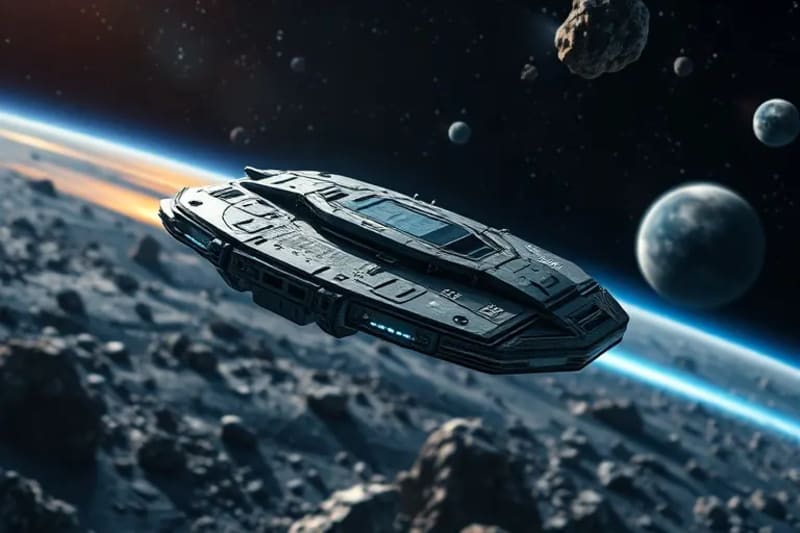 Conceptual visualizations of advanced spacecraft, theoretical trajectories, and the vast cosmic environment that inspires humanity's drive for interstellar exploration.
This image is an AI-generated conceptual render, showcasing the potential future of space exploration, blending scientific aspiration with artistic interpretation.
Astrodynamics, also known as orbital mechanics, is the study of spacecraft trajectories, orbital maneuvers, and the gravitational forces that dictate their motion. It is a complex field that synthesizes principles from physics, mathematics, and engineering to predict and control the path of objects in space. The core challenge in astrodynamics is to efficiently move a spacecraft from one celestial body to another, minimizing fuel consumption and travel time while adhering to strict mission constraints.
The foundation of astrodynamics rests on Newton's laws of motion and universal gravitation, which describe how objects interact under gravitational influence. However, the multi-body problem—where more than two celestial bodies exert significant gravitational forces—introduces considerable complexity. For interplanetary missions, engineers often simplify this by using the "patched conic approximation," treating the spacecraft's trajectory as a series of two-body problems, dominated by the gravitational pull of the nearest large body (e.g., Earth, Sun, Mars).
Key concepts in astrodynamics include delta-v (Δv), which represents the change in velocity required to perform an orbital maneuver, and specific impulse (Isp), a measure of rocket engine efficiency. Minimizing Δv is paramount for interplanetary missions, as it directly correlates with the amount of propellant needed, which in turn affects launch mass and mission cost. Trajectory design involves calculating these Δv budgets and planning maneuvers at optimal points in a spacecraft's orbit.
| Concept | Description | Significance for Interplanetary Travel |
|---|---|---|
| Delta-v (Δv) | Measure of the impulse needed to change a spacecraft's velocity. | Directly impacts fuel requirements and mission cost; minimizing Δv is crucial. |
| Specific Impulse (Isp) | Efficiency of a rocket engine, indicating how much thrust is generated per unit of propellant consumed. | Higher Isp means less propellant needed for a given Δv, enabling longer missions. |
| Orbital Elements | Six parameters that uniquely define an orbit (e.g., semi-major axis, eccentricity). | Essential for precisely describing and predicting a spacecraft's path. |
| Gravity Assist | Using a planet's gravitational pull to alter a spacecraft's speed and/or direction. | Saves significant fuel, enabling missions to outer solar system with smaller rockets. |
Key Interplanetary Routes and Trajectories
The journey between planets is not a straight line but a carefully orchestrated dance through gravitational fields. The choice of trajectory depends on mission objectives, available propulsion, and desired travel time. The most fundamental and fuel-efficient interplanetary trajectory is the Hohmann transfer orbit.
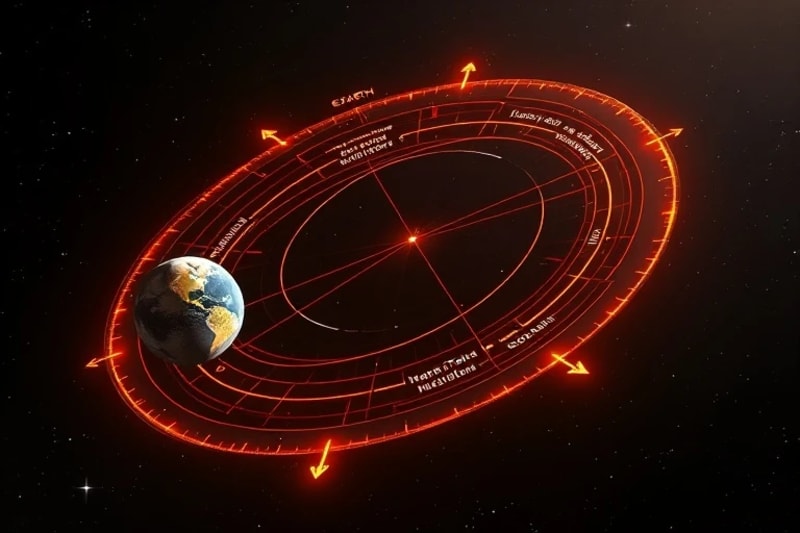 Detailed scientific diagrams illustrating the concept of a Hohmann transfer, a cornerstone of astrodynamic efficiency for orbital maneuvers.
Rendered with precision, this conceptual image depicts the mathematical elegance behind interplanetary trajectories, often found in academic publications and engineering schematics.
A Hohmann transfer is an elliptical orbit used to transfer between two circular orbits of different radii around a central body, typically the Sun. For a journey from Earth to Mars, a spacecraft would perform a burn to enter an elliptical orbit whose perihelion (closest point to the Sun) is at Earth's orbit and whose aphelion (farthest point from the Sun) is at Mars' orbit. Upon reaching Mars' orbit, another burn is performed to match Mars' velocity and enter its orbit. While fuel-efficient, Hohmann transfers are time-consuming, taking several months for Mars and years for outer planets.
For missions requiring faster travel or to reach more distant targets with limited fuel, gravity assists (also known as planetary swing-bys) are indispensable. By flying close to a planet, a spacecraft can "steal" or "give" orbital energy from/to the planet, altering its velocity and trajectory without expending propellant. This technique was famously used by Voyager probes to explore the outer solar system, significantly reducing travel time and fuel needs.
More advanced concepts include low-energy transfers (LETs) or "interplanetary superhighways," which exploit gravitational perturbations to achieve transfers with minimal fuel. These trajectories often take much longer but can be highly efficient for certain missions, particularly those involving asteroid rendezvous or sample returns. The downside is their sensitivity to initial conditions and longer travel times, making them less suitable for human missions.
Overcoming the Challenges of Deep Space Travel
Interplanetary travel is fraught with challenges that push the boundaries of human ingenuity and technological capability. One of the primary hurdles is propulsion. Current chemical rockets, while powerful, are inefficient for long-duration missions due to their high fuel consumption. The need for more advanced propulsion systems is critical for reducing travel times and increasing payload capacity.
Another significant challenge is radiation. Beyond Earth's protective magnetosphere, spacecraft and astronauts are exposed to harmful cosmic rays and solar particle events. These high-energy particles can damage electronics and pose severe health risks, including increased cancer risk, acute radiation sickness, and central nervous system damage. Developing effective radiation shielding and mitigation strategies is paramount for human interplanetary missions.
Life support systems for long-duration missions must be robust, reliable, and capable of recycling resources efficiently. Systems that can provide breathable air, potable water, and sustenance for years without resupply from Earth are essential. Biohacking and epigenetic research are exploring ways to enhance human resilience to space environments, but closed-loop ecological systems remain a complex engineering feat. Furthermore, the psychological impact of isolation and confinement during extended journeys requires careful consideration, potentially drawing lessons from digital minimalism for mental well-being.
Communication delays also become substantial as distances increase. A signal to Mars can take between 3 and 22 minutes to reach Earth, depending on the planets' positions. This latency makes real-time control impossible and necessitates a high degree of autonomy for spacecraft and crew, relying on sophisticated onboard AI and pre-programmed decision-making protocols.
Future Technologies Paving the Way
To overcome the current limitations, significant investments are being made in developing revolutionary technologies. Advanced propulsion systems are at the forefront. Nuclear thermal propulsion (NTP) and nuclear electric propulsion (NEP) offer significantly higher specific impulse than chemical rockets, drastically reducing travel times and increasing payload capacity for missions to Mars and beyond. Solar electric propulsion, already in use for some robotic missions, provides continuous low thrust over long periods, enabling highly efficient trajectories.
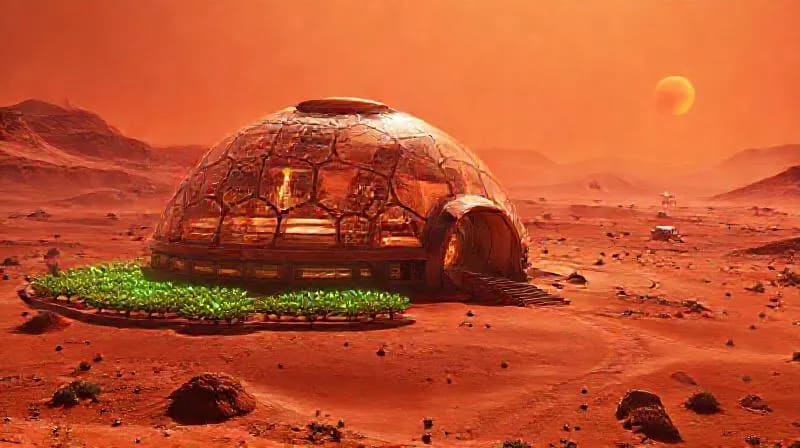 Artistic renditions of future Martian habitats, featuring advanced life support systems and sustainable infrastructure, symbolizing humanity's ambition to establish off-world colonies.
This digital artwork, created by an AI, envisions the architectural and ecological challenges of living on another planet, drawing inspiration from scientific proposals and speculative design.
In-situ resource utilization (ISRU) is another game-changer. By extracting and processing local resources on celestial bodies (e.g., water ice on the Moon or Mars for propellant and breathable air), future missions can become more self-sufficient, reducing the need to launch everything from Earth. This approach is crucial for establishing sustainable outposts and reducing the overall cost of space exploration.
Artificial intelligence (AI) and machine learning are poised to revolutionize mission planning and execution. AI can optimize complex trajectories, manage autonomous systems, monitor astronaut health, and even assist in scientific discovery. From decoding complex data patterns to predictive maintenance, AI's role will be indispensable for the increasing complexity of interplanetary missions. Robotics and automation will also play a critical role, performing hazardous tasks and constructing infrastructure before human arrival.
The Conquest of the Solar System: Destinations and Visions
The ultimate goal of interplanetary travel is the exploration and eventual settlement of the solar system. Mars stands as the most immediate and compelling target for human missions, offering potential for scientific discovery, resource extraction, and the establishment of a second home for humanity. Plans for Martian missions involve multi-year stays, requiring advanced habitats, closed-loop life support, and robust protection against radiation and dust storms.
Beyond Mars, the Moon remains a crucial stepping stone, serving as a proving ground for technologies and procedures necessary for deeper space exploration. Its proximity and potential water ice resources make it an ideal location for a lunar base, supporting future missions to Mars and beyond. Asteroids, rich in valuable minerals and water, also represent significant targets for future resource utilization and scientific study, potentially fueling future space economies.
The outer solar system, with its gas giants and icy moons like Europa and Titan, holds immense scientific interest, particularly in the search for extraterrestrial life. While human missions to these distant worlds are still far off, advanced robotic probes continue to push the boundaries of exploration, providing invaluable data that informs future human endeavors. The vision of a multi-planetary civilization, once a distant dream, is slowly but surely becoming a tangible objective, driven by continuous innovation in astrodynamics and space technology.
Explore More Space and Tech Insights
- Cognitive Biases in Investment: Optimal Financial Decisions
- Sustainable Ecotourism: Impact, Conservation, Local Development
- AI Ethics in Artistic Creation: Originality, Authorship, Rights
- Digital Minimalism: Optimized Professional Productivity
- Precision Functional Nutrition: Metabolomic Biohacking
- Neuro-Astrology Quantum: Brain Synchronization Genetic Potential
- Karmic Nodes Fixed Stars: Rectifying Past Life Wounds
Source: Hybrid content assisted by AI and human editorial supervision.


Comentarios