
Astrodynamics Interplanetary Travel Routes Challenges Solar System
Humanity's ambition to explore beyond Earth has driven incredible advancements in science and technology. Interplanetary travel, once a staple of science fiction, is now a tangible goal, with missions to Mars and beyond increasingly becoming a reality. At the heart of this endeavor lies astrodynamics, the science of spacecraft trajectories and orbital mechanics.
Understanding how celestial bodies move and interact is crucial for designing missions that can efficiently and safely navigate the vast distances of our solar system. This field combines principles from physics, mathematics, and engineering to plot the most fuel-efficient and timely paths for probes and crewed vehicles. From the initial launch to the final rendezvous, every maneuver is meticulously calculated to harness the gravitational forces of planets and moons.
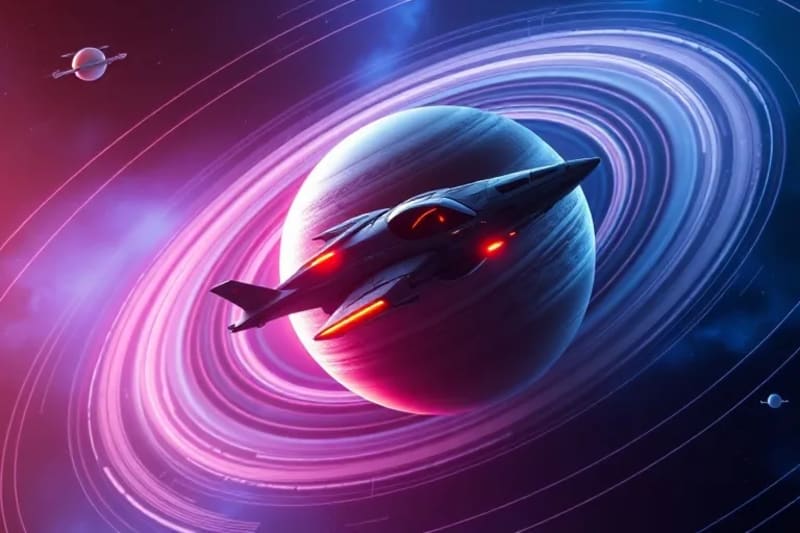 A futuristic spacecraft embarking on an intricate journey through the solar system, illustrating the complex dance of astrodynamics.
This article delves into the fundamental principles of astrodynamics, explores the innovative routes spacecraft take, and examines the formidable challenges that must be overcome to make interplanetary travel a routine reality. We will uncover the elegant mathematics behind orbital transfers and discuss the cutting-edge technologies that promise to revolutionize our journey to the stars.
- 1. The Foundation of Interplanetary Travel
- 2. Understanding Orbital Mechanics and Gravitational Dance
- 3. Crafting Interplanetary Trajectories
- 4. Overcoming the Vastness: Key Challenges
- 5. The Quest for Advanced Propulsion Systems
- 6. Human Factors and Life Support in Deep Space
- 7. The Future Horizons of Space Exploration
1. The Foundation of Interplanetary Travel
Interplanetary travel is the journey between planets, typically within a single planetary system. For our solar system, this means traveling from Earth to other celestial bodies like Mars, Jupiter, or Saturn. The core discipline enabling these voyages is astrodynamics, which applies Newton's laws of motion and universal gravitation to predict and control the trajectories of spacecraft.
Early pioneers like Johannes Kepler laid the groundwork with his laws of planetary motion, describing how planets orbit the Sun. Isaac Newton then provided the theoretical framework with his law of universal gravitation, explaining the force that governs these motions. These foundational principles are still central to modern astrodynamics, albeit with sophisticated computational tools.
The ultimate goal of astrodynamics is to find the most efficient path for a spacecraft, minimizing fuel consumption and travel time while ensuring mission success. This involves a delicate balance of speed, direction, and gravitational interactions. Without a precise understanding of these dynamics, any attempt at interplanetary travel would be akin to blindly throwing a dart across a continent.
2. Understanding Orbital Mechanics and Gravitational Dance
Orbital mechanics, a sub-discipline of astrodynamics, focuses on the motion of objects under the influence of gravity. Key concepts include orbital parameters, such as eccentricity, inclination, and semi-major axis, which define the shape and orientation of an orbit. Understanding these parameters allows engineers to predict a spacecraft's future position and plan necessary adjustments.
One of the most critical principles is the concept of delta-v (Δv), which represents the change in velocity required to perform an orbital maneuver. Every burn of a rocket engine consumes fuel to achieve a certain Δv. Minimizing Δv is paramount for interplanetary missions, as every kilogram of fuel saved translates to more payload or a smaller, less expensive rocket.
The gravitational influence of multiple bodies creates complex scenarios. While the two-body problem (e.g., a spacecraft orbiting Earth) has an exact analytical solution, the three-body problem (e.g., Earth-Moon-spacecraft) does not. This necessitates numerical simulations and sophisticated computational methods to accurately model trajectories, often revealing fascinating and counter-intuitive paths.
3. Crafting Interplanetary Trajectories
Designing an interplanetary trajectory involves choosing the most suitable path based on mission objectives, available technology, and launch windows. Several types of trajectories are commonly employed:
- Hohmann Transfer Orbits: These are the most fuel-efficient paths between two circular orbits in the same plane. They involve two engine burns: one to leave the initial orbit and another to enter the target orbit. While efficient, Hohmann transfers often take a long time, making them suitable for cargo missions but less ideal for crewed missions requiring faster transit.
- Gravity Assists (Slingshot Maneuvers): This ingenious technique uses the gravitational pull of a planet or moon to accelerate or decelerate a spacecraft without expending fuel. By flying close to a celestial body, the spacecraft "steals" or "gives" momentum, altering its speed and direction. This method was famously used by the Voyager probes to tour the outer solar system, significantly reducing mission duration and fuel requirements.
- Low-Energy Transfers (Ballistic Capture): These trajectories exploit gravitational perturbations and stable Lagrange points to achieve orbit insertion with minimal or no propulsive burn upon arrival. While extremely fuel-efficient, they typically involve much longer travel times, sometimes years longer than Hohmann transfers. They are particularly useful for missions to asteroids or lunar orbits.
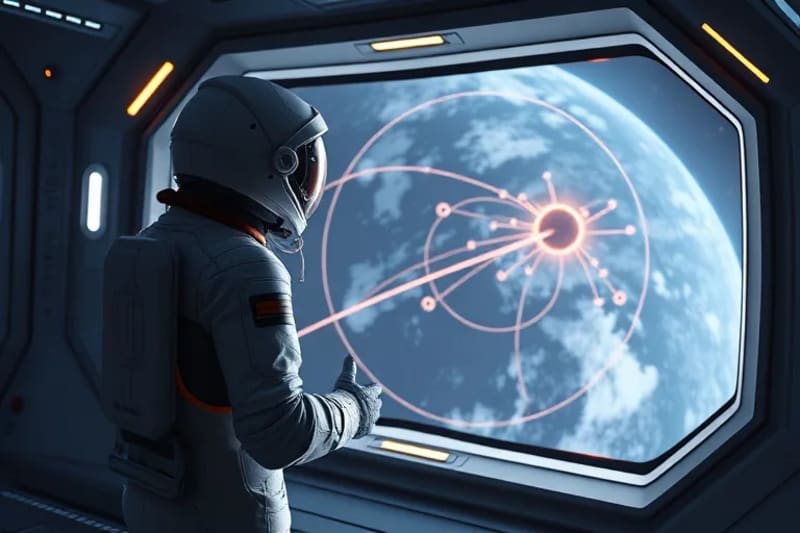 An astronaut contemplating the intricate network of interplanetary routes, visualizing the future of space exploration.
The choice of trajectory also depends on the launch window, which is a specific period when the relative positions of Earth and the target planet are optimal for a transfer. These windows occur infrequently, sometimes only every few years, emphasizing the importance of precise planning and execution. The concept of scientific aberration, in a broader sense, can sometimes refer to deviations or anomalies from expected paths, which astrodynamicists must account for in their calculations.
4. Overcoming the Vastness: Key Challenges
Interplanetary travel presents a myriad of challenges that push the boundaries of human ingenuity and technological capability. The sheer distances involved mean travel times can span months or even years, requiring robust spacecraft design and resilient human crews.
One of the most significant challenges is radiation exposure. Beyond Earth's protective magnetosphere, astronauts are exposed to harmful cosmic rays and solar particle events, which can cause acute radiation sickness, increase cancer risk, and damage electronic systems. Developing effective shielding and predictive models for solar activity is critical for long-duration missions.
Another hurdle is the development of advanced propulsion systems. Chemical rockets, while powerful, are limited by the amount of fuel they can carry. New technologies like electric propulsion (ion thrusters), nuclear thermal propulsion, or even theoretical concepts like warp drives are being explored to achieve faster and more efficient transit times, which are essential for reducing exposure risks and mission costs.
Life support systems must be closed-loop and highly reliable for extended periods, recycling air, water, and waste with minimal resupply from Earth. The psychological impact of isolation and confinement on crews is also a major concern, requiring careful crew selection, training, and support systems. These challenges highlight the need for future skills for space exploration that go beyond technical expertise, encompassing adaptability and psychological resilience.
5. The Quest for Advanced Propulsion Systems
The future of interplanetary travel heavily relies on breakthroughs in propulsion technology. Current chemical rockets, while effective for Earth orbit and lunar missions, become prohibitively expensive and slow for deep-space journeys. Therefore, scientists and engineers are actively researching and developing more efficient alternatives.
- Electric Propulsion: Ion thrusters, for example, use electricity to ionize and accelerate a propellant (like xenon) to very high speeds. They produce low thrust but can operate for extended periods, achieving high specific impulse (fuel efficiency). This makes them ideal for long-duration, uncrewed missions, such as the Dawn spacecraft's journey to Vesta and Ceres.
- Nuclear Thermal Propulsion (NTP): NTP systems use a nuclear reactor to heat a propellant (typically hydrogen) to extreme temperatures, expelling it through a nozzle to generate thrust. NTP offers significantly higher thrust and efficiency than chemical rockets, potentially cutting travel times to Mars by half. This technology is currently under renewed development by NASA.
- Solar Sails: These innovative systems use large, ultrathin membranes to harness the momentum of photons from the Sun, generating continuous, albeit very small, thrust. Over long distances, this constant acceleration can build up considerable speed, offering a propellant-less propulsion method for certain missions.
- Advanced Concepts: Beyond these, more speculative concepts include fusion propulsion, antimatter rockets, and even theoretical warp drives, which could dramatically reduce travel times to other star systems. While still in early research phases, these ideas inspire the long-term vision of interstellar travel.
 A conceptual depiction of a gravity assist maneuver, a key astrodynamic technique for efficient interplanetary travel.
The development of these propulsion systems is not just about speed; it's also about opening up new possibilities for exploration, allowing heavier payloads, more frequent missions, and ultimately, making human presence beyond Earth a more sustainable endeavor. The integration of cutting-edge technology with human needs also touches upon concepts like techno-shamanism in digital healing, where advanced tech supports human well-being in extreme environments.
6. Human Factors and Life Support in Deep Space
While astrodynamics focuses on the physics of motion, the success of crewed interplanetary missions hinges equally on understanding and mitigating human factors. Long durations in microgravity lead to physiological changes, including bone density loss, muscle atrophy, and cardiovascular deconditioning. Countermeasures like exercise regimens and specialized diets are crucial, but more research is needed for multi-year missions.
Psychological well-being is another critical aspect. The isolation, confinement, and distance from Earth can lead to stress, anxiety, and interpersonal conflicts. Astronaut selection processes are rigorous, focusing on resilience, teamwork, and problem-solving skills. Mission planners also integrate communication protocols and recreational activities to maintain crew morale and mental health.
Life support systems are the lifeline of any crewed mission. These complex systems must provide breathable air, potable water, and waste management, often in a closed-loop environment to minimize reliance on resupply. Advanced biological systems, such as growing food in space, are being explored to create more sustainable and self-sufficient habitats for future long-duration missions. Research into genomic nutritional optimization for astronauts is also vital for tailoring diets to individual needs and mitigating the physiological stresses of space.
7. The Future Horizons of Space Exploration
The future of interplanetary travel is bright with ambitious plans for human exploration and scientific discovery. Mars remains a primary target, with ongoing robotic missions paving the way for eventual crewed landings and potential colonization. Beyond Mars, the moons of Jupiter and Saturn, particularly Europa and Titan, hold immense scientific interest due to their potential for subsurface oceans and unique chemical environments.
Asteroids also present a compelling destination, not only for scientific study but also for resource utilization. These celestial bodies are rich in valuable minerals and water ice, which could be harvested to support deep-space missions and future off-world settlements, reducing the cost and complexity of bringing resources from Earth.
International collaboration is becoming increasingly important for these grand endeavors, pooling resources, expertise, and political will to tackle the immense challenges. The development of reusable rockets, orbital refueling capabilities, and advanced in-situ resource utilization (ISRU) technologies will further reduce the cost and increase the feasibility of sustained interplanetary presence.
Ultimately, interplanetary travel is not just about reaching new destinations; it's about expanding our understanding of the universe, inspiring future generations, and ensuring the long-term survival and prosperity of humanity. The intricate dance of astrodynamics will continue to guide our way, charting paths through the cosmic ocean to unlock the secrets of our solar system and beyond.
Explore More
Source: Hybrid content assisted by AI and human editorial supervision.


Comentarios