
Greek Abacus Legacy: Ancient Computing to AI Evolution
The Greek abacus, an ingenious device born from the cradle of Western civilization, stands as a testament to humanity's early quest for systematic calculation. Far from being a mere historical curiosity, its principles laid foundational concepts that, in an abstract sense, echo through the complex algorithms of modern Artificial Intelligence (AI) and the mind-bending mechanics of quantum computing. This ancient tool was not just a counting machine; it was an embodiment of logical thought, a physical representation of mathematical operations that shaped commerce, architecture, and scientific inquiry in the Hellenistic world.
Understanding the legacy of the Greek abacus requires a journey back to its origins, exploring its design, its practical applications, and the intellectual environment that fostered its development. From there, we can trace a conceptual lineage, observing how fundamental ideas of state, operation, and result, first manipulated with beads on rods, have evolved into the intricate data processing systems that define our digital age. This article delves into this fascinating evolution, bridging millennia to connect the tactile world of ancient Greece with the abstract realms of contemporary computation.
Table of Contents
- Origins and Design of the Greek Abacus
- Computational Principles: Beyond Simple Counting
- Cultural and Economic Impact in Ancient Greece
- The Conceptual Bridge to Modern Computing
- The Abacus and Artificial Intelligence: Algorithmic Roots
- Quantum Computing and Ancient Logic: A Surprising Parallel
- Enduring Legacy and Future Perspectives
Origins and Design of the Greek Abacus
While the precise origins of the abacus are debated, with evidence pointing to Mesopotamian and Egyptian precursors, the Greek version, particularly the Salamis Tablet, provides concrete insight into its form and function. Discovered in 1846 on the island of Salamis, this marble slab dates back to around 300 BCE and is considered the oldest surviving counting board. It features carved parallel lines and columns, indicating a sophisticated system for numerical representation and manipulation.
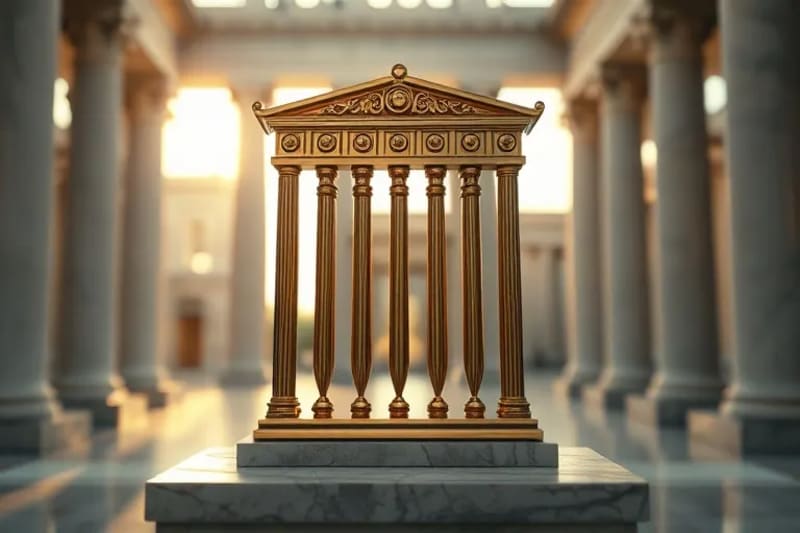
A meticulously recreated ancient Greek abacus, representing the foundational tools of early mathematical and computational thinking in classical antiquity.
This conceptual render, generated by AI, visualizes the historical instrument that underpinned ancient Greek arithmetic and logic.The Greek abacus typically consisted of a board (abax) with grooves or lines, on which pebbles (calculi) or counters were moved. These lines represented different powers of ten, allowing users to perform addition, subtraction, multiplication, and division. Unlike some later abacus designs with fixed beads, the Greek version often used loose counters, offering flexibility in representation. The design reflected the decimal system, which, despite the Greeks' sophisticated geometry, was practical for everyday arithmetic.
Computational Principles: Beyond Simple Counting
At its core, the Greek abacus operated on principles of positional notation and base-10 arithmetic. Each column or groove represented a specific decimal place (units, tens, hundreds, etc.). Moving a pebble from one column to the next effectively multiplied or divided its value by ten. This physical manipulation of counters mirrored the abstract operations of arithmetic, making complex calculations accessible to a wider range of individuals, not just highly trained mathematicians.
- Addition: Counters representing numbers were placed on the board. Combining counters in each column and carrying over tens to the next column performed addition.
- Subtraction: The inverse of addition, where counters were removed or "borrowed" from higher columns.
- Multiplication: Often performed through repeated addition, or more advanced methods involving partial products and shifts, conceptually similar to modern long multiplication.
- Division: Achieved through repeated subtraction or by distributing counters across rows representing divisors.
The efficiency of the abacus lay in its ability to externalize memory and process. Instead of holding numbers in one's head, the abacus provided a tangible workspace. This cognitive offloading is a fundamental concept in computing, where external devices handle data storage and manipulation, freeing up mental resources for higher-level problem-solving. The abacus was, in essence, an early form of a computational register.
Cultural and Economic Impact in Ancient Greece
The Greek abacus played a crucial role in the daily life and economic activities of ancient Greece. From merchants calculating transactions in the agora to architects planning monumental structures, the abacus was an indispensable tool. Its widespread use facilitated trade, enabled more accurate accounting, and supported the complex administrative tasks of city-states.
A visual representation of the conceptual leap from ancient counting devices to the intricate digital systems of today.
This vector illustration, created by AI, metaphorically connects historical computational tools with modern technological advancements.Beyond practical applications, the abacus also influenced intellectual development. It provided a concrete model for understanding abstract mathematical concepts, potentially aiding in the development of logical reasoning and problem-solving skills. While Greek mathematicians like Euclid and Archimedes focused on theoretical geometry and number theory, the abacus provided the practical computational backbone for many of their applications in engineering and astronomy.
The very word "calculate" derives from the Latin "calculus," meaning small stone or pebble, directly referencing the counters used on the abacus. This linguistic legacy underscores the profound impact of this device on human thought and language related to numerical operations. It was a tool that democratized arithmetic, making it accessible to a broader segment of society than would have been possible with purely mental calculations.
The Conceptual Bridge to Modern Computing
The leap from a stone abacus to a silicon microchip seems immense, yet fundamental computational concepts bridge this vast temporal gap. The abacus operates on a discrete state system: a bead is either in one position or another, representing a specific value. This binary (or rather, decimal-based discrete) state representation is analogous to the on/off states of transistors in modern digital computers, which represent bits (0s and 1s).
Furthermore, the abacus performs operations through a sequence of defined steps – an algorithm. To add two numbers, one follows a specific procedure of placing, moving, and carrying counters. This procedural execution is the essence of all computing, from the simplest calculator to the most complex supercomputer. Every program, every line of code, is an algorithm designed to manipulate data in a structured way to achieve a desired outcome.
The concept of registers, where data is temporarily held and manipulated, also finds a rudimentary parallel in the columns of the abacus. Each column acts as a register for a specific power of ten. Modern CPUs utilize various registers for storing instructions, memory addresses, and data during processing. This abstract idea of a temporary storage unit for active computation has remained constant, evolving in complexity and speed but not in its core function.
The Abacus and Artificial Intelligence: Algorithmic Roots
While AI seems far removed from simple arithmetic, its foundations are deeply rooted in algorithmic thinking, a concept the abacus embodies. AI systems, particularly those based on neural networks, perform vast numbers of calculations: multiplications, additions, and comparisons. These operations, at their most basic level, are the same ones performed on an abacus, albeit at an unimaginably faster rate and with far greater complexity.

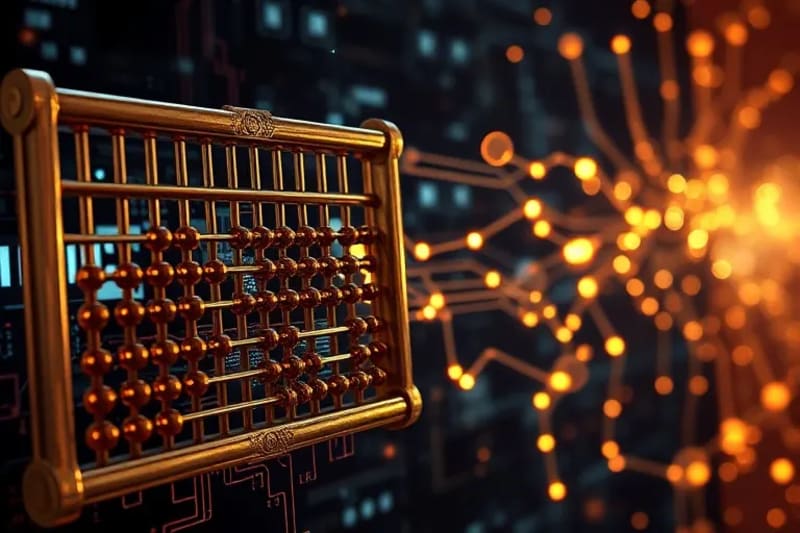
An abstract visualization connecting the fundamental principles of ancient calculation with the advanced concepts of quantum mechanics.
This AI-generated digital artwork explores the conceptual continuity between historical tools and future computational paradigms.Consider the training phase of a machine learning model. It involves iterative adjustments of weights and biases based on input data and desired outputs. Each adjustment is a calculation, a comparison, and a modification – a sophisticated sequence of arithmetic operations. The abacus, by providing a tangible model for these operations, helped solidify the abstract idea that complex problems could be broken down into a series of simpler, repeatable steps. This is the very essence of how AI algorithms learn and process information.
The development of Edge AI, which processes data closer to its source, often relies on highly optimized algorithms that perform computations with minimal resources. This efficiency echoes the abacus's elegant simplicity in achieving complex results with basic physical components. The drive for efficient computation, whether in ancient times or the modern era of AI, remains a constant.
Quantum Computing and Ancient Logic: A Surprising Parallel
The connection between the Greek abacus and quantum computing might seem tenuous, given the latter's reliance on quantum mechanics. However, a conceptual thread can be drawn through the idea of "state" and "superposition." In an abacus, a bead's position defines its state (its value). In quantum computing, a qubit can exist in a superposition of states (both 0 and 1 simultaneously) until measured. While vastly different in mechanism, both systems fundamentally deal with manipulating states to perform calculations.
The abacus demonstrated that physical systems could represent and process information. Quantum computers extend this by leveraging the quantum properties of matter to represent and process information in ways classical computers cannot. The underlying goal remains the same: to find efficient ways to solve problems by manipulating information states. The ancient Greeks, through their philosophical inquiries and practical tools like the abacus, were among the first to systematically explore the relationship between physical reality and abstract mathematical operations.
The challenges in securing these advanced systems are also a modern parallel. Just as ancient scribes guarded their ledgers, modern Quantum Cybersecurity focuses on protecting the integrity of quantum information. Furthermore, the complexities of managing quantum data in distributed environments lead to discussions around Quantum Cloud Cybersecurity, highlighting the continuous evolution of computational challenges.
Enduring Legacy and Future Perspectives
The Greek abacus, a simple yet powerful tool, stands as a monumental precursor to the digital age. Its legacy is not found in direct technological lineage but in the conceptual frameworks it helped establish: discrete states, algorithmic processes, and the externalization of cognitive load for computation. These fundamental ideas have transcended millennia, adapting and evolving with each technological paradigm shift.
From the pebbles on a marble slab to the electrons in a transistor and the qubits in a quantum processor, humanity's drive to compute, to understand, and to master complexity remains constant. The abacus reminds us that even the most advanced technologies are built upon layers of foundational thought, often originating in the simplest of inventions. Its story is a powerful testament to the enduring human ingenuity that bridges ancient wisdom with future frontiers of computation.
Explore More Related Content
- AI Meditation: Personalized Digital Rituals for Mindfulness
- Psycho-Astrology: Jungian Natal Chart Integration Guide
Source: Hybrid content assisted by AI and human editorial supervision.


Comentarios