
Black Holes AI Unraveling Cosmic Mysteries
Black holes, those enigmatic regions of spacetime where gravity is so intense that nothing, not even light, can escape, have long captivated the human imagination. For decades, their study was largely theoretical, confined to complex mathematical equations and speculative models. However, the advent of Artificial Intelligence (AI) is rapidly transforming our ability to probe these cosmic behemoths, offering unprecedented insights into their formation, evolution, and profound impact on the universe. This new era of exploration promises to unravel some of the cosmos's deepest mysteries.
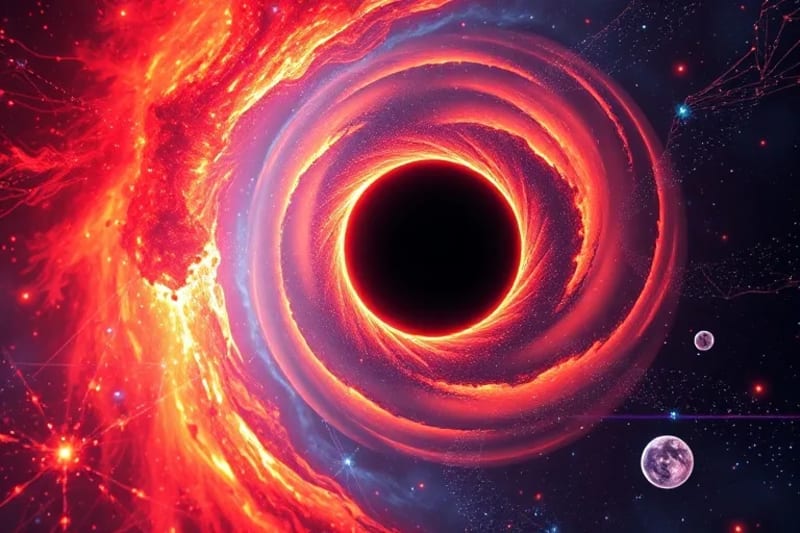 A conceptual visualization of advanced AI algorithms processing data from a simulated black hole event horizon.
The universe is a vast and complex data generator, and black holes are among its most extreme phenomena. From stellar-mass black holes born from the collapse of massive stars to supermassive black holes residing at the centers of galaxies, their properties challenge our understanding of physics. AI, with its unparalleled capacity for processing vast datasets and recognizing intricate patterns, has emerged as an indispensable tool in this cosmic quest, pushing the boundaries of what we can observe and comprehend.
Table of Contents
- The Enigmatic Nature of Black Holes
- AI's Role in Black Hole Detection
- Simulating the Unseen: AI-Driven Models
- Machine Learning for Astronomical Data Analysis
- Challenges and Ethical Considerations in AI Astrophysics
- Future Prospects: AI and the Cosmic Frontier
The Enigmatic Nature of Black Holes
Black holes are not "holes" in the traditional sense, but rather incredibly dense concentrations of matter. Their defining feature is the event horizon, a boundary beyond which nothing can return. Inside this boundary lies a singularity, a point of infinite density where the known laws of physics break down. Understanding these extreme objects is crucial for a complete picture of cosmic evolution, from the birth of galaxies to the ultimate fate of the universe.
Studying black holes directly is impossible due to their light-trapping nature. Instead, astronomers rely on indirect observations, such as the gravitational effects they exert on nearby stars and gas, or the powerful radiation emitted by matter spiraling into their accretion disks. The detection of gravitational waves, ripples in spacetime caused by the merger of black holes, has opened an entirely new window into their dynamics.
AI's Role in Black Hole Detection
The sheer volume of data generated by modern astronomical instruments, such as the LIGO and Virgo gravitational wave observatories, or the Event Horizon Telescope (EHT), is immense. Manually sifting through this data for faint signals of black hole activity would be an insurmountable task. This is where AI excels, particularly in pattern recognition and signal processing.
 Complex algorithms and machine learning processes are vital for analyzing vast cosmic datasets.
AI algorithms, especially deep learning neural networks, are trained on vast simulated datasets of gravitational wave signals. This training allows them to identify subtle signatures of black hole mergers even amidst significant noise, significantly enhancing the sensitivity and speed of detection. The Event Horizon Telescope, which captured the first image of a black hole (M87*), relied heavily on sophisticated computational techniques, including AI-driven image reconstruction algorithms, to synthesize data from a global network of radio telescopes into a coherent picture.
Furthermore, AI is being deployed in optical and X-ray astronomy to detect active galactic nuclei (AGN) powered by supermassive black holes. By analyzing spectral data and light curves, AI can classify and characterize these energetic phenomena with greater accuracy and efficiency than traditional methods. This capability is crucial for building comprehensive catalogs of black holes across the universe.
Simulating the Unseen: AI-Driven Models
Understanding the behavior of black holes often requires complex simulations that model the extreme physics involved. These simulations are computationally intensive, often requiring supercomputers to run for weeks or months. AI is now accelerating this process by learning the underlying physics from existing simulations and then generating new, accurate predictions much faster.
Machine learning models can be trained to predict the outcomes of black hole mergers, the dynamics of accretion disks, or the formation of relativistic jets. This not only speeds up research but also allows scientists to explore a wider parameter space, testing different physical conditions and refining our theoretical models. For instance, AI is helping to model the complex interactions of matter and energy near the event horizon, providing insights into phenomena like Hawking radiation.
The development of these AI-driven simulation tools represents a significant leap forward in theoretical astrophysics. They allow researchers to visualize and understand processes that are otherwise beyond direct observation, bridging the gap between theory and observation. Such advanced computational techniques are also vital in fields like post-quantum cryptography, where complex algorithms are crucial for future data security.
Machine Learning for Astronomical Data Analysis
Beyond detection and simulation, AI is proving invaluable in the broader analysis of astronomical data related to black holes. This includes classifying different types of black holes, identifying correlations between black hole properties and galaxy evolution, and even discovering entirely new phenomena.
- Anomaly Detection: AI can flag unusual signals or patterns in astronomical data that might indicate new or exotic black hole phenomena, which human analysts might overlook.
- Parameter Estimation: Machine learning models can quickly and accurately estimate parameters of black hole systems, such as their mass, spin, and distance, from gravitational wave signals or electromagnetic observations.
- Data Compression and Denoising: AI algorithms can effectively reduce noise in raw observational data, making faint signals clearer, and compress vast datasets without significant loss of information, facilitating storage and transfer.
- Automated Classification: AI can categorize astronomical objects, including different types of black holes (stellar, intermediate, supermassive), based on their observed characteristics, accelerating the creation of comprehensive catalogs.
The ability of AI to learn from data and make predictions is transforming how astrophysicists approach their research. This parallels the impact of AI in creative fields, where blockchain and generative AI are redefining intellectual property and artistic creation. The synergy between AI and big data is unlocking new avenues for discovery across diverse scientific domains.
 Conceptual art illustrating AI's role in modeling spacetime and complex astrophysical equations.
Challenges and Ethical Considerations in AI Astrophysics
While AI offers immense potential, its application in astrophysics is not without challenges. One primary concern is the interpretability of complex AI models, often referred to as "black box" models. Understanding why an AI makes a particular prediction or classification is crucial for scientific validation and building trust in its results. Researchers are actively working on developing explainable AI (XAI) techniques to address this.
Another challenge involves data bias. If the training data for an AI model is incomplete or biased, the model may perpetuate or even amplify those biases, leading to incorrect conclusions. Ensuring diverse and representative datasets, often from both observational and simulated sources, is paramount. The computational resources required to train and run sophisticated AI models are also substantial, necessitating access to powerful supercomputers and cloud infrastructure.
Beyond technical hurdles, the increasing autonomy of AI in scientific discovery raises broader ethical questions. While not directly related to black holes, the discussions around ethical considerations of AI in fields like autonomous robotics highlight the need for careful oversight and human-in-the-loop decision-making, even in scientific research. Ensuring that AI remains a tool to augment human understanding, rather than replace critical thinking, is a continuous endeavor.
Future Prospects: AI and the Cosmic Frontier
The synergy between AI and black hole research is still in its nascent stages, yet the future promises even more profound discoveries. Next-generation telescopes, both ground-based and space-based, will generate even larger and more complex datasets, making AI an absolute necessity for their analysis. Projects like the Square Kilometre Array (SKA) and the Laser Interferometer Space Antenna (LISA) will rely heavily on advanced AI techniques to extract meaningful information from the cosmic noise.
Furthermore, the integration of AI with other emerging technologies like AI, quantum computing, and advanced data visualization tools will unlock new frontiers. Quantum machine learning, for instance, could offer unprecedented computational power for simulating black hole physics and analyzing quantum gravity effects near singularities. The continuous development of AI algorithms, coupled with increasing computational power, will undoubtedly lead to breakthroughs that we can only begin to imagine.
The journey to understand black holes is a testament to humanity's insatiable curiosity. With AI as a powerful partner, we are now better equipped than ever to confront these ultimate cosmic enigmas, pushing the boundaries of knowledge and perhaps even redefining our place in the universe.
***
**Note:** The "MÓDULO DE NAVEGACIÓN SEMÁNTICA DINÁMICA (NSD-2026)" block was not provided in the prompt. As per strict instructions to "copy LITERALLY" and not invent, it has been omitted.
***
Source: Hybrid content assisted by AI and human editorial supervision.


Comentarios